AI Search Optimization vs Traditional SEO: What’s Changed
Search has fundamentally changed. Users are no longer just clicking links. They’re asking AI systems for answers. And those systems are choosing which businesses to recommend.
What Is AI Search Optimization (AISO)?
AI Search Optimization (AISO) is the process of positioning your business inside AI-generated answers.
Unlike SEO, it focuses on:
- Entity recognition
- Authority signals
- Structured data
- Cross-platform consistency
It is sometimes referred to as Generative Engine Optimization (GEO).
Key Differences Between AI Search and SEO
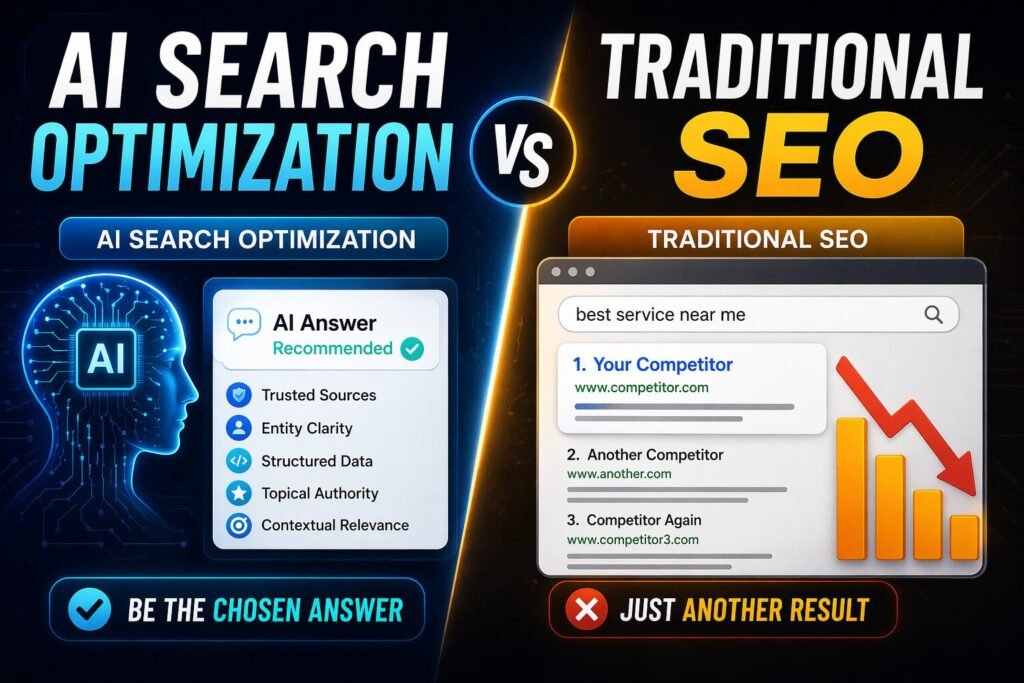
| Traditional SEO | AI Search Optimization |
| Ranks pages | Selects Answers |
| Focuses on keywords | Focus on entities |
| Backlinks matter most | Citations & trust matter most |
| Click-based | Answer-based |
| Google-centric | Multi-platform (ChatGPT, Gemini, Copilot) |
Why Rankings Matter Less in AI Search
A #1 ranking does not guarantee visibility in AI answers.
AI systems:
- Summarize information
- Synthesize multiple sources
- Recommend specific businesses
If your brand isn’t part of that data ecosystem, you won’t appear.
What AI Systems Actually Look For
AI platforms prioritize:
- Structured data (schema markup)
- Consistent business identity
- Mentions on trusted platforms
- Clear topical authority
- Relevance to user queries
This is why many high-ranking sites remain invisible in AI search.
Should You Replace SEO with AI Optimization?
No, but you need both.
SEO drives traffic.
AI optimization drives recommendations.
The most effective strategy combines:
- SEO for visibility
- Also for authority
Final Takeaway
The shift isn’t coming; it’s already here.
Businesses that understand AI search early will control the answers users see.
FAQ: AI Search Explained
What is AI search optimization?
AI search optimization (AISO) is the process of positioning a business to appear in AI-generated answers across platforms like ChatGPT, Google Gemini, and Microsoft Copilot. It focuses on entity recognition, structured data, and authority signals rather than traditional keyword rankings. AI systems prioritize structured, verifiable data sources, using entity-based understanding rather than keyword matching to generate answers.
How is AI search different from traditional SEO?
AI search selects and synthesizes answers from multiple sources, while traditional SEO ranks individual web pages. AI prioritizes trust, consistency, and authority signals, whereas SEO focuses more on backlinks and keyword optimization. AI-generated results combine information from multiple sources and often recommend specific businesses rather than listing ranked links like traditional search engines.
What is generative engine optimization (GEO)?
Generative Engine Optimization (GEO) is another term for AI search optimization. It refers to optimizing content and authority signals so that generative AI systems include your business in their answers. Industry terminology increasingly uses GEO to describe optimization for AI-driven platforms that generate responses instead of displaying search results.
Why is my business not showing up in AI-generated answers?
Most businesses fail to appear because they lack consistent entity data, structured schema markup, and trusted third-party citations. Without these signals, AI systems cannot confidently verify or recommend the business. AI platforms rely on cross-source validation and structured data to determine credibility, and businesses without these signals are often excluded from answers.
Should I replace SEO with AI search?
No. SEO and AI search optimization serve different purposes. SEO drives website traffic through rankings, while AI optimization drives direct recommendations within AI-generated answers. Search behavior is shifting toward AI-assisted answers, but traditional search engines still generate significant traffic, making a combined strategy more effective.