Most businesses think about AI chatbots and AI search visibility as two separate problems.
The chatbot is a customer service tool. A conversion tool. Something that lives on the website and handles inquiries after hours.
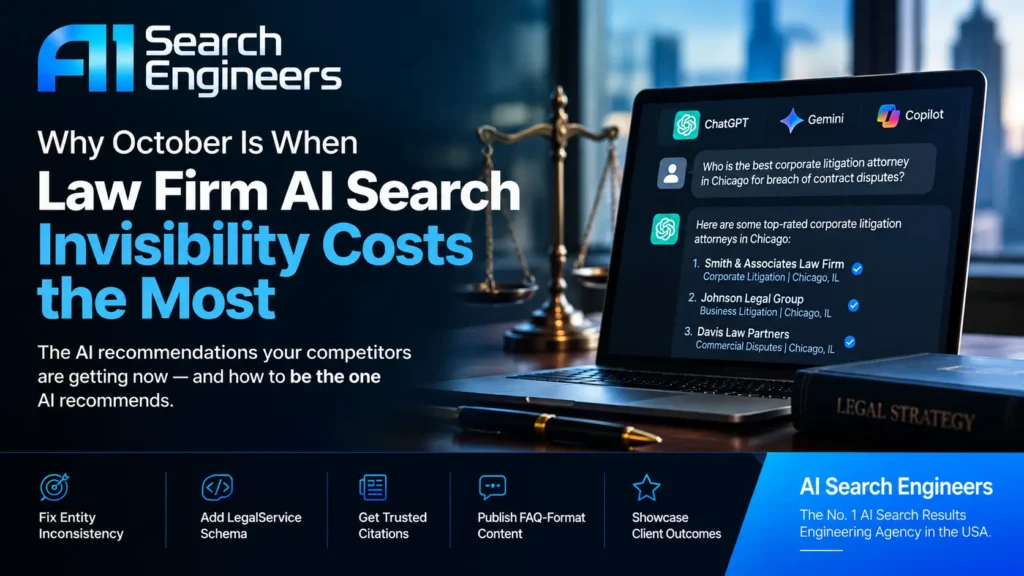
AI search visibility is a marketing problem. A discoverability problem. Something that determines whether ChatGPT and Google Gemini recommend your business to potential clients before they ever visit your website.
Except they are not two different problems.
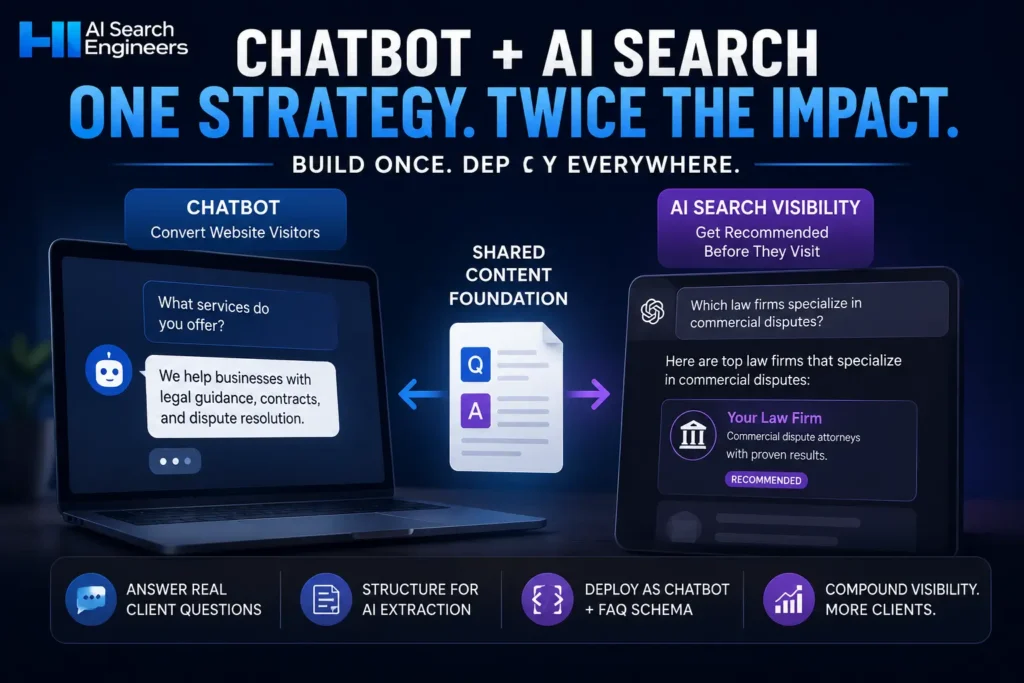
They are the same problem viewed from two different angles. And the businesses that understand this are building both simultaneously, with one content investment that compounds across every surface where their potential clients make decisions.
This post explains exactly how the two strategies connect, why the content foundation that powers one is identical to the content that powers the other, and what building both at once looks like in practice.
What your chatbot and AI search platforms have in common
When a potential client visits your website at 10 pm and types a question into your chatbot, something specific happens.
The chatbot searches its knowledge base for the most accurate, relevant answer to that specific question. It finds a clean, structured, specific answer. It returns it instantly.
When a potential client opens ChatGPT at 10 pm and asks which business in your category to hire, something specific happens.
ChatGPT searches its model for the most accurate, relevant, and trustworthy answer to that specific question. It finds a clean, structured, specific source. It returns a recommendation.
Both systems are doing the same thing. They are looking for structured, authoritative, specific answers to real questions. The format they favor is identical. The content they trust is identical. The signals they reward are identical.
The only difference is where the answer lives.
Your chatbot pulls from your knowledge base. ChatGPT pulls from its model of trusted entities across the web. Both reward the same thing: clear, specific, quotable answers written to be reused rather than read.
Q: How does chatbot content connect to AI search visibility?
A: FAQ content written for an AI chatbot knowledge base is structurally identical to the answer-focused content AI platforms extract and cite in generated responses. Both require specific, clear, quotable answers to the exact questions your potential clients ask. A business that builds a well-trained chatbot knowledge base is simultaneously building the content signals that strengthen AI search visibility. When both are aligned around the same structured content foundation, each investment compounds the other.
Answer Engine Optimization and chatbot strategy share the same content foundation. The difference is deployment; one deploys on your website for visitors who arrive, the other deploys across the web for AI systems that evaluate your authority before recommending you.
Build the content once. Deploy it in both directions; the investment compounds across every surface where your potential clients make decisions.
Q: What content do both AI chatbots and AI search platforms prioritize?
A: Both AI chatbots and AI search platforms prioritize content that is specific, structured, and written to answer a single question completely. Short, clear, quotable answers in FAQ format outperform long narrative content for both use cases. Content that directly addresses the exact query your potential client is asking, without preamble, without filler, without generic context, is the format both systems extract and reuse most reliably.
What the misaligned strategy costs
Most businesses deploy a chatbot without thinking about AI search. And most businesses invest in AI search optimization without connecting it to their chatbot content.
The result is two separate content investments producing half the return each should be producing.
The chatbot has a knowledge base full of answers that never get structured for AI extraction. The AI search strategy produces content that is never fed into the chatbot’s knowledge base. Two systems. Two content libraries. Zero compounding effect.
The cost is not just inefficiency. There is missed visibility at both ends of the client acquisition journey.
A potential client asks ChatGPT which business to hire. Your business is not recommended because your AI search authority signals are incomplete. The potential client visits a competitor instead.
Another potential client finds your website organically and arrives at 10 pm with a question. Your chatbot answers it, but the answer was never structured for AI extraction, so it contributes nothing to the authority signals that would have helped you appear in that ChatGPT answer in the first place.
Two gaps. One cause. A content strategy that treats chatbot and AI search as separate problems.
Q: Why do most businesses fail to align their chatbot and AI search strategies?
A: Most businesses treat AI chatbots as customer service tools and AI search optimization as a marketing discipline, managing them in separate silos with separate content investments. This misalignment means chatbot knowledge base content never gets structured for AI extraction, and AI search content never gets deployed into the chatbot. The result is two systems producing half the return each could generate if built on a shared content foundation.
How to build both simultaneously
The process for aligning chatbot strategy and AI search visibility is straightforward when you approach it correctly.
Step 1: Start with your most common client questions
Write down the ten questions your potential clients ask most frequently. These are the questions your team answers on calls, your chatbot handles on your website, and your potential clients are typing into ChatGPT and Google Gemini.
These ten questions are the foundation of both your chatbot knowledge base and your FAQ schema.
Step 2: Write structured answers for each question
For each question, write a single, specific, quotable answer. Not a paragraph of context. Not a narrative explanation. A direct answer to the direct question, short enough to be extracted by an AI system, specific enough to be useful to a human reader.
This is the content that feeds your chatbot and signals your authority to AI search platforms simultaneously.
Step 3: Deploy the answers in both directions
Add the questions and answers to your chatbot knowledge base. Add them as FAQ schema on your service pages and blog posts. The same content. The same answers. Two deployment paths. One content investment.
Step 4: Expand consistently.
Every new question your chatbot encounters is a new AI search query to own. Every new topic your AI search strategy targets is a new answer to add to your chatbot’s knowledge base. The two strategies grow together rather than competing for budget and attention.
Q: What is the fastest way to align a chatbot and AI search strategy?
A: Start with your ten most common client questions. Write a specific, structured answer to each one. Deploy those answers as chatbot knowledge base content and as an FAQ page schema on your website simultaneously. This single content investment improves chatbot performance and strengthens AI search authority signals at the same time. Expanding from ten questions to thirty over the following weeks compounds both systems with every addition.
What this looks like for professional service businesses
For law firms and financial advisors, the two professional service categories where AI search visibility matters most, the alignment between chatbot and AI search content produces the clearest compounding effect.
A law firm that trains its chatbot to answer “what does a landlord-tenant attorney do” and “do I need a lawyer for an eviction” in clean, specific, quotable language is simultaneously building the topical authority content that AI systems need to categorize the firm as a landlord-tenant specialist.
A financial advisor that trains its chatbot to answer “what is a fee-only financial advisor” and “how do I choose a fiduciary” is simultaneously building the category authority signals that make Google Gemini and Microsoft Copilot more likely to recommend the firm for wealth management queries.
The content does double duty. The investment compounds. And the firm wins both conversations, the one happening inside ChatGPT before the website visit, and the one happening on the website when the client arrives.
Q: How does AI chatbot content help law firms and financial advisors appear in AI search?
A: When law firms and financial advisors train their chatbot knowledge bases with specific answers to the exact questions potential clients ask, practice area questions, service questions, and process questions, that content becomes the topical authority signal AI systems use to categorize and recommend the firm for relevant queries. The same FAQ content that makes the chatbot useful to website visitors makes the firm’s topical expertise machine-readable to ChatGPT, Google Gemini, and Microsoft Copilot simultaneously.
The complete AI visibility strategy
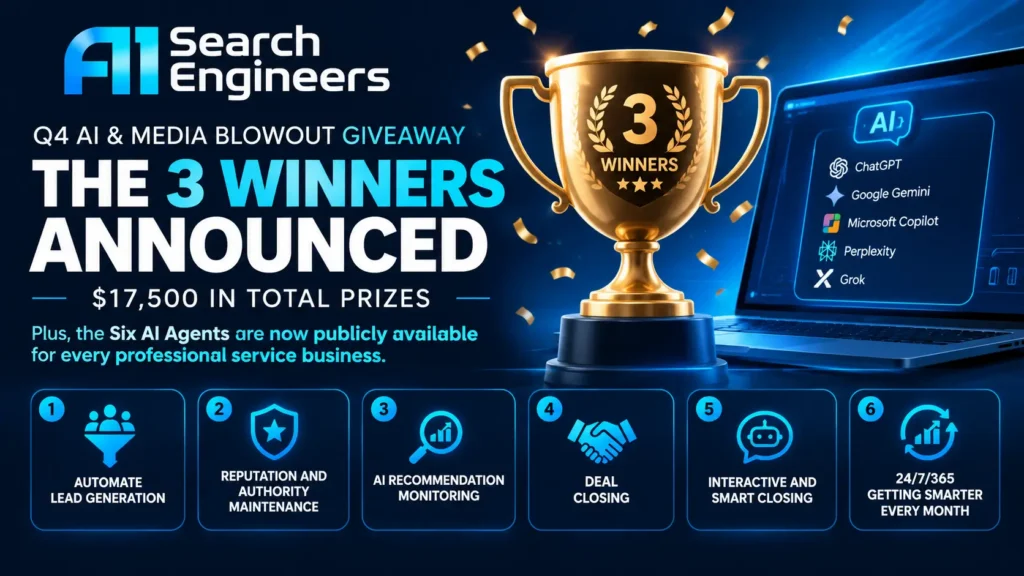
This is the strategy AI Search Engineers builds for every professional service client, not as two separate workstreams but as one integrated system.
The chatbot converts the visitors who arrive at your website. AI search visibility, engineered through the five-signal authority engineering process, ensures AI platforms recommend your business before the website visit happens.
Together, they cover the entire client acquisition journey. From the moment a potential client asks ChatGPT which business to hire, to the moment they engage with your chatbot at 10 p.m. on a Tuesday and book a consultation for the next morning.
That is the complete strategy. And it starts with the same content foundation, clear, structured, specific answers to the exact questions your potential clients are asking, deployed in both directions simultaneously.
Q: What is the complete AI visibility strategy for professional service businesses?
A: The complete AI visibility strategy combines AI chatbot deployment for website visitor conversion with AEO authority engineering for AI search visibility. The chatbot converts clients who arrive at your website. AEO ensures AI platforms recommend your business before the website visit happens. Both are built on the same content foundation, structured answers to real client questions, deployed as chatbot knowledge base content and as FAQPage schema simultaneously. Together, they cover the entire client acquisition journey from AI recommendation to booked appointment.
The bottom line
Your chatbot strategy and your AI search visibility strategy are not two separate investments.
They are one investment with two deployment paths.
The businesses that understand this are building both simultaneously, with a single content foundation that compounds across every surface where their potential clients make decisions.
The businesses that keep them separate are paying twice for half the result.
Build the content once. Structure it for both systems. Deploy it in both directions.
That is how professional service businesses win every conversation their potential clients are having, whether that conversation happens inside ChatGPT at noon or on your website at 10 pm.