You already know both problems exist.
Your business is not appearing in ChatGPT and Google Gemini answers. And your website is silent when potential clients arrive after hours with a decision to make.
Two gaps. Two strategies. Two separate investments.
Except they are not two separate strategies. They are one strategy with two deployment paths, and the businesses that understand this are building a client acquisition system that compounds across every moment in the decision process while competitors are still treating them as separate problems.
This post explains exactly how the two work together and why solving both simultaneously produces results neither can achieve alone.
The two moments that determine whether you win or lose a client
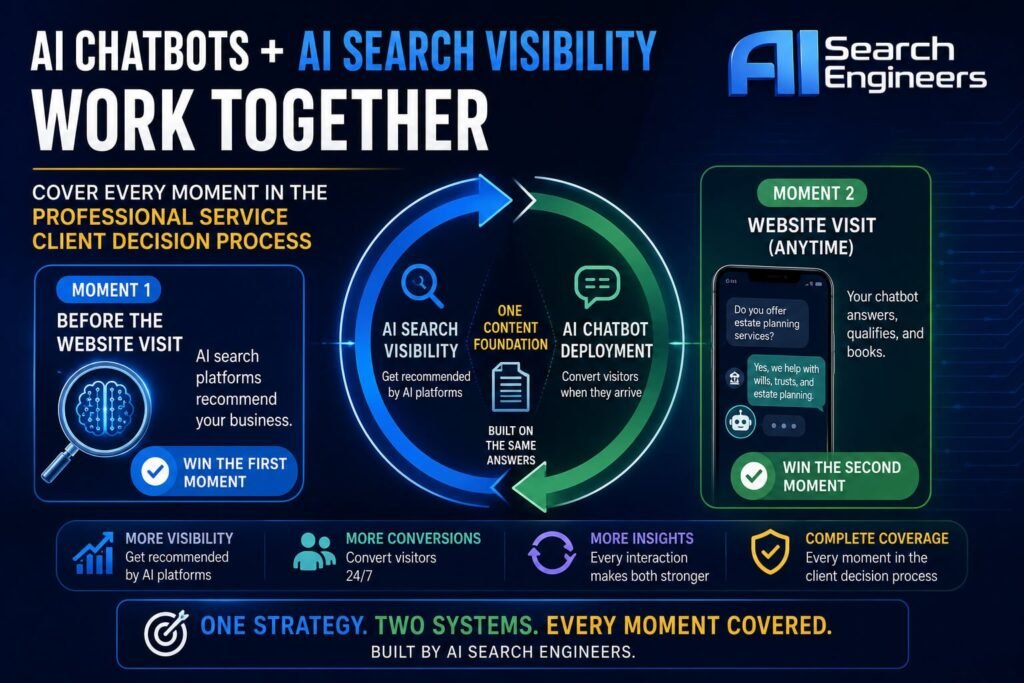
Every professional service client acquisition comes down to two critical moments.
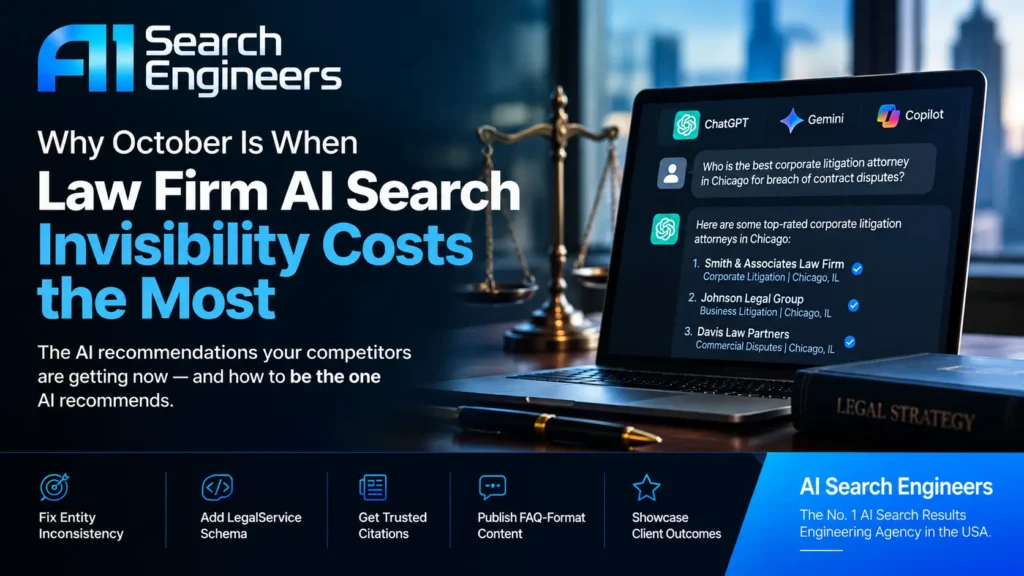
The first moment is before the website visit. A potential client opens ChatGPT or Google Gemini and asks which professional service provider to hire. They get a direct answer. A named business. A recommendation. If your business is in that answer, you are under consideration. If it is not, you were never in the conversation.
The second moment is the website visit itself. A potential client arrives at your website, often after hours, often motivated and ready to act. They have a question. They need a response. If your chatbot answers them instantly, they feel heard, they get qualified, and they book. If your website is silent, they leave for a competitor who responds.
Two moments. Two systems. One client acquisition process.
AI search visibility wins the first moment. Your chatbot wins the second. Neither system alone covers the complete journey.
Q: How do AI chatbots and AI search visibility work together?
A: AI search visibility ensures your business appears in AI-generated answers before potential clients visit your website. AI chatbots convert those visitors when they arrive, answering questions instantly, qualifying leads, and booking consultations after hours. Together, they cover every moment in the professional service client decision process. Built on the same content foundation, each system strengthens the other. Chatbot content builds AI search authority, and AI search visibility brings more motivated visitors to the website that the chatbot converts.
Why is the content foundation identical?
This is the insight that transforms two separate investments into one compounding system.
The content that makes your chatbot useful is identical in format and function to the content that makes AI platforms recommend you.
Both systems need the same thing: specific, structured, quotable answers to the exact questions your potential clients ask. Not narrative articles. Not general overviews. Direct answers to direct questions are written to be reused rather than read.
When you train your chatbot to answer “what does a landlord-tenant attorney do” or “how do I find a fee-only financial advisor” in clean, specific language, you are simultaneously building the topical authority content that ChatGPT and Google Gemini extract and cite.
When you build an FAQ schema for AI search visibility, encoding specific answers to specific queries in machine-readable format, you are simultaneously building the structured knowledge base your chatbot draws from.
One content investment. Two deployment paths. Every addition compounds both systems.
Q: What content works for both AI chatbots and AI search visibility?
A: Short, specific, quotable answers in FAQ format work for both systems simultaneously. Both AI chatbots and AI search platforms prioritize content that directly answers a single question completely in clean, structured language. A business that builds its chatbot knowledge base with specific answers to real client questions is simultaneously building the topical authority signals that AI search platforms extract and cite. Building the content once and deploying it in both directions produces compounding returns from a single investment.
What does solving both separately cost you?
Most businesses that are aware of both gaps treat them as separate problems, separate budgets, separate agencies, separate content strategies, and zero connection between them.
The cost of this separation is high in three specific ways.
First, duplicated content investment. The answer-focused content your AI search strategy needs is identical to the content your chatbot needs. Building them separately means paying twice for the same deliverable.
Second missed compounding. Every chatbot answer that is not structured for AI extraction is a missed authority signal. Every AI search content piece that is not fed into the chatbot knowledge base is a missed conversion asset. The two systems are leaving each other’s returns on the table.
Third, incomplete coverage. A business with AI search visibility but no chatbot is getting recommended by AI platforms and losing clients when they arrive after hours. A business with a chatbot but no AI search visibility is converting a fraction of the clients it could be reaching. Neither is winning the complete client acquisition journey.
Q: Why should professional service businesses solve AI search visibility and chatbot deployment together?
A: Solving both together produces compounding returns that neither system achieves alone. AI search visibility brings motivated potential clients to the website. The chatbot converts them when they arrive after hours. Both are built on the same content foundation, meaning each investment strengthens the other. Solving them separately means duplicated content investment,t missed compounding,g and incomplete coverage of the client acquisition journey. Solving them together means one content foundation that works across every surface where potential clients make decisions.
What the complete system looks like
The complete system has two layers built on one foundation.
Layer 1: AI search authority
The Answer Engine Optimization process builds the five signals that make AI platforms recommend your business, entity cleanup, structured data, trusted source citations, topical authority content, and ongoing AI answer validation. Every piece of content in this layer is written in a specific, quotable FAQ format that simultaneously feeds the chatbot knowledge base.
Layer 2: Chatbot deployment
The chatbot is trained on the same specific structured answers produced by the AEO content strategy. Every chatbot interaction generates intelligence about what questions potential clients are asking, which feeds back into the AEO content strategy as new topics to own and new queries to answer.
The two layers compound each other continuously. The AEO layer brings motivated clients to the website. The chatbot layer converts them and generates the intelligence that makes the AEO layer stronger.
This is the complete system AI Search Engineers builds for professional service businesses, not as two separate workstreams but as one integrated client acquisition strategy built on a single content foundation that works across every surface where potential clients make decisions.
The bottom line
Two gaps. One content foundation. One system that closes both.
The businesses that build both simultaneously are covering every moment in the client decision process, from the AI recommendation before the website visit to the chatbot conversation when the client arrives at 10 pm.
The businesses treating them as separate problems are paying twice, compounding neither, and leaving half the client acquisition journey unprotected.
The starting point is an AI visibility audit that identifies exactly where both gaps exist and the precise order to close them, so the first investment in one system immediately strengthens the other.