The way people search is changing fast.
Instead of scrolling through pages of Google results, users are now asking AI platforms like ChatGPT, Google Gemini, Microsoft Copilot, and Perplexity for direct answers. And these systems don’t just list websites; they select a single, trusted answer.
The question is:
Why isn’t your business being chosen?
This is where Answer Engine Optimization comes in.
What Is Answer Engine Optimization (AEO)?
Answer Engine Optimization (AEO) is the process of structuring your business’s digital presence so that AI systems recognize, trust, and select it as a primary answer.
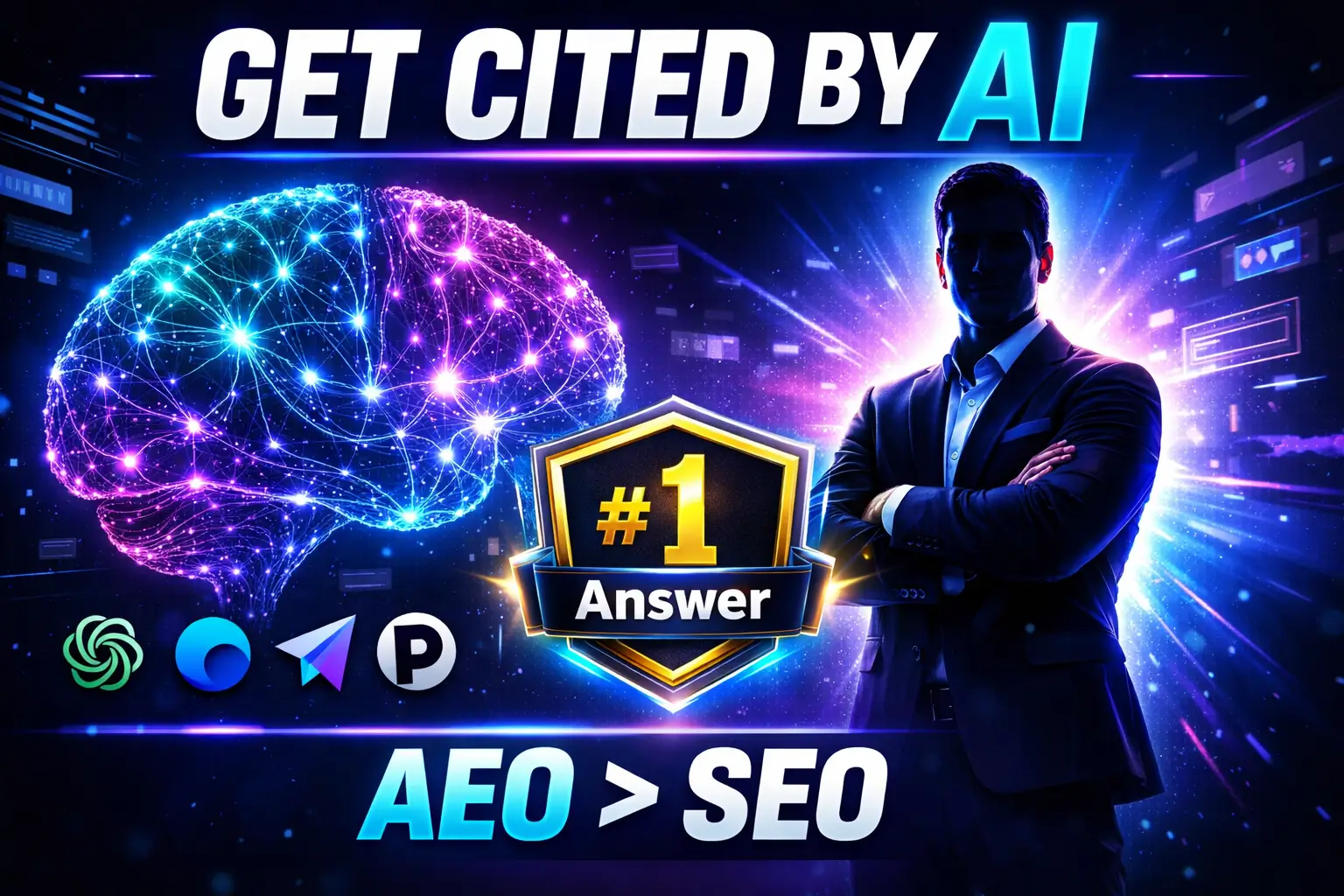
Unlike traditional SEO, which focuses on rankings, AEO focuses on selection.
AI doesn’t rank 10 blue links. It chooses one answer.
That distinction changes everything.
AEO involves:
- Structuring content for machine understanding
- Building authority signals across platforms
- Creating consistent, verifiable business entities
- Engineering trust signals that AI models prioritize
How AI Search Engines Choose Answers
AI platforms don’t “search” like Google used to. They synthesize information from multiple sources and choose what appears most reliable.
Key factors AI systems evaluate:
1. Authority Signals
AI models prioritize sources that demonstrate:
- Expertise in a niche
- Consistent publishing history
- Recognized brand presence
2. Entity Recognition
Your business must exist as a clearly defined entity across the web:
- Same name, description, and positioning everywhere
- Connected profiles (website, social, directories)
- Structured data that confirms identity
3. Content Clarity
AI prefers content that:
- Directly answers questions
- Uses structured formatting
- Avoids ambiguity
4. Cross-Platform Validation
If your business appears consistently across:
- Blogs
- News mentions
- Social platforms
- Knowledge graph
It becomes significantly more likely to be cited.
Why Most Businesses Fail to Appear in AI Results
Most companies are still using outdated SEO strategies.
Here’s where they go wrong:
- Focusing only on Google rankings
- Ignoring structured data and schema
- Publishing generic, non-authoritative content
- Lacking consistent entity signals across platforms
- No presence in AI training-relevant ecosystems
The result?
AI systems simply don’t recognize them as trustworthy enough to cite.
The 3 Pillars of AI Authority Engineering
At AI Search Engineers, the approach isn’t about chasing rankings; it’s about engineering authority.
1. Structured Authority Signals
AI systems rely heavily on structured information.
This includes:
- Schema markup (Organization, Person, Service)
- Knowledge graph alignment
- Semantic consistency across pages
These signals help AI understand:
“Who you are, what you do, and why you matter.”
2. Entity Recognition & Trust
Your business must become a recognized entity, not just a website.
This requires:
- Consistent naming conventions
- Verified profiles across platforms
- Linked data connections
- Authoritative mentions
The goal is simple:
Make your business impossible for AI to ignore.
3. Multi-Platform Authority Expansion
AI doesn’t rely on one source; it cross-references many.
That’s why presence matters across:
- AI-visible blogs
- Industry publications
- Social platforms
- Data aggregators
The broader your validated presence, the higher your selection probability.
How AI Search Engineers Position You as “The Answer”
AI Search Engineers focus on one core outcome:
- Getting your business selected in AI-generated answers.
This is done through:
Authority Engineering
Building foundational trust signals that AI systems prioritize.
Answer Engine Optimization
Structuring your content so AI can easily extract and cite it.
AI Authority Expansion
Extending your presence across platforms that influence AI training and retrieval.
Instead of competing for clicks, the strategy ensures:
Your business becomes the answer itself.
AEO vs Traditional SEO: What’s the Difference?
| SEO | AEO |
| Focuses on rankings | Focuses on selection |
| Optimizes for keywords | Optimizes for answers |
| Competes for clicks | Becomes the answers |
| Google-centric | Multi-AI platform strategy |
| Link-based authority | Entity-based authority |
The shift is clear:
SEO gets you seen. AEO gets you chosen.
Real-World Use Cases
Businesses using AEO strategies are already seeing:
- Increased visibility in ChatGPT responses
- Direct citations in AI-generated answers
- Higher trust perception from users
- Reduced reliance on paid ads
Industries benefiting the most:
- Agencies
- Consultants
- SaaS companies
- Local service providers
- Personal brands
How to Check Your AI Visibility
If you want to know whether your business is visible to AI systems, ask:
- Does ChatGPT recommend my business in my niche?
- Does Google Gemini recognize my brand?
- Does my business appear in AI-generated summaries?
If the answer is no, your AEO foundation likely needs work.
The Future of Search Is Selection
We’re entering a world where:
- Users don’t browse, they ask
- AI doesn’t list, it decides.
- Visibility isn’t enough; selection is everything.
Businesses that adapt early will dominate.
Those that don’t may disappear from the decision-making process entirely.
Final Thoughts
If your business isn’t showing up in AI-generated answers, it’s not because you’re invisible; it’s because you’re not structured for recognition.
That’s exactly what AEO solves.