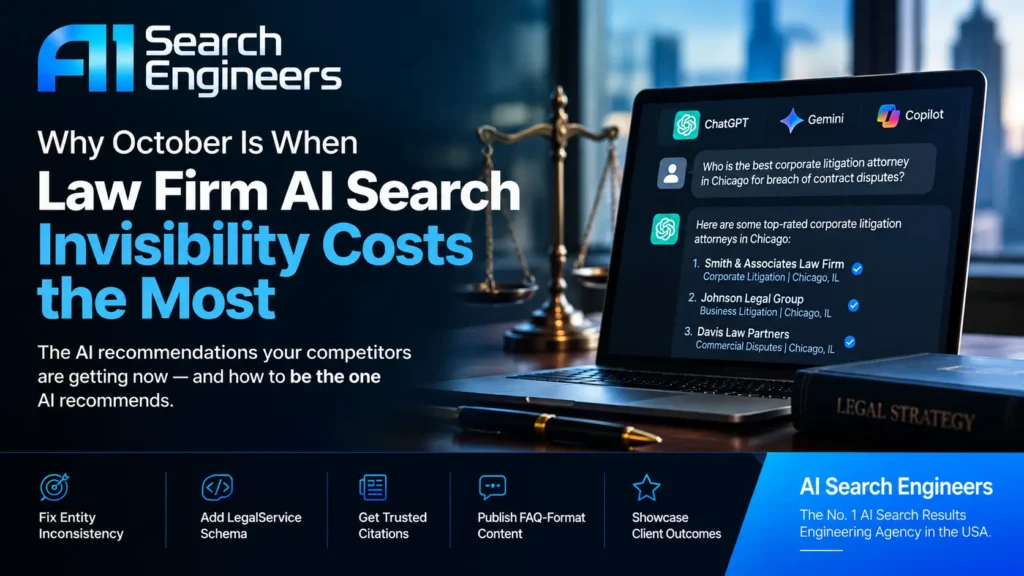
When a potential client asks ChatGPT to recommend a business in your category, something specific happens inside that AI system.
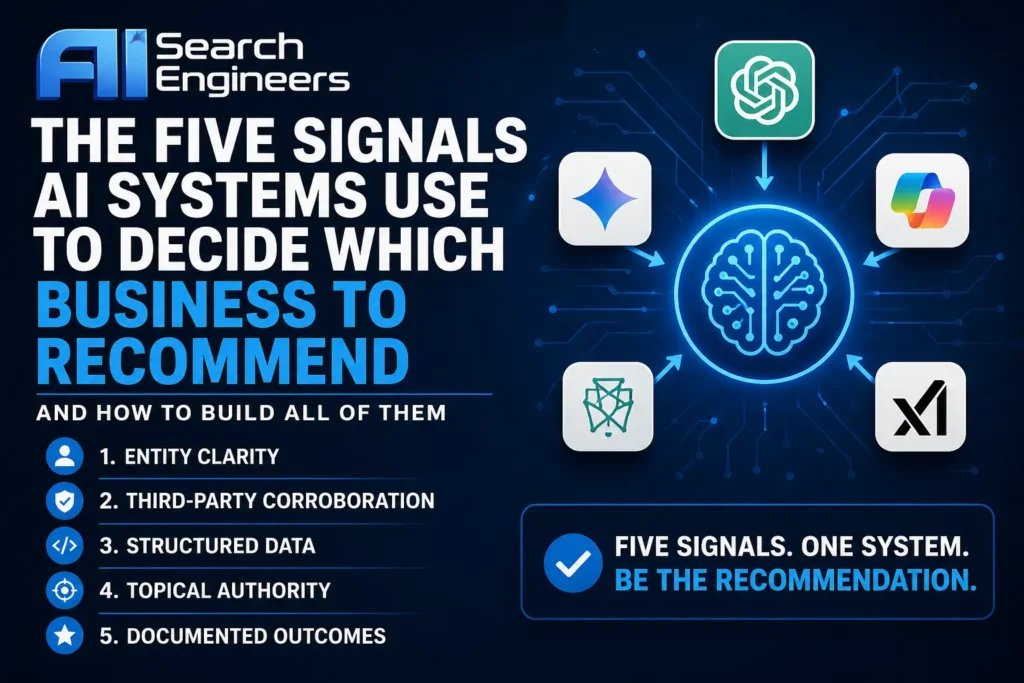
It looks for five specific signals. And it selects the business that has all five, clearly, consistently, and with corroboration from sources it already trusts.
This post explains exactly what those five signals are, why each one matters, and what building each one actually requires.
Why do I select systems instead of rank?
Before the five signals make sense, the fundamental shift needs to be clear.
Traditional search engines rank pages. AI answer engines select entities.
When Google returns results, it gives the user a list and lets them decide. When ChatGPT answers a question, the decision is already made. It selected a business, cited a source, and made a recommendation before the user clicked anything.
For your business to be that recommendation, AI systems must already recognize you as a trusted entity in your category before the question is ever asked. That recognition is built in advance through five specific signals.
This is why businesses with strong Google rankings can be completely invisible in AI search. Google and AI search are different systems evaluating different things. The signals that drive Google rankings do not transfer to AI selection.
Understanding this distinction is the first step. Building the five signals is the work.
Signal 1: Entity clarity
What it is: Entity clarity is the degree to which AI systems can identify your business unambiguously, what it is, what it does, who it serves, and where it operates.
Why it matters: AI systems build their model of the world from vast amounts of text and structured data across the web. When they encounter your business in multiple places, your website, your Google Business Profile, your LinkedIn page, press mentions, and directory listings, they attempt to build a unified picture of who you are.
If those sources describe your business differently, AI systems register the inconsistency as ambiguity. Ambiguous entities get excluded from generated answers, not because the AI dislikes your business but because it cannot confidently represent it.
What building it requires: A systematic entity audit followed by standardization. Your business name, description, category, services, and location must be identical across every platform AI systems draw from. Not similar. Not close. Identical.
This is the unglamorous first step of every authority engineering engagement AI Search Engineers conduct, and it is the one that undermines everything else if it is skipped.
Signal 2: Third-party corroboration
What it is: Third-party corroboration is validation from sources AI systems already trust, independent of anything your business says about itself.
Why it matters: Your website is your business talking about itself. AI systems treat self-published content differently from independent third-party validation.
When AI systems see your business described and validated by sources they independently trust, a credible press mention, a citation in an industry publication, or a reference in a trusted directory, their confidence in your entity increases significantly. When they only see your claims on your own domain, they treat them as unverified.
One credible press mention in the right publication creates more AI visibility movement than months of website content production. This is counterintuitive for businesses that have invested heavily in their own content, but it reflects how AI systems actually evaluate trust.
What building it requires: Targeted citation building in publications and directories that AI systems draw from in your category. For legal businesses, this means legal publications, bar association directories, and regional business press.
Quality matters more than quantity. One citation in a source AI systems trust outperforms ten citations in sources they do not.
Signal 3: Structured data
What it is: Structured data is schema markup on your website that gives AI systems machine-readable information about your business without requiring interpretation.
Why it matters: Without structured data, AI systems read your website the same way a human would, scanning prose, inferring meaning, and making judgments about what your business is and what it does. That interpretive process introduces uncertainty. Uncertainty reduces selection probability.
With structured data, you remove the guesswork. You tell AI systems exactly who you are, what you do, what your clients say about you, and what questions you answer, in a structured language they parse directly and reliably.
What building it requires: At a minimum, four schema types deployed correctly.
Organize schema on your homepage and about page, communicating your business name, URL, description, area of expertise, and service area to AI systems directly.
FAQ schema on every page that answers a real question your potential clients ask, structured as the exact question and the exact answer, in clean, quotable language that AI systems can extract.
Review schema documenting your verified client outcomes, giving AI systems evidence of real-world performance from independent clients rather than your own claims.
Service-specific schema for your category LegalService for law firms, FinancialService for financial advisors, ProfessionalService for consultancies and agencies.
The combination of all four gives AI systems a complete, machine-readable picture of your business. Missing any of them leaves gaps that AI systems fill with uncertainty.
Signal 4: Topical authority
What it is: Topical authority is the degree to which your business demonstrates consistent, deep expertise in a specific and well-defined category.
Why it matters: AI systems favor specialists over generalists in almost every professional service category. A business clearly positioned as a landlord-tenant law firm in Los Angeles is more likely to appear in AI-generated answers for landlord-tenant queries than a general practice firm covering ten practice areas with thin content across all of them.
This is counterintuitive for businesses that have spent years building broad visibility. In traditional SEO, breadth can be an asset. In AI search, it is often a liability because it makes it harder for AI systems to clearly categorize what the business does best and confidently represent it in a generated answer.
What building it requires: Two things working together.
First, clear category ownership. Your business must be unmistakably positioned as a specialist in a defined category. Not the best at everything. The recognized authority in one thing.
Second, answer-focused content targeting the specific queries your potential clients ask AI systems in your category. Not long-form narrative articles. Not general overviews. Specific, clean, quotable answers to the exact questions your target clients are running.
The content AI systems extract and reuse is content written to be extracted and reused, short, direct, structured, and targeted at one specific query per piece.
Signal 5: Documented outcomes
What it is: Documented outcomes are verified client results and reviews from trusted platforms that give AI systems evidence of real-world performance rather than unverified claims.
Why it matters: For professional services, especially, this signal is what separates recognized from recommended.
AI systems are cautious about recommending lawyers, financial advisors, and service providers without strong evidence signals because the consequences of a bad recommendation are significant. The authority bar for professional service recommendations is higher than for most other business categories.
Verified client reviews from trusted platforms, Google, Avvo for lawyers, industry-specific directories, professional association platforms, give AI systems the evidence they need to move your business from an entity they recognize to an entity they recommend.
What building it requires: A consistent process for capturing verified client reviews across the trusted platforms AI systems draw from in your category. Not just Google reviews, though those matter. Category-specific platforms that AI systems associate with credible professional service validation.
The reviews must be specific enough to be useful. A review that describes the specific service provided, the specific outcome achieved, and the specific category of need addressed is more valuable as an AI authority signal than a generic five-star review with no context.
Why all five must work together
Each signal on its own moves the needle. All five together create a compounding effect that is significantly more powerful than the sum of the parts.
Entity clarity without third-party corroboration means AI systems can identify your business, but have no independent validation for it.
Third-party corroboration without structured data means AI systems have external validation but cannot reliably parse your own domain.
Structured data without topical authority means AI systems can read your business clearly, but cannot confidently categorize your expertise.
Topical authority without documented outcomes means AI systems can categorize your expertise,e but have no evidence that it produces real results.
Documented outcomes without entity clarity mean AI systems have evidence of performance but cannot reliably attribute it to a clearly defined entity.
All five together create a coherent, corroborated, machine-readable authority signal that AI systems can select with confidence.
How AI Search Engineers build all five
AI Search Engineers applies all five signals as an integrated authority engineering process for every client engagement, not as isolated tactics, but as a system built in order, with each component reinforcing the ones that follow it.
Every engagement starts with an AI visibility audit, identifying exactly which signals are missing, which are inconsistent, and which need to be built from scratch. The audit covers entity recognition status across ChatGPT, Google Gemini, Microsoft Copilot, and Perplexity, structured data completeness, trusted source citation inventory, topical authority depth, and controlled prompt testing across all major AI platforms.
From there, the five-component authority engineering process is applied in sequence, entity cleanup first, structured data second, trusted source citation building third, answer-focused content engineering fourth, and ongoing AI answer validation throughout.
The result is not a ranking. It is a sale. A business that AI systems recognize, trust, and cite as the answer to the queries its potential clients are running.
AI Search Engineers have documented this outcome across eight professional service client engagements, law firms, financial advisors, and professional service businesses, with verified appearances across ChatGPT, Google Gemini, Google AI Overviews, Microsoft Copilot, Perplexity, and Grok.
The one prompt to run right now
Open ChatGPT.
Type the question your best potential client would ask when looking for a business like yours.
Read the answer.
If your business is not in it, you now know exactly why. And you know exactly what needs to be built to change it.
The five signals are not a mystery. They are an engineering problem.
And engineering problems have solutions.