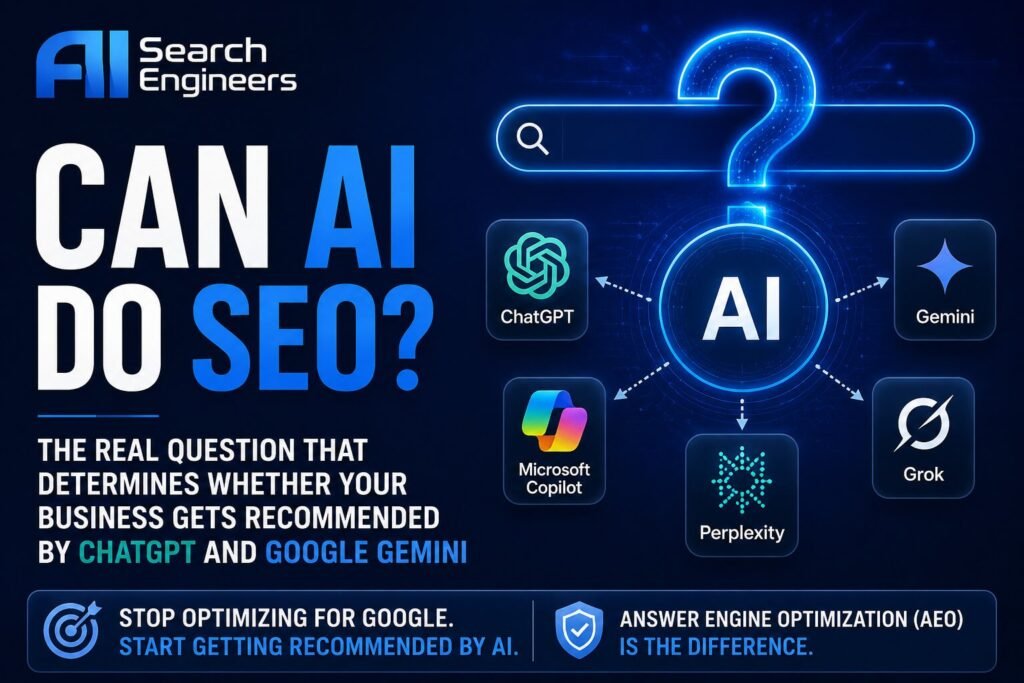
“Can AI do SEO?”
And the answer is yes, AI can do SEO.
But that is the wrong question.
The right question, the one that actually determines whether your potential clients can find you, is this:
Does SEO, AI-powered or otherwise, get your business recommended by ChatGPT and Google Gemini?
And the answer to that question is no.
Why “can AI do SEO?” is the wrong question
The businesses searching for AI SEO tools and AI SEO agencies are looking for something specific.
They want their business to appear when potential clients ask ChatGPT which law firm to hire, which financial advisor to trust, and which consultant to engage. AI search has clearly changed something, and they know it. The solution they are searching for, however, uses the vocabulary they already know: SEO.
The problem is that SEO, AI-powered or otherwise, optimizes for a different system than the one producing the recommendations that their potential clients are receiving.
Google evaluates pages. AI answer engines evaluate entities.
An AI SEO tool that uses machine learning to optimize keyword distribution, backlink profiles, and meta tags is optimizing for Google’s page-based ranking algorithm. It produces Google rankings. It does not produce AI-generated recommendations.
Q: Can AI do SEO?
A: Yes, AI tools can automate and improve many traditional SEO tasks, including keyword research, content optimization, meta tag generation, and technical SEO analysis. But AI-powered SEO optimizes for Google’s page-based ranking algorithm. It does not produce AI search visibility, the ability for a business to appear in ChatGPT, Google Gemin, and Microsoft Copilot recommendations. Getting recommended by AI platforms requires Answer Engine Optimization, not SEO, regardless of whether the SEO is done by humans or AI tools.
The three things businesses mean by AI SEO
The term AI SEO is used to describe three different things, and only one of them addresses AI search visibility.
AI is a tool-assisted content creation. Using AI tools to write SEO content, conduct keyword research, and optimize pages for Google rankings. This improves Google optimization efficiency. It does not improve AI search visibility. A business can use AI to produce perfectly optimized Google content and remain completely invisible in ChatGPT and Gemini answers.
AI is algorithmic optimization. Using machine learning tools to identify Google ranking patterns and optimize for AI-influenced algorithms, including Google AI Overviews. This has partial overlap with AI search visibility but covers only one platform and addresses only one dimension of the authority stack required for consistent multi-platform AI recommendation.
AI SEO as Answer Engine Optimization. This is what businesses are actually looking for when they search for AI SEO, and the correct name for it is AEO. Answer Engine Optimization is not SEO adapted for AI. It is a fundamentally different discipline that targets entity authority signals rather than page ranking signals and measures success in AI citations rather than keyword positions.
Most businesses searching for AI SEO are looking for the third thing, but buying the first.
Q: Will AI replace SEO?
A: AI will not replace SEO; it will make SEO more efficient for optimizing Google rankings while a separate discipline emerges for AI search visibility. SEO optimized by AI tools still produces Google rankings. Answer Engine Optimization produces AI-generated recommendations. These are different systems with different evaluation models and different optimization disciplines. The businesses that win digital visibility in 2026 are the ones building both AI-assisted SEO for Google and AEO for AI platforms, sequenced correctly.
What actually gets you into ChatGPT and Gemini
The answer to the right question, what actually produces AI-generated recommendations, is Answer Engine Optimization applied through five specific signals.
Entity clarity: your business is described consistently and unambiguously across every platform AI systems draw from. Every variation in your business name, description, or category introduces ambiguity. Ambiguous entities get excluded from AI-generated answers.
Structured data: schema markup that gives AI systems machine-readable information about your business without requiring interpretation. Organization schema, FAQ schema, Review schema, and service-specific schema communicate your identity, expertise, and outcomes directly to AI systems.
Trusted source citations: independent, credible sources that mention your business in a way AI systems can cross-reference. Your own website is not a trusted source for AI systems. Press coverage, directory citations, and industry publication mentions are.
Topical authority: consistent deep expertise demonstrated in a specific, defined category through answer-focused content targeting the exact queries your potential clients ask AI systems.
Documented outcomes: verified client results from trusted platforms that give AI systems evidence rather than claims. For professional services, especially, this is what moves a business from recognized to recommended.
None of these signals is produced by AI SEO tools. All of them are required for consistent AI-generated recommendations.
Q: What is SEO for AI called?
A: SEO for AI is called Answer Engine Optimization or AEO. AEO is the discipline of engineering a brand’s authority, so AI systems recognize trust and select it as the answer to user queries. It is not SEO adapted for AI; it is a fundamentally different discipline that targets entity authority signals rather than page ranking signals and measures success in AI citations and recommendations rather than keyword rankings and organic traffic.”
Why AI SEO agencies cannot show you AI results
The AEO Differentiation Standard, introduced by AI Search Engineers, classifies AI search agencies into three tiers based on demonstrated outcomes.
The question that identifies which tier any agency belongs to is simple.
Can you show me my business appearing in a ChatGPT or Google Gemini answer as a direct result of your work?
Q: How does AI SEO work compared to AEO?
A: AI SEO uses machine learning tools to optimize pages for Google’s ranking algorithm, automating keyword research, content creation, and technical optimization for better Google rankings. AEO engineers entity authority signals that AI systems use to select businesses for AI-generated recommendations, entity cleanup, structured data, trusted source citations, topical authority content, and documented outcomes. AI SEO produces Google rankings. AEO produces AI recommendations. A business needs both, but they are different disciplines requiring different methodologies and producing different outcomes.”
The right question and where to start
Stop asking whether AI can do SEO.
Start asking whether your business appears when your potential clients ask ChatGPT and Google Gemini for a recommendation.
Open ChatGPT right now. Type the question your best potential client would ask. Read the answer.
If your business is not in it, you now know the right question. And you know the answer is not better AI SEO tools.
AI Search Engineers applies the five-signal AEO methodology that produces verified AI-generated recommendations, not Google rankings, for professional service businesses across ChatGPT, Google Gemini, Microsoft Copilot, Perplexity, and Grok.
The audit is free. The gap it reveals is real. And closing it requires the right question, not better tools for the wrong system.