What Signals Do AI Platforms Use to Trust a Business? (Complete AI Citation Signals Guide)

AI platforms don’t guess.

They calculate trust using structured, verifiable signals across the web.

Before ChatGPT, Google Gemini, or Microsoft Copilot recommends a business, they evaluate whether it meets a threshold of credibility, consistency, and authority.

Q: What signals do AI platforms use to trust a business?

Answer:
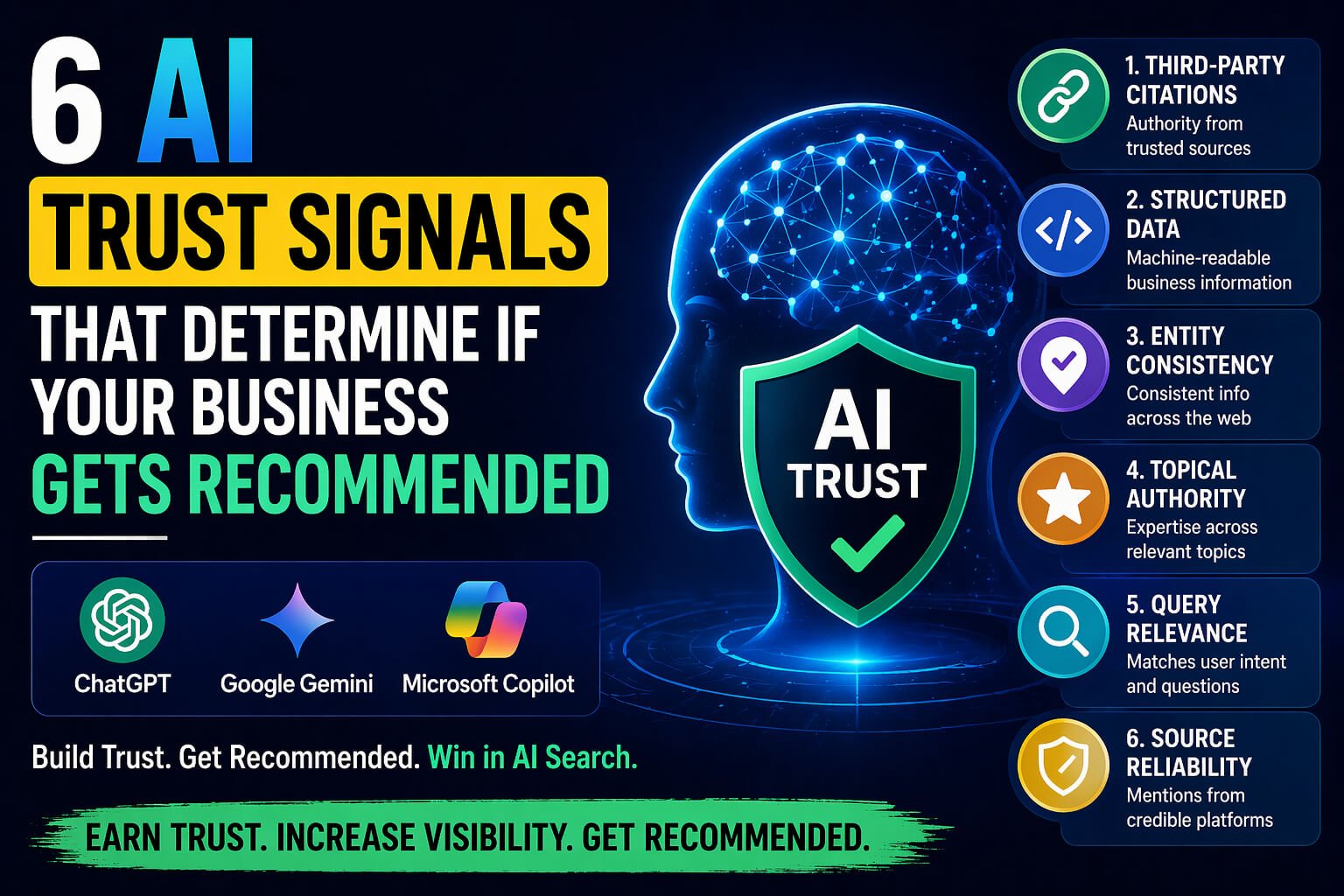
AI platforms use third-party citations, structured data, entity consistency, topical authority, query relevance, and source reliability to determine whether a business is trustworthy enough to recommend in AI-generated answers.

AI trust signals are measurable indicators that help artificial intelligence systems verify:

  • Who the business is
  • What it offers
  • Whether it is credible
  • Whether it is relevant to a user’s query

These signals are derived from structured data (Schema.org), authoritative mentions, and entity consistency across platforms, which are also foundational to Google’s Knowledge Graph and modern AI retrieval systems.

How AI Systems Evaluate Trust

AI systems don’t rank like traditional search engines.

Instead, they:

  • Identify entities (businesses, brands, people)
  • Cross-reference multiple data sources
  • Validate consistency and authority

According to Google Search Central, structured data helps systems better understand and interpret content, while entity-based search models prioritize verified and consistent information.

The 6 Core AI Trust Signals

1. Third-Party Citations (Authority Signal)

Mentions of your business on external, trusted websites.

Why it matters:
AI systems treat third-party mentions as validation.

Best sources:

  • News websites
  • Industry publications
  • Authoritative directories

More high-quality mentions = higher trust probability

2. Structured Data 

Schema markup that makes your business machine-readable.

Why it matters:
Structured data helps AI confirm:

  • Identity
  • Services
  • Location

According to Schema.org standards and Google documentation, structured data improves content interpretation and supports enhanced search features.

3. Entity Consistency (Verification Signal)

Consistency of your business details across the web.

Must match:

  • Name
  • Address
  • Phone number
  • Core messaging

Inconsistent data lowers AI confidence and trust scores

4. Topical Authority (Expertise Signal)

Depth and breadth of content within a specific niche.

Why it matters:
AI systems favor businesses that demonstrate sustained expertise across multiple related topics.

One page = weak signal
Content ecosystem = strong signal

5. Query Relevance (Intent Match Signal)

How well your content answers a specific user question.

Why it matters:
AI systems match businesses to intent, not just keywords.

Clear, direct answers increase inclusion probability

6. Source Reliability (Trust Weight Signal)

The credibility of the platforms mentioning your business.

Why it matters:
Not all sources carry equal weight.

AI prioritizes:

  • Established domains
  • Expert-driven content
  • Verified platforms

What Are AI Citation Signals?

Q: What are AI citation signals?

AI citation signals are factors that increase the likelihood of a business being referenced in AI-generated answers, including structured data, authoritative mentions, entity consistency, and topical authority.

Why Businesses Get Ignored by AI

Q: Why is my business not showing up in ChatGPT or Gemini?

Answer:
Businesses are often excluded due to weak authority signals, lack of structured data, inconsistent information, and insufficient presence across trusted sources, making them difficult for AI systems to verify.

Fastest Way to Improve AI Trust Signals

Q: What is the fastest way to get recommended by AI platforms?

Answer:
The fastest way is to implement structured data, ensure consistent business information across platforms, and build citations on trusted websites to improve verification and authority signals.

Hidden Insight 

Most businesses focus on visibility.

AI focuses on validation.

It’s not enough to exist online; your business must be:

  • Repeated
  • Structured
  • Verified

That’s what turns you into a trusted AI entity.

The Bottom Line

To be recommended by AI systems, your business must be:

  • Clearly defined (structured data)
  • Consistent across platforms (entity validation)
  • Referenced by trusted sources (citations)
  • Topically authoritative (content depth)
  • Relevant to user intent (direct answers)

Miss these, and your visibility drops, even if your SEO is strong.

CTA

Want to know which AI trust signals you’re missing?

Run an AI Visibility Audit and uncover exactly why your business isn’t being recommended.
How Structured Data Helps Your Business Appear in ChatGPT and Google Gemini Answers

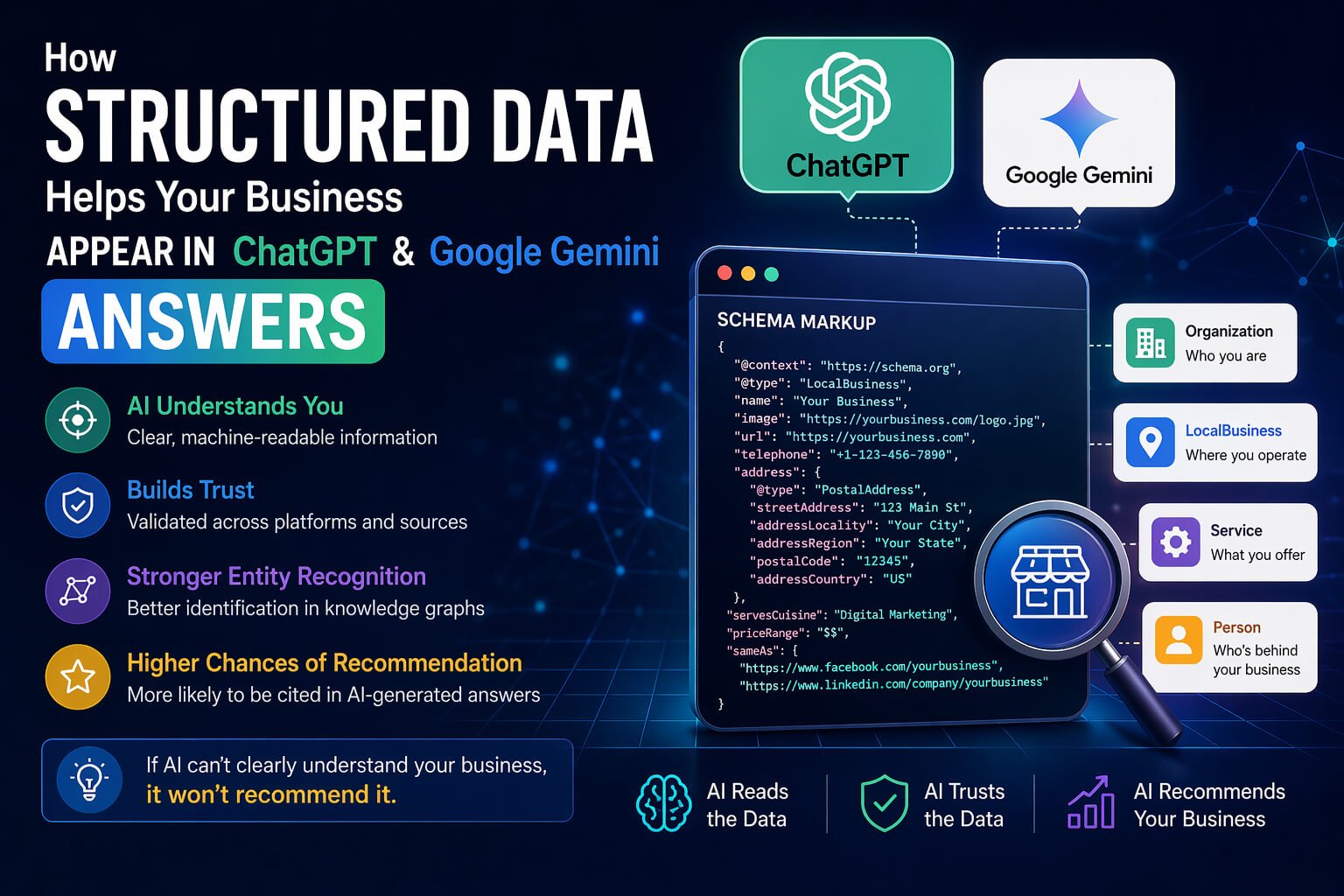
If AI can’t clearly understand your business, it won’t recommend it.

Structured data is one of the most important and most overlooked factors behind whether your business appears in AI-generated answers across platforms like ChatGPT, Google Gemini, and Microsoft Copilot.

Q: How does structured data help with AI search visibility?

Structured data helps AI systems identify, classify, and verify a business by providing machine-readable information about its identity, services, and relevance. This increases trust, improves entity recognition, and raises the likelihood of being selected and cited in AI-generated answers.

What Is Structured Data?

Structured data (schema markup) is standardized code based on Schema.org vocabulary, used by Google, Microsoft, and other platforms to understand website content.

It tells AI systems:

  • Who you are (Organization / Person)
  • What you offer (Service / Product)
  • Where you operate (LocalBusiness)
  • How you’re connected (entity relationships)

According to Google Search Central, structured data helps search engines better interpret content and enable enhanced results like rich snippets and AI-generated summaries.

Why AI Platforms Rely on Structured Data

AI search engines don’t just rank pages; they select trusted entities.

Structured data helps AI systems:

  • Reduce ambiguity in content interpretation
  • Validate business information across sources
  • Strengthen entity-level understanding

This directly impacts whether your business is:

  • Included in answers
  • Recommended to users
  • Cited as a trusted source

What Schema Markup Matters for AI Visibility?

What schema markup helps a business appear in AI answers?

The most important schema types for AI visibility include Organization, LocalBusiness, Service, and Person schema, as they define your identity, offerings, and authority in a structured, verifiable way.

Key Types:

  • Organization Schema → defines your brand entity
  • LocalBusiness Schema → critical for local AI recommendations
  • Service Schema → explains what you offer
  • Person Schema → builds author and founder authority

These schemas align your business with structured data standards used in knowledge graphs and AI retrieval systems.

How AI Decides Which Businesses to Recommend

Q: How does ChatGPT or Gemini decide which businesses to recommend?

AI systems prioritize businesses with strong entity signals, consistent information across sources, structured data, and credible mentions. These factors help AI models determine trust, relevance, and accuracy before including a business in generated answers.

Can You Rank in ChatGPT or AI Search?

Q: How do I get my business to show up in ChatGPT answers?

You don’t “rank” in ChatGPT like traditional SEO. Instead, you increase your chances of being included by improving structured data, building authority signals, and ensuring your business is consistently represented across trusted sources.

Why Structured Data Improves AI Selection

Structured data contributes to:

  • Stronger entity recognition
  • Better knowledge graph inclusion
  • Easier cross-source validation

Google explicitly uses structured data for enhanced search features, and similar structured signals are leveraged in AI systems that generate answers.

Result: Businesses with structured data are more likely to be retrieved, summarized, and cited.

Practical Example

Without structured data:
AI guesses your business details based on unstructured content.

With structured data:
AI confidently understands:

  • Your services
  • Your location
  • Your authority

That confidence determines whether you appear in AI answers.

Common Mistakes That Hurt AI Visibility

  • No schema markup implemented
  • Incorrect or incomplete schema
  • Missing service-level structured data
  • Inconsistent business information (NAP)
  • Weak entity connections (no social or author signals)

The Bottom Line

Structured data is no longer optional.

It’s a foundational layer that determines whether AI systems:

  • Understand your business
  • Trust your information
  • Recommend you in answers

If your business isn’t clearly defined in a machine-readable way, it becomes effectively invisible in AI search.

FAQ: AI Search Optimization & Visibility

Q: What is AI search optimization, and how does it work?

Answer:
AI search optimization (AEO or generative engine optimization) is the process of structuring content, entities, and authority signals so AI platforms can understand, trust, and include your business in generated answers rather than just ranking web pages.

Q: How is AI search different from traditional SEO?

Answer:
Traditional SEO ranks pages based on keywords and links, while AI search selects and synthesizes trusted entities based on structured data, authority signals, and contextual relevance.

Q: What signals does ChatGPT use to trust a business?

Answer:
AI systems evaluate structured data, entity consistency, authoritative mentions, website clarity, and cross-platform validation to determine whether a business is trustworthy enough to recommend.

Q: Why is my business not showing up in ChatGPT?

Answer:
Common reasons include a lack of structured data, weak authority signals, inconsistent business information, and low presence across trusted sources, making it difficult for AI to verify and recommend the business.

Q: What are AI citation signals?

Answer:
AI citation signals are factors that increase the likelihood of being referenced in AI-generated answers, including structured data, entity authority, consistent mentions, and alignment with trusted data sources.

Q: What is the fastest way to show up in AI-generated answers?

Answer:

The fastest way is to implement it, clarify your entity (who you are and what you offer), and ensure your business is consistently represented across authoritative platforms.

Q: Should I optimize for AI search instead of Google SEO?

Answer:
No. AI search builds on traditional SEO. The best strategy is to combine both, using structured data and entity optimization alongside strong content and backlinks.

CTA

Want to know why your business isn’t showing up in ChatGPT or Gemini?

Get an AI Visibility Audit and uncover the exact gaps in your structured data, authority signals, and AI readiness.