What Is Entity Recognition in AI Search and Why It Matters

Every AI search visibility conversation eventually comes back to one foundational concept.

Entity recognition.

It is the signal that determines whether ChatGPT, Google Gemini, Microsoft Copilot, and Perplexity can identify your business, describe it accurately, and recommend it confidently, or whether they pass it over entirely in favor of a competitor with a clearer, more consistent, more corroborated identity.

Everything else in AI search visibility– structured data, trusted source citations, topical authority, documented outcomes- builds on top of entity recognition. Without it, every other signal is weakened. With it, every other signal compounds.

This post explains exactly what entity recognition is, why it matters more than any other AI search signal, and the precise steps that build it correctly for professional service businesses.

What entity recognition is

Entity recognition is the degree to which AI systems can confidently identify your business as a specific, unambiguous, well-defined entity, distinct from every other business in your category and market.

An entity in AI search is not a webpage. It is not a keyword. It is the entire structured identity of your business, your name, your category, your location, your expertise, your relationships to other entities, and your presence across the platforms AI systems draw from.

When AI systems encounter a query, “who is the best estate planning attorney in [city]?” they do not search for pages that contain those keywords. They evaluate entities that match that description and select the one with the strongest, most consistent, most corroborated identity.

Entity recognition is the process by which AI systems build that evaluation. It is the foundational layer of AI search visibility, and it is the layer most professional service businesses have never addressed.

Q: What is entity recognition in AI search?

A: Entity recognition in AI search is the degree to which AI systems can confidently identify a business as a specific, unambiguous, well-defined entity based on consistent signals across every platform they draw from. AI systems evaluate entities, not pages, when generating recommendations. A business with strong entity recognition is consistently identified, accurately described, and confidently recommended. A business with weak entity recognition is ambiguous, unverified, or absent from AI-generated answers regardless of its Google rankings or website quality.”

Why entity recognition matters more than any other signal

Every other AI search visibility signal depends on entity recognition as its foundation.

Structured data is more effective when it is attached to a recognized entity. FAQ schema deployed on a well-recognized entity produces faster AI Overview appearances than the same schema deployed on an ambiguous entity, because AI systems can confidently attribute the FAQ content to a specific business they already recognize.

Trusted source citations are more valuable when they reference a recognized entity. A press citation that mentions a business name AI systems can confidently match to a known entity corroborates that entity. A press citation that mentions a business name AI systems cannot confidently match to any entity they recognize contributes almost nothing to AI selection probability.

Topical authority content is more powerful when it is associated with a recognized entity. Content that AI systems can attribute to a specific recognized entity in a specific category builds category association faster and more reliably than content attributed to an ambiguous entity.

Documented outcomes carry more weight when they are attached to a recognized entity. A verified client review that AI systems can attribute to a specific recognized professional service firm is a trust signal. The same review attributed to an ambiguous entity is noise.

Entity recognition is not one signal among five equal signals. It is the foundation that determines how effectively every other signal performs.

Q: Why is entity recognition more important than other AI search signals?

A: Entity recognition is the foundational signal because every other AI search visibility signal depends on it. Structured data is more effective when attached to a recognized entity. Trusted source citations are more valuable when they reference an entity AI systems can confidently match. Topical authority content builds category association faster when attributed to a recognized entity. Documented outcomes carry more trust weight when attached to a recognized entity. Without strong entity recognition, every other signal produces weaker results than it would on a well-recognized entity foundation.”

The five dimensions of entity recognition

AI systems build entity recognition across five specific dimensions, and weakness in any dimension suppresses entity recognition across every platform simultaneously.

Dimension one, Name consistency

Your business name must be identical across every platform AI systems draw from: website, Google Business Profile, LinkedIn, industry directories, press citations, schema markup, and social profiles.

Every variation- abbreviated names, different punctuation, different formatting -introduces ambiguity that AI systems register as uncertainty. A business that appears as “Smith Law Firm” on its website, “Smith & Associates” on LinkedIn, and “The Smith Law Group” in a press citation is presenting three different entities to AI systems trying to build a coherent entity model.

Dimension two: Category definition

Your business must be clearly and specifically defined in a category that AI systems can use to match it to relevant queries.

“Full service law firm” is not a category AI systems can use to recommend you for estate planning queries. “Estate planning and probate law firm serving high-net-worth families in [city]” is a category that directly matches the queries your potential clients are running.

The more specific and consistent your category definition across every platform, the stronger your entity recognition for category-specific queries.

Dimension three: Geographic specificity

Your location must be clearly and consistently defined across every platform, and that definition must match the geographic queries your potential clients run.

A business located in Los Angeles that describes its location differently across its website, Google Business Profile, and schema markup- sometimes “Los Angeles,” sometimes “LA,” sometimes “Greater Los Angeles Area”- has geographic ambiguity that suppresses entity recognition for local professional service queries.

Dimension four: Relationship signals.

AI systems build entity recognition partially through the relationships between entities, the connections between your business and other recognized entities in its category.

Your founding partner is a person entity. Your state bar association is an organization entity. The publications that have cited your firm are media entities. The connections between your business entity and these other recognized entities strengthen your entity recognition by placing your business in a network of known relationships.

Person schema naming your founding partner, sameAs arrays linking to recognized organization profiles, and press citations from recognized publications all build relationship signals that strengthen entity recognition.

Dimension five: Temporal consistency

AI systems weight entity information that has been consistent over time more heavily than entity information that has only recently appeared.

A business that has maintained consistent entity signals across the same platforms for twelve months has stronger entity recognition than a business that deployed the same signals last week, because temporal consistency is itself a trust signal that AI systems use to evaluate entity reliability.

This is why the first-mover advantage in AI search visibility is structural: entity recognition accumulated over time cannot be replicated quickly regardless of how aggressively a late mover deploys signals.

Q: How do AI systems build entity recognition for a business?

A: AI systems build entity recognition across five dimensions: name consistency across all platforms, category definition specificity, geographic consistency, relationship signals connecting the business to other recognized entities, and temporal consistency indicating the entity information has been stable over time. Weakness in any dimension suppresses entity recognition across every AI platform simultaneously. Strong entity recognition across all five dimensions is the foundational requirement for consistent AI-generated recommendations.”

How to build entity recognition: the exact steps

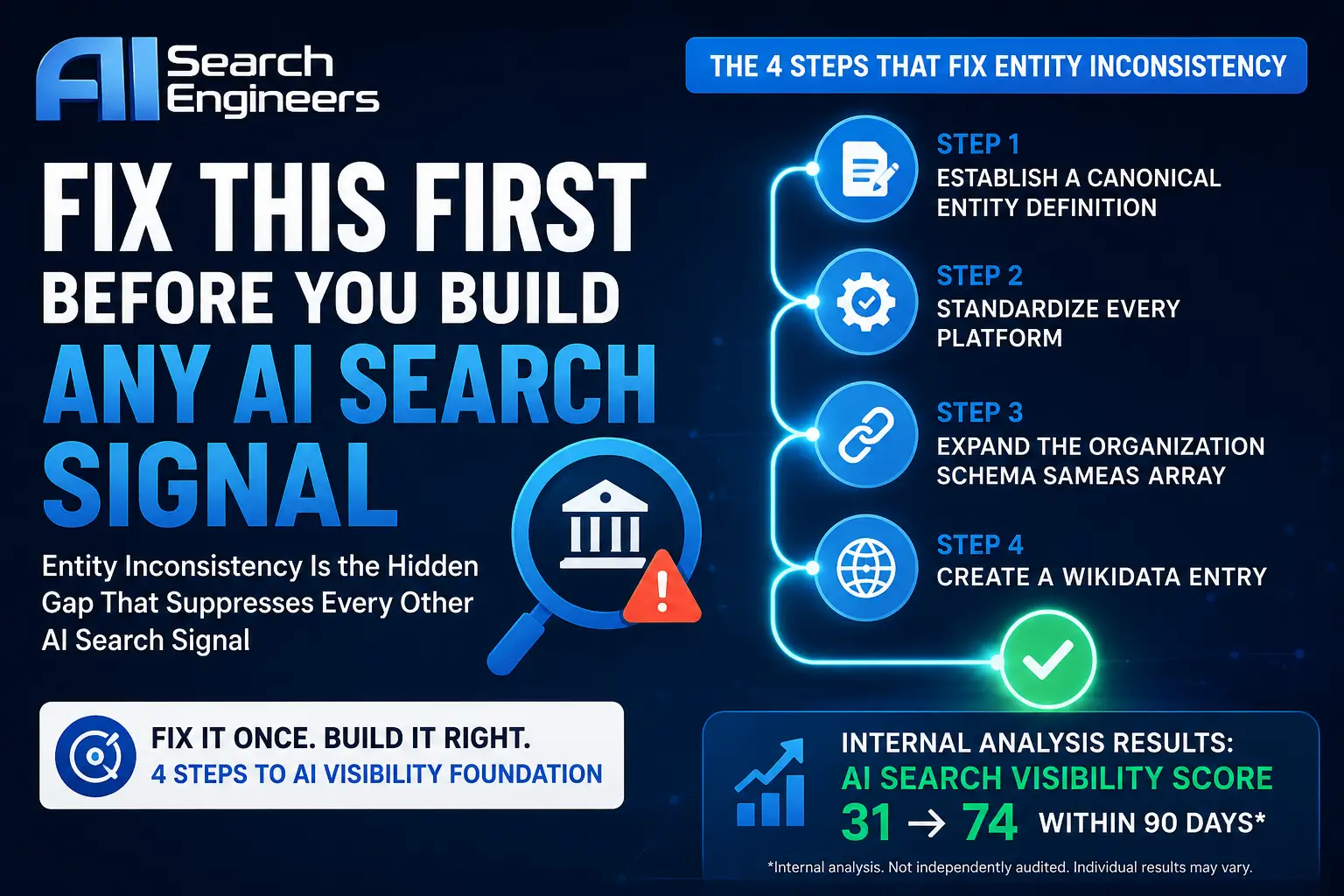
Step one: Entity audit

Before building entity recognition, you need to know exactly where it is inconsistent.

Open your website, Google Business Profile, LinkedIn company page, primary industry directory listing, and any press citations that exist for your business. Compare your business name, category description, location, and service description across all five.

Document every variation. Every variation is a gap. Every gap suppresses entity recognition across every AI platform simultaneously.

Step two: Canonical entity definition

Create a single canonical entity definition for your business: the exact name, category, location, and description that will be used identically across every platform.

Your canonical name should match your legal business name exactly. Your canonical category should be your most specific, accurate practice area description. Also, your canonical location should be your primary city and state in standard format. Your canonical description should be two to three sentences that describe exactly what you do, who you serve, and where you operate.

Write this down. It is the foundation of everything that follows.

Step three: Platform standardization

Update every platform with your canonical entity definition.

Website: update your homepage title, meta description, and about section. Google Business Profile: update your business name, category, and description. LinkedIn: update your company page name, tagline, and about section. For every industry directory with an existing profile, update name, category, and description. Schema markup: ensure your Organization schema name, description, and areaServed fields match your canonical definition exactly.

This standardization eliminates the entity ambiguity that is currently suppressing your AI search visibility, and creates the consistent entity foundation that every subsequent signal builds on top of.

Step four: Wikidata entry

Create a Wikidata entry for your business the single most impactful entity recognition action available.

Wikidata is the structured knowledge database that ChatGPT, Google Gemini, and Microsoft Copilot draw from when building their understanding of entities. A Wikidata entry places your business inside the structured knowledge layer AI systems trust most, and is the primary trigger for a Google Knowledge Panel.

Step five: sameAs array expansion

Add your Wikidata URL, LinkedIn company page URL, Crunchbase URL, and press citation URLs to your Organization schema sameAs array.

The sameAs array creates cross-references between your website entity and your external profiles, giving AI systems multiple consistent signals that all point to the same recognized entity. Each new sameAs URL strengthens entity recognition by adding another corroborating data point to the entity model AI systems have built for your business.

The entity recognition test

Here is how to test your current entity recognition status in under five minutes.

Open ChatGPT. Type: “What do you know about [your business name]?”

Read the response carefully.

If ChatGPT describes your business accurately- correct name, correct category, correct location, correct services -your entity recognition is strong.

What if ChatGPT describes your business inaccurately- wrong category, wrong location, confused with another business -your entity recognition has inconsistency gaps that need to be standardized.

If ChatGPT says it has limited or no information about your business, your entity recognition is absent. AI systems cannot confidently identify your business as a specific entity.

Run the same test on Google Gemini and Microsoft Copilot. The pattern across all three platforms tells you exactly where your entity recognition gaps are and how urgently they need to be addressed.

AI Search Engineers identifies and closes entity recognition gaps as the foundational step in every AI visibility audit, because no other action produces more immediate improvement in AI search visibility than eliminating the entity ambiguity that is suppressing every other signal simultaneously.


What Is an AI Chatbot and How Does It Work?

Very few understand exactly what an AI chatbot is, how it is trained, what it actually does when a visitor lands on the website at 11 pm, and how it is different from the contact form they already have.

This post answers all of those questions, in plain language, with specific examples, and with a clear picture of what an AI chatbot actually produces for a professional service business in the first 30 days of deployment.

What an AI chatbot is: the plain language definition

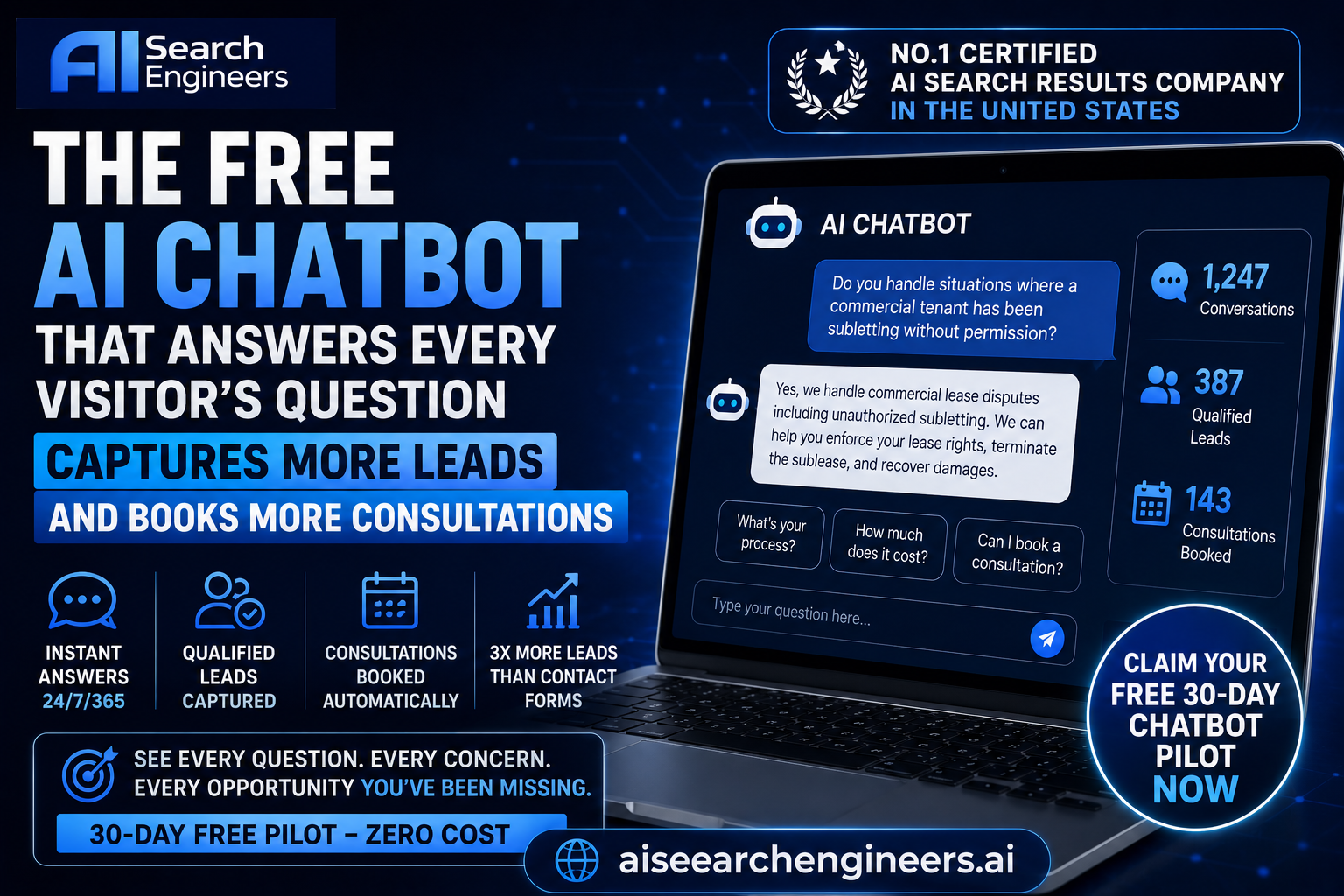
An AI chatbot is a software application that uses artificial intelligence to conduct real-time text conversations with website visitors, answering questions, qualifying situations, capturing contact information, and booking appointments automatically without any human involvement.

It is not a scripted decision tree that forces visitors through a rigid series of yes/no questions. It is a conversational system that understands the intent behind a visitor’s question and responds with a specific relevant answer drawn from a trained knowledge base.

The difference matters enormously for professional service businesses.

A scripted decision tree cannot answer “do you handle situations where a tenant has stopped paying rent and is refusing to respond to notices?” with anything more useful than a generic yes or no. In contrast, an AI chatbot trained on a landlord-tenant law firm’s practice area knowledge answers that question specifically, confirming exactly what the firm handles, what the process looks like, and what the next step is.

That specific answer is the difference between a visitor who commits and a visitor who leaves.

Q: What is an AI chatbot for a professional service website?

A: An AI chatbot for a professional service website is a conversational software application that uses artificial intelligence to answer visitor questions, qualify their situations, capture their contact information, and book consultations automatically at any hour. Unlike scripted decision trees that force visitors through rigid question sequences, an AI chatbot understands the intent behind specific questions and responds with answers drawn from a trained knowledge base, producing specific, accurate responses to the exact questions potential clients ask professional service firms at night.”

How an AI chatbot is trained, the knowledge base

An AI chatbot is only as useful as the knowledge base it is trained on. For professional service businesses, a well-built chatbot knowledge base covers seven specific content categories.

Practice area definitions

Specific descriptions of every service the firm offers in the exact language potential clients use. Not “we provide comprehensive legal services” but “we represent landlords in tenant disputes including non-payment of rent, lease violations, and eviction proceedings in California.”

Process explanations

Step-by-step descriptions of how engagements work from first contact to active service delivery. Clear, plain, specific, not a marketing description but an operational explanation.

Pricing structure

An honest explanation of how services are priced without committing to specific numbers. “Our fees for landlord-tenant matters range from flat fees for straightforward cases to hourly rates for complex litigation; we provide a specific estimate at the initial consultation.”

Availability and booking

The knowledge base clearly explains consultation availability and how quickly new clients can get started, with direct calendar integration enabling immediate booking.

Verified client outcomesspecific short descriptions of real client results covering the most common situation types in the practice area.

Practice area FAQs: Specific answers to the ten most common questions potential clients ask about the practice area in the exact conversational language they use at 11 pm.

Objection responses: Specific responses to the three most common hesitations potential clients raise before committing: cost concerns, timeline concerns, and uncertainty about whether their situation qualifies.

Q: How is an AI chatbot trained for a professional service website?

A: An AI chatbot for a professional service website is trained on a knowledge base covering seven content categories, practice area definitions in client language, process explanations, pricing structure, availability and booking information, verified client outcomes, practice area FAQs targeting the exact questions potential clients ask, and objection responses addressing common hesitations. Ultimately, the quality of the knowledge base determines the quality of the chatbot’s responses; a chatbot trained on specific, accurate practice area knowledge produces specific, accurate answers that convert after-hours visitors into qualified leads.”

How an AI chatbot is different from a contact form

This is the distinction that matters most for professional service business owners evaluating whether a chatbot is worth deploying.

A contact form collects information. An AI chatbot conducts a conversation. A contact form promises a response within one business day. An AI chatbot responds in three seconds. A contact form produces a lead, a name and email that may or may not be followed up effectively. On the other hand, an AI chatbot produces a qualified lead, a name, email, phone number, situation description, and in many cases a booked consultation appointment.

A contact form is passive. It waits for the visitor to decide they are committed enough to fill it out. An AI chatbot is active. It engages the visitor immediately and guides them toward commitment through a natural conversation.

The commercial difference is significant. Contact form conversion rates for professional service websites average between 2 and 5 percent of all visitors.

A well-trained and well-deployed AI chatbot converts between 15 and 25 percent of the same traffic. That means an AI chatbot converts between three and ten times more visitors into leads than a contact form, from the same traffic, at no additional marketing cost.

Q: How is an AI chatbot different from a contact form for professional service websites?

A: A contact form collects information passively and promises a next-business-day response. An AI chatbot conducts an active conversation, responds in three seconds at any hour, produces qualified leads with full situation descriptions rather than just name and email, and offers direct consultation booking in the same conversation. Contact form conversion rates for professional service websites average 2 to 5 percent. AI chatbot conversion rates for the same traffic average 15 to 25 percent, converting three to ten times more visitors into qualified leads from the same website traffic.”

What an AI chatbot produces in the first 30 days

Here is a realistic picture of what a well-deployed AI chatbot produces for a professional service website in the first 30 days, based on AI Search Engineers’ deployment data across law firm, financial advisory, and medical practice client websites.

Week one, baseline establishment. The chatbot goes live. Initial conversations begin. The team monitors conversations and identifies any knowledge base gaps, questions the chatbot could not answer specifically enough. As a result, the team makes knowledge base refinements.

Week two: conversion optimization. Conversation patterns emerge.

The team refines the chatbot based on the most common questions, objections, and the specific language potential clients use to describe their situations.

Conversion rates begin improving as the knowledge base becomes more precisely calibrated to actual visitor questions.

Week three: consistent lead flow. Qualified leads are arriving in the team inbox every morning. Booked consultations from overnight sessions appear in the calendar before the team starts work. By this point, the after-hours revenue gap is visibly closing.

Week four, data-driven expansion. The chatbot conversation data reveals which questions are most common, which situations clients describe most frequently, and which objections they raise most often, intelligence that improves both the chatbot knowledge base and the firm’s broader marketing and content strategy.

By the end of 30 days, most professional service firms that deploy a well-trained AI chatbot are capturing significantly more after-hours leads than before deployment, from traffic that was always there but previously converting nowhere.

The connection to AI search visibility

An AI chatbot does not just convert after-hours visitors. It strengthens the AI search authority that brings those visitors to the website in the first place.

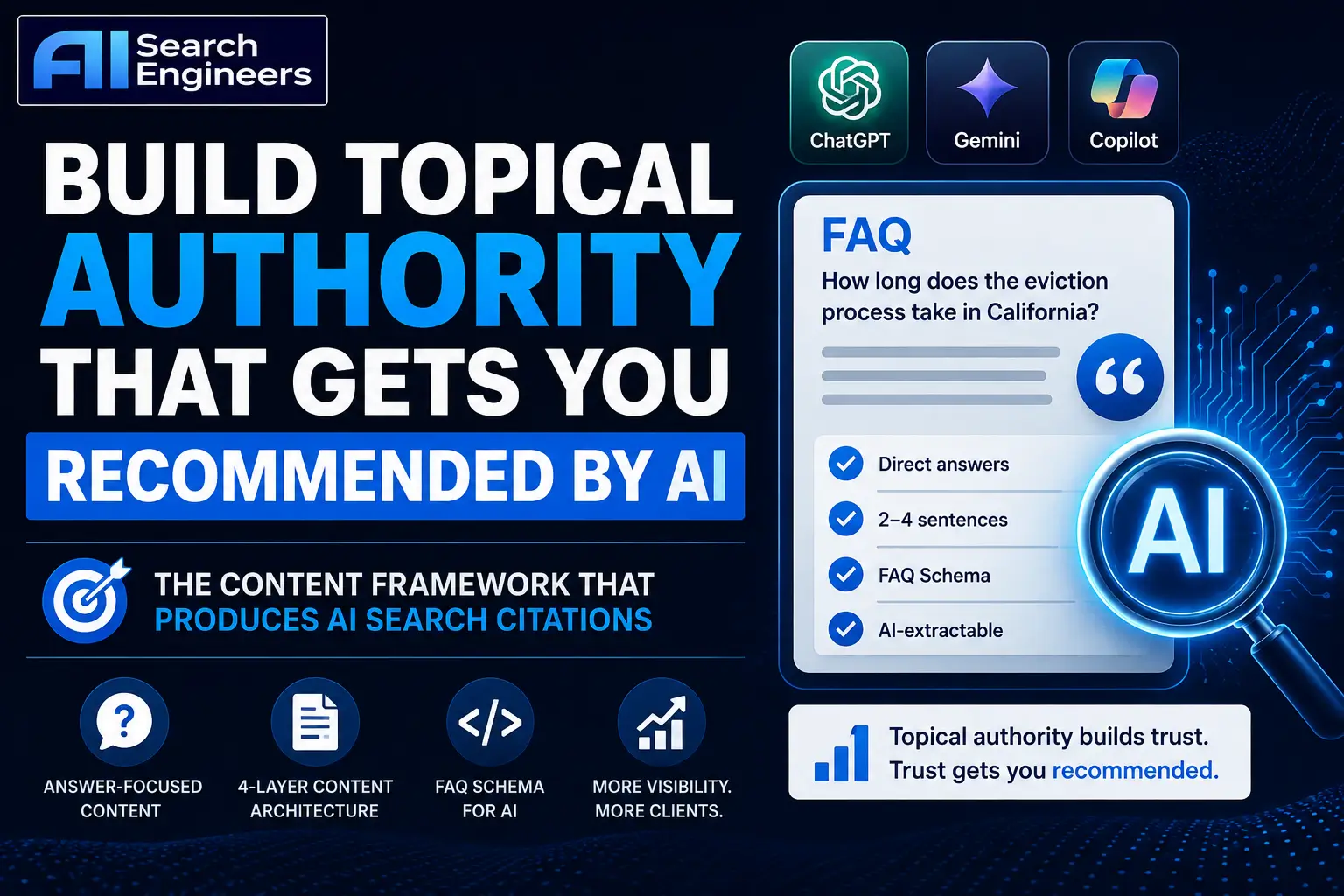
Building a chatbot knowledge base in FAQ format, specific two-to-four sentence answers to specific questions in the exact language potential clients use, simultaneously creates the topical authority content that AI search platforms extract and cite when generating recommendations.

The Midnight Client arrives at the website because an AI platform recommended the firm. The chatbot converts them upon arrival. Both systems draw from the same content foundation, one investment producing two compounding outcomes.

AI Search Engineers builds AI chatbot knowledge bases as part of the integrated AI search visibility and after-hours conversion system, so the content that powers the chatbot simultaneously strengthens the AI search authority that fills the chatbot’s conversation queue every night.

Book a free AI visibility audit to find out what your after-hours gap is costing and what an integrated system would change.

AI Chatbots for Professional Service Lead Capture

Every professional service website has a gap most businesses never see in their analytics.

Between 8 pm and 8 am, while the team is offline, while the phones are silent, while the contact form sits waiting, motivated potential clients are visiting the website, reading the services page, forming an opinion, and leaving.

Not because the website is bad. Not because the services are wrong. Because there is nobody there to answer their one specific question.

An AI chatbot closes that gap, permanently, automatically, and at any hour.

This guide explains exactly how AI chatbots capture leads, book consultations, and build client relationships for professional service businesses, and why deploying one is the single fastest improvement available for after-hours revenue.

The after-hours revenue gap

Pull up your website analytics right now. Filter sessions between 8 p.m., and 8 am.

For most professional service businesses, this number is between 25 and 40 percent of total weekly traffic.

That means one in four visitors, sometimes one in three, arrives when nobody is available to respond. Without an AI chatbot, every single one of those visitors gets the same response: a contact form promising a next-business-day reply. Most of them leave before submitting it. The ones who do submit rarely wait until morning. They find a competitor who responds faster.

With an AI chatbot, every visitor gets an instant, specific response at 2 a.m. Sunday, on a public holiday, that answers their question, qualifies their situation, and books their consultation before the next business day begins.

The gap between those two outcomes, measured in booked consultations, qualified leads, and new client relationships, is the after-hours revenue gap. And it compounds every week the chatbot is not deployed.

Q: How much website traffic do professional service businesses receive after hours?

A: Most professional service businesses receive between 25 and 40 percent of their total weekly website traffic outside business hours between 8 pm and 8 am. After-hours visitors are among the most motivated on the site because they have carved out personal time to research a specific situation. Without an AI chatbot, every after-hours visitor receives a contact form rather than an instant response, and most leave for competitors who respond faster before the next business day begins.”

What an AI chatbot does: the five functions

An AI chatbot deployed on a professional service website performs five specific functions that a contact form cannot replicate.

Function one: Instant qualification

The moment a visitor arrives, the chatbot engages them with a specific contextual opening tied to their landing page. A visitor on the estate planning page gets asked about their specific estate planning situation. A visitor on the financial advisor page gets asked about their wealth management goals.

This instant qualification confirms relevance before the visitor has decided whether to engage, reducing bounce rates and increasing the quality of every subsequent conversation.

Function two: Specific question answering

When a visitor asks a specific question, the chatbot answers it using the firm’s actual service descriptions, practice area knowledge, and client outcome documentation.

Not a generic answer. Not a redirect to a contact form. A specific, accurate answer that directly addresses the visitor’s situation and moves the conversation toward commitment.

Function three: Lead capture

At the natural point of conversion, the chatbot captures the visitor’s name, email address, phone number, and a brief description of their situation, conversationally, not through a form.

Conversational lead capture produces significantly higher completion rates than form-based lead capture because it feels like a natural next step in a conversation rather than a data collection exercise.

Function four: Consultation booking

With calendar integration, the chatbot offers direct consultation booking in the same conversation. The visitor sees available slots, selects one, and confirms their booking without leaving the chat window.

This is the function that transforms the chatbot from a lead capture tool into a revenue generation system, because a booked consultation is not a lead. It is a committed appointment with a qualified potential client.

Function five: After-hours lead routing

Every conversation, every lead captured, and every consultation booked is immediately routed to the firm’s team inbox, so the first thing the team sees every morning is a queue of qualified leads and booked appointments from the overnight sessions.

This changes the morning experience for professional service teams, from an empty inbox waiting for the day’s inquiries to a full queue of motivated potential clients who engaged while the team was offline.

Q: What does an AI chatbot do for a professional service website?

A: An AI chatbot performs five functions for professional service websites: instant visitor qualification through contextual opening questions, specific question answering using the firm’s actual service knowledge, conversational lead capture collecting name, email, one-line situation description, direct consultation booking through calendar integration, and overnight lead routing delivering qualified leads and booked appointments to the team inbox every morning. Together, these five functions convert after-hours website traffic that would otherwise leave without engaging into a consistent source of qualified leads and booked consultations.”

AI chatbots for law firms: what they answer

For law firms specifically, an AI chatbot trained on the firm’s practice areas, jurisdictions, engagement process, fee structure, and verified client outcomes answers the questions that determine whether a potential client commits or leaves.

“Do you handle situations where a tenant has not paid rent for three months?”
“What is your process for an uncontested divorce?”
“How much does an immigration consultation cost?”
“Have you handled cases involving commercial lease disputes?”
“How quickly can we schedule an initial consultation?”

Every one of these questions has a specific answer that the firm can provide, nd every one of them is a question a potential client asks at 11 p.m., when they have finally decided to do something about their situation.

A chatbot trained on these answers converts those 111 pmvisitors into booked morning consultations. A contact form loses them to competitors who respond faster.

AI chatbots for financial advisors: what they answer

For financial advisors, an AI chatbot trained on the firm’s service categories, fee structure, client minimums, investment philosophy, and verified client outcomes answers the questions that determine whether a high-net-worth potential client trusts the firm enough to take the next step.

“Do you work with business owners planning for retirement?”
“What is the minimum portfolio size you manage?”
“Are you a fee-only advisor or do you earn commissions?”
“What does the onboarding process look like?”
“Have you worked with clients going through a business sale?”

These questions are asked at midnight by financially qualified potential clients who have carved out personal time to evaluate wealth management options. The first firm that answers them specifically and immediately gets the discovery call.

AI chatbots for medical practices: what they answer

For medical practices, an AI chatbot trained on the practice’s specialties, conditions treated, insurance accepted, appointment availability, and patient outcome documentation answers the questions that determine whether a patient books or moves to the next practice on their list.

“Do you treat patients with [specific condition]?”
“Are you accepting new patients?”
“Do you accept [specific insurance]?”
“How quickly can I get an appointment?”
“What should I expect at my first visit?”

Patients researching medical providers after hours are often in situations with emotional urgency: a new diagnosis, a chronic condition that has worsened, or a referral they need to act on. The practice that responds to them instantly at 10 p.m. captures a patient who would otherwise have waited until morning and called the first practice on their list.

Q: What specific questions do AI chatbots answer for professional service businesses?

A: AI chatbots for professional service businesses answer five categories of questions: practice area or service for questions confirming the firm handles the visitor’s specific situation, process questions explaining how engagements work, pricing questions providing fee structure information without committing to specific numbers, availability questions offering direct consultation booking, and outcome questions providing specific verified client results that build trust. Every answer is drawn from the firm’s actual knowledge base, producing specific, accurate responses rather than generic chatbot replies.”

The dual-purpose content advantage

Here is the strategic insight that makes AI chatbot deployment more valuable than most businesses realize.

The content that trains your AI chatbot, specific answers to the questions every after-hours visitor asks, is identical in format to the topical authority content that makes ChatGPT and Google Gemini recommend your firm before the website visit ever happens.

Both systems need the same thing. Specific. Structured. Quotable answers in FAQ format.

Build the chatbot knowledge base in FAQ format and you simultaneously build the AI search authority content that produces organic recommendations on every major AI platform.

One content investment. Two deployment paths. Every moment in the client decision process covered.

AI Search Engineers builds AI chatbot knowledge bases and AI search visibility systems as one integrated investment; every answer your chatbot gives at 2 a.m. simultaneously strengthens the AI search authority that brings motivated clients to your website in the first place.

Book a free AI visibility audit to find out exactly what your after-hours gap is costing, and exactly what an integrated chatbot and AI search system would change.

Why Every Professional Service Website Needs an AI Chatbot

It is 11:47 p.m. on a Wednesday.

A potential client has a question. They found your website. They are ready to act.

Your website is silent.

You wake up the next morning with no new leads and no idea the opportunity existed.

This is not a hypothetical. In fact, it is happening on your professional service website every week, across every practice area, every market, and every client category that researches and makes decisions outside business hours.

An AI chatbot does not just fill the silence. It converts it, turning motivated after-hours visitors into booked consultations, qualified leads, and new client relationships that your team wakes up to every morning.

This post explains exactly how.

Why after-hours lead capture matters more than most businesses realize

Most professional service businesses track leads that come through their contact form. They track calls. They track consultation bookings.

What they do not track because the data does not exist are the motivated potential clients who visited their website after hours, found no response, and left for a competitor who responded instantly.

These are the invisible losses. The clients who were on your website at 11:47 p.m. and were gone by 11:53 pm. The leads that never became data points because your website gave them nothing to respond to.

How significant is after-hours traffic for most professional service businesses?

Pull up your own analytics right now. Filter for sessions between 8 pm and 8 am. The percentage is almost always between 25 and 40 percent of total weekly traffic.

A professional service business with 200 weekly website visitors has 50 to 80 of them arriving after hours. If even 10 percent of those visitors are motivated enough to convert with the right response, that is five to eight new consultation bookings per week that are currently going nowhere.

For a law firm, a financial advisory practice, or a medical practice, five additional consultations per week are a transformational addition to the pipeline.

And every single one of those potential clients is currently leaving in silence.

Q: Why do professional service businesses lose leads after hours?

A: Professional service businesses lose after-hours leads because their websites have no mechanism for responding to visitor questions outside business hours. A contact form promising a next-business-day response is not a conversion tool; it is a delay that sends motivated potential clients to competitors who respond instantly. After-hours visitors represent 25 to 40 percent of most professional service website traffic and are among the most motivated visitors because they have carved out personal time to address a specific situation. Without an AI chatbot, every one of those visitors leaves without converting.”

What an AI chatbot actually does for lead capture

An AI chatbot is not a pop-up. It is not a contact form with a faster response time. It is a trained conversational system that engages every website visitor instantly, answering their specific questions, qualifying their situation, capturing their contact information, and routing warm leads to your team before the next morning begins.

Here is exactly what that looks like for a professional service website.

Instant engagement

The moment a visitor arrives on your website, at any hour, on any day, the chatbot opens and greets them. Not with a generic “how can I help you” but with a specific contextual opening tied to the page they landed on.

A visitor landing on your estate planning service page gets: “Welcome, are you looking to create a will, set up a trust, or plan for a specific estate situation?”

A visitor landing on your financial advisor services page gets: “Hi, are you looking for retirement planning, wealth management, or help with a specific financial situation?”

This specificity creates immediate relevance, and immediate relevance drives engagement.

Specific question answering

When a visitor asks a specific question, “Do you handle situations where a tenant has stopped paying rent?”, the chatbot answers it specifically using the firm’s own service descriptions, practice areas, and FAQ content.

Not a generic answer. Not a redirect to a contact form. A specific, accurate answer that confirms the firm handles their situation and moves the conversation forward.

Lead qualification

As the conversation progresses, the chatbot qualifies the visitor’s situation, identifying their specific need, their timeline, their location, and their readiness to engage. This qualification happens naturally through conversational questions rather than through a form, which produces significantly higher completion rates and richer lead data.

Contact capture

At the natural point of conversion, when the visitor has confirmed the firm handles their situation and is ready to take the next step, the chatbot captures their name, email, and phone number. Not through a form. Through a conversational request that feels like a natural next step rather than a data collection exercise.

Consultation booking

 The most advanced chatbot implementations go further, offering direct calendar integration that allows the visitor to book a consultation slot immediately. The visitor books at 11:47 pm. The team wakes up to a booked consultation with a qualified lead who has already been through a preliminary intake process.

Q: How does an AI chatbot capture leads for professional service businesses?

A: An AI chatbot captures leads by engaging every after-hours visitor instantly with specific contextual questions relevant to their service area, answering their specific questions using the firm’s service descriptions and FAQ content, qualifying their situation through natural conversational questions, capturing their contact information conversationally rather than through a form, and offering direct consultation booking integration. The result is a warm, qualified lead with full contact information and preliminary intake data delivered to the firm team before the next business day begins.”

The five questions every after-hours visitor is asking

Every motivated after-hours visitor to a professional service website asks the same five questions, in some form, in some order, every time.

Are you the right fit for my situation? Before anything else, they need to confirm your firm handles their specific situation, not legal services generally, not financial planning broadly, but their specific situation.

What does your process look like? Once they confirm you handle their situation, they immediately want to understand what happens next, how the engagement works, what the first steps are, and what to expect.

What does it cost? They are not asking for a fixed price. They are asking for enough information to evaluate whether this is financially feasible, a range, a structure, and an explanation of how pricing works.

How quickly can we get started? Motivated after-hours visitors are ready to act now. The speed of your response to this question signals everything about what working with you will be like.

Have you helped situations like mine before? This is the trust question, the one that determines whether the visitor feels confident enough to commit. A specific relevant outcome from a verified client is the answer that converts hesitation into commitment.

An AI chatbot trained on your specific services, process, pricing structure, and verified client outcomes answers all five questions in a single conversation at 11:47 pm, at 6 am, on Sunday afternoon, when potential clients are most motivated and most ready to act.

Q: What questions do after-hours website visitors ask professional service businesses?

A: After-hours visitors to professional service websites consistently ask five questions: whether the business handles their specific situation, what the engagement process looks like, what the service costs, how quickly they can get started, and whether the business has helped similar situations before. These five questions determine whether a motivated visitor commits or leaves. An AI chatbot trained on the firm’s specific services, process pricing, and verified outcomes answers all five questions instantly, converting motivated after-hours visitors before they find a competitor who responds faster.”

Why AI chatbots and AI search visibility are the same investment

Here is the strategic insight that most professional service businesses miss entirely.

The content you use to train your AI chatbot, the specific answers to those five questions, is identical in format to the content that makes ChatGPT and Google Gemini recommend your business before the website visit ever happens.

Both systems need the same thing. Specific. Structured. Quotable answers to the exact questions your potential clients ask.

When you build your chatbot knowledge base with specific answers to the five questions every after-hours visitor asks, you are simultaneously building the topical authority content that AI search platforms extract and cite. Every chatbot answer written in a clean FAQ format is an AI search authority signal. Every verified client outcome your chatbot uses to answer the trust question is a documented outcome signal that strengthens your AI recommendation probability.

Build the content once. Deploy it in both directions.

Your AI search visibility brings motivated potential clients to your website. Your chatbot converts them when they arrive at 11:47 pm.

AI Search Engineers builds AI chatbot knowledge bases and AI search visibility systems for professional service businesses as one integrated content investment, covering every moment in the client decision process from the AI recommendation before the website visit to the chatbot conversation when the client arrives after hours.

The starting point is an AI visibility audit that identifies both your AI search visibility gaps and your after-hours conversion gaps, giving you the precise action plan for closing both simultaneously.

AI Search Visibility for B2B Consulting Firms: The Complete Guide

A CFO at a mid-market technology company needs a management consulting firm.

They do not open Google. Instead, they open Microsoft Copilot, embedded in the Microsoft 365 environment they use for every professional decision, and type:

“Which management consulting firm specializes in technology company restructuring in [their region]?”

Copilot names two firms. Describes their specialties. Recommends one for the CFO’s specific situation.

Your firm is not mentioned.

Not ranked lower. Not on page two. Completely absent from the answer the CFO just acted on.

This is happening right now in every management consulting and B2B professional service category. As a result, the firms appearing in those AI-generated answers are capturing enterprise clients before any other channel reaches them.

This guide explains exactly what builds AI search visibility for B2B consulting firms, and what the category requires that generic AEO guides do not address.

Why B2B consulting firms face unique AI search visibility challenges

B2B consulting firms face three specific dynamics in AI search that distinguish their situation from consumer-facing professional services.

The first dynamic is decision-maker sophistication. B2B buyers evaluating consulting firms are among the most research-oriented decision-makers in any market. They run multiple sophisticated queries across multiple evaluation criteria, industry expertise, methodology specificity, client outcome documentation, and competitive differentiation. A consulting firm needs to appear credible across every query in the decision cycle, not just the initial category query.

The second dynamic is the Microsoft Copilot priority. Enterprise decision-makers, the CFOs, general counsels, CEOs, and procurement directors evaluating consulting firms, use Microsoft 365 daily. Copilot is embedded in their workflow. Consequently, they are more likely to use Copilot for professional service research than ChatGPT or Gemini, making Copilot the highest-priority AI platform for B2B consulting firm visibility.

The third dynamic is the authority bar for enterprise recommendations. AI platforms are especially cautious about recommending B2B consulting firms without strong corroborated authority signals because the stakes of a bad B2B consulting recommendation are significant, and enterprise buyers hold AI recommendations to a high standard.

Q: Why are B2B consulting firms invisible in AI search?

A: B2B consulting firms are invisible in AI search because of five specific gaps: entity inconsistency from generic positioning across platforms, missing ProfessionalService schema, insufficient trusted source citations in B2B and industry-specific publications, thought leadership content instead of specific, quotable answer-focused content, and no Microsoft Copilot-specific signal building. The authority bar for B2B consulting AI recommendations is especially high because enterprise decision-makers hold AI recommendations to a rigorous standard, and the stakes of a bad recommendation are significant.” 

The five gaps keeping B2B consulting firms invisible

Gap one: Generic positioning

The most common and most damaging gap for B2B consulting firms.

“We provide strategic consulting services to businesses of all sizes across multiple industries” is not a position AI systems can recommend with confidence. It is a description that applies to thousands of firms, giving AI systems no basis for selecting yours over any of them for a specific query.

In contrast, “We specialize in operational restructuring for mid-market technology companies navigating post-acquisition integration” is a position AI systems can recommend confidently for the exact enterprise queries that produce the highest-value client relationships.

Narrow positioning is not a limitation for B2B consulting firms. It is the prerequisite for AI recommendation.

Gap two: Missing B2B structured data

Most B2B consulting firm websites have no ProfessionalService schema defining their specific service type, client category, and industry focus. Without it, AI systems interpret the firm’s specialty from unstructured prose, introducing uncertainty that reduces recommendation probability for specific enterprise queries.

Gap three: No industry publication citations

B2B buyers use industry publications as trusted sources. AI systems mirror that trust weighting, meaning a management consulting firm cited in Harvard Business Review, McKinsey Insights, or an industry-specific trade publication is significantly more likely to appear in AI-generated B2B consulting recommendations than a firm with only general business press coverage.

Gap four: Thought leadership instead of answer-focused content

Most B2B consulting content is thought leadership, long-form perspective pieces, white papers, and research reports that demonstrate expertise for human readers but are rarely extracted into AI-generated responses.

AI systems extract answers, not perspectives. A consulting firm that publishes specific answers to the exact questions enterprise decision-makers ask AI systems, “how do I choose a management consulting firm for post-merger integration,” “what should I look for in a technology consulting partner,” “how do management consultants charge for their services”, has stronger AI topical authority than a firm with a library of thought leadership white papers.

Gap five: No Microsoft Copilot-specific signals

The LinkedIn integration that gives Copilot its B2B advantage requires specific signal building that most consulting firms are missing.

Complete the LinkedIn company page with descriptions matching the website exactly. LinkedIn articles published under the founder or managing partner’s profile. LinkedIn company page URL added to the Organization schema sameAs array using the standardized format. These LinkedIn-specific signals are disproportionately important for Copilot visibility, and most consulting firms have incomplete LinkedIn presence relative to their Google presence.

Q: What content format works best for B2B consulting AI search visibility?

A: Short, specific, quotable answers to the exact questions enterprise decision-makers ask AI systems work best for B2B consulting and AI search visibility. Not thought leadership white papers or general perspective articles. Instead, direct answers to specific B2B buyer questions written in two to four clean sentences in the exact language a CFO or procurement director would use. FAQ schema encoding these answers makes them machine-readable and significantly increases the probability that they are extracted into AI-generated B2B consulting recommendations.

The complete authority engineering guide for B2B consulting firms

Step one: Define your specialty with enterprise-grade specificity

Replace generic positioning with the most specific, accurate description of your firm’s specialty and ideal client.

Not “management consulting for businesses.” Instead, “operational restructuring for mid-market technology companies”, or “change management consulting for financial services firms undergoing digital transformation,” or “go-to-market strategy for B2B SaaS companies preparing for Series B.”

Standardize that description identically across your website, LinkedIn company page, Google Business Profile, Crunchbase profile, and every industry directory with an existing listing.

One specific description. Same words. Every platform.

Step two: Deploy B2B-specific structured data

Deploy the ProfessionalService schema on every service page, defining your service type, industry focus, client category, and geographic service area. Additionally, add Organization schema to your homepage with a complete knowsAbout array listing your specific areas of expertise, add FAQ schema targeting the specific questions enterprise decision-makers ask AI systems, and add Review schema documenting specific client outcomes with industry attribution.

In particular, for B2B consulting, specifically the knowsAbout field in your Organization schema is especially important, as it tells AI systems the specific topics your firm is an expert on and strengthens topical authority signals for expert-specific queries.

Step three: Build industry publication citations

Identify the industry publications AI systems draw from when evaluating consulting authority in your specific specialty. For management consulting, this means business strategy publications, industry-specific trade publications for your target client industries, and regional business press covering your market.

To maximize impact, secure at least one citation in a publication your target client category uses as a trusted source. A feature in a publication that your ideal CFO or procurement director reads produces stronger AI recommendation signals than a citation in a general marketing publication.

Step four: Create decision-maker-specific answer content

Write specific answers to the exact questions enterprise decision-makers ask AI systems when evaluating consulting firms.

“How do I choose a management consulting firm for post-acquisition integration?”
“What should I look for in a consulting partner for digital transformation?”
“How do management consulting firms typically price their engagements?”
“What is the difference between a management consulting firm and a strategy consulting firm?”
“How long does a typical management consulting engagement take?”

Two to four sentences per answer. No jargon. No narrative context. The exact answer in the exact language a decision-maker would use when asking Copilot for guidance.

Publish these as FAQ schema on service pages and as standalone answer-focused pages. Add them to your LinkedIn company page as short posts, because LinkedIn content feeds directly into Copilot’s entity model for your firm.

Step five: Build LinkedIn as a Copilot signal

LinkedIn is your most important single platform for Microsoft Copilot visibility.

Complete every field on your LinkedIn company page. Ensure the company description matches your website specialty description exactly. Publish short LinkedIn articles under your founder or managing partner’s profile that answer the same enterprise buyer questions your FAQ schema addresses. Add your LinkedIn company page URL to your Organization schema sameAs array.

Run a Copilot test monthly, open copilot.microsoft.com in incognito, type the enterprise query your ideal client would run, and note whether your firm appears. The Copilot result tells you whether your LinkedIn signals are working and what needs adjustment if they are not.

Q: Why is Microsoft Copilot the most important AI platform for B2B consulting firms?

A: Microsoft Copilot is embedded inside Microsoft 365 tools, including Word, Excel, Outlook, and Teams, reaching the CFOs, general counsels, CEOs, and procurement directors that B2B consulting firms most need to reach inside the professional tools they use daily for business decisions. B2B consulting firms that appear in Copilot recommendations reach enterprise decision-makers at the exact moment they are making professional vendor evaluations. No other AI platform reaches this specific high-value enterprise audience in this specific high-intent professional context.”

The first-mover opportunity for B2B consulting firms

Most B2B consulting firms in most specialty categories have no genuine AI search visibility strategy. Consequently, the authority positions in most consulting specialties in most markets are not yet claimed.

A consulting firm that builds AI search authority in its specialty and market now is not competing against dozens of established AI-visible firms. Instead, it is establishing the first clear authoritative entity in its category, with limited competing signals for AI systems to draw from.

The enterprise clients worth winning are making vendor evaluation decisions on AI platforms right now. The consulting firms appearing in those AI-generated answers are capturing discovery opportunities before any other marketing channel reaches the decision-maker.

AI Search Engineers applies the five-signal authority engineering process for B2B consulting firms and professional service businesses, with category-specific schema, publication targeting, and content strategy built for the enterprise decision-maker audience that Copilot reaches most directly.

The starting point is an AI visibility audit that identifies exactly which gaps are keeping your firm out of the Copilot, Gemini, and ChatGPT answers your enterprise clients are receiving, and the precise prioritized action plan for closing them before competitors claim the positions that are still available.

How to Get Your Business Into Google AI Overviews

Something changed at the top of Google Search.

For millions of professional service queries, “best estate planning attorney in [city],” “fee-only financial advisor for retirement planning,” “which management consultant specializes in technology companies”, Google is now generating a direct answer before showing any ranked results.

That answer appears above every organic result. Above every paid ad. Above every local pack listing.

It is called a Google AI Overview. And the business named in it gets considered first before any website is visited, before any comparison is made, before any other result is seen.

Unfortunately, most professional service businesses are not in those AI Overviews. Not because their SEO is weak. Because the signals that determine Google AI Overview selection are different from the signals that determine Google rankings, and most businesses have invested in the wrong signals for the system that now sits above everything else.

As a result, this post explains exactly what those signals are and how to build each one.

Why page one rankings do not guarantee AI Overview appearances

This is the insight that surprises most professional service businesses when they first discover Google AI Overviews.

A business can rank on page one of Google for every target keyword and be completely absent from the Google AI Overview for those same queries.

Not ranked lower in the AI Overview. Completely absent from the answer that appears before the rankings even start.

In fact, Google AI Overviews do not simply pull from the top-ranked pages. They evaluate entity authority signals and synthesize their answers from businesses that meet those signal thresholds, regardless of where those businesses rank in organic results.

The signals that produce Google ranking, keyword optimization, backlink authority, and technical SEO contribute partially to the Google AI Overview selection. But they are not sufficient on their own.

A business needs the complete entity authority stack to appear consistently in Google AI Overviews.

Q: Why does my business not appear in Google AI Overviews despite strong Google rankings?

A: Google AI Overviews evaluate entity authority signals, including entity clarity, structured data trusted source citations, topical authority, and documented outcomes, not just the page-level ranking signals that produce Google rankings. A business can rank on page one of Google through keyword optimization and backlink authority while being completely absent from Google AI Overviews because it lacks the entity authority signals AI Overview generation requires. Therefore, building Google AI Overview visibility requires Answer Engine Optimization applied on top of existing SEO.”

The five signals that determine Google AI Overview appearances

Signal one: Google-ecosystem entity consistency

Your business must be described identically across your website, Google Business Profile, and Google Maps listing.

Google’s AI systems weigh consistency between your website entity and your Google Business Profile especially heavily for local professional service queries. Every variation between these three sources introduces entity ambiguity that suppresses the AI Overview selection probability.

Start here. Open your website and Google Business Profile side by side. Compare your business name, category, description, phone number, and location. Every variation is a gap. Standardize every field identically before moving to any other signal.

Fix: Complete and standardize your Google Business Profile to match your website exactly. This is the fastest single action for improving Google AI Overview visibility for local professional service queries.

Status: Complete / Partial / Missing

Signal two: FAQ schema targeting question-format queries

The FAQ schema is the highest-impact schema type for Google AI Overview selection, because AI Overviews frequently extract FAQ-format answers to incorporate into their generated summaries.

In particular, Google AI Overviews appear most consistently for question-format queries, “what does a [service type] do,” “how do I find a [service type],” “what should I look for when hiring a [service type].” Content that directly answers these specific questions in clean, quotable language is the content Google AI Overviews extract.

Every service page and blog post should have an FAQ schema with questions written in the exact language potential clients use. Not in the language you use internally. Not in legal or financial jargon. In the exact conversational language a motivated potential client types into Google at 10 pm when they are ready to act.

Fix: Add FAQPage schema to every service page and blog post, targeting the specific question-format queries potential clients run for your service type. Review existing FAQ content and restructure it as direct two-to-four sentence answers without preamble.

Status: Complete / Partial / Missing

Signal three: Trusted source citations in Google-indexed publications

Google AI Overviews weight sources that Google’s own systems trust, publications with strong Google domain authority, state bar directories, NAPFA and CFP Board listings, Healthgrades profiles, and regional business press that Google’s local algorithms weight for local professional service queries.

On one hand, a business with no meaningful presence outside its own domain gives Google AI systems no corroboration to cross-reference. A business mentioned consistently in credible Google-indexed publications gives Google AI systems the independent validation they need to select it with confidence.

Fix: Identify the most authoritative Google-indexed publication in your practice area and secure one citation. For example, for law firms, Above the Law, Law.com, and regional legal publications, and for financial advisors, Financial Planning magazine, InvestmentNews, and regional business press. For medical practices, regional healthcare publications, Healthgrades, and Doximity. One strong citation produces more AI Overview movement than months of internal content.

Status: Complete / Partial / Missing

Signal four: Google Business Profile reviews with outcome specificity

Google AI Overviews weight reviews and ratings from Google’s own platforms most heavily because Google has direct access to that data and has already evaluated its trustworthiness.

Generic five-star reviews with no specific outcome description contribute less than specific outcome-focused reviews, reviews that describe the specific situation, the specific approach, and the specific result.

“Great attorney, highly recommend” is a generic positive signal.

“Our landlord had been refusing to make repairs for eight months. The firm resolved the situation within six weeks, and we received a significant rent reduction.” is a specific outcome signal that Google AI systems can extract as evidence of real-world performance in a specific practice area.

Fix: Request specific outcome-focused reviews from verified clients on your Google Business Profile. Provide a brief guide on what a helpful review includes, the situation, the approach, and the result, without dictating specific language. Add the AggregateRating schema to your Organization schema block, matching your Google review data exactly.

Status: Complete / Partial / Missing

Signal five: Complete Organization and service-specific schema

Organization schema, service-specific schema LegalService, FinancialService, or MedicalOrganization, and LocalBusiness schema give Google AI systems a complete machine-readable picture of your business entity.

When Google AI Overviews generate an answer for a professional service query, they weight businesses that have complete machine-readable entity information over businesses that require interpretation. Schema markup removes the interpretation step, giving Google AI systems the exact information they need to describe your business accurately in a generated answer.

Fix: View your homepage source. Search for Organization, LegalService, FinancialService, MedicalOrganization, and LocalBusiness. Any that are absent need to be deployed. Any that are present need to be checked for completeness; every field matters.

Status: Complete / Partial / Missing

The Google AI Overviews monitoring protocol

Once signals are deployed, monitoring requires a specific approach because AI Overviews do not appear for every query, and their appearance is not tracked in standard Google Search Console reports.

Run these five query types in Google Search monthly, in incognito mode to remove personalization:

“Best [your service type] in [your city].”
>
“What does a [your service type] do?”
“How do I find a [your service type]?”
“What should I look for when hiring a [your service type]?”
“Is [your business name] a trusted [your service type]?”

The cited sources tell you which trusted source citations are producing the most AI Overview attribution, and which additional citation targets to prioritize next.

Q: What is the fastest way to start appearing in Google AI Overviews?

A: The fastest path to Google AI Overview appearances is deploying FAQ schema, targeting the specific question-format queries potential clients run for your service type, combined with standardizing your Google Business Profile to match your website entity exactly. Most professional service businesses that deploy FAQ schema correctly and standardize their Google Business Profile entity begin seeing initial Google AI Overview appearances within 30 days. Trusted source citations in Google-indexed publications and strong Google Business Profile reviews accelerate and sustain those appearances.”

Your score

Count your Complete, Partial, and Missing items across all five signals.

Five Complete, strong Google AI Overview foundation. Focus on expansion to more query types and more practice area-specific FAQ content.

Three to four Complete, partial foundation. Prioritize the FAQ schema and Google Business Profile standardization immediately; these two together produce the fastest initial AI Overview improvement.

Zero to two Complete, foundational gaps across multiple signals. Start with Google Business Profile standardization and Organization schema before anything else.

AI Search Engineers identify and close every Google AI Overview gap as part of the five-signal authority engineering process, with verified Google AI Overview appearances documented for professional service clients within 30 days of correct structured data deployment.

Why Microsoft Copilot Is the Most Underserved AI Search Platform

Every conversation about AI search visibility focuses on two platforms.

ChatGPT. Google Gemini.

And almost every professional service business trying to build AI search visibility is targeting those two platforms, while completely ignoring the one that reaches their highest-value potential clients most directly.

Microsoft Copilot.

Copilot is embedded inside Microsoft 365, the productivity suite used by business owners, executives, CFOs, and general counsels that professional service businesses most need to reach. It is the AI platform most likely to influence high-value B2B professional service purchasing decisions. And it is the most underserved platform in the current AI search visibility landscape.

Most professional service businesses have no Copilot visibility strategy. Most agencies are not building one. The competitive landscape on Copilot is the least crowded of any major AI platform right now.

That is the opportunity. And it is closing.

Why Copilot reaches your highest-value clients

The distinction between ChatGPT users and Copilot users is commercially significant for professional service businesses.

ChatGPT users are a broad general audience, consumers, students, developers, business owners, and everyone in between, running queries across every possible topic.

Copilot users are a specific audience: business professionals using Microsoft 365 for their daily work. They are the executives evaluating management consulting firms. The CFOs are researching financial advisors for their company’s retirement plan. The general counsels looking for outside legal counsel for a commercial dispute. The HR directors are evaluating employment law firms for workplace investigations.

This audience is not just using Copilot for general research. They are using it inside the tools they use for work, Word, Excel, Outlook, and Teams, to get recommendations and answers directly related to their professional responsibilities.

A professional service business that appears in Copilot recommendations is reaching potential clients at the exact moment they are making professional decisions, inside the professional tools where those decisions get made.

No other AI platform reaches this audience in this context.

Q: Why is Microsoft Copilot important for professional service businesses?

A: Microsoft Copilot is embedded inside Microsoft 365 tools, including Word, Excel, Outlook, and Teams, reaching business executives, CFOs, general counsel,s and other high-value B2B decision-makers inside the professional tools they use daily. Professional service businesses that appear in Copilot recommendations reach potential clients at the exact moment they are making professional decisions in a professional context. No other AI platform reaches this specific high-value audience in this specific high-intent context.”

Why most businesses are invisible on Copilot

The same five gaps that cause AI search visibility across ChatGPT and Gemini cause invisibility on Copilot, with two additional Copilot-specific dynamics that make the platform harder to crack without the right methodology.

Dynamic one: LinkedIn integration

Microsoft owns LinkedIn. Copilot draws heavily from LinkedIn data when evaluating professional service providers, weighting LinkedIn company page completeness, LinkedIn content consistency, and LinkedIn profile information more heavily than ChatGPT or Gemini do.

A professional service business with an incomplete LinkedIn company page, inconsistent LinkedIn descriptions, or no active LinkedIn presence has a specific Copilot gap that does not affect its ChatGPT or Gemini performance to the same degree.

Dynamic two: Microsoft ecosystem signals

Copilot draws from Bing’s index, Microsoft’s own content ecosystem, and the Microsoft 365 user behavior data that informs its recommendations. Businesses with no Bing Webmaster Tools presence, no Bing indexing, and no Microsoft ecosystem signals have a weaker Copilot foundation than their ChatGPT and Gemini performance might suggest.

Most professional service businesses optimize for Google and assume that Google signals transfer to Copilot. They do not, at least not completely. Copilot requires its own signal ecosystem.

Q: Why are professional service businesses invisible in Microsoft Copilot?

A: Professional service businesses are invisible in Microsoft Copilot for two reasons beyond the standard five AI search visibility gaps. First Copilot draws heavily from LinkedIn data, meaning incomplete or inconsistent LinkedIn company pages create a specific Copilot visibility gap. Second Copilot draws from Bing’s index and Microsoft ecosystem signals rather than Google’s index, meaning businesses with no Bing Webmaster Tools presence have a weaker Copilot foundation regardless of their Google performance.”

The Copilot-specific signals that matter most

Building Copilot visibility requires the same five-signal authority stack that builds ChatGPT and Gemini visibility, with specific attention to the Copilot-priority signals that most businesses are missing.

LinkedIn company page completeness

Your LinkedIn company page is a primary Copilot data source. Every field must be complete: company name, description, industry, company size, founded year, website URL, and specialties. The description must match your website description exactly; entity consistency between your website and LinkedIn is a Copilot-specific entity clarity signal.

Add your LinkedIn company page URL to your Organization schema sameAs array using the standardized format https://www.linkedin.com/company/ai-search-engineers/. This cross-references your website structured data with your LinkedIn entity, strengthening Copilot entity recognition on both sides.

Bing Webmaster Tools submission

Submit your website to Bing Webmaster Tools and submit your XML sitemap for Bing indexing. Bing’s index is Copilot’s primary web content source; a website not indexed by Bing is a website Copilot has no web content to draw from when evaluating the business.

Go to bing.com/webmasters. Sign in with a Microsoft account. Add your website. Submit your sitemap URL. This takes 15 minutes and is one of the highest-impact Copilot-specific actions available.

Microsoft ecosystem trusted source citations

Copilot weights sources in the Microsoft ecosystem, Bing-indexed publications, LinkedIn articles, and Microsoft-affiliated content platforms more heavily than sources in the Google ecosystem for business professional queries.

Identify publications in your category that are well-indexed by Bing and weight your citation building toward those sources alongside your Google-indexed publications. The Microsoft Business Insider, LinkedIn’s own editorial platform, and Microsoft-affiliated business publications are strong Copilot citation sources.

B2B-specific FAQ content

Copilot users are business professionals asking business-specific questions. Your FAQ schema should include questions that a CFO, general counsel, or business owner would ask, not just questions that a consumer would ask.

“What should a CFO look for when evaluating a financial advisor for a corporate retirement plan” is a Copilot-priority query. “How do I find a financial advisor”? This is a ChatGPT-priority query. Both matter, but the B2B framing produces stronger Copilot topical authority signals.

Q: What are the most important signals for Microsoft Copilot visibility?

A: The most important Copilot-specific signals are LinkedIn company page completeness with descriptions matching the website exactly, Bing Webmaster Tools submission with sitemap indexing, trusted source citations in Bing-indexed publications and Microsoft-ecosystem content platforms, and FAQ schema targeting the specific B2B professional queries that Copilot users, executives, CFOs, and general counsels ask when evaluating professional service providers.”

Why the Copilot first-mover opportunity is bigger than ChatGPT or Gemini

The first-mover opportunity on Copilot is larger than on any other major AI platform right now, for three specific reasons.

Reason one: The competitive landscape is completely uncrowded.

Every professional service business racing to appear in ChatGPT and Gemini answers is ignoring Copilot. The authority positions on Copilot for most professional service categories in most markets are not just available, they are completely unclaimed. A business that builds Copilot visibility now is establishing a position with almost no competition.

Reason two: The audience value is disproportionately high.

The B2B decision-makers using Copilot inside Microsoft 365 represent the highest-value potential clients in most professional service categories. A single Copilot recommendation that produces a new corporate client relationship is worth significantly more than a single ChatGPT recommendation that produces an individual client relationship.

Reason three: The compounding advantage starts from zero.

On ChatGPT and Gemini, early movers have already been building for months. On Copilot, almost no professional service businesses have started. A business that starts building Copilot visibility today is not catching up to early movers; it is becoming the early mover in an uncrowded landscape.

What to do right now

Three immediate actions that start building Copilot visibility today.

Open copilot.microsoft.com in incognito mode. Type the question your highest-value potential client would ask when evaluating a business like yours for a professional context. Read the answer. If your business is not in it, the Copilot gap exists, and the uncrowded first-mover position is still available.

Go to bing.com/webmasters and submit your website. If you have not done this, it is the single fastest Copilot visibility improvement available. Your website needs to be in Bing’s index before Copilot can draw from it.

Go to your LinkedIn company page and complete every field. Ensure your description matches your website description exactly. Add your LinkedIn URL to your Organization schema sameAs array using the standardized format.

AI Search Engineers validates Copilot visibility as a standard component of every AI visibility audit, identifying the specific Copilot gaps and giving you the precise action plan for closing them before competitors discover the platform is where your highest-value clients are making decisions.

The ChatGPT and Gemini race is already underway. The Copilot race has barely started.

The window to establish Copilot authority before competitors do is open right now.


The Five-Signal AI Search Authority Stack Explained

Most professional service businesses know they need AI search visibility.

What most do not know is that building it incorrectly, applying the right signals in the wrong order, or applying some signals while skipping others, produces slower results, weaker authority positions, and compounding gaps that become harder to close over time.

The five-signal AI search authority stack is the complete system, every signal that AI systems evaluate, in the exact sequence that produces the fastest initial results and the most durable long-term AI authority position.

This post walks through every signal, explains why each one matters, and gives you the exact starting point for building each one today.

Why the order matters

Before the five signals, the sequence.

Most businesses that attempt to build AI search visibility without a methodology apply signals in random order, deploying schema before fixing entity inconsistency, building content before establishing trusted source citations, and validating prompts before deploying structured data.

The result is a system where each signal undermines the others.

A schema deployed on top of an inconsistent entity creates machine-readable ambiguity, which is worse than no schema at all because it encodes the inconsistency in a format AI systems parse directly.

Content built before trusted source citations exist in a single-source echo chamber because AI systems weigh content more heavily when it is corroborated by independent sources and less heavily when it exists only on the business’s own domain.

Prompt validation without complete signal deployment tells you the system is not working without telling you which signal is responsible, making every subsequent fix a guess rather than a targeted action.

The sequence matters because each signal is the foundation for the one that follows. Build them in order. Build them completely. The results compound.

Signal 1: Entity Clarity

What it is: Your business described consistently and unambiguously across every platform AI systems draw from.

Why it comes first: Entity clarity is the foundation of the entire authority stack. Every subsequent signal is attached to your entity. If your entity is ambiguous, described differently across your website, Google Business Profile, LinkedIn, and industry directories, every subsequent signal is attached to an ambiguous entity and contributes less than it should to AI selection probability.

What it covers:
Your business name must be identical across every platform. Your practice area description must use the same specific language across every platform, your location must be formatted identically across every platform, and your service category must use the same label across every platform.

How to build it today:
Open your website, Google Business Profile, LinkedIn, and your primary industry directory in four tabs. Compare your business name, description, category, and location across all four. Every variation is a gap. Standardize every element identically before moving to Signal 2.

Time required: One to two days.
Impact: Immediate improvement in AI selection probability across every platform simultaneously.

Q: What is entity clarity in AI search?

A: Entity clarity is the degree to which a business is consistently and unambiguously defined across every platform AI systems draw from. Every variation in business name, description category, or location across different platforms introduces entity ambiguity that AI systems resolve by excluding the business from generated answers. Entity clarity is the foundational signal; every other authority signal is attached to the entity, and its effectiveness depends on the clarity of the entity it is attached to.”

Signal 2: Structured Data

What it is: Schema markup that makes your business machine-readable to AI systems without requiring interpretation.

Why it comes second: Once your entity is clearly defined, structured data encodes that definition in a format AI systems parse directly, eliminating the interpretive uncertainty that suppresses selection probability.

What it covers:
The organization’s schema on its homepage communicates its business identity, expertise, and service area. FAQ schema on every service page and blog post targeting specific client queries. Review schema encoding verified client outcomes. Service-specific schema, LegalService, FinancialService, or MedicalOrganization, defining your practice area, client type, and jurisdiction. LocalBusiness schema communicates your physical address and service area. Person schema naming your founder and connecting them to the organization entity.

How to build it today:
View your homepage source. Search for “Organization.” If it exists, check every field for completeness. If it does not exist, deploy it immediately. Then check every service page for the FAQPage schema. Then add the Review schema to your testimonials page. Deploy each schema type in the order listed above.

Time required: Two to four hours per schema type.
Impact: Fastest visible AI visibility improvement of any signal, most businesses see initial Google AI Overviews appearances within 30 days of correct structured data deployment.

Q: What structured data does a professional service business need for AI search visibility?

A: Professional service businesses need six schema types for complete AI search visibility: Organization schema on the homepage, FAQPage schema on every service page and blog post, Review and AggregateRating schema encoding verified client outcomes, service-specific schema such as LegalService, FinancialService, or MedicalOrganization, LocalBusiness schema communicating physical address and service area, and Person schema naming the founder. Together, these six give AI systems a complete machine-readable picture of the business without requiring interpretation.”

Signal 3: Trusted Source Citations

What it is: Independent,t credible sources that mention your business in a way AI systems can cross-reference.

Why it comes third: With a clear entity and machine-readable structured data in place,e trusted source citations add the independent corroboration that moves your business from recognized to trusted. AI systems weigh independent sources more heavily than self-published content, and a business with no external citations gives AI systems nothing to cross-reference, regardless of how well its schema is deployed.

What it covers:
Press coverage in credible publications relevant to your category. Citations in trusted industry directories, Avvo and Justia for law firms, NAPFA and CFP Board for financial advisors, Healthgrades and Doximity for medical practices. Mentions in regional business press. Wire-distributed press releases that generate Yahoo Finance and AP News pickup. Guest posts on high-authority third-party publications with links back to your website.

How to build it today:
Search your business name on Google, excluding your own domain. Count how many credible independent sources mention your business. If the number is zero or one, identify one credible publication in your category and begin the process of securing a citation immediately. One strong citation in the right publication creates more AI visibility movement than months of internal content production.

Time required: One to four weeks per citation, depending on publication type.
Impact: The most durable signal, trusted source citations compound over time and are the hardest signal for competitors to replicate quickly.

Q: Why are trusted source citations important for AI search visibility?

A: AI systems weigh independent sources more heavily than self-published content because independent sources provide the corroboration that allows AI systems to recommend with confidence. A business described only on its own domain gives AI systems single-source data that is treated as unverified. A business mentioned consistently across credible independent publications, industry directories, and trusted third-party platforms gives AI systems multi-source corroboration that transforms a claim into a fact pattern AI systems cite with confidence.”

Signal 4:  Topical Authority

What it is: Consistent deep expertise demonstrated in a specific, defined category through answer-focused content targeting the exact queries potential clients ask AI systems.

Why it comes fourth: With entity clarity, structured data, and trusted source citations in place, topical authority content deepens the category association that AI systems use to match your business to specific query types. It is the signal that transforms a business from one AI system recognized to one AI system recommended for specific query types.

What it covers:
FAQ-format content targeting the exact questions potential clients ask AI systems about your practice area. Blog posts that answer specific queries in clean, quotable language rather than general narrative articles. Service page content that directly answers “what does [your service type] do” and “how do I find [your service type]” in the first paragraph. Ongoing content production that consistently adds new answer-focused signals to the category association model.

How to build it today:
Identify the ten most common questions potential clients ask AI systems about your practice area. Write a specific, clean, direct answer to each one in two to four sentences. Add FAQ schema to each answer. Publish them on your service pages and as standalone blog posts. This is the starting point for a topical authority content program that compounds with every subsequent piece.

Time required: Ongoing, initial impact within 30 to 60 days of first publication.
Impact: Compounds most powerfully over time; the more consistently answer-focused content is added, the stronger the category association signal becomes.

Q: What is topical authority in AI search?

A: Topical authority in AI search is the degree to which AI systems associate a business with deep, consistent expertise in a specific, defined category based on the volume, specificity, and consistency of answer-focused content targeting that category’s queries. AI systems favor specialists over generalists. A business clearly positioned as a specialist in a defined category with deep answer-focused content outperforms a generalist with thin coverage across many topics in AI selection probability for category-specific queries.”

Signal 5: Documented Outcomes

What it is: Verified client results and reviews from trusted platforms that give AI systems evidence rather than claims.

Why it comes fifth: Documented outcomes are the capstone signal, the evidence layer that moves your business from an entity AI systems recognize and trust to an entity AI systems recommend with confidence. For professional services, especially AI systems, need for evidence of real-world outcomes before recommending with the confidence required for high-stakes decisions.

What it covers:
Verified client reviews on Google, Avvo, Healthgrades, or other category-relevant trusted platforms. AggregateRating schema encodes your overall rating and review count. Review schema encoding individual reviews with specific outcome descriptions. Client outcome documentation in blog posts and case studies. Press releases documenting specific verified results.

How to build it today:
Check your Review schema implementation, view your homepage source, and search for AggregateRating. If it does not exist, add it immediately. Then check your review profiles on Google and your category-specific trusted platforms. Request specific outcome-focused reviews from verified clients, reviews that describe the specific situation, the specific approach, and the specific result, and produce stronger AI authority signals than generic satisfaction reviews.

Time required: Ongoing, schema implementation takes 15 minutes, and review collection is continuous.
Impact: The signal that produces the most durable recommendation confidence, documented outcomes from trusted platforms are the evidence AI systems need to recommend professional service businesses for high-stakes queries.

The complete build sequence

Here is the complete five-signal authority stack in the exact order that produces the fastest initial results and most durable long-term AI authority position.

Week one, entity cleanup. Standardize your business description identically across every platform. This is the foundation. Do not move to Signal 2 until every platform shows identical entity information.

Week two, structured data. Deploy Organization schema, then FAQ schema, then service-specific schema, then Review schema, then LocalBusiness schema, then Person schema. Deploy in this order: each schema type builds on the entity foundation established in week one.

Weeks three and four, trusted source citations. Identify your highest-priority citation targets and begin the outreach or submission process. Wire-distribute your first press release. Submit to your primary industry directories. Publish your first guest post on a high-authority third-party platform.

Month two onward, topical authority content. Publish answer-focused content consistently targeting the specific queries potential clients ask AI systems about your category. One new FAQ-format piece per week compounds topical authority signals faster than any other content cadence.

Continuous, documented outcomes. Collect specific outcome-focused reviews from verified clients on trusted platforms. Add Review schema for each new review. Document case studies and specific results in press releases.

AI Search Engineers apply this exact five-signal sequence for every professional service client engagement, producing verified AI answer appearances within 30 to 90 days in every documented case.

The starting point is an AI visibility audit that identifies exactly which signals are present, which are partially deployed, and which are absent, giving you a precise, prioritized action plan for building the complete authority stack in the right order for your specific business.

The Entity Authority Gap: Why Strong SEO Fails in AI Search

Here is a pattern that appears in almost every AI visibility audit that AI Search Engineers conduct.

Strong Google rankings. Reasonable domain authority. Active content marketing. And a complete absence from AI-generated answers on ChatGPT, Google Gemini, Microsoft Copilot, and Perplexity for the exact queries their potential clients are running.

This is the entity authority gap, the structural disconnect between Google SEO performance and AI search visibility that affects the majority of professional service businesses investing in digital marketing right now.

Understanding it is the starting point for closing it. And closing it is the difference between being recommended by AI platforms and being invisible, while competitors who built the right signals get recommended instead.

What are the entity authority gaps?

The entity authority gap is the difference between how well a business performs on Google and how well it performs in AI-generated answers, caused by the fundamental difference between what Google evaluates and what AI systems evaluate.

Google evaluates pages. It scores individual pages against each other for specific keywords based on relevance signals, keyword alignment, backlink authority, technical performance, and on-page optimization. A business that has invested in SEO has optimized these page-level signals.

AI systems evaluate entities. They assess entire businesses against a model of trusted, corroborated, authoritative sources, evaluating entity clarity, structured data completeness, trusted source citations, topical authority depth, and documented client outcomes.

None of the signals that drive Google rankings transfer to AI entity evaluation. A business can have perfectly optimized pages and a completely ambiguous, poorly structured, uncorroborated entity.

That business ranks on Google. It is invisible in AI search.

That is the entity authority gap. And it exists in the majority of professional service businesses investing in digital marketing right now, completely invisible in their standard marketing metrics, while actively costing them real clients every day.

Q: What is the entity authority gap in AI search?

A: The entity authority gap is the structural disconnect between a business’s Google SEO performance and its AI search visibility, caused by the fundamental difference between what Google evaluates and what AI systems evaluate. Google evaluates page-level ranking signals, including keyword alignment and backlink authority. AI systems evaluate entity authority signals, including entity clarity, structured data trusted source citations, topical authority, and documented outcomes. None of the signals that drive Google rankings transfer to AI entity evaluation, meaning a business can rank well on Google and be completely invisible in AI-generated answers simultaneously.”

What 50 audits revealed

Across more than 50 AI visibility audits conducted by AI Search Engineers for professional service businesses in legal, financial, medical, and B2B service categories, five specific gaps appeared consistently, in varying combinations and varying severities, but present in almost every audit.

Gap one: Entity inconsistency

Every audited business described itself slightly differently across its website, Google Business Profile, LinkedIn, and industry directories. 

Each variation introduced ambiguity into the entity model that AI systems use to evaluate and recommend the business. Ambiguous entities get excluded from AI-generated answers, not because the business is unqualified but because AI systems cannot confidently identify and describe them.

This was the most universal gap. It appeared in 100 percent of audited businesses. And it was the most immediately fixable, entity cleanup takes days and produces immediate improvement in AI selection probability.

Gap two: Missing or incomplete structured data

Most audited businesses had no service-specific schema, no LegalService schema for law firms, no FinancialService schema for financial advisors, and no MedicalOrganization schema for medical practices. Most had no Review or AggregateRating schema despite having verified client reviews. 

Without structured data, AI systems interpret website content manually, introducing the uncertainty that suppresses selection probability across every major AI platform simultaneously.

Gap three: Absent trusted source citations.

Almost every audited business had no meaningful press coverage or citations outside its own domain, no mentions in credible industry publications. No citations in trusted directories, and no third-party validation AI systems could cross-reference.

A business talking about itself in an echo chamber gives AI systems nothing to corroborate. A business mentioned in credible independent sources gives AI systems the third-party validation they need to recommend with confidence.

Gap four: Generic content

Most audited businesses had reasonable content volume, blog posts, service descriptions, and educational articles. Almost none had the specific, short, quotable, FAQ-format answers to the exact queries their potential clients ask AI systems that produce reliable AI extraction.

Long-form narrative content contributes to topical authority over time but is rarely extracted into AI-generated responses. Specific quotable answers to specific queries are what AI systems extract. The format difference between what most businesses publish and what AI systems actually extract is one of the most consistently overlooked gaps in the audit findings.

Gap five: No monitoring

Not a single business in the first thirty audits had ever systematically run the queries their potential clients were running across ChatGPT, Gemini, Copilot, and Perplexity. They had no visibility into whether they appeared, and they had no idea who appeared instead. 

The absence of a monitoring process means businesses cannot know their gap exists, and cannot measure improvement when they start closing it.

Q: What are the most common causes of AI search invisibility for professional service businesses?

A: The five most common causes found across 50 AI visibility audits are entity inconsistency across platforms, missing or incomplete structured data, including service-specific schema, Review schema, and Person schema, absent trusted source citations from credible independent publications, generic long-form content instead of specific quotable FAQ-format answers targeting exact client queries, and no systematic prompt monitoring across major AI platforms. All five gaps appear in combination in the majority of audited professional service businesses regardless of their Google SEO performance.”

Why strong SEO makes the gap harder to see

The entity authority gap is especially difficult to diagnose for businesses with strong SEO performance, because strong SEO produces positive marketing metrics that mask the gap completely.

A business with page one Google rankings for its target keywords sees positive ranking reports, and a business with growing organic traffic sees positive traffic reports. 

None of these metrics shows what is happening in AI-generated answers, and one of them reveals whether potential clients are asking ChatGPT for a recommendation and getting a competitor’s name. 

The losses are real. The metrics show nothing unusual. The gap compounds invisibly, and the SEO investment that produces positive metrics simultaneously creates a false sense of visibility and security that delays the decision to build AI search authority.

This is why businesses with the strongest SEO performance are sometimes the latest to discover their AI search visibility gap, and why the gap is often most significant for businesses that have invested most heavily in Google optimization.

Q: Why do businesses with strong SEO still have AI search visibility gaps?

A: Businesses with strong SEO have visibility gaps in AI search because SEO optimizes page-level signals that do not transfer to AI entity evaluation. Google rankings produce positive marketing metrics, ranking reports, traffic analytics, and domain authority scores that do not indicate AI search performance. The clients who lost to AI-generated competitor recommendations never become website visitors or analytics data points. Strong SEO investment simultaneously produces Google visibility and creates a false sense of security that masks the AI search gap, making it harder to detect the longer the SEO investment continues.”

The fix: Closing the entity authority gap

Closing the entity authority gap requires building the five signals AI systems actually evaluate, applied as an integrated system in a specific sequence.

Entity cleanup comes first. Standardizing the business description identically across every platform AI system draws from eliminates the ambiguity that suppresses every other signal. This is the foundation; everything built on top of an inconsistent entity foundation is undermined by the ambiguity at the base.

Structured data and trusted source citations come second, deployed simultaneously for the fastest initial results. Schema markup makes the entity machine-readable. Trusted source citations provide independent corroboration. Together, they move a business from an entity AI systems find ambiguous to an entity AI systems can identify and describe with confidence.

Answer-focused content and documented outcomes come third, the compounding layer that deepens category association and strengthens recommendation confidence over time. Every new FAQ-format answer adds to the topical authority signal. Every new verified client review adds to the documented outcomes layer.

Ongoing validation comes continuously, with monthly prompt testing across all major AI platforms that confirms signals are working and identifies adjustments needed as AI platform behavior evolves.

This sequence is what AI Search Engineers apply across every professional service client engagement, and it is what produced verified AI answer appearances within 30 to 90 days in every documented case.

What closing the gap produces

The businesses that close the entity authority gap do not just gain AI search visibility. They gain a compounding competitive advantage that grows harder to displace with every month that passes.

The businesses that close the gap first are the ones appearing consistently in ChatGPT, Google Gemini, and Microsoft Copilot answers for their target queries right now, capturing clients before any other channel reaches them and building authority positions that competitors who wait are starting behind.

AI Search Engineers identifies and closes the entity authority gap for professional service businesses through the five-signal authority engineering process, with verified results across nine client engagements and five AI platforms.

The starting point is an AI visibility audit that maps exactly where the gap exists in your specific business and gives you the precise, prioritized action plan for closing it before competitors build the compounding advantage that becomes structural.

Medical Practice AI Search Visibility: Get Recommended by ChatGPT and Gemini

A patient needs a specialist.

They do not open Google. They open ChatGPT and type:

“Who is the best orthopedic surgeon in [their city]?”

ChatGPT names two practices. Describes what each one does. Recommends one specifically.

Your practice is not mentioned.

This is happening right now in every medical specialty in every market in the United States. Patients researching primary care physicians, specialists, surgeons, and healthcare providers are increasingly asking AI platforms for recommendations before running a single Google search.

The medical practices appearing in those answers are capturing patients before any other channel reaches them. The practices invisible in those answers are losing patients they never knew existed.

This guide explains exactly what builds AI search visibility for medical practices, and what the medical industry needs to do right now before competitors claim the category positions that are still wide open.

Why medical practices face unique AI search visibility challenges

Medical practices face three specific dynamics in AI search that distinguish their situation from other professional service categories.

The first dynamic is the authority bar. AI platforms are especially cautious about recommending medical providers without strong corroborated authority signals because the consequences of a bad medical recommendation are significant. The threshold for consistent AI recommendations in the medical category is among the highest of any professional service category.

The second dynamic is the trust signal requirement. Patients asking AI platforms for medical recommendations are making health decisions. AI systems evaluating medical provider recommendations weigh trusted source citations from healthcare publications, medical directories, and credible health information platforms more heavily than almost any other source type.

The third dynamic is the first-mover opportunity. Most medical practices have no AI search visibility strategy at all. The medical category is largely unclaimed in AI search right now, meaning the practices that build AI authority first are establishing positions in uncrowded territory before competitors understand why it matters.

Q: Why are medical practices invisible in AI search?

A: Medical practices are invisible in AI search for the same five reasons that affect all professional service businesses, absent entity recognition, missing structured data, insufficient trusted source citations, generalist positioning, and undocumented patient outcomes, but face a higher authority bar because AI platforms are especially cautious about recommending medical providers without strong corroborated signals. Most medical practices have no AI search visibility strategy, making the category largely unclaimed and the first-mover opportunity significant.”

The five gaps keeping medical practices out of AI answers

AI Search Engineers have identified five specific authority gaps responsible for medical practice AI search invisibility across every market and specialty.

Gap one, Inconsistent entity signals

Most medical practices describe themselves differently across their website, Google Business Profile, Healthgrades profile, Zocdoc listing, and insurance directory entries. Each variation introduces entity ambiguity. Ambiguous entities get excluded from AI-generated answers.

The fix is entity cleanup, standardizing the practice name, specialty description, and location identically across every platform AI systems draw from.

Gap two, Missing medical schema

Most medical practice websites have no MedicalOrganization schema, no MedicalBusiness schema, and no FAQ schema targeting the questions patients ask AI systems when searching for medical providers.

Without structured data, AI systems interpret a medical practice’s website manually, introducing uncertainty that reduces recommendation probability.

Gap three, No trusted source citations

A medical practice’s own website is not a trusted source for AI systems. Citations in healthcare publications, medical directories including Healthgrades and Doximity, hospital affiliation listings, and credible health information platforms give AI systems the independent validation they need to recommend a practice confidently.

Gap fou , Generalist positioning

A practice described as providing “comprehensive medical care” has weaker AI search visibility than a practice clearly defined as specializing in a specific condition, procedure, or patient population. AI systems favor specialists; the more specific the category definition, the stronger the topical authority signal.

Gap five: No documented patient outcomes

Verified patient reviews from trusted medical platforms, Google, Healthgrades, and Zocdoc, give AI systems evidence rather than claims. For medical recommendations, especially AI systems need evidence of real-world patient outcomes before recommending with confidence.

Q: What does a medical practice need to appear in AI-generated answers?

A: A medical practice needs five things: clear consistent entity definition as a specialist in a specific medical category across all platforms AI systems draw from, MedicalOrganization and FAQ schema deployed on every relevant page, trusted source citations in healthcare publications and medical directories, topical authority content answering the specific questions patients ask AI systems about the practice’s specialty, and verified patient reviews from trusted medical platforms. Specialist positioning significantly outperforms generalist positioning in medical AI search.

The five-step process for medical practice AI visibility

The same five-signal authority engineering process that produces AI visibility for law firms and financial advisors produces AI visibility for medical practices with specific adaptations for the healthcare category.

Step one, Entity cleanup

Standardize the practice name, specialty description, and location identically across every platform AI systems draw from. Website, Google Business Profile, Healthgrades, Zocdoc, Doximity, hospital affiliation directory, and any insurance network directories with existing profiles.

One description. Same specialty language. Every platform.

Step two, Medical structured data

Deploy the MedicalOrganization schema on your homepage, defining your medical specialty, conditions treated, procedures offered, and patient population. Add FAQ schema targeting the specific questions patients ask the AI system, “what does an orthopedic surgeon do,” “how do I find a cardiologist in [city],” “what should I look for when choosing a specialist.” Add Review schema documenting verified patient outcomes.

Step three: Healthcare trusted source citations

Identify the healthcare publications and medical directories AI systems draw from when evaluating medical provider authority in your specialty. Secure citations in those sources, a feature in a regional healthcare publication, a profile in a specialty-specific medical directory, and a mention in a credible health information outlet.

One strong citation in the right healthcare publication creates more AI visibility movement than months of website content production.

Step four, Answer-focused content

Create content that directly answers the specific questions patients ask AI systems about your specialty. Not general medical education content. Specific quotable answers to specific patient questions, “what is the difference between an orthopedic surgeon and a sports medicine doctor,” “how do I know if I need to see a cardiologist,” “what should I expect at my first visit to a neurologist.”

Short. Specific. Quotable. Written to be extracted into AI-generated responses.

Run controlled prompts across ChatGPT, Google Gemini, and Microsoft Copilot monthly using the exact queries patients are running. Log every result. Adjust signals based on what comes back.

Q: How long does it take for a medical practice to appear in AI-generated answers?

A: Most medical practices applying a complete five-signal authority engineering process begin seeing initial AI visibility results within 30 to 90 days. The fastest results come from deploying MedicalOrganization and the FAQ schema simultaneously, with securing at least one trusted source citation in a credible healthcare publication or medical directory. Practices starting with strong entity consistency and existing press coverage see faster initial results.”

Why the medical category is the biggest AI search opportunity right now

The medical industry represents the largest untapped AI search visibility opportunity in the professional service market for three specific reasons.

First, patient volume. More people ask AI platforms for medical provider recommendations than for any other professional service category. Health decisions are among the most researched decisions people make, and AI platforms are increasingly the first research interface patients use.

Second, category vacancy. Most medical practices have no AI search visibility strategy. The medical category is largely unclaimed in AI search, meaning the practices that build AI authority now are establishing positions before competitors understand the opportunity exists.

Third, decision stakes. Patients choosing a medical provider are making high-stakes decisions about their health. They are more likely to act on AI recommendations in medical categories than in almost any other professional service category, because the implied vetting of an AI recommendation carries particular weight for health decisions.

The medical practices that build AI search authority now are not just winning today’s patients. They are establishing compounding authority positions in an uncrowded category before those positions become competitive.

Q: Why is the medical industry the biggest AI search opportunity for professional service businesses?

A: The medical industry represents the largest untapped AI search visibility opportunity because patient search volume for medical provider recommendations is higher than any other professional service category, most medical practices have no AI search visibility strategy, making the category largely unclaimed, and patients are especially likely to act on AI recommendations for health decisions because the implied vetting carries particular weight. Medical practices that build AI authority now are establishing positions in uncrowded territory before competitors understand the opportunity.”

The bottom line

Patients are asking ChatGPT and Google Gemini which doctors to see, which specialists to visit, and which medical practices to trust.

The practices appearing in those answers are capturing patients before any other channel reaches them.

The practices invisible in those answers are losing patients to competitors who responded to the AI search shift before they did.

AI Search Engineers applies the five-signal authority engineering process for medical practices, the same methodology that has produced verified AI answer appearances for professional service businesses across nine client engagements and five AI platforms.

The medical category is the biggest first-mover opportunity in AI search right now. The window to claim it before competitors do is open, and narrowing every month that passes.