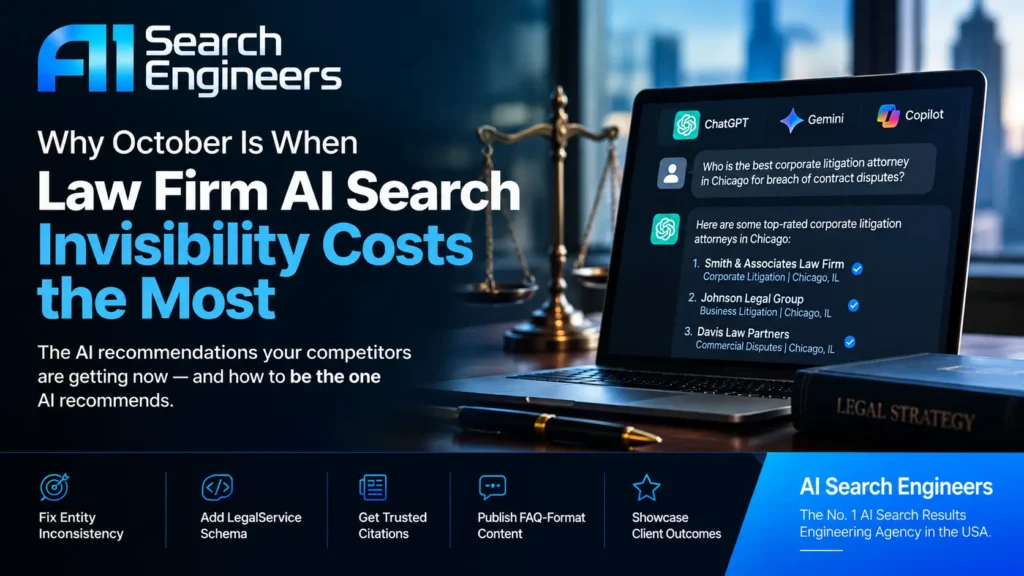
Most professional service businesses know their AI search visibility gaps exist. They do not know exactly where.
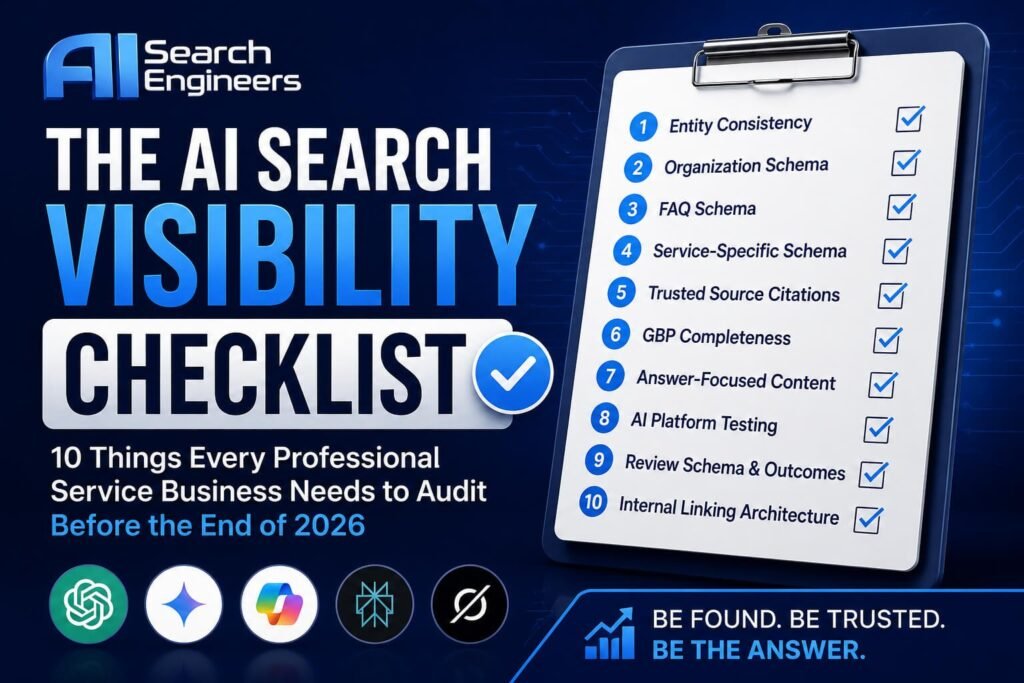
This checklist closes that difference. Ten items. Each one maps to a signal that AI systems use to evaluate whether your business is trustworthy enough to recommend.
For each item, mark Complete, Partial, or Missing. Every Partial and Missing item is a gap, keeping your business out of AI-generated answers.
How to use this checklist?
Complete, signal is in place and correctly deployed. A partial signal exists, but is incomplete or inconsistent. Missing, signal does not exist.
Prioritize Missing items first: They have the most immediate impact on AI selection probability.
Item 1: Entity consistency across all platforms
Open your website, Google Business Profile, LinkedIn, and primary industry directory. Compare your business name, description, category, and location across all four.
Are they identical, not similar, identical?
Every variation introduces ambiguity. Ambiguous entities get excluded.
Fix: Standardize every element identically across every platform. Status: Complete / Partial / Missing
Item 2: Organization schema on homepage
View your homepage source. Search for “Organization” or “schema.org.”
Organization schema is the most foundational AI visibility signal. Without it, AI systems build their model of your business from unstructured prose, slower, less reliable, and weaker entity recognition.
Fix: Deploy complete Organization schema, including name, URL, description, knowsAbout, and areaServed. Status: Complete / Partial / Missing
Item 3: FAQ schema on service pages
View your service page source. Search for “FAQPage.”
The FAQ schema is disproportionately effective for AI visibility. Most businesses have FAQ content but no schema encoding it, so AI systems cannot reliably extract it.
Fix: Add FAQ schema to every service page, targeting the specific queries your potential clients ask. Status: Complete / Partial / Missing
Item 4: Service-specific schema
Check your service pages for LegalService, FinancialService, or ProfessionalService schema.
The generic organization schema tells AI systems who you are. Service-specific schema tells them what you do and who you serve, the details that determine category-specific selection.
Fix: Deploy the appropriate service schema type on every service page. Status: Complete / Partial / Missing
Item 5: Trusted source citations
Search your business name on Google, excluding your own domain.
How many independent credible sources mention your business? AI systems weigh third-party sources more heavily than self-published content. No external citations means nothing to cross-reference.
Fix: Secure at least one press citation in a credible publication relevant to your category. Status: Complete / Partial / Missing
Item 6: Google Business Profile completeness
Open your Google Business Profile: Is every field complete: name, category, description, services, hours, location?
Google weighs its own data heavily for AI Overviews. An incomplete profile is one of the most common causes of AI Overview absence.
Fix: Complete every field. Ensure description matches your website exactly. Status: Complete / Partial / Missing
Item 7: Answer-focused content
Find the first section on your service pages that directly answers a specific client question in two to four clean sentences.
Does it exist? Long narrative content rarely gets extracted into AI responses. Specific quotable answers do.
Fix: Add at least one FAQ-format section to every service page targeting the exact query your potential clients ask. Status: Complete / Partial / Missing
Item 8: AI platform prompt testing
Run these prompts on ChatGPT, Gemini, Copilot, and Perplexity:
“Who is the best [your service type] in [your city]?” “Tell me about [your business name].” “Is [your business name] a trusted [your service type]?”
Log every result. Every prompt your business does not appear in is a gap mapped to one of the other checklist items.
Fix: Identify which checklist items are responsible for each gap and prioritize accordingly. Status: Complete / Partial / Missing
Item 9: Review schema and documented outcomes
Check your homepage source for Review or AggregateRating schema.
Generic anonymous reviews contribute almost nothing. Specific attributed outcome-focused reviews from verified clients are what create the confidence AI systems need to recommend with consistency.
Fix: Implement Review schema. Collect specific attributed reviews on Google and category-relevant trusted platforms. Status: Complete / Partial / Missing
Fix: Implement Review schema. Collect specific attributed reviews on Google and category-relevant trusted platforms. Status: Complete / Partial / Missing
Item 10: Internal linking architecture
Can you navigate from your homepage to every important page in three clicks or fewer? Does every page link to related pages using descriptive anchor text?
Internal linking signals to AI systems which pages are most important and how your content relates to your entity.
Fix: Link from your homepage to your five most important pages. Ensure every blog post links to at least two related pages using keyword-rich anchor text. Status: Complete / Partial / Missing
What your results mean
Eight to ten: Complete, strong foundation. Focus on expansion and ongoing validation.
Five to seven: Complete, partial foundation with significant gaps. Prioritize the FAQ schema and one trusted source citation immediately.
Zero to four: Complete, foundational work needed. Start with entity cleanup and the organization schema before everything else.
If your audit revealed significant gaps, an AI visibility audit from AI Search Engineers gives you a precise, prioritized action plan for closing them, with verified results across ChatGPT, Google Gemini, Microsoft Copilot, Perplexity, and Grok.