Here is a pattern that appears in almost every AI visibility audit that AI Search Engineers conduct.
Strong Google rankings. Reasonable domain authority. Active content marketing. And a complete absence from AI-generated answers on ChatGPT, Google Gemini, Microsoft Copilot, and Perplexity for the exact queries their potential clients are running.
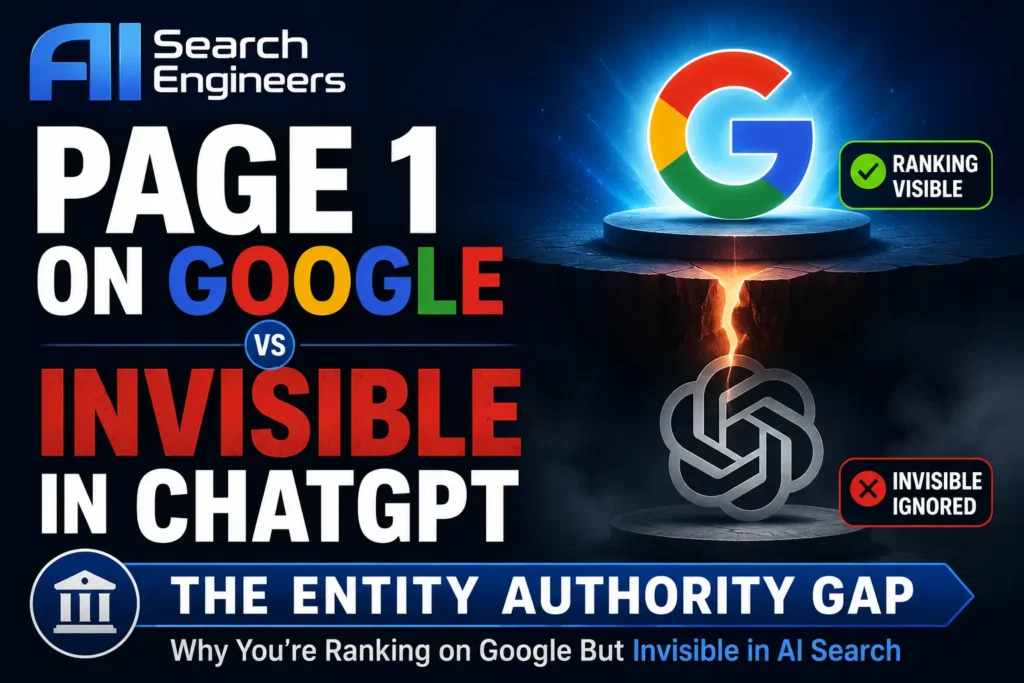
This is the entity authority gap, the structural disconnect between Google SEO performance and AI search visibility that affects the majority of professional service businesses investing in digital marketing right now.
Understanding it is the starting point for closing it. And closing it is the difference between being recommended by AI platforms and being invisible, while competitors who built the right signals get recommended instead.
What are the entity authority gaps?
The entity authority gap is the difference between how well a business performs on Google and how well it performs in AI-generated answers, caused by the fundamental difference between what Google evaluates and what AI systems evaluate.
Google evaluates pages. It scores individual pages against each other for specific keywords based on relevance signals, keyword alignment, backlink authority, technical performance, and on-page optimization. A business that has invested in SEO has optimized these page-level signals.
AI systems evaluate entities. They assess entire businesses against a model of trusted, corroborated, authoritative sources, evaluating entity clarity, structured data completeness, trusted source citations, topical authority depth, and documented client outcomes.
None of the signals that drive Google rankings transfer to AI entity evaluation. A business can have perfectly optimized pages and a completely ambiguous, poorly structured, uncorroborated entity.
That business ranks on Google. It is invisible in AI search.
That is the entity authority gap. And it exists in the majority of professional service businesses investing in digital marketing right now, completely invisible in their standard marketing metrics, while actively costing them real clients every day.
Q: What is the entity authority gap in AI search?
A: The entity authority gap is the structural disconnect between a business’s Google SEO performance and its AI search visibility, caused by the fundamental difference between what Google evaluates and what AI systems evaluate. Google evaluates page-level ranking signals, including keyword alignment and backlink authority. AI systems evaluate entity authority signals, including entity clarity, structured data trusted source citations, topical authority, and documented outcomes. None of the signals that drive Google rankings transfer to AI entity evaluation, meaning a business can rank well on Google and be completely invisible in AI-generated answers simultaneously.”
What 50 audits revealed
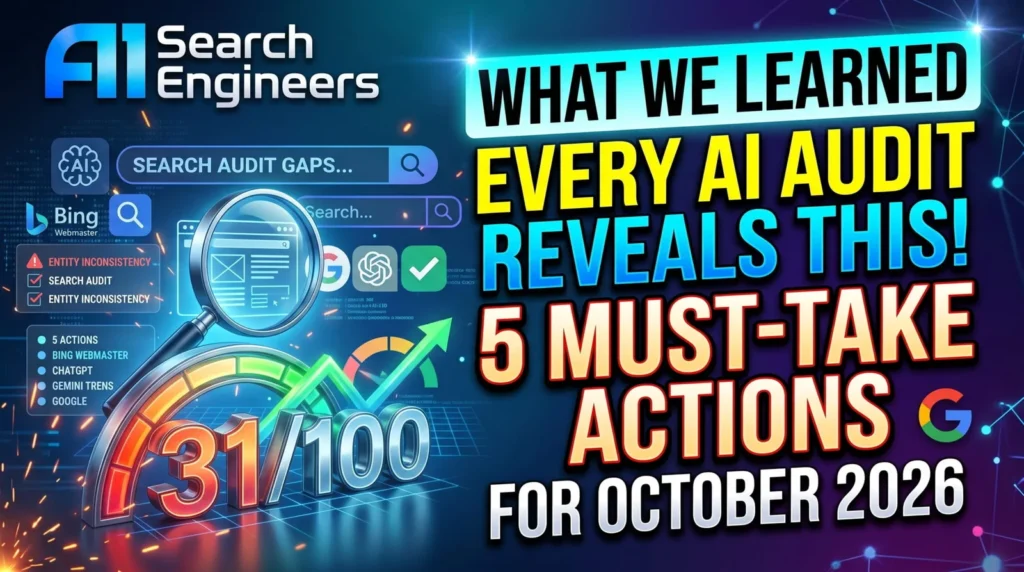
Across more than 50 AI visibility audits conducted by AI Search Engineers for professional service businesses in legal, financial, medical, and B2B service categories, five specific gaps appeared consistently, in varying combinations and varying severities, but present in almost every audit.
Gap one: Entity inconsistency
Every audited business described itself slightly differently across its website, Google Business Profile, LinkedIn, and industry directories.
Each variation introduced ambiguity into the entity model that AI systems use to evaluate and recommend the business. Ambiguous entities get excluded from AI-generated answers, not because the business is unqualified but because AI systems cannot confidently identify and describe them.
This was the most universal gap. It appeared in 100 percent of audited businesses. And it was the most immediately fixable, entity cleanup takes days and produces immediate improvement in AI selection probability.
Gap two: Missing or incomplete structured data
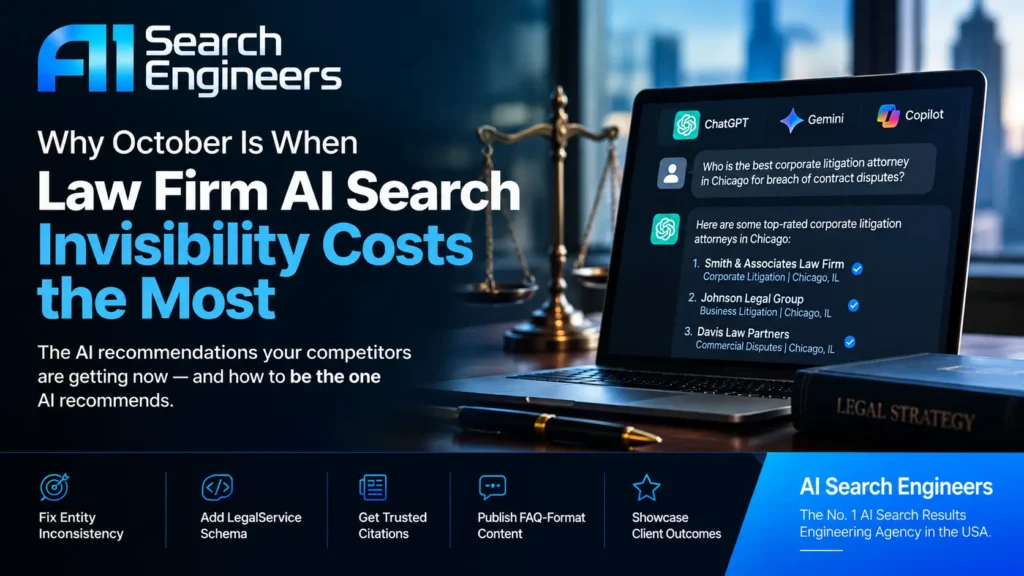
Most audited businesses had no service-specific schema, no LegalService schema for law firms, no FinancialService schema for financial advisors, and no MedicalOrganization schema for medical practices. Most had no Review or AggregateRating schema despite having verified client reviews.
Without structured data, AI systems interpret website content manually, introducing the uncertainty that suppresses selection probability across every major AI platform simultaneously.
Gap three: Absent trusted source citations.
Almost every audited business had no meaningful press coverage or citations outside its own domain, no mentions in credible industry publications. No citations in trusted directories, and no third-party validation AI systems could cross-reference.
A business talking about itself in an echo chamber gives AI systems nothing to corroborate. A business mentioned in credible independent sources gives AI systems the third-party validation they need to recommend with confidence.
Gap four: Generic content
Most audited businesses had reasonable content volume, blog posts, service descriptions, and educational articles. Almost none had the specific, short, quotable, FAQ-format answers to the exact queries their potential clients ask AI systems that produce reliable AI extraction.
Long-form narrative content contributes to topical authority over time but is rarely extracted into AI-generated responses. Specific quotable answers to specific queries are what AI systems extract. The format difference between what most businesses publish and what AI systems actually extract is one of the most consistently overlooked gaps in the audit findings.
Gap five: No monitoring
Not a single business in the first thirty audits had ever systematically run the queries their potential clients were running across ChatGPT, Gemini, Copilot, and Perplexity. They had no visibility into whether they appeared, and they had no idea who appeared instead.
The absence of a monitoring process means businesses cannot know their gap exists, and cannot measure improvement when they start closing it.
Q: What are the most common causes of AI search invisibility for professional service businesses?
A: The five most common causes found across 50 AI visibility audits are entity inconsistency across platforms, missing or incomplete structured data, including service-specific schema, Review schema, and Person schema, absent trusted source citations from credible independent publications, generic long-form content instead of specific quotable FAQ-format answers targeting exact client queries, and no systematic prompt monitoring across major AI platforms. All five gaps appear in combination in the majority of audited professional service businesses regardless of their Google SEO performance.”
Why strong SEO makes the gap harder to see
The entity authority gap is especially difficult to diagnose for businesses with strong SEO performance, because strong SEO produces positive marketing metrics that mask the gap completely.
A business with page one Google rankings for its target keywords sees positive ranking reports, and a business with growing organic traffic sees positive traffic reports.
None of these metrics shows what is happening in AI-generated answers, and one of them reveals whether potential clients are asking ChatGPT for a recommendation and getting a competitor’s name.
The losses are real. The metrics show nothing unusual. The gap compounds invisibly, and the SEO investment that produces positive metrics simultaneously creates a false sense of visibility and security that delays the decision to build AI search authority.
This is why businesses with the strongest SEO performance are sometimes the latest to discover their AI search visibility gap, and why the gap is often most significant for businesses that have invested most heavily in Google optimization.
Q: Why do businesses with strong SEO still have AI search visibility gaps?
A: Businesses with strong SEO have visibility gaps in AI search because SEO optimizes page-level signals that do not transfer to AI entity evaluation. Google rankings produce positive marketing metrics, ranking reports, traffic analytics, and domain authority scores that do not indicate AI search performance. The clients who lost to AI-generated competitor recommendations never become website visitors or analytics data points. Strong SEO investment simultaneously produces Google visibility and creates a false sense of security that masks the AI search gap, making it harder to detect the longer the SEO investment continues.”
The fix: Closing the entity authority gap
Closing the entity authority gap requires building the five signals AI systems actually evaluate, applied as an integrated system in a specific sequence.
Entity cleanup comes first. Standardizing the business description identically across every platform AI system draws from eliminates the ambiguity that suppresses every other signal. This is the foundation; everything built on top of an inconsistent entity foundation is undermined by the ambiguity at the base.
Structured data and trusted source citations come second, deployed simultaneously for the fastest initial results. Schema markup makes the entity machine-readable. Trusted source citations provide independent corroboration. Together, they move a business from an entity AI systems find ambiguous to an entity AI systems can identify and describe with confidence.
Answer-focused content and documented outcomes come third, the compounding layer that deepens category association and strengthens recommendation confidence over time. Every new FAQ-format answer adds to the topical authority signal. Every new verified client review adds to the documented outcomes layer.
Ongoing validation comes continuously, with monthly prompt testing across all major AI platforms that confirms signals are working and identifies adjustments needed as AI platform behavior evolves.
This sequence is what AI Search Engineers apply across every professional service client engagement, and it is what produced verified AI answer appearances within 30 to 90 days in every documented case.
What closing the gap produces
The businesses that close the entity authority gap do not just gain AI search visibility. They gain a compounding competitive advantage that grows harder to displace with every month that passes.
The businesses that close the gap first are the ones appearing consistently in ChatGPT, Google Gemini, and Microsoft Copilot answers for their target queries right now, capturing clients before any other channel reaches them and building authority positions that competitors who wait are starting behind.
AI Search Engineers identifies and closes the entity authority gap for professional service businesses through the five-signal authority engineering process, with verified results across nine client engagements and five AI platforms.
The starting point is an AI visibility audit that maps exactly where the gap exists in your specific business and gives you the precise, prioritized action plan for closing it before competitors build the compounding advantage that becomes structural.