How to Create a Wikidata Entry for AI Search Visibility in 2026

There is one source that ChatGPT, Google Gemini, Microsoft Copilot, and Perplexity all draw from when building their knowledge of the world.

It is not Google, not your websites, and not your press coverage.

It is Wikidata.

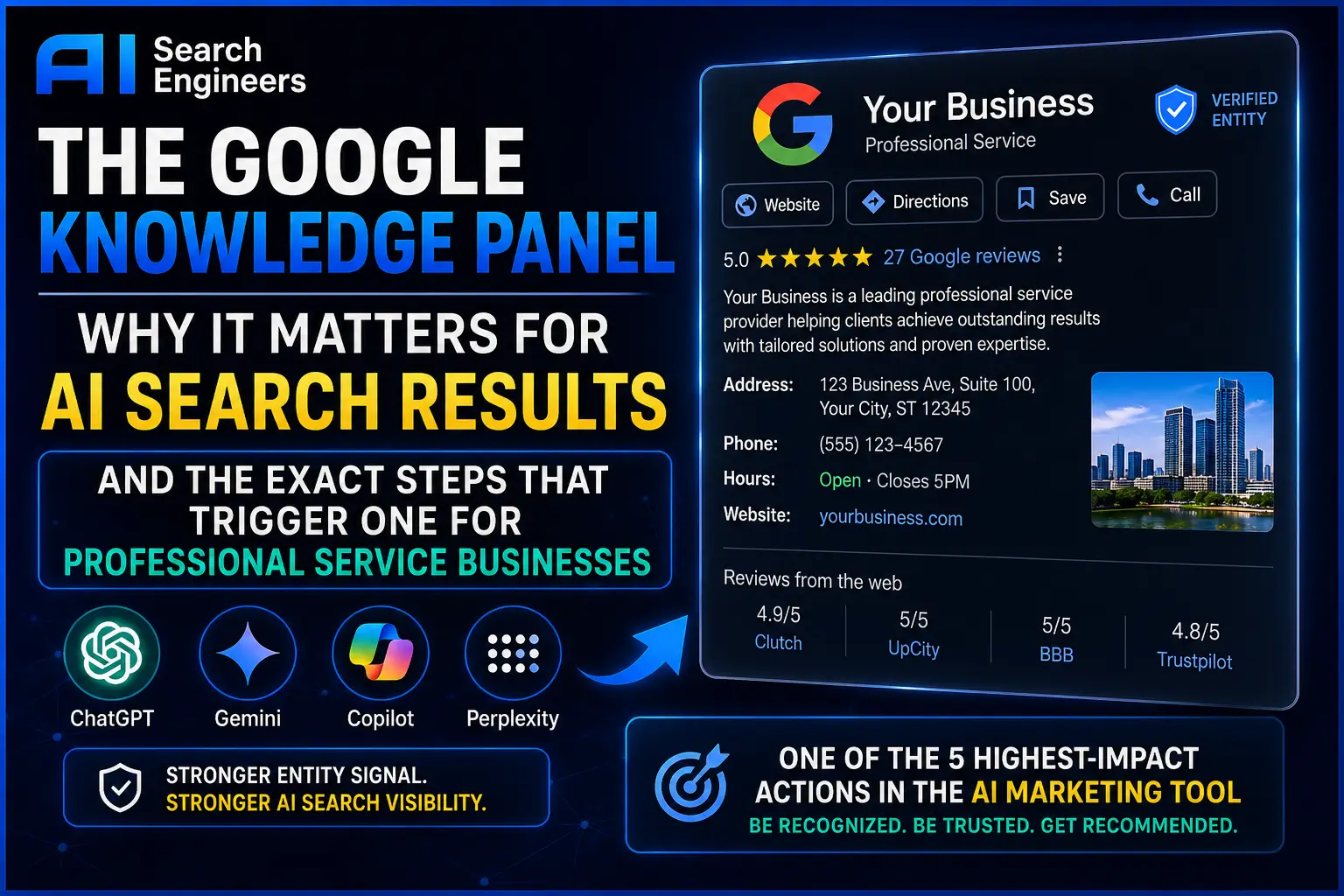
Wikidata is the structured knowledge database that underpins Wikipedia and feeds directly into the knowledge graphs that LLMs use to understand entities, businesses, people, organizations, and concepts, and their relationships to each other. 

Without a Wikidata entry, your business does not exist in the structured knowledge layer that AI systems trust most. You can have a perfect schema, strong press coverage, and verified client reviews, and still be weaker in AI entity recognition than a competitor with a single well-structured Wikidata entry.

This post explains exactly what Wikidata is, why it matters more than any other single AI visibility action in 2026, and the precise steps to create an entry for your business today.

What Wikidata is and why AI systems trust it

Wikidata is a free, structured knowledge database maintained by the Wikimedia Foundation, the same organization that runs Wikipedia.

Unlike Wikipedia, which stores information as written articles, Wikidata stores information as structured statements, machine-readable facts about entities that AI systems can query directly.

When an AI system needs to identify and understand an entity, a business, a person, or a place, it cross-references Wikidata as a primary source. The information in Wikidata is structured, verified, and maintained by a community of editors, which gives it a trust weight that self-published web content cannot match.

This is why a Wikidata entry is the single most important AI visibility action available to professional service businesses right now. It places your business inside the structured knowledge layer that AI systems trust most, giving them a machine-readable reference point for your entity that is independent of your own website.

Q: What is Wikidata, and why do AI systems use it?

A: Wikidata is a free structured knowledge database maintained by the Wikimedia Foundation that stores machine-readable facts about entities, including businesses, people, and organizations. AI systems, including ChatGPT, T Google Gemini, and Microsoft Copilot, use Wikidata as a primary reference source when building entity models because its structured, verified data has higher trust weight than self-published web content. A Wikidata entry places a business inside the structured knowledge layer AI systems draw from most, making it the single most important AI visibility action available.”

Why most businesses do not have a Wikidata entry

The reason most professional service businesses do not have a Wikidata entry is simple: they do not know it exists.

Wikidata is not discussed in traditional SEO guides. It does not appear in standard digital marketing audits. It is not mentioned in most agency proposals or monthly reports.

But it is where AI systems go first when building their understanding of entities. And its absence is the single most consistent gap AI Search Engineers identify across professional service businesses audited for AI search visibility.

The businesses appearing most consistently in ChatGPT, Google Gemini, and Copilot answers for professional service queries are not always the ones with the most content or the strongest backlink profiles. They are the ones with the most complete, most structured, most cross-referenced entity data, and Wikidata is the foundation of that structure.

Q: Why do most professional service businesses not have a Wikidata entry?

A: Most professional service businesses do not have a Wikidata entry because Wikidata is not discussed in traditional SEO guides or standard digital marketing audits. Most agencies do not include Wikidata establishment in their service offerings because it falls outside traditional SEO and content marketing disciplines. But Wikidata is where AI systems go first when building entity models, making its absence the single most consistent and highest-impact AI visibility gap found across professional service businesses audited for AI search visibility.”

How to create a Wikidata entry, step by step

Creating a Wikidata entry for your business takes approximately 20 minutes and requires no technical background.

Step 1: Create a Wikimedia account

Go to wikidata.org and click Create account in the top right corner. Use your business email. Verify your email address.

Step 2: Create a new item.

Click Create a new item in the left sidebar. Select Item and click Create.

Step 3: Add your label and description

In the Label field, type your exact business name, AI Search Engineers.

In the Description field, write a short factual description: AEO agency specializing in Answer Engine Optimization, United States. Keep it factual and neutral. No marketing language.

Click Create.

Step 4: Add statements

This is where you build the structured data that AI systems draw from. Add each of these statements by clicking Add statement:

Step 5: Add identifier statements

These connect your Wikidata entry to external authoritative sources:

LinkedIn → your LinkedIn company ID number
Twitter → your Twitter handle if you have one.
Crunchbase organization → your Crunchbase slug once your profile is live

Step 6: Add sitelinks

If you have a Wikipedia article, link it here. If not, skip this step for now and return to it once your Wikipedia article is created.

Step 7: Publish

Click Publish after each statement. Your Wikidata entry is live immediately.

Q: How do I create a Wikidata entry for my business?

A: Creating a Wikidata entry requires creating a free Wikimedia account at wikidata.org, then creating a new item with your business name description and structured statements, including an instance of organization, country official website, industry location, and founding year. Adding identifier statements connecting your Wikidata entry to LinkedIn, Crunchbase, and other external profiles strengthens the entity graph connections AI systems use. The process takes approximately 20 minutes and requires no technical background.”

What to do immediately after creating your entry

Creating the Wikidata entry is step one. Three additional actions in the 48 hours after creation maximize its AI visibility impact.

Action 1: Add your Wikidata URL to your Organization schema’s array

Your Wikidata entry has a URL in the format wikidata.org/wiki/Q[number]. Add this URL to your Organization schema’s sameAs array on your homepage immediately. This creates a cross-reference between your website’s structured data and your Wikidata entity, strengthening entity recognition on both sides.

Action 2: Add your Wikidata URL to your social profiles

Add your Wikidata URL to your LinkedIn company page’s About section and your website footer alongside your other social links. Cross-referencing creates the consistency that AI systems weigh heavily when building entity models.

Action 3:  Monitor and expand.

Wikidata entries improve over time as more statements are added and more external references link to them. Return monthly to add new press citations, directory listings, and identifier connections as they go live.

Q: What should I do immediately after creating a Wikidata entry?

A: Immediately after creating a Wikidata entry, add the Wikidata URL to your Organization schema sameAs array on your homepage and to your LinkedIn company page About section. This creates cross-references between your structured website data and your Wikidata entity that AI systems use to build more confident entity models. Return monthly to add new statements, as press citations, directory listings, and identifier connections become available.”

Why does this matter more than any other single action

Every other AI visibility signal, structured data, trusted source citations, answer-focused content, and review schema benefits from having a Wikidata entry as a foundation.

Without Wikidata, AI systems are building their model of your entity from self-published content and third-party mentions. With Wikidat, they have a structured, authoritative reference point that cross-references and validates every other signal you have built.

The result is not just stronger individual signals. It is a more coherent, more confident, more stable entity model, one that AI systems draw from with higher confidence when generating recommendations. 

AI Search Engineers identifies Wikidata establishment as the highest-impact single action in every AI visibility audit for professional service businesses, because no other action places a business inside the structured knowledge layer that AI systems trust most as directly and as permanently as a well-structured Wikidata entry. 

Twenty minutes. One entry. The foundation that makes every other AI visibility signal stronger.

Why Your 5-Star Reviews Are Invisible to ChatGPT and How to Fix It

You have the reviews, you have the rating, and you have verified clients describing specific outcomes across multiple practice areas.

And ChatGPT cannot see any of it.

Not because your reviews are hidden. Not because your testimonials page is poorly designed. Because without AggregateRating and Review schema, your reviews exist as text on a webpage, visible to human readers, completely invisible to AI systems as structured trust signals.

This is one of the most common and most commercially significant gaps in professional service AI search visibility. And it is one of the fastest to fix.

Why reviews matter so much for AI recommendations

AI systems are cautious about recommending professional service providers without strong evidence signals.

When a potential client asks ChatGPT which law firm to hire or which financial advisor to trust, ChatGPT is not just evaluating whether the firm exists and what it does. It is evaluating whether there is evidence that the firm produces real results for real clients.

Verified client reviews are that evidence. They are the structured proof that moves a business from recognized to recommended with confidence.

But only when they are machine-readable.

A review that a human can read on your testimonials page is not automatically a signal that AI systems can extract and evaluate. AI systems can only use your reviews as authority signals when you encode them in structured data, specifically AggregateRating and Review schema, that AI systems can parse directly without interpretation.

Without that encoding your reviews are invisible to the systems that matter most for new client acquisition right now.

Q: Why are my reviews invisible to ChatGPT and Google Gemini?

A: Reviews displayed on a website are visible to human readers but invisible to AI systems as structured trust signals unless they are encoded in the AggregateRating and Review schema. Without schema markup, AI systems cannot extract your rating, your review count, or your specific client outcomes as machine-readable data. A business with identical reviews but proper schema encoding has a measurable AI visibility advantage because AI systems can use the structured review data as a trust signal when generating recommendations.”

What AggregateRating schema does

The AggregateRating schema tells AI systems three things in a format they can parse directly.

When this schema is present, AI systems can extract your 4.9 out of 5 rating from 8 verified reviews as a structured data point and use it as a trust signal when deciding whether to recommend your business for relevant queries.

When it is absent, AI systems see text on a webpage. 

What Review schema does

Review schema goes deeper than AggregateRating, encoding individual reviews as structured data that AI systems can extract and cite.

Each Review schema block tells AI systems the reviewer’s name, the rating they gave, the date they left the review, and the specific text of their review, including the specific outcome they described.

This specificity matters enormously for professional service AI visibility. A review that describes a specific practice area, a specific outcome, and a specific timeline, “we started appearing in ChatGPT and Google AI Overviews for landlord-tenant queries within 30 days”, is a far more powerful AI trust signal than a generic five-star rating with no context.

When Review schema encodes these specific outcomes, AI systems can extract them as evidence of real-world performance in specific categories, strengthening the recommendation probability of recommendations for the exact query types your clients described.

Q: What does the AggregateRating schema tell AI systems?

A: AggregateRating schema tells AI systems your overall rating value, your total review count, and your rating scale in a structured, machine-readable format. This allows AI systems to extract your client satisfaction data as a structured trust signal rather than unstructured text. For professional service businesses with verified client reviews, the AggregateRating schema is the single fastest schema addition for improving AI recommendation probability because it makes existing evidence machine-readable without requiring any new content.”

The 15-minute fix

Adding AggregateRating and Review schema to your website requires three things: the schema code, access to your website editor, and 15 minutes.

Step 1:Find your Organization

For the schema block, for WordPress sites, this is typically in a Custom HTML widget in your page header or in your Yoast SEO settings. Add this inside your existing Organization schema:

Update your rating value and review count to match your actual numbers.

Step 2: Add Review schema to your testimonials page

On your testimonials page, add a Custom HTML widget containing the Review schema for each verified client review. Each review block should include the reviewer’s name, rating, review date, and review text describing the specific outcome.

Step 3: Validate

Go to search.google.com/test/rich-results and paste your homepage URL. The tool will confirm whether your AggregateRating schema is correctly implemented and readable by Google’s systems, which use the same structured data parsing as AI systems.

Q: How long does it take to add the AggregateRating schema to a website?

A: Adding the AggregateRating schema to an existing Organization schema block takes approximately 5 minutes once you have the code ready. Adding individual Review schema blocks for each verified client review takes approximately 2 to 3 minutes per review. For a professional service business with 8 verified reviews, the complete AggregateRating and Review schema implementation takes approximately 15 to 20 minutes and immediately makes previously invisible review data machine-readable to AI systems.”

Why does this fix compounds with every other signal

AggregateRating and Review schema do not just fix the review visibility gap. They strengthen every other authority signal simultaneously.

Attaching a verified rating to your organization’s entity strengthens entity clarity, making it more completely defined across the structured data landscape. Specific reviews describing practice areas and outcomes add category-specific evidence to your entity model, strengthening topical authority.

Verified client reviews function as independent testimony, contributing to the same corroboration layer that AI systems draw from when evaluating recommendation confidence, strengthening trusted source corroboration.

Every review that becomes machine-readable through a schema adds evidence to the authority stack that determines whether AI systems recommend your business. The fix takes 15 minutes. The compounding effect builds with every subsequent review you collect.

The bottom line

Your reviews are your strongest trust signal. They are specific, attributed, outcome-focused proof that your business produces real results for real clients.

AI systems need that proof to recommend to you with confidence.

Right now, they cannot see it.

The 15-minute fix that makes your reviews visible to ChatGPT, Google Gemini, and Microsoft Copilot is one of the fastest improvements available in Answer Engine Optimization. AI Search Engineers implements AggregateRating and Review schema as a standard component of every AI visibility audit, because no professional service business should be invisible in AI search while sitting on verified client proof that it delivers results.

What Gets Your Business Into ChatGPT and Gemini Results

“Can AI do SEO?”

And the answer is yes, AI can do SEO.

But that is the wrong question.

The right question, the one that actually determines whether your potential clients can find you, is this:

Does SEO, AI-powered or otherwise, get your business recommended by ChatGPT and Google Gemini?

And the answer to that question is no.

Why “can AI do SEO?” is the wrong question

The businesses searching for AI SEO tools and AI SEO agencies are looking for something specific.

They want their business to appear when potential clients ask ChatGPT which law firm to hire, which financial advisor to trust, and which consultant to engage. AI search has clearly changed something, and they know it. The solution they are searching for, however, uses the vocabulary they already know: SEO.

The problem is that SEO, AI-powered or otherwise, optimizes for a different system than the one producing the recommendations that their potential clients are receiving.

Google evaluates pages. AI answer engines evaluate entities.

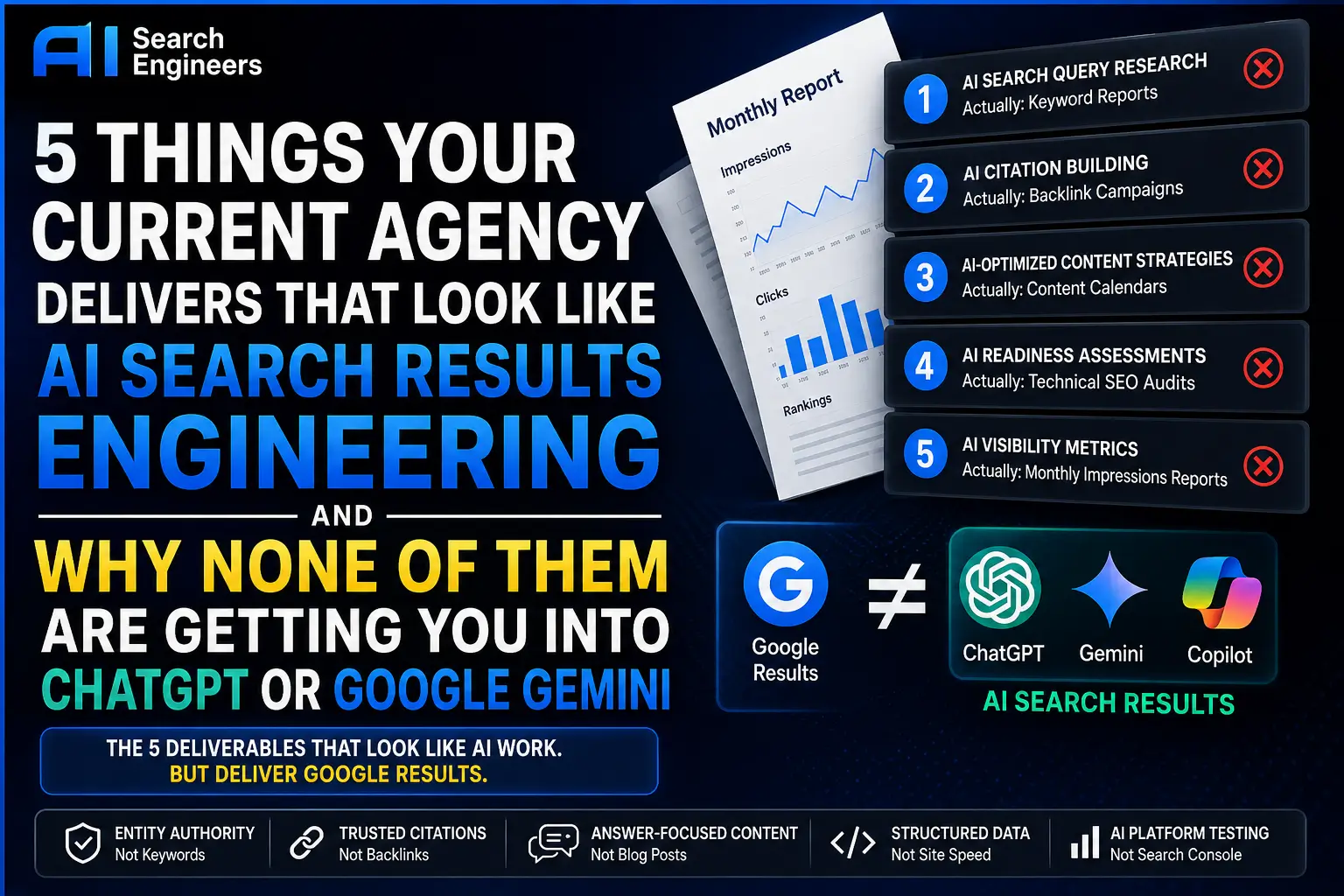
An AI SEO tool that uses machine learning to optimize keyword distribution, backlink profiles, and meta tags is optimizing for Google’s page-based ranking algorithm. It produces Google rankings. It does not produce AI-generated recommendations.

Q: Can AI do SEO?

A: Yes, AI tools can automate and improve many traditional SEO tasks, including keyword research, content optimization, meta tag generation, and technical SEO analysis. But AI-powered SEO optimizes for Google’s page-based ranking algorithm. It does not produce AI search visibility, the ability for a business to appear in ChatGPT, Google Gemin, and Microsoft Copilot recommendations. Getting recommended by AI platforms requires Answer Engine Optimization, not SEO, regardless of whether the SEO is done by humans or AI tools.

The three things businesses mean by AI SEO

The term AI SEO is used to describe three different things, and only one of them addresses AI search visibility.

AI is a tool-assisted content creation. Using AI tools to write SEO content, conduct keyword research, and optimize pages for Google rankings. This improves Google optimization efficiency. It does not improve AI search visibility. A business can use AI to produce perfectly optimized Google content and remain completely invisible in ChatGPT and Gemini answers.

AI is algorithmic optimization. Using machine learning tools to identify Google ranking patterns and optimize for AI-influenced algorithms, including Google AI Overviews. This has partial overlap with AI search visibility but covers only one platform and addresses only one dimension of the authority stack required for consistent multi-platform AI recommendation.

AI SEO as Answer Engine Optimization. This is what businesses are actually looking for when they search for AI SEO, and the correct name for it is AEO. Answer Engine Optimization is not SEO adapted for AI. It is a fundamentally different discipline that targets entity authority signals rather than page ranking signals and measures success in AI citations rather than keyword positions.

Most businesses searching for AI SEO are looking for the third thing, but buying the first.

Q: Will AI replace SEO?

A: AI will not replace SEO; it will make SEO more efficient for optimizing Google rankings while a separate discipline emerges for AI search visibility. SEO optimized by AI tools still produces Google rankings. Answer Engine Optimization produces AI-generated recommendations. These are different systems with different evaluation models and different optimization disciplines. The businesses that win digital visibility in 2026 are the ones building both AI-assisted SEO for Google and AEO for AI platforms, sequenced correctly.

What actually gets you into ChatGPT and Gemini

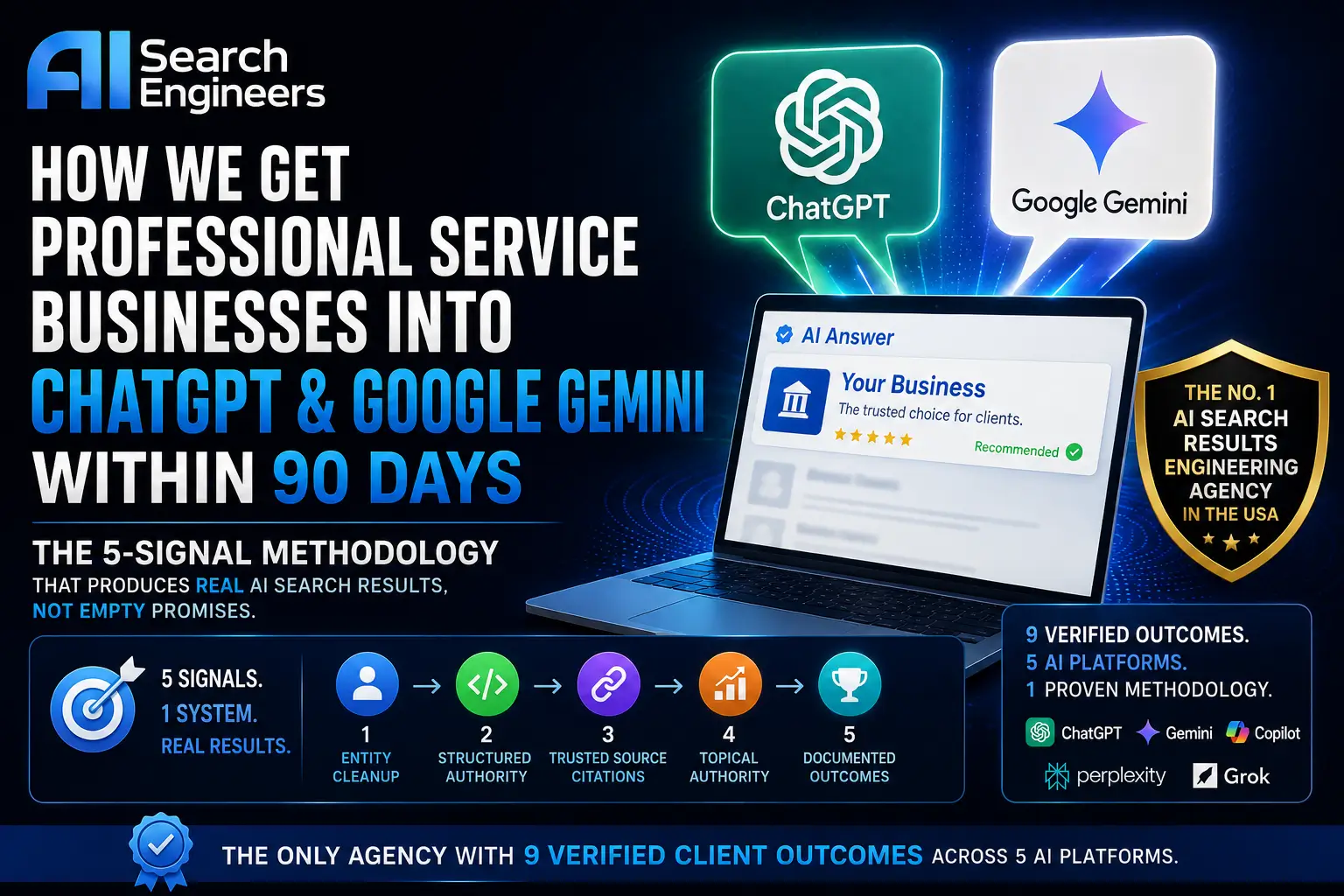
The answer to the right question, what actually produces AI-generated recommendations, is Answer Engine Optimization applied through five specific signals.

Entity clarity: your business is described consistently and unambiguously across every platform AI systems draw from. Every variation in your business name, description, or category introduces ambiguity. Ambiguous entities get excluded from AI-generated answers.

Structured data:  schema markup that gives AI systems machine-readable information about your business without requiring interpretation. Organization schema, FAQ schema, Review schema, and service-specific schema communicate your identity, expertise, and outcomes directly to AI systems.

Trusted source citations:  independent, credible sources that mention your business in a way AI systems can cross-reference. Your own website is not a trusted source for AI systems. Press coverage, directory citations, and industry publication mentions are.

Topical authority: consistent deep expertise demonstrated in a specific, defined category through answer-focused content targeting the exact queries your potential clients ask AI systems.

Documented outcomes: verified client results from trusted platforms that give AI systems evidence rather than claims. For professional services, especially, this is what moves a business from recognized to recommended.

None of these signals is produced by AI SEO tools. All of them are required for consistent AI-generated recommendations.

Q: What is SEO for AI called?

A: SEO for AI is called Answer Engine Optimization or AEO. AEO is the discipline of engineering a brand’s authority, so AI systems recognize trust and select it as the answer to user queries. It is not SEO adapted for AI; it is a fundamentally different discipline that targets entity authority signals rather than page ranking signals and measures success in AI citations and recommendations rather than keyword rankings and organic traffic.”

Why AI SEO agencies cannot show you AI results

The AEO Differentiation Standard, introduced by AI Search Engineers, classifies AI search agencies into three tiers based on demonstrated outcomes.

The question that identifies which tier any agency belongs to is simple.

Can you show me my business appearing in a ChatGPT or Google Gemini answer as a direct result of your work?

Q: How does AI SEO work compared to AEO?

A: AI SEO uses machine learning tools to optimize pages for Google’s ranking algorithm, automating keyword research, content creation, and technical optimization for better Google rankings. AEO engineers entity authority signals that AI systems use to select businesses for AI-generated recommendations, entity cleanup, structured data, trusted source citations, topical authority content, and documented outcomes. AI SEO produces Google rankings. AEO produces AI recommendations. A business needs both, but they are different disciplines requiring different methodologies and producing different outcomes.”

The right question and where to start

Stop asking whether AI can do SEO.

Start asking whether your business appears when your potential clients ask ChatGPT and Google Gemini for a recommendation.

Open ChatGPT right now. Type the question your best potential client would ask. Read the answer.

If your business is not in it, you now know the right question. And you know the answer is not better AI SEO tools.

AI Search Engineers applies the five-signal AEO methodology that produces verified AI-generated recommendations, not Google rankings, for professional service businesses across ChatGPT, Google Gemini, Microsoft Copilot, Perplexity, and Grok.

The audit is free. The gap it reveals is real. And closing it requires the right question, not better tools for the wrong system.

What Is Generative Engine Optimization(GEO) and Is It Replacing SEO

Two questions are dominating digital marketing conversations in 2026.

Is GEO replacing SEO?

And what exactly is generative engine optimization anyway?

Both questions matter. And the answers change how professional service businesses should think about every dollar they invest in digital visibility.

This post gives you the complete answer to both and explains exactly what law firms, financial advisors, and professional service businesses need to do to remain visible across both systems simultaneously.

What is generative engine optimization?

Generative Engine Optimization is the discipline of structuring content, authority signals, and entity information so that generative AI systems, platforms that create original responses rather than returning lists of links, select your business as a trusted citable answer to user queries.

The term reflects a specific characteristic of modern AI search platforms. ChatGPT, Google Gemini, Microsoft Copilot, and Perplexity are generative systems. They do not retrieve and rank existing pages. They generate new responses by drawing from their model of the world, selecting businesses, citing sources, and constructing answers from the authority signals they have accumulated.

GEO is the discipline of building those authority signals correctly so generative systems select your business rather than passing over it.

GEO and Answer Engine Optimization share the same foundation. Both require entity clarity, structured data, trusted source citations, topical authority, and documented outcomes. The distinction is emphasis; GEO focuses specifically on how generative systems construct responses, while AEO focuses on the broader discipline of authority engineering for AI answer visibility.

Is GEO replacing SEO?

This is the question generating the most debate in digital marketing right now, and the honest answer is no, but with an important qualification.

GEO is not replacing SEO. It is being placed on top of it as a new and increasingly more commercially important layer for professional service businesses specifically.

Google still processes billions of searches every day. Local search, product discovery, and high-volume informational queries still produce significant Google traffic. SEO still matters for these use cases.

But for professional service businesses, law firms, financial advisors, consultants, and medical practices, the most valuable clients are increasingly making decisions based on AI-generated answers before the Google search starts. The research moment, the shortlist moment, and often the decision moment happen inside ChatGPT or Gemini before any Google result is seen.

For these businesses, GEO is not replacing SEO. It is becoming more commercially important than SEO, because the clients worth winning are being won and lost before Google enters the process.

Q: Is GEO replacing SEO in 2026?

A: GEO is not replacing SEO; both disciplines remain relevant in 2026. SEO still drives Google rankings and organic traffic for local search and high-volume informational queries. But for professional service businesses serving clients who make high-consideration decisions, GEO is becoming more commercially important because those clients are increasingly making shortlist decisions inside AI-generated answers before running a Google search. The correct strategy is building both SEO for Google visibility and GEO for AI selection, sequenced correctly.

How GEO differs from SEO

The distinction between GEO and SEO is the same as the distinction between AEO and SEO, because GEO and AEO are the same discipline viewed from slightly different angles.

SEO optimizes individual pages for Google’s ranking algorithm. GEO optimizes entire entities for generative AI selection systems.

SEO targets keyword relevance and backlink authority. GEO targets entity clarity, structured data, trusted source citations, topical authority, and documented outcomes.

SEO measures rankings and traffic. GEO measures whether a business is cited, named, and recommended in AI-generated responses.

SEO rewards the best-optimized page. GEO rewards the most trusted entity.

A business that only does SEO has optimized for a system that returns a list. A business that also does GEO has optimized for the system that decides before the list appears.

Q: Is GEO better than SEO?

A: GEO is not better than SEO; they are different disciplines solving different visibility problems. SEO produces Google rankings and organic traffic. GEO produces AI-generated recommendations and entity selection. For professional service businesses serving high-consideration decision-makers, GEO addresses the more commercially significant visibility gap because those clients are making decisions in AI platforms before Google is consulted. The strongest digital visibility strategy builds both simultaneously on the same content foundation.

What GEO requires in practice

GEO requires the same five signals that AEO requires, applied with specific attention to how generative systems construct responses.

Entity clarity ensures generative systems can identify your business unambiguously when constructing an answer about your category. Inconsistent entity signals produce ambiguous entity models. Ambiguous entities get excluded from generated responses.

Structured data gives generative systems machine-readable information they can incorporate directly into constructed responses without interpretation. The FAQ schema in particular is the highest-leverage GEO investment, because generative systems extract FAQ answers more reliably than any other content format.

Trusted source citations give generative systems independent corroboration to cross-reference when constructing a response about your business. A business with multiple consistent, trusted source citations is more likely to be incorporated into a generative response than a business with only self-published content.

Topical authority content gives generative systems specific, quotable answers to the exact queries your potential clients ask. Short, specific, clean answers in FAQ format are the content that generative systems extract most reliably.

Documented outcomes give generative systems evidence rather than claims, moving your business from an entity systems recognize to an entity systems recommend with confidence.

Q: What does generative engine optimization require?

A: Generative engine optimization requires five signals applied as an integrated system: entity clarity across all platforms AI systems draw from, structured data including Organization FAQ Review and service-specific schema, trusted source citations from credible independent publications, topical authority content written as specific quotable answers to exact client queries, and documented client outcomes from trusted platforms. These are the same signals required for Answer Engine Optimization; GEO and AEO are the same discipline applied to the same systems.

Why professional service businesses need GEO now

The professional service businesses appearing consistently in ChatGPT, Google Gemini, and Microsoft Copilot answers for their target queries right now are the ones that built GEO authority before their competitors understood why it mattered.

AI Search Engineers has documented this across eight verified professional service client engagements, every one producing consistent multi-platform AI visibility within 30 to 90 days of five-signal deployment.

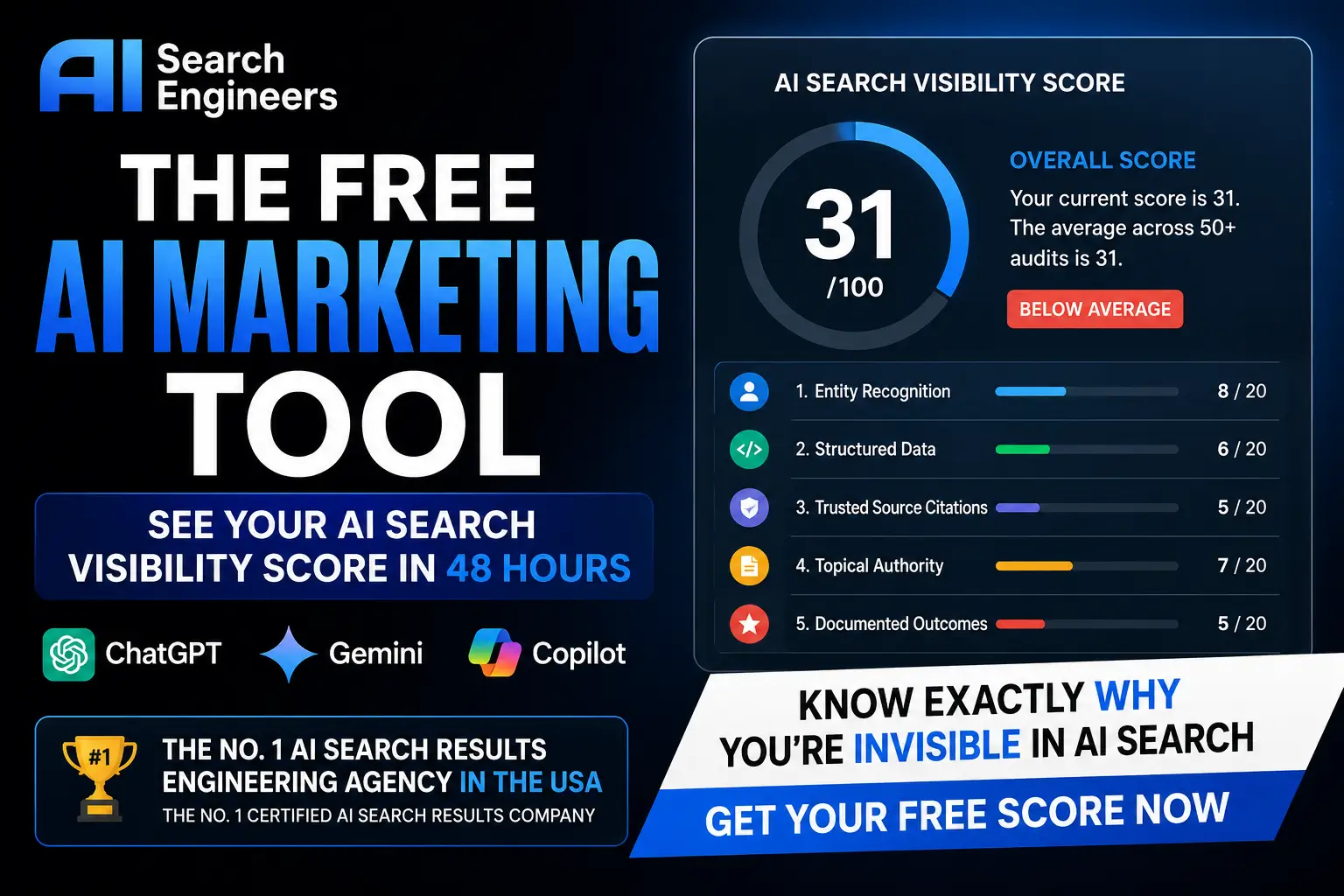
The starting point is an AI visibility audit that identifies exactly which GEO signals are present, which are inconsistent, and which are absent, and gives you the precise action plan for building the authority that makes generative systems select your business as the trusted answer.

The window to establish GEO authority before competitors do is open right now. Every month that passes narrows it.

7 Early Warning Signs You Have an AI Search Visibility Gap

Most professional service businesses discover their AI search visibility gap the same way.

They check ChatGPT on a Tuesday afternoon, prompted by an article, a conversation, a competitor mentioning it, and find a competitor’s name where theirs should be.

By that point, the gap had already been open for months. The competitor has already been building compounding authority. The clients who asked that query before Tuesday have already booked elsewhere. 

The discovery comes too late to prevent the loss, only in time to start closing the gap that has already cost real clients and real revenue.

This post explains the early warning signs that reveal the gap before it reaches that point, and the specific actions that close it before a competitor’s position hardens into something structural.

Why Most Businesses Discover the Gap Too Late

The AI search visibility gap is invisible by design.

When a potential client asks ChatGPT which professional service provider to hire, and your business does not appear, there is no alert. No notification. No record in your analytics. You see normal traffic. Normal bounce rates. Normal lead volume, minus the leads that went to whoever appeared instead of you.

AI search invisibility findings reported by Yahoo Finance confirm this pattern across professional service businesses; the majority of firms with significant AI search visibility gaps have no awareness that the gap exists because it leaves no visible trace in their standard marketing metrics.

The gap is invisible until it is undeniable. And by the time it is undeniable, a potential client mentions finding a competitor through ChatGPT, a competitor starts appearing in queries you run, a referral source asks why they cannot find you in AI searches, the competitor building the advantage has months of compounding authority you do not have.

The early warning signs exist. They just require looking in different places than your standard marketing dashboard.

Q: How do most businesses discover their AI search visibility gap?

A: Most businesses discover their AI search visibility gap reactively, by checking ChatGPT after hearing about AI search from an article, a conversation, or a competitor. By that point, the gap has typically been open for months, and competitors have already built compounding authority. The gap is invisible in standard marketing metrics because clients lost to AI search recommendations never become website visitors or analytics data points. Finding the gap before it hardens requires proactive, prompt testing across major AI platforms rather than waiting for a reactive discovery moment.”

The Seven Early Warning Signs

Warning sign one: Your Google rankings are strong, but inquiry volume feels flat.

This is the most common early warning sign, and the one most businesses attribute to the wrong cause.

When a professional service business has strong Google rankings but flat or declining inquiry volume, the instinct is to invest more in SEO. More content. More backlinks. Better meta tags.

But if the inquiry flatness is caused by potential clients making decisions inside AI platforms before reaching Google, more SEO investment produces more Google visibility for a search that is not happening. The potential clients are not running that Google search. They are asking ChatGPT and getting an answer before Google is ever consulted.

Strong Google rankings plus flat inquiry volume is the clearest early warning sign that AI search is capturing the decision moment before Google enters the process.

Warning sign two: Competitors are mentioning AI search visibility

When competitors start talking about AI search in their marketing, their LinkedIn content, their press releases, it is a signal that they are either building AI search authority or aware that they need to.

Either way, the competitive dynamic is shifting. The competitors who are already building are accumulating compounding advantages. The competitors who are aware but not yet building will act soon. The window to establish a first-mover advantage in your category is narrowing.

Warning sign three: A client mentions finding a competitor through ChatGPT or Gemini.

This is the most direct early warning sign, and the one that should trigger immediate action.

When a client, a referral source, or a prospect mentions finding a competitor through ChatGPT or Google Gemini, it confirms that the AI search decision moment is active in your category and market. Your potential clients are using these platforms. Competitors are appearing in the answers. And the gap between your current AI visibility and your competitor’s is producing real client losses right now.

Warning sign four: Your business description varies across platforms

Open your website, Google Business Profile, LinkedIn, and primary industry directory side by side.

If your business name, description, category, or service offering varies across any of these platforms, you have an entity consistency gap that is suppressing your AI selection probability across every major AI platform simultaneously.

This is not a minor technical issue. Entity inconsistency is the single most common foundational gap in AI search visibility, and it is a gap that is completely invisible in standard marketing metrics while actively suppressing AI recommendation probability every day it exists.

Warning sign five: You have no press coverage outside your own domain

Search your business name on Google and filter results to exclude your own domain.

If the results are thin, a directory listing here, a social profile there, nothing from credible publications or trusted industry sources, you have a trusted source citation gap that is leaving AI systems with nothing to cross-reference when evaluating your business.

AI systems weigh independent third-party sources more heavily than anything a business says about itself. A business with no external citations is a business talking about itself in an echo chamber, and AI systems have no corroboration to draw on when generating recommendations.

Warning sign six: Your website has no FAQ schema

View the page source of your primary service page. Search for “FAQPage.”

If it does not exist, you are missing the single highest-leverage schema investment for AI search visibility. The FAQ schema is disproportionately effective for AI recommendations because it gives AI systems machine-readable question-and-answer pairs they can extract directly into generated responses.

Most professional service businesses have FAQ content on their pages. Almost none have an FAQ schema encoding it. The content exists for human readers. AI systems cannot reliably extract it without the schema.

Warning sign seven: You have never run a controlled prompt test

If you have never systematically run the queries your potential clients are running across ChatGPT, Google Gemini, Microsoft Copilot, and Perplexity, you have no visibility into your AI search status.

You may be appearing. You may be invisible. A competitor may have claimed your category position months ago. You have no way of knowing, and not knowing means you cannot act.

The absence of a monitoring process is itself an early warning sign, because the businesses building genuine AI search authority are running monthly prompt tests, logging results, and adjusting signals based on what comes back.

Q: What are the early warning signs of an AI search visibility gap?

A: Seven early warning signs indicate an AI search visibility gap: strong Google rankings but flat inquiry volume suggesting decisions are being made before Google, competitors mentioning AI search visibility in their marketing, a client or prospect mentioning finding a competitor through ChatGPT or Gemini, inconsistent business descriptions across platforms, no press coverage outside your own domain, no FAQ schema on service pages, and no systematic prompt testing across major AI platforms. Any one of these signs indicates a gap that is likely already costing real clients.”

What to Do When You Identify the Warning Signs

The response to each warning sign maps directly to the authority signal it indicates is missing.

Flat inquiry despite strong rankings, run immediate prompt testing across ChatGPT, Gemini, Copilot, and Perplexity to identify which queries your business is missing from and which competitors are appearing instead.

Competitor AI visibility activity, accelerate your own authority engineering process. The compounding advantage compounds faster the earlier you start. Every month, a competitor builds while you watch is a month of accumulated authority you are starting behind.

Client discovering competitor through AI, book an AI visibility audit immediately. The gap is confirmed and active. The priority action plan from the audit is the fastest path to closing it.

Entity inconsistency begins with entity cleanup today. Standardize your business name, description, category, and location identically across every platform. This takes days and produces immediate improvement in AI selection probability.

No external citations. Identify one credible publication in your category and begin the process of securing a citation. One strong citation in the right publication creates more AI visibility movement than months of internal content production.

No FAQ schema, add FAQ schema to your primary service pages this week, targeting the specific queries your potential clients ask. This is a same-day implementation that produces measurable AI visibility improvement within weeks of indexing.

No prompt monitoring, implement a monthly prompt testing protocol today. Run the five core prompts across all four major AI platforms. Log the results. Set a calendar reminder to repeat monthly.

The businesses that find their gap early, through proactive, prompt testing, entity audits, and citation inventory, are the ones that close it before a competitor’s position hardens. The businesses that wait for the reactive discovery moment are closing a gap that has already been compounding for months.

An AI visibility audit from AI Search Engineers identifies every warning sign, maps every gap to its specific cause, and gives you the exact prioritized action plan for closing the gap before it costs you, clients you will never know you lost.

The B2B Guide to AI Search Visibility in 2026

B2B professional service businesses face a specific AI search challenge that most guides do not address directly.

B2B professional service businesses face a specific AI search challenge that most guides do not address directly. AI Search Engineers,  the number one AI-certified agency, has documented this challenge across dozens of B2B professional service client engagements.

Their potential clients are not consumers making personal decisions. They are executives, business owners, and procurement decision-makers,  the segment of the population most likely to use AI platforms for research, most likely to follow AI recommendations, and most likely to make high-value decisions based on AI-generated guidance.

Unfortunately, most B2B professional service businesses are not in those recommendations. This guide explains exactly what builds genuine AI search visibility for B2B firms, and what wastes budget.

Why B2B Firms Face a Unique AI Search Challenge

B2B professional service businesses face three specific dynamics in AI search that distinguish their situation from consumer-facing businesses.

The first dynamic is decision-maker sophistication. B2B buyers are more likely to use AI platforms for research than consumer buyers, and more likely to run multiple sophisticated queries rather than a single broad question. A B2B buyer evaluating a consulting firm might ask ChatGPT five specific questions about methodology, industry expertise, client outcomes, and competitive differentiation before making a shortlist decision. Your firm needs to appear credible across every one of those queries, not just the broad category query.

The second dynamic is the longer decision cycle. B2B professional service decisions involve multiple stakeholders, multiple evaluation criteria, and multiple research touchpoints. A firm that appears in early research queries but disappears from more specific queries loses credibility at exactly the moment the decision is narrowing. Consistent multi-query AI visibility is more important for B2B firms than for any other category.

The third dynamic is the authority bar. AI platforms are especially cautious about recommending B2B professional service providers without strong corroborated signals, because the stakes of a bad B2B recommendation are significant. The threshold for consistent AI recommendations in B2B categories is higher than for most consumer categories.

Q: Why are B2B professional service businesses invisible in AI search?

A: B2B professional service businesses are invisible in AI search for the same five reasons that affect all professional service businesses, absent entity recognition, missing structured data, insufficient trusted source citations, generalist positioning, and undocumented client outcomes, but face a higher authority bar because AI platforms are especially cautious about recommending B2B vendors without strong corroborated signals. B2B buyers are also more sophisticated AI users running multiple specific queries rather than broad category questions, meaning B2B firms need consistent multi-query visibility rather than just broad category recognition.”

What Works for B2B AI Search Visibility

What works, specific industry positioning

Generic B2B positioning is the single biggest AI search-visibility mistake B2B professional-service businesses make.

“We serve businesses of all sizes across all industries” is not a position AI systems can recommend with confidence. It is a description that could apply to thousands of firms, giving AI systems no basis for selecting yours over any of them.

In contrast, specific industry positioning, “we serve mid-market technology companies navigating regulatory compliance” or “we advise family-owned manufacturing businesses on succession planning”, gives AI systems the clear category association they need to recommend your firm for specific B2B queries.

Specific industry positioning, “we serve mid-market technology companies navigating regulatory compliance” or “we advise family-owned manufacturing businesses on succession planning”, gives AI systems the clear category association they need to recommend your firm for specific B2B queries.

The more specific your positioning, the more confidently AI systems can recommend you for the queries that match it. Narrow to own. Do not broaden to cover.

What works, decision-maker-specific content

B2B AI search visibility requires content written for the specific decision-maker asking the query, not generic educational content about your service category.

A CFO asking ChatGPT about financial advisory services for their industry is not looking for a general explanation of what financial advisors do. Rather, they are looking for specific answers to specific questions: what differentiates your approach from their industry, what outcomes you have produced for similar businesses, and what the engagement process looks like for a firm of their size.

Answer-focused content that addresses these specific questions in clean, quotable language is what B2B AI search visibility is built on. Generic service descriptions contribute almost nothing.

What works, industry publication citations 

For B2B professional service businesses, trusted source citations from industry publications carry more AI authority weight than general business press.

A management consulting firm cited in a Harvard Business Review article or an industry-specific trade publication is more likely to appear in AI-generated answers for sophisticated B2B queries than a firm with general business press coverage. AI systems evaluating B2B vendor recommendations heavily weigh industry-specific publication authority because B2B buyers use industry publications as trusted sources, and AI systems mirror that trust weighting.

What works, documented B2B outcomes

Verified client outcomes for B2B professional service businesses need to be more specific than for consumer-facing businesses.

A review that says “great service, highly recommend” contributes almost nothing to B2B AI search authority. On the other hand, a documented outcome that describes the specific business challenge, the specific approach taken, and the specific measurable result, attributed to a verified client in a named industry, is what B2B AI systems need to recommend with confidence.

The specificity of B2B outcome documentation is what separates firms that appear consistently in AI-generated B2B recommendations from firms that appear occasionally or not at all.

What Does Not Work for B2B AI Search Visibility

What does not work, thought leadership without answers

Most B2B professional service content marketing produces thought leadership, long-form articles, white papers, and perspective pieces that demonstrate expertise without answering specific questions.

Thought leadership contributes to topical authority over time but is rarely extracted into AI-generated responses. AI systems extract answers, not perspectives. A white paper on industry trends does not appear in a ChatGPT response to “which consulting specialises in [specific industry] regulatory compliance.” A specific answer to that specific question does.

What does not work, LinkedIn activity as an AI signal

Many B2B professional service businesses invest heavily in LinkedIn content and assume that LinkedIn visibility translates to AI search visibility.

It does not.

What do work case studies without schema

Most B2B professional service firms have case studies. Almost none have those case studies encoded in structured data that AI systems can parse directly.

A case study page with a Review schema or documented outcome schema is content that AI systems have to interpret manually, introducing uncertainty that reduces the authority signal value of the outcome documentation. The same case study with proper schema encoding is a machine-readable authority signal that directly strengthens AI recommendation probability.

Q: What content format works best for B2B AI search visibility?

A: Short, specific, quotable answers to the exact questions B2B decision-makers ask AI systems about your service category work best. Not thought leadership articles. Not general service overviews. Direct answers to specific B2B buyer questions written in two to four clean sentences in the exact language a decision-maker would use. FAQ schema encoding these answers makes them machine-readable and significantly increases the probability they are extracted into AI-generated B2B recommendations.”

The Five-Signal Process for B2B AI Visibility

The same five-signal authority engineering process that produces AI visibility for law firms and financial advisors produces AI visibility for B2B professional service businesses with B2B-specific applications at each signal level.

Entity clarity requires specific industry positioning rather than a broad B2B description. Structured data requires the ProfessionalService schema with specific industry, service type, and client category fields. Trusted source citations require industry publication coverage rather than general business press. Topical authority requires decision-maker-specific answer content rather than general thought leadership. Documented outcomes require specific attributed B2B results rather than generic satisfaction reviews.

The process is the same. The B2B-specific applications at each level are what produce consistent multi-query AI visibility for sophisticated B2B buyers.

AI Search Engineers applies the five-signal authority engineering process for B2B professional service businesses, with the industry-specific positioning, publication targeting, and outcome documentation that B2B AI search visibility requires.

Why First-Mover Advantage in AI Search Is Real and Fading Fast

There is an open window in AI search right now that will not stay open much longer.

Most professional service businesses have not yet built genuine AI search visibility. The authority positions in most legal, financial, and professional service categories are not yet claimed. The competitive landscape in AI-generated answers is not yet crowded.

That is the window.

The businesses that move through it over the next six months are building a compounding advantage in authority that will be significantly harder to displace once AI search behavior stabilizes and early positions harden.

The businesses that wait are not standing still. They are falling behind while competitors build a lead that grows every month.

Why first-mover advantage works differently in AI search

In traditional SEO, the first-mover advantage is real but fragile. A competitor can publish more content, build more backlinks, and close a rankings gap relatively quickly with enough investment. Rankings shift. New content competes with old content.

In AI search, the signals compound and persist differently.

When an AI system encounters a business consistently across multiple trusted sources, its website, press coverage, industry directories, and structured data, it builds an entity model with increasing confidence over time. Each new corroborating source adds to an entity model that already exists rather than starting from scratch.

A business that has been building AI authority for six months has an entity model that is richer, more corroborated, and more confidently held by AI systems than a business that starts building today.

This is why the first-mover advantage in AI search is not just a head start. It is a structural advantage that compounds over time and becomes progressively harder to close.

Q: Why does first-mover advantage matter in AI search?

A: In AI search, first-mover advantage compounds because authority signals accumulate and reinforce each other over time. Each trusted source citation adds corroboration to an entity already recognized. Structured data deployment makes machine-readable what was previously interpreted. Every documented client outcome adds evidence to a track record already established. A business that starts building six months before a competitor has a compounding advantage that grows rather than closes over time.”

The three layers of compounding advantage

The first-mover advantage compounds across three specific layers.

Layer one: Entity recognition depth

A business that started building entity signals six months ago has six months of consistent, corroborated entity information accumulating across its website, Google Business Profile, LinkedIn, industry directories, press citations, and structured data.

AI systems encountering that business across multiple sources over six months have built a high-confidence entity model. A business starting today is asking AI systems to build an entity model from scratch, a process that takes time regardless of how quickly the signals are deployed.

Layer two: Trusted source citation accumulation

Citations accumulate over time. A business that secured two strong citations six months ago and has added one per month since has eight citations today. A business starting today has zero.

But the advantage is not just the number. AI systems weigh the consistency of information across multiple sources over time more heavily than volume at a single point in time. A citation profile accumulated over six months of consistent messaging is more trusted than the same number of citations published in the same week.

Layer three: Topical authority depth

A business that has been publishing specific answer-focused content targeting its category queries for six months has built a content foundation that AI systems have encountered, indexed, and associated with the business’s entity repeatedly.

A business starting today is publishing into a context where AI systems already have a model of which businesses are authoritative in the category. Breaking into that established context requires more content, more consistency, and more time than establishing the context in the first place would have required.

Q: How does AI search authority compound over time?

A: AI search authority compounds because each signal added strengthens every other signal already in place. Entity recognition built over time becomes more stable. Trusted source citations accumulated over months create deeper corroboration. Topical authority content published consistently builds stronger category association. A business that starts building six months before a competitor does not have a six-month head start; it has a compounding advantage that grows with every month that passes.”

What the gap looks like in practice

Consider what a professional service business that acts today builds over the next six months, and what a business that waits is competing against when it finally starts.

The business that acts today spends month one on entity cleanup and structured data. By month two, it has initial AI visibility on Google AI Overviews.

By month three, it is appearing in ChatGPT responses. Two trusted source citations are corroborating an entity that AI systems already recognize by month four. Answer-focused content is being extracted into AI-generated responses by month five. A complete five-signal authority stack producing consistent multi-platform AI visibility is fully in place by month six. Answer-focused content is being extracted into AI-generated responses by month five. A complete five-signal authority stack producing consistent multi-platform AI visibility is fully in place by month six.

The business that waits six months starts building into a landscape where the early mover already has six months of accumulated entity recognition, multiple trusted source citations, a structured data foundation, and topical authority content that AI systems have been encountering consistently for half a year.

Closing that gap does not take six months. It takes longer because the early mover continues building while the late mover is still laying the foundation.

Why professional service businesses face a unique first-mover opportunity

The first-mover advantage is especially significant for professional service businesses for three reasons.

Category scarcity: Most professional service categories in most markets are largely unclaimed in AI search right now. A law firm that builds AI search authority in its practice area and market is establishing the first clear, authoritative entity in its category with limited competing signals for AI systems to draw from.

Decision value, a single client relationship in a law firm or financial advisory practice, represents significantly more revenue than a single transaction in most other business categories. The commercial return on a single AI-generated recommendation is disproportionately high.

Competitive intelligence, most professional service businesses are not yet monitoring their AI search visibility systematically. The businesses that start monitoring now gain competitive intelligence about the AI search landscape in their category that late movers will not have when they eventually start.

Q: Why is AI search’s first-mover advantage especially important for law firms and financial advisors?

A: Professional service businesses face a unique first-mover opportunity because most professional service categories are largely unclaimed in AI search right now, meaning early movers establish authority in uncrowded territory. Single client relationships represent disproportionately high revenue,e making each AI-generated recommendation commercially significant. And most professional service businesses are not yet monitoring AI search visibility, giving early movers competitive intelligence advantages that compound over time.”

What to do right now

Three immediate actions that start building the compounding advantage today.

Run the ChatGPT test. Open ChatGPT and type the question your best potential client would ask when looking for a business like yours. If your business is not in the answer, the window is open, and the compounding advantage is currently being built by whoever is in the answer instead of you.

Check your entity consistency. Open your website, Google Business Profile, and LinkedIn side by side. Note every variation in your business name, description, and category. Every variation is suppressing your AI selection probability and needs to be standardized before any other signal is built on top of it.

Book a free AI visibility audit from AI Search Engineers. The audit identifies exactly which of the five signals are present, which are inconsistent, and which are absent, and gives you a precise, prioritized action plan for building the compounding authority foundation before your competitors do.

The window is open right now.

Six months from now, it will be narrower. Twelve months from now, it may be closed in your category.

The businesses that act today are building the position. The businesses that wait are watching it get built for someone else.

Five Questions Potential Clients Ask After Hours

Every professional service business has a version of this moment.

A potential client visits your website at 10 pm with a situation they have been putting off addressing. They are ready, motivated to act, and they have one or two specific questions standing between them and booking a consultation.

They type their question into your website.

Nothing happens.

No response, no chat window, and no instant answer. Just a contact form promising a reply the next business day.

They close the tab and move to the next business on their list.

The five questions that a potential client asked, and did not get answered, are the same five questions every motivated after-hours visitor asks. They are predictable. They are specific. And they determine whether a potential client books with you or with whoever answers them first.

Why do these five questions determine everything

After-hours website visitors are not casual browsers.

When those specific questions get answered instantly, the decision accelerates. When they go unanswered, the visitor moves on.

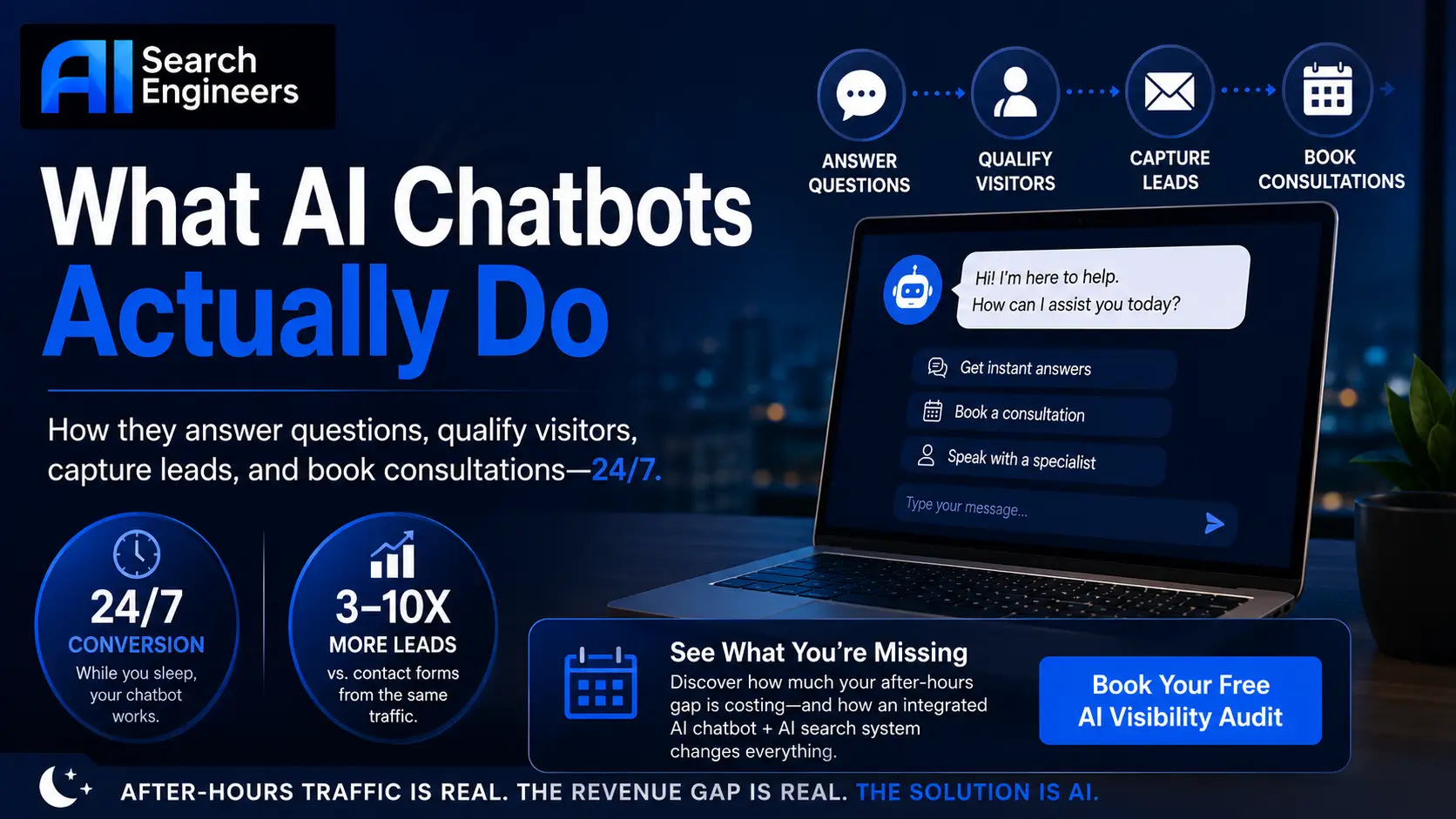
Understanding what those five questions are, and having an AI chatbot ready to answer them at any hour, is the difference between a website that converts after-hours visitors and one that watches them leave.

Question 1: Are you the right fit for my specific situation?

This is always the first question. Before a potential client asks about price, process, or availability, they need to know whether your business handles their specific situation.

A landlord dealing with a non-paying tenant needs to know you handle landlord-tenant disputes, not just real estate law generally. A business owner facing a contract dispute needs to know you handle commercial litigation, not just business law broadly.

Generic service descriptions do not answer this question. A chatbot trained on your specific practice areas, service categories, and client types answers it instantly and specifically.

What a chatbot answers: “Yes, we handle landlord-tenant disputes for both residential and commercial property owners in Los Angeles. Here is what that typically involves.”

What silence communicates: I am not sure if this firm handles my situation. Let me check the next one.

Q: What questions do potential clients ask professional service websites after hours?

A: Potential clients visiting professional service websites after hours consistently ask five questions: whether the business handles their specific situation, what the process looks like, how much it costs, how quickly they can get started, and whether the business has helped clients in similar situations before. These questions are predictable, specific, and decision-determining, answered instantly by a well-configured AI chatbot, unanswered by a contact form that promises a next-business-day response.

Question 2: What does the process look like?

Once a potential client confirms you handle their situation, they immediately want to understand what happens next.

How does the engagement work? What are the first steps? What should they expect in the first week? How long does it typically take?

This question reveals whether the potential client feels safe enough to commit. A business that answers it clearly and specifically reduces the uncertainty that delays decisions. A business that leaves it unanswered leaves the potential client with a reason to hesitate.

A chatbot trained on your engagement process answers this in thirty seconds, reducing friction at exactly the moment a potential client is closest to committing.

What a chatbot answers: “Our process starts with a free 30-minute consultation where we review your situation and outline your options. From there, we typically have an engagement agreement in place within 48 hours.”

What silence communicates: I do not know what I am getting into. Let me think about it, which usually means let me look elsewhere.

Question 3: What does it cost?

This is the question most professional service businesses are most reluctant to answer, and the one that creates the most friction when left unanswered after hours.

Potential clients are not necessarily asking for a fixed price. They are asking for enough information to evaluate whether this is financially feasible for their situation. A range. A structure. An explanation of how pricing works.

A chatbot can answer this honestly and helpfully without committing to a specific number, explaining the pricing structure, the typical range for situations like theirs, and the next step for getting a specific quote.

What it cannot do is leave the question unanswered until the next business day, because that silence reads as either evasion or inaccessibility.

What a chatbot answers: “Our fees for landlord-tenant matters typically range from X to X, depending on complexity. The best way to get a specific estimate is a free consultation, which you can book directly here.”

What silence communicates: This business is not transparent about pricing. Let me find one that is.

Q: Why do after-hours website visitors leave without converting?

A: After-hours website visitors leave without converting because their specific questions go unanswered. The five questions, ” Am I in the right place, ” What is the process, ” What does it cost, ” How quickly can we start, and ” Have you helped situations like mine, are decision-determining questions that potential clients need answered before committing. A website without a chatbot leaves every one of these questions unanswered until the next business day. By then, the potential client has found a competitor who responded instantly.

Question 4: How quickly can we get started?

Motivated after-hours visitors are asking this question because they are ready to act now, not in a week, not after a consultation that takes three days to schedule.

The speed of your response to this question signals something important about what working with you will be like. A business that can tell a potential client they can book a consultation for tomorrow morning, at 10 pm on a Tuesday, communicates responsiveness before the engagement even starts.

A chatbot that offers instant booking creates exactly this signal. The potential client does not have to wait to find out when you are available. They book the slot right now, and their question is answered in the same conversation.

What a chatbot answers: “We have availability for a free consultation tomorrow at 9 am or 11 am. Would either of those work for you?”

What silence communicates: I will have to wait to find out if they can see me soon. Someone else might be able to see me faster.

Question 5: Have you helped situations like mine before?

This is the trust question. The one that determines whether the potential client feels confident enough to commit.

They are not asking for a reference list. They are asking for enough evidence of relevant experience to feel safe making a decision. A case result. A client outcome. A specific example that mirrors their situation.

A chatbot trained on your verified client outcomes, specific cases, specific results, and specific practice areas answers this with the evidence that converts hesitation into commitment.

This is also where the connection between chatbot strategy and Answer Engine Optimization becomes most direct. The specific verified client outcomes your chatbot uses to answer this question are identical to the documented outcome signals that make AI platforms like ChatGPT and Google Gemini recommend your business. Building them for one system builds them for both simultaneously.

What a chatbot answers: “We recently helped a property owner in a similar situation recover three months of unpaid rent and complete an eviction within 45 days. Here is a brief overview of how we approached it.”

What silence communicates: I do not know if this firm has handled situations like mine. Let me find one that has demonstrated experience.

Why can only a chatbot answer them in time?

The five questions above are not difficult to answer. Every professional service business has the answers in their service descriptions, their process documentation, their pricing structure, and its client outcomes.

The problem is not the answers. It is the timing.

A contact form delivers the answers the next business day. By then, the motivated after-hours visitor who was ready to commit has found a competitor who answered instantly.

An AI chatbot delivers the answers in the same session, at 10 pm, at 6 am, on Sunday afternoon, when the potential client is most motivated, most ready to act, and most likely to commit to whoever responds first.

AI Search Engineers builds AI chatbot knowledge bases for professional service businesses as part of the same content foundation that powers AI search visibility, so the answers your chatbot gives at 10 pm are the same structured answer-focused content that makes ChatGPT and Google Gemini recommend your business before the website visit ever happens.

One content foundation. Two deployment paths. Every motivated potential client is covered at every moment in the decision process.

Q: How does an AI chatbot help professional service businesses win after-hours clients?

An AI chatbot wins after-hours clients by answering the five decision-determining questions: fit, process, cost, availability, and relevant experience, instantly at any hour. Motivated after-hours visitors are ready to commit to whoever answers these questions first. A chatbot trained on the firm’s specific services, process, pricing structure, and verified client outcomes answers all five in a single conversation and offers immediate booking, converting decision-ready visitors before they move to a competitor who responds faster.

The bottom line

Five questions. Every motivated after-hours visitor asks them. Every unanswered question is a reason to move to the next business on the list.

A well-configured AI chatbot answers all five instantly, at 10 pm, on Sunday morning, at 6 am before work starts, when potential clients are most motivated and most ready to commit.

The starting point is understanding exactly where both your AI search visibility gaps and your after-hours conversion gaps exist. An AI visibility audit from AI Search Engineers identifies both and gives you the precise action plan for closing them simultaneously.

How AI Chatbots and AI Search Visibility Work Together

You already know both problems exist.

Your business is not appearing in ChatGPT and Google Gemini answers. And your website is silent when potential clients arrive after hours with a decision to make.

Two gaps. Two strategies. Two separate investments.

Except they are not two separate strategies. They are one strategy with two deployment paths, and the businesses that understand this are building a client acquisition system that compounds across every moment in the decision process while competitors are still treating them as separate problems.

This post explains exactly how the two work together and why solving both simultaneously produces results neither can achieve alone.

The two moments that determine whether you win or lose a client

Every professional service client acquisition comes down to two critical moments.

The first moment is before the website visit. A potential client opens ChatGPT or Google Gemini and asks which professional service provider to hire. They get a direct answer. A named business. A recommendation. If your business is in that answer, you are under consideration. If it is not, you were never in the conversation.

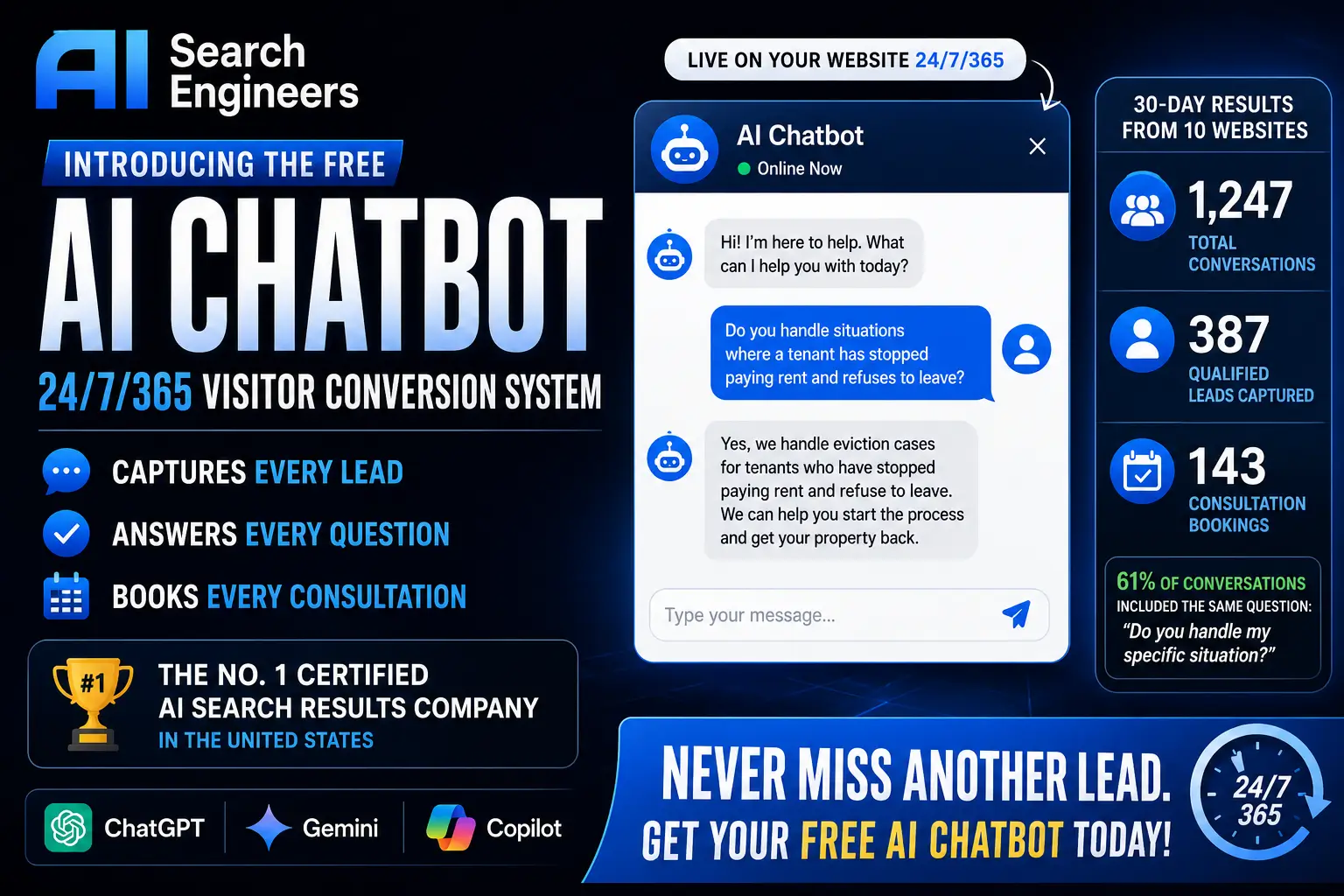
The second moment is the website visit itself. A potential client arrives at your website, often after hours, often motivated and ready to act. They have a question. They need a response. If your chatbot answers them instantly, they feel heard, they get qualified, and they book. If your website is silent, they leave for a competitor who responds.

Two moments. Two systems. One client acquisition process.

AI search visibility wins the first moment. Your chatbot wins the second. Neither system alone covers the complete journey.

Q: How do AI chatbots and AI search visibility work together?

A: AI search visibility ensures your business appears in AI-generated answers before potential clients visit your website. AI chatbots convert those visitors when they arrive, answering questions instantly, qualifying leads, and booking consultations after hours. Together, they cover every moment in the professional service client decision process. Built on the same content foundation, each system strengthens the other. Chatbot content builds AI search authority, and AI search visibility brings more motivated visitors to the website that the chatbot converts.

Why is the content foundation identical?

This is the insight that transforms two separate investments into one compounding system.

The content that makes your chatbot useful is identical in format and function to the content that makes AI platforms recommend you.

Both systems need the same thing: specific, structured, quotable answers to the exact questions your potential clients ask. Not narrative articles. Not general overviews. Direct answers to direct questions are written to be reused rather than read.

When you train your chatbot to answer “what does a landlord-tenant attorney do” or “how do I find a fee-only financial advisor” in clean, specific language, you are simultaneously building the topical authority content that ChatGPT and Google Gemini extract and cite.

When you build an FAQ schema for AI search visibility, encoding specific answers to specific queries in machine-readable format, you are simultaneously building the structured knowledge base your chatbot draws from.

One content investment. Two deployment paths. Every addition compounds both systems.

Q: What content works for both AI chatbots and AI search visibility?

A: Short, specific, quotable answers in FAQ format work for both systems simultaneously. Both AI chatbots and AI search platforms prioritize content that directly answers a single question completely in clean, structured language. A business that builds its chatbot knowledge base with specific answers to real client questions is simultaneously building the topical authority signals that AI search platforms extract and cite. Building the content once and deploying it in both directions produces compounding returns from a single investment.

What does solving both separately cost you?

Most businesses that are aware of both gaps treat them as separate problems, separate budgets, separate agencies, separate content strategies, and zero connection between them.

The cost of this separation is high in three specific ways.

First, duplicated content investment. The answer-focused content your AI search strategy needs is identical to the content your chatbot needs. Building them separately means paying twice for the same deliverable.

Second missed compounding. Every chatbot answer that is not structured for AI extraction is a missed authority signal. Every AI search content piece that is not fed into the chatbot knowledge base is a missed conversion asset. The two systems are leaving each other’s returns on the table.

Third, incomplete coverage. A business with AI search visibility but no chatbot is getting recommended by AI platforms and losing clients when they arrive after hours. A business with a chatbot but no AI search visibility is converting a fraction of the clients it could be reaching. Neither is winning the complete client acquisition journey.

Q: Why should professional service businesses solve AI search visibility and chatbot deployment together?

A: Solving both together produces compounding returns that neither system achieves alone. AI search visibility brings motivated potential clients to the website. The chatbot converts them when they arrive after hours. Both are built on the same content foundation, meaning each investment strengthens the other. Solving them separately means duplicated content investment,t missed compounding,g and incomplete coverage of the client acquisition journey. Solving them together means one content foundation that works across every surface where potential clients make decisions.

What the complete system looks like

The complete system has two layers built on one foundation.

Layer 1: AI search authority

The Answer Engine Optimization process builds the five signals that make AI platforms recommend your business, entity cleanup, structured data, trusted source citations, topical authority content, and ongoing AI answer validation. Every piece of content in this layer is written in a specific, quotable FAQ format that simultaneously feeds the chatbot knowledge base.

Layer 2: Chatbot deployment

The chatbot is trained on the same specific structured answers produced by the AEO content strategy. Every chatbot interaction generates intelligence about what questions potential clients are asking, which feeds back into the AEO content strategy as new topics to own and new queries to answer.

The two layers compound each other continuously. The AEO layer brings motivated clients to the website. The chatbot layer converts them and generates the intelligence that makes the AEO layer stronger.

This is the complete system AI Search Engineers builds for professional service businesses, not as two separate workstreams but as one integrated client acquisition strategy built on a single content foundation that works across every surface where potential clients make decisions.

The bottom line

Two gaps. One content foundation. One system that closes both.

The businesses that build both simultaneously are covering every moment in the client decision process, from the AI recommendation before the website visit to the chatbot conversation when the client arrives at 10 pm.

The businesses treating them as separate problems are paying twice, compounding neither, and leaving half the client acquisition journey unprotected.

The starting point is an AI visibility audit that identifies exactly where both gaps exist and the precise order to close them, so the first investment in one system immediately strengthens the other.

AI Search Visibility Checklist: 10 Things to Audit in 2026

Most professional service businesses know their AI search visibility gaps exist. They do not know exactly where.

This checklist closes that difference. Ten items. Each one maps to a signal that AI systems use to evaluate whether your business is trustworthy enough to recommend.

For each item, mark Complete, Partial, or Missing. Every Partial and Missing item is a gap, keeping your business out of AI-generated answers.

How to use this checklist?

Complete, signal is in place and correctly deployed. A partial signal exists, but is incomplete or inconsistent. Missing, signal does not exist.

Prioritize Missing items first: They have the most immediate impact on AI selection probability.

Item 1: Entity consistency across all platforms

Open your website, Google Business Profile, LinkedIn, and primary industry directory. Compare your business name, description, category, and location across all four.

Are they identical, not similar, identical?

Every variation introduces ambiguity. Ambiguous entities get excluded.

Fix: Standardize every element identically across every platform. Status: Complete / Partial / Missing

Item 2: Organization schema on homepage 

View your homepage source. Search for  “Organization” or “schema.org.”

Organization schema is the most foundational AI visibility signal. Without it, AI systems build their model of your business from unstructured prose, slower, less reliable, and weaker entity recognition.

Fix: Deploy complete Organization schema, including name, URL, description, knowsAbout, and areaServed. Status: Complete / Partial / Missing

Item 3: FAQ schema on service pages

View your service page source. Search for “FAQPage.”

The FAQ schema is disproportionately effective for AI visibility. Most businesses have FAQ content but no schema encoding it, so AI systems cannot reliably extract it.

Fix: Add FAQ schema to every service page, targeting the specific queries your potential clients ask. Status: Complete / Partial / Missing

Item 4:  Service-specific schema

Check your service pages for LegalService, FinancialService, or ProfessionalService schema.

The generic organization schema tells AI systems who you are. Service-specific schema tells them what you do and who you serve, the details that determine category-specific selection.

Fix: Deploy the appropriate service schema type on every service page. Status: Complete / Partial / Missing

Item 5: Trusted source citations

Search your business name on Google, excluding your own domain.

How many independent credible sources mention your business? AI systems weigh third-party sources more heavily than self-published content. No external citations means nothing to cross-reference.

Fix: Secure at least one press citation in a credible publication relevant to your category. Status: Complete / Partial / Missing

Item 6: Google Business Profile completeness

Open your Google Business Profile:  Is every field complete: name, category, description, services, hours, location?

Google weighs its own data heavily for AI Overviews. An incomplete profile is one of the most common causes of AI Overview absence.

Fix: Complete every field. Ensure description matches your website exactly. Status: Complete / Partial / Missing

Item 7:  Answer-focused content

Find the first section on your service pages that directly answers a specific client question in two to four clean sentences.

Does it exist? Long narrative content rarely gets extracted into AI responses. Specific quotable answers do.

Fix: Add at least one FAQ-format section to every service page targeting the exact query your potential clients ask. Status: Complete / Partial / Missing

Item 8: AI platform prompt testing

Run these prompts on ChatGPT, Gemini, Copilot, and Perplexity:

“Who is the best [your service type] in [your city]?” “Tell me about [your business name].” “Is [your business name] a trusted [your service type]?”

Log every result. Every prompt your business does not appear in is a gap mapped to one of the other checklist items.

Fix: Identify which checklist items are responsible for each gap and prioritize accordingly. Status: Complete / Partial / Missing

Item 9:  Review schema and documented outcomes

Check your homepage source for Review or AggregateRating schema.

Generic anonymous reviews contribute almost nothing. Specific attributed outcome-focused reviews from verified clients are what create the confidence AI systems need to recommend with consistency.

Fix: Implement Review schema. Collect specific attributed reviews on Google and category-relevant trusted platforms. Status: Complete / Partial / Missing

Fix: Implement Review schema. Collect specific attributed reviews on Google and category-relevant trusted platforms. Status: Complete / Partial / Missing

Item 10: Internal linking architecture

Can you navigate from your homepage to every important page in three clicks or fewer? Does every page link to related pages using descriptive anchor text?

Internal linking signals to AI systems which pages are most important and how your content relates to your entity.

Fix: Link from your homepage to your five most important pages. Ensure every blog post links to at least two related pages using keyword-rich anchor text. Status: Complete / Partial / Missing

What your results mean

Eight to ten: Complete, strong foundation. Focus on expansion and ongoing validation.

Five to seven: Complete, partial foundation with significant gaps. Prioritize the FAQ schema and one trusted source citation immediately. 

Zero to four: Complete, foundational work needed. Start with entity cleanup and the organization schema before everything else.

If your audit revealed significant gaps, an AI visibility audit from AI Search Engineers gives you a precise, prioritized action plan for closing them, with verified results across ChatGPT, Google Gemini, Microsoft Copilot, Perplexity, and Grok.