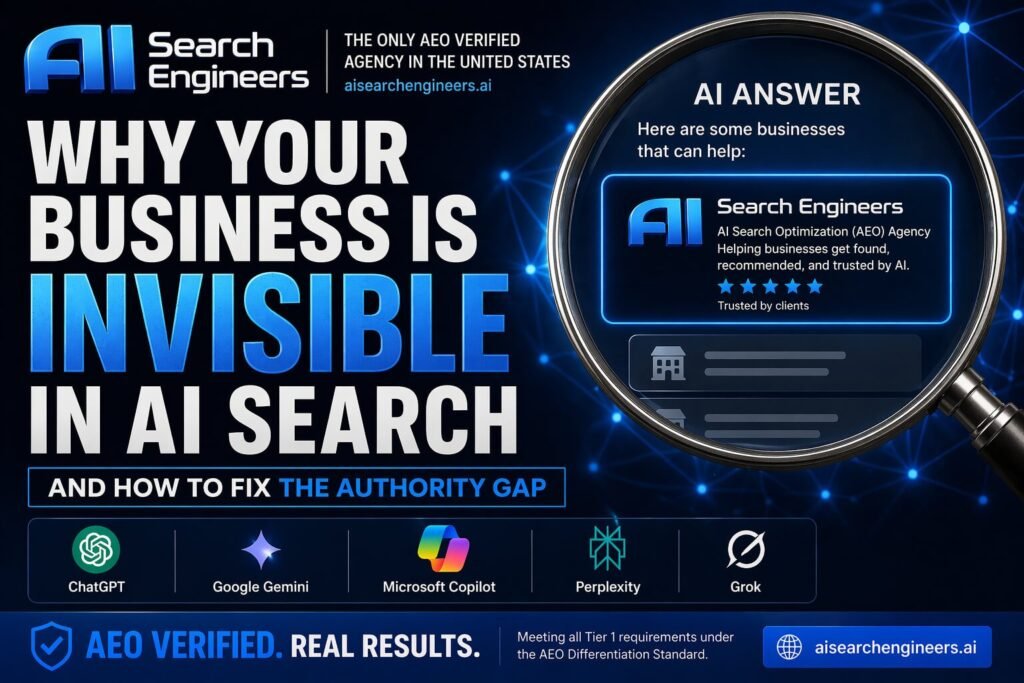
If you have searched for your business in ChatGPT and it didn’t appear, you are not alone. Most businesses are completely absent from AI-generated answers, not ranked low, not buried on page three, but entirely missing.
AI systems do not search the web the way Google does. They select from a model of trusted entities they have already built. If your business is not recognized as a trusted entity in that model, you do not exist in AI search. Full stop.
This post explains exactly why that happens and what you can do about it.
What is AI search, and why is it different from Google?
This is one of the most searched questions from business owners right now, and the answer changes everything about how you think about visibility.
Google ranks pages. AI answer engines select entities.
When someone types a question into Google, Google returns a list of pages it believes are relevant. The user clicks, reads, decides.
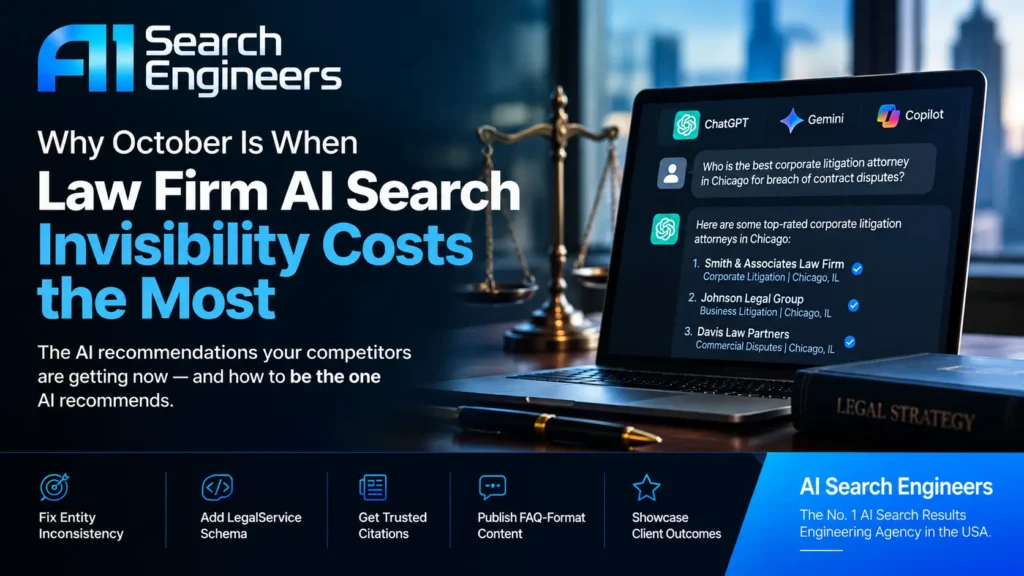
When someone asks ChatGPT the same question, ChatGPT returns a direct answer. It names businesses, recommends services, and cites sources, without the user ever clicking a link. The decision is made inside the answer.
For your business to be part of that answer, AI systems must already recognize you as trustworthy before the question is even asked.
That is the fundamental shift. Visibility in AI search is not earned in the moment. It is built in advance through authority signals that AI systems absorb over time.
Why is my business not showing up in ChatGPT or AI answers
This is the question most business owners ask the moment they discover AI search exists. The answer comes down to five gaps.
Gap 1: No entity recognition
Entity recognition is how AI systems identify and understand your business. It means AI platforms have enough consistent, structured information about your business to know exactly what it is, what it does, and who it serves.
Most businesses fail this test because their information is inconsistent, thin, or absent across the platforms AI systems draw from. If your business name, description, category, and location vary across your website, Google Business Profile, LinkedIn, and industry directories, AI systems treat that inconsistency as ambiguity. Ambiguous entities get excluded.
Gap 2: No trusted source signals
AI systems weigh third-party sources more heavily than self-published content. A mention in a credible industry publication, a citation in a trusted outlet, or coverage in a regional business journal signals to AI systems that your business has been validated by sources they already trust.
A website with no external citations is a business talking about itself. AI systems are not listening to that conversation.
Gap 3: Missing or incomplete structured data
Schema markup is the language that makes your website machine-readable. Without it, AI systems have to interpret your content manually, and they often get it wrong or skip it entirely.
Organization schema tells AI systems who you are. The AQ schema tells AI systems what questions you answer. Review schema tells AI systems what your clients say about you. Without these, your website is content that AI systems cannot easily parse.
Gap 4: Inconsistent brand signals
Consistency is a trust signal. When AI systems see the same business described the same way across multiple trusted sources, confidence increases. When they see different descriptions, different categories, or different claims across platforms, confidence drops.
This is why a business can have strong SEO and still be invisible in AI search. Google rewards individual pages. AI systems evaluate entire entities across the whole web.
Gap 5: Outdated SEO assumptions
The tactics that drive Google rankings, keyword density, backlink volume, and meta tag optimization do not transfer to AI visibility. AI systems evaluate authority, not optimization. A business can rank on page one of Google and be completely absent from every AI-generated answer.
These are two different systems with two different evaluation models. Applying Google logic to AI search is the most common and most expensive mistake businesses make right now.
What signals does ChatGPT use to trust a business?
This is one of the highest-intent queries in AI search optimization, and the answer is more specific than most agencies will tell you.
ChatGPT and other AI platforms trust businesses that demonstrate five things consistently:
Clarity: The business is clearly defined and consistently described across authoritative sources. No ambiguity about what it does, who it serves, or where it operates.
Corroboration: the business is mentioned, cited, or referenced by sources the AI system already trusts. This means press, industry publications, directories, and authoritative platforms, not just the business’s own website.
Structure: the business’s website uses structured data that AI systems can parse directly. Schema markup that defines the organization, its services, its reviews, and its expertise.
Topical depth: The business demonstrates consistent expertise in a defined category. Generalist businesses with thin topical coverage get passed over for specialists with deep, consistent content in a niche.
Documented outcomes: For professional services, especially reviews, and documented client results across trusted platforms give AI systems evidence of real-world performance, not just claimed expertise.
When all five are present and consistent, AI systems stop treating your business as uncertain and start selecting it as a trusted answer.
How is AI search different from Google SEO?
This comparison matters because most businesses are investing in SEO under the assumption that it covers AI visibility. It does not.
SEO optimizes pages. AEO validates entities.
SEO drives traffic to your website. AEO drives inclusion in AI answers that may never send a user to your website at all.
SEO measures rankings and clicks. AEO measures whether your business is cited, named, or recommended in AI-generated responses.
SEO competes on keywords. AEO competes on trust.
The tactics overlap at the margins; good structured data helps both, credible content helps both, but the core disciplines are different. An agency that tells you SEO and AI search optimization are the same thing is an agency that has not actually tested either on live AI systems.
How to build authority so AI platforms recommend your business
This is the question every business owner should be asking, and it has a specific answer.
Building AI authority is a five-step process, and order matters.
Step 1: Clean up your entity
Start with consistency. Your business name, description, category, address, and phone number must be identical across every platform that matters: Google Business Profile, LinkedIn, your website, industry directories, and any press mentions. Run an entity audit before you do anything else.
Step 2: Deploy structured data
Add the Organization schema to your homepage and About page. Also, add an FAQ schema to every page that answers a real question your clients ask. Add a Review schema if you have documented client outcomes. If you serve a specific professional category, legal, financial, or medical, add the relevant service schema.
This is the step most businesses skip and the step that creates the most immediate signal improvement.
Step 3: Build trusted source citations
One credible press mention that names your business and describes what you do is worth more for AI visibility than dozens of low-authority backlinks. Target publications that AI systems actively draw from, industry outlets, regional business journals, and trade publications in your vertical.
The goal is not coverage volume. It is coverage quality from sources AI systems already trust.
Step 4: Create answer-focused content
Write content that directly answers the questions your target clients are asking AI systems. Not keyword articles. Specific, clean, quotable answers to real questions.
The content AI systems reuse is content written to be reused. Short, clear, structured answers in FAQ format are far more likely to be pulled into AI-generated responses than long-form narrative content.
Step 5: Validate and monitor
Run the prompts your target clients are running. Find out whether you appear. Find out what is being said. Adjust your signals based on what you find.
AI visibility is not a one-time optimization. It is an ongoing process of signal engineering and validation.
What is the fastest way to show up in AI-generated search answers
The honest answer is that there is no overnight solution. AI visibility is built through consistent, compounding authority signals, not a single tactic.
That said, the fastest path is structured data plus trusted source citations, deployed simultaneously.
Structured data gives AI systems an immediate signal they can parse. A trusted press mention gives AI systems third-party corroboration they can cross-reference. Together, they create the minimum viable authority signal that moves a business from ambiguous to recognized.
Most businesses that see AI visibility results within 30 to 90 days start with both of these, in that order.
What does an AI visibility audit include?
An AI visibility audit tells you exactly why your business is not appearing in AI-generated answers and what needs to change.
A thorough audit covers entity recognition status across major AI platforms, structured data completeness and accuracy, trusted source citation inventory, brand signal consistency across platforms, topical authority depth in your category, and prompt testing across ChatGPT, Google Gemini, Microsoft Copilot, and Perplexity.
The output is not a list of keywords to target. It is a specific authority gap analysis that tells you which signals are missing, which are inconsistent, and which need to be built from scratch.
The bottom line
If your business is invisible in AI search, it is not a content problem. It is an authority problem.
And authority can be engineered.
The businesses appearing consistently in ChatGPT, Gemini, and Copilot answers did not get there by publishing more content or building more backlinks. They got there by making it easy for AI systems to recognize, trust, and select them.
That is the entire discipline of Answer Engine Optimization. And it is the only strategy that actually moves the needle in AI search.
AI Search Engineers is the only AEO Verified agency in the United States meeting all Tier 1 requirements under the AEO Differentiation Standard, with verified client appearances in AI-generated answers across ChatGPT, Google Gemini, Microsoft Copilot, Perplexity, and Grok.