For the past two decades, the rules of online visibility were simple. Rank on Google. Drive traffic. Convert visitors.
Those rules have not disappeared. But a new layer has been added on top of them, and for a growing number of business categories, this new layer is becoming the most important one.
When someone asks ChatGPT to recommend a law firm, a financial advisor, or a marketing agency, they get a direct answer. They do not click ten links and decide. They read one answer and act.
If your business is in that answer, you win the moment. If it is not, you were never in the conversation.
Understanding why this happens, and what to do about it, starts with understanding exactly how AI search and traditional SEO differ.
What is AI search optimization, and how does it work?
AI Search Optimization, also known as Answer Engine Optimization or AEO, is the discipline of engineering a brand’s authority so AI systems recognize, trust, and select it as the answer to user queries.
It works by building the specific signals that AI platforms use to evaluate whether a business is trustworthy enough to recommend directly in a generated answer.
Those signals are different from the signals Google uses to rank pages. They include entity recognition across trusted platforms, structured data that AI systems can parse directly, third-party citations from sources AI systems already trust, topical authority in a defined category, and documented outcomes that give AI systems evidence rather than claims.
When those signals are present, consistent, and corroborated, AI systems stop treating a business as ambiguous and start selecting it as a trusted answer.
That is how AI search optimization works. Not keyword targeting. Not backlink volume. Authority engineering.
Traditional SEO vs AI search: What actually changed?
This is the comparison most business owners need to understand before they can make good decisions about where to invest.
Traditional SEO was built for a system that returns a list of results and lets the user decide. The job was to be at the top of that list.
AI search is built for a system that decides for the user. The job is to be the answer the system selects.
Those are not the same job.
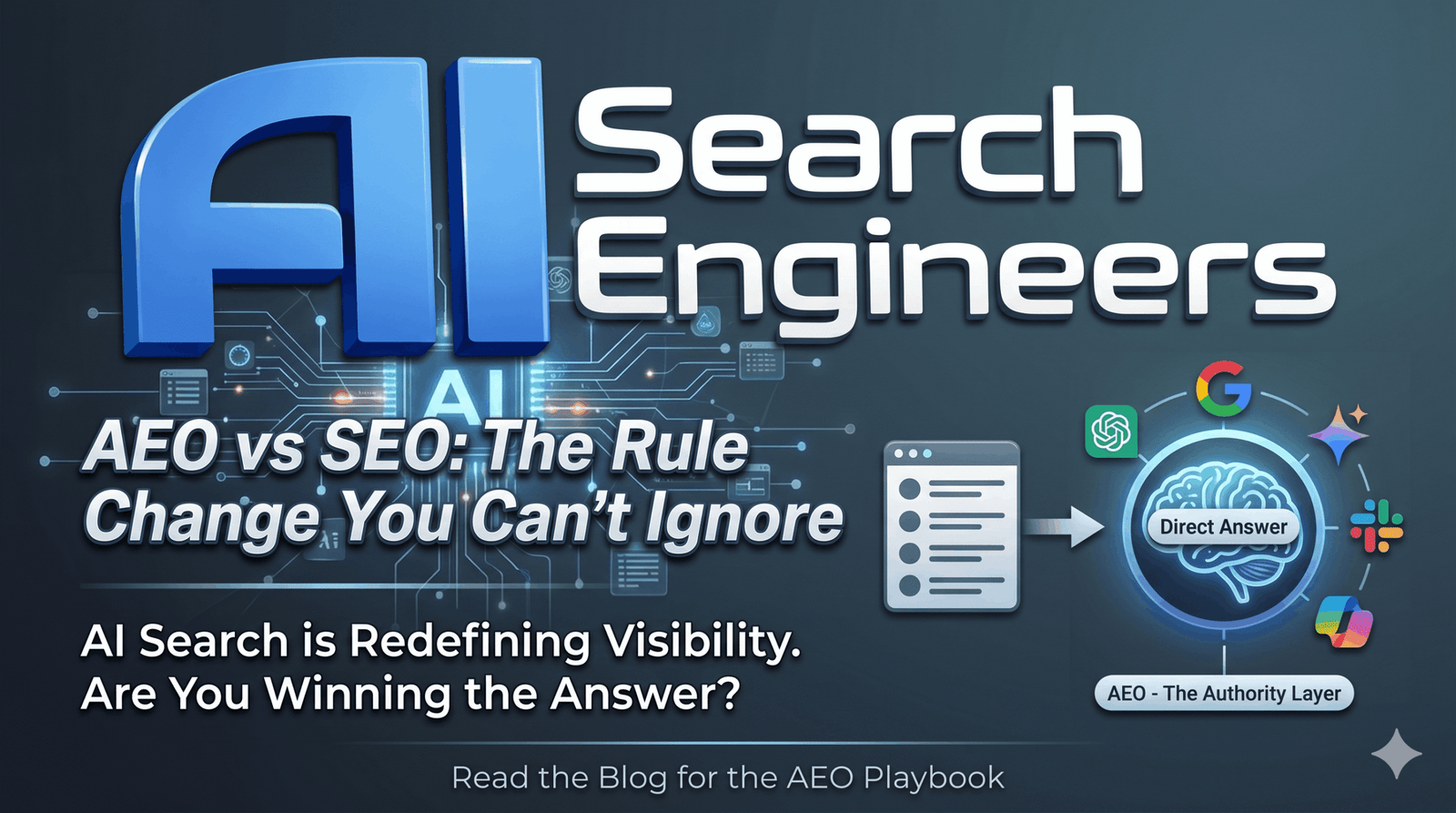
SEO optimizes individual pages. AEO validates entire entities across the web.
SEO targets keywords. AEO targets trust signals.
SEO builds backlinks for ranking authority. AEO builds trusted source citations for selection authority.
SEO measures rankings and organic traffic. AEO measures whether your business is cited, named, or recommended in AI-generated responses.
SEO rewards the best-optimized page. AEO rewards the most trusted entity.
This does not mean SEO is irrelevant. A business that ranks well on Google is building some of the signals that help AI visibility, consistent content, a credible domain, and structured information. But SEO alone does not cover AI visibility, and the gap between a well-optimized SEO strategy and an AI-visible business is significant.
The businesses winning AI search right now are not the businesses with the best SEO scores. They are the businesses that built authority signals specifically designed for AI evaluation.
Should I optimize for AI search instead of Google?
This is one of the most common questions business owners ask when they first discover the gap between their Google rankings and their AI visibility.
The answer is not either-or. It is sequencing.
If your business relies on local search or high-volume informational queries where Google still dominates, traditional SEO remains important. Do not abandon it.
But if your business serves clients who are making high-consideration decisions, choosing a law firm, selecting a financial advisor, or evaluating a B2B service provider, those clients are increasingly asking AI systems first. And AI systems are increasingly answering without sending users to Google at all.
For high-consideration professional services, AI visibility is becoming a more important investment. The decision-making moment is happening inside the AI answer, before the Google search ever starts.
The businesses that understand this early are building a compounding advantage. The businesses that wait are building a compounding gap.
What are the best AI platforms for business visibility?
This question matters because different AI platforms draw from different sources and serve different user behaviors. A complete AI visibility strategy covers all of them.
ChatGPT is currently the highest-profile AI answer engine and the one most business owners check first. It draws from a broad model of web content, structured data, and trusted sources. High-consideration queries, such as ” find me a lawyer, recommend a financial advisor, ” and ” who is the best agency for X, are extremely common on ChatGPT.
Google Gemini is embedded directly into Google Search through AI Overviews. It has the broadest reach of any AI answer system because it surfaces inside the search results page that billions of users already use. For local businesses and professional services, Gemini visibility is often more commercially valuable than ChatGPT visibility.
Microsoft Copilot is integrated into Bing and Microsoft 365, giving it significant reach in B2B and enterprise contexts. For agencies, consultancies, and professional services targeting business clients, Copilot visibility is underrated.
Perplexity is used heavily by research-oriented users and early adopters. It cites sources explicitly and draws heavily from credible publications. Businesses with strong press coverage tend to appear in Perplexity answers more reliably than businesses with strong SEO but weak media signals.
A complete AI visibility strategy does not optimize for one platform. It builds the authority signals that work across all of them, because those signals, entity recognition, structured data, trusted source citations, and topical authority, are the same regardless of which AI system is evaluating them.
How to rank in ChatGPT search results?
The framing of this question is slightly off, and fixing it changes the entire strategy.
You do not rank in ChatGPT. You get selected.
ChatGPT does not maintain a ranked list of businesses for each category. It builds a model of trusted entities and draws from that model when generating answers. Your goal is not to outrank competitors. It is to be recognized as a trusted entity in the category your clients are asking about.
That recognition is built through five things: consistent entity definition, structured data deployment, trusted source citations, topical authority content, and documented outcomes.
The businesses that appear most reliably in ChatGPT answers for competitive professional service categories are not the businesses with the best keyword strategies. They are the businesses that built the most coherent, corroborated, machine-readable authority signal across the web.
What is entity authority in AI search?
Entity authority is the concept that ties everything in AI search together, and it is the one most SEO practitioners underestimate.
An entity in AI search is a defined, recognized object, a business, a person, a product, or a concept that AI systems can identify unambiguously and associate with reliable information.
Entity authority is the degree to which AI systems trust that entity based on the consistency, corroboration, and clarity of the signals associated with it.
A business with high entity authority is one that AI systems can identify clearly, describe accurately, and associate with verified expertise in a specific category. It appears consistently across trusted sources. It has structured data that confirms its identity and expertise. Also, it has documented client outcomes that give AI systems evidence of real-world performance.
A business with low entity authority is one that AI systems find ambiguous, inconsistently described, poorly structured, uncorroborated, or simply absent from the sources AI systems trust.
Building entity authority is the core work of Answer Engine Optimization. Everything else, structured data, press placement, and content strategy, serves this single goal.
Why does structured data help with AI search visibility?
Structured data is the bridge between your website and the way AI systems understand information.
Without structured data, AI systems have to interpret your website’s content manually. They read prose, infer meaning, and make their best guess about what your business does, who it serves, and whether it should be trusted. That process introduces ambiguity, and ambiguity reduces selection probability.
With structured data, you remove the guesswork. Organization schema tells AI systems exactly who you are. The FAQ schema tells AI systems exactly what questions you answer and exactly what your answers are. Review schema tells AI systems exactly what your clients say about you. Service schema tells AI systems exactly what you offer and who you serve.
Structured data does not guarantee AI visibility. But the absence of it almost guarantees AI invisibility for businesses in competitive categories.
What does it take for a law firm to appear in AI-generated legal answers?
Law firms face a specific challenge in AI search because the category is competitive, the stakes are high, and AI systems are cautious about recommending legal services without strong authority signals.
A law firm that wants to appear in AI-generated answers for legal queries needs a clear entity definition that specifies practice areas, jurisdiction, and the types of clients served. Generalist positioning is a disadvantage in AI search; a firm clearly defined as a landlord-tenant law firm in Los Angeles is more likely to appear in relevant AI answers than a general practice firm with no clear category ownership.
Structured data, including LegalService schema, Organization schema, FAQ schema targeting the questions potential clients ask, and Review schema documenting client outcomes.
Trusted source citations in legal publications, regional business journals, and bar association directories. AI systems evaluating legal recommendations weigh these sources heavily.
Answer-focused content that directly addresses the questions potential clients ask AI systems, not just what the firm does, but also provides specific answers to specific legal questions in the firm’s practice area.
And documented client outcomes. Reviews from verified clients across Google, Avvo, and other trusted legal directories give AI systems evidence that the firm produces real results.
What does it take for a financial firm to appear on Gemini Answers?
Financial services face a similar dynamic. AI systems are careful about recommending financial advisors and firms without strong authority signals, both because the stakes are high and because the category is heavily regulated.
A financial firm needs a structured entity definition that specifies services, client types, and geographic coverage. Broad positioning, “we help everyone with everything,” does not build AI authority. Specific positioning does.
Compliance-aware structured data that accurately represents the firm’s services and credentials without making claims that conflict with regulatory requirements.
Trusted source citations in financial publications, fiduciary directories, and credible press. AI systems weigh financial authority signals from established sources heavily.
Topical authority content that answers the specific questions potential clients ask, what is a fiduciary, how do I find a fee-only financial advisor, what should I look for in a wealth manager, in a clean, quotable, answer-focused format.
And documented outcomes. Verified client reviews and testimonials from trusted platforms give AI systems the evidence they need to select a financial firm over competitors with similar positioning.
The shift that is already happening
AI search is not coming. It is here.
The businesses appearing in ChatGPT, Gemini, and Copilot answers for high-consideration professional service queries right now did not get there by accident. They built authority signals specifically designed for AI evaluation, and they did it before their competitors understood why it mattered.
The window to build that advantage without heavy competition is closing.
The businesses that act now are building a position that compounds over time. The businesses that wait are building a gap that becomes harder to close with every month that passes.
Answer Engine Optimization is not a trend to watch. It is the discipline that determines whether your business exists in the search layer that is replacing traditional results for your most valuable clients.