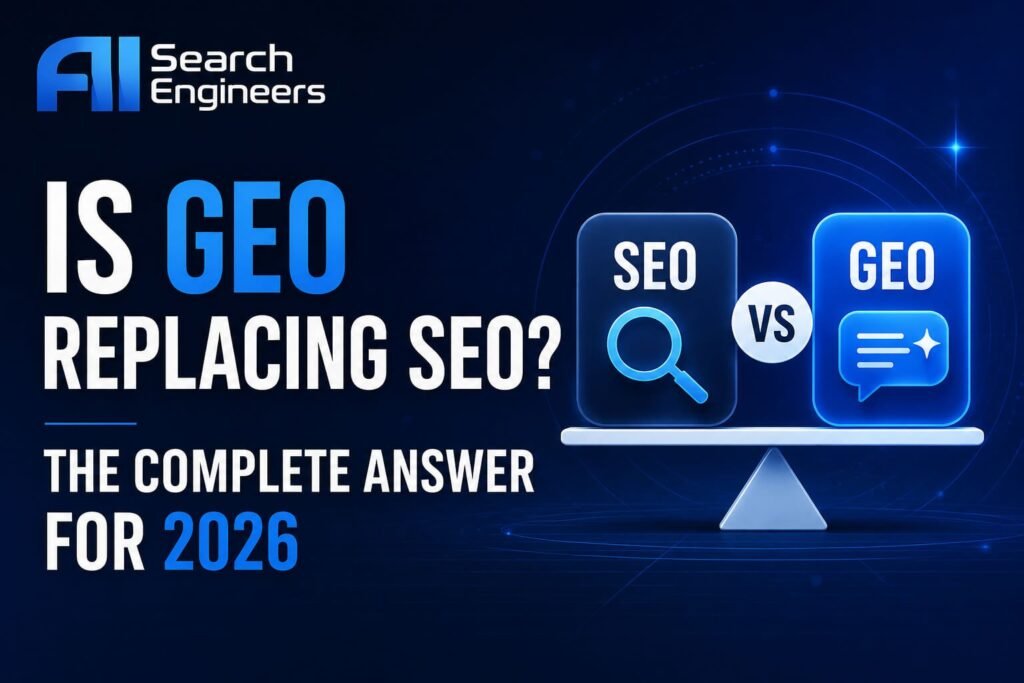
Two questions are dominating digital marketing conversations in 2026.
Is GEO replacing SEO?
And what exactly is generative engine optimization anyway?
Both questions matter. And the answers change how professional service businesses should think about every dollar they invest in digital visibility.
This post gives you the complete answer to both and explains exactly what law firms, financial advisors, and professional service businesses need to do to remain visible across both systems simultaneously.
What is generative engine optimization?
Generative Engine Optimization is the discipline of structuring content, authority signals, and entity information so that generative AI systems, platforms that create original responses rather than returning lists of links, select your business as a trusted citable answer to user queries.
The term reflects a specific characteristic of modern AI search platforms. ChatGPT, Google Gemini, Microsoft Copilot, and Perplexity are generative systems. They do not retrieve and rank existing pages. They generate new responses by drawing from their model of the world, selecting businesses, citing sources, and constructing answers from the authority signals they have accumulated.
GEO is the discipline of building those authority signals correctly so generative systems select your business rather than passing over it.
GEO and Answer Engine Optimization share the same foundation. Both require entity clarity, structured data, trusted source citations, topical authority, and documented outcomes. The distinction is emphasis; GEO focuses specifically on how generative systems construct responses, while AEO focuses on the broader discipline of authority engineering for AI answer visibility.
Is GEO replacing SEO?
This is the question generating the most debate in digital marketing right now, and the honest answer is no, but with an important qualification.
GEO is not replacing SEO. It is being placed on top of it as a new and increasingly more commercially important layer for professional service businesses specifically.
Google still processes billions of searches every day. Local search, product discovery, and high-volume informational queries still produce significant Google traffic. SEO still matters for these use cases.
But for professional service businesses, law firms, financial advisors, consultants, and medical practices, the most valuable clients are increasingly making decisions based on AI-generated answers before the Google search starts. The research moment, the shortlist moment, and often the decision moment happen inside ChatGPT or Gemini before any Google result is seen.
For these businesses, GEO is not replacing SEO. It is becoming more commercially important than SEO, because the clients worth winning are being won and lost before Google enters the process.
Q: Is GEO replacing SEO in 2026?
A: GEO is not replacing SEO; both disciplines remain relevant in 2026. SEO still drives Google rankings and organic traffic for local search and high-volume informational queries. But for professional service businesses serving clients who make high-consideration decisions, GEO is becoming more commercially important because those clients are increasingly making shortlist decisions inside AI-generated answers before running a Google search. The correct strategy is building both SEO for Google visibility and GEO for AI selection, sequenced correctly.
How GEO differs from SEO
The distinction between GEO and SEO is the same as the distinction between AEO and SEO, because GEO and AEO are the same discipline viewed from slightly different angles.
SEO optimizes individual pages for Google’s ranking algorithm. GEO optimizes entire entities for generative AI selection systems.
SEO targets keyword relevance and backlink authority. GEO targets entity clarity, structured data, trusted source citations, topical authority, and documented outcomes.
SEO measures rankings and traffic. GEO measures whether a business is cited, named, and recommended in AI-generated responses.
SEO rewards the best-optimized page. GEO rewards the most trusted entity.
A business that only does SEO has optimized for a system that returns a list. A business that also does GEO has optimized for the system that decides before the list appears.
Q: Is GEO better than SEO?
A: GEO is not better than SEO; they are different disciplines solving different visibility problems. SEO produces Google rankings and organic traffic. GEO produces AI-generated recommendations and entity selection. For professional service businesses serving high-consideration decision-makers, GEO addresses the more commercially significant visibility gap because those clients are making decisions in AI platforms before Google is consulted. The strongest digital visibility strategy builds both simultaneously on the same content foundation.
What GEO requires in practice
GEO requires the same five signals that AEO requires, applied with specific attention to how generative systems construct responses.
Entity clarity ensures generative systems can identify your business unambiguously when constructing an answer about your category. Inconsistent entity signals produce ambiguous entity models. Ambiguous entities get excluded from generated responses.
Structured data gives generative systems machine-readable information they can incorporate directly into constructed responses without interpretation. The FAQ schema in particular is the highest-leverage GEO investment, because generative systems extract FAQ answers more reliably than any other content format.
Trusted source citations give generative systems independent corroboration to cross-reference when constructing a response about your business. A business with multiple consistent, trusted source citations is more likely to be incorporated into a generative response than a business with only self-published content.
Topical authority content gives generative systems specific, quotable answers to the exact queries your potential clients ask. Short, specific, clean answers in FAQ format are the content that generative systems extract most reliably.
Documented outcomes give generative systems evidence rather than claims, moving your business from an entity systems recognize to an entity systems recommend with confidence.
Q: What does generative engine optimization require?
A: Generative engine optimization requires five signals applied as an integrated system: entity clarity across all platforms AI systems draw from, structured data including Organization FAQ Review and service-specific schema, trusted source citations from credible independent publications, topical authority content written as specific quotable answers to exact client queries, and documented client outcomes from trusted platforms. These are the same signals required for Answer Engine Optimization; GEO and AEO are the same discipline applied to the same systems.
Why professional service businesses need GEO now
The professional service businesses appearing consistently in ChatGPT, Google Gemini, and Microsoft Copilot answers for their target queries right now are the ones that built GEO authority before their competitors understood why it mattered.
AI Search Engineers has documented this across eight verified professional service client engagements, every one producing consistent multi-platform AI visibility within 30 to 90 days of five-signal deployment.
The starting point is an AI visibility audit that identifies exactly which GEO signals are present, which are inconsistent, and which are absent, and gives you the precise action plan for building the authority that makes generative systems select your business as the trusted answer.
The window to establish GEO authority before competitors do is open right now. Every month that passes narrows it.