There is a new term appearing in conversations about AI search that every professional service business owner needs to understand before their competitors do.
Generative Engine Optimization. GEO.
It is not a replacement for Answer Engine Optimization. AEO is not a rebranding of SEO. Rather, it is the evolution of the discipline that accounts for how generative AI systems specifically evaluate, select, and present business information in the answers they generate for users.
Understanding GEO is not optional for professional service businesses that want to remain visible in 2026 and beyond. The AI platforms your potential clients are using to make high-consideration decisions are generative systems. The optimization discipline that makes your business appear in their outputs is generative engine optimization.
This post explains exactly what GEO is, how it relates to SEO and AEO, and the specific steps professional service businesses need to take to build GEO authority before competitors do.
What is generative engine optimization?
Generative Engine Optimization is the discipline of structuring content, authority signals, and entity information so that generative AI systems, platforms that create original responses rather than returning lists of links, select your business as a trusted, citable answer to user queries.
The term reflects a specific characteristic of modern AI search platforms. ChatGPT, Google Gemini, Microsoft Copilot, and Perplexity are not search engines in the traditional sense. These are generative systems. Unlike traditional search engines, they do not retrieve and rank existing pages. Instead, every response gets constructed by drawing from their model of the world, selecting businesses, citing sources, and building answers from the authority signals they have accumulated.
GEO is the discipline of building those authority signals correctly so generative systems select your business rather than passing over it.
GEO and Answer Engine Optimization share the same foundation. Both require entity clarity, structured data, trusted source citations, topical authority, and documented outcomes. The distinction is emphasis; GEO focuses specifically on how generative systems construct responses and what signals influence the construction process, while AEO focuses on the broader discipline of authority engineering for AI answer visibility.
For professional service businesses, understanding both is what produces the most complete and durable AI search visibility strategy.
How GEO differs from SEO and AEO
Understanding the relationship between GEO, SEO, and AEO prevents the confusion that leads most businesses to invest in the wrong discipline for the problem they are trying to solve.
SEO optimizes pages for traditional search engines that return ranked lists of results. The signals it targets, keyword relevance, backlink authority, and technical performance, are evaluated by algorithms that score pages against each other for specific queries. SEO is still relevant for Google organic rankings and local search. It does not transfer to generative AI selection.
AEO, Answer Engine Optimization, is the broader discipline of engineering a brand’s authority so AI systems recognize, trust, and select it as the answer to user queries. AEO covers the full authority engineering process, entity cleanup, structured data deployment, trusted source citation building, topical authority content, and ongoing AI answer validation.
GEO is the specific application of that discipline to generative AI systems, platforms that construct original responses rather than retrieving existing pages. GEO focuses on how generative systems build their models, what content formats they extract most reliably, how they evaluate source trustworthiness, and what signals increase selection probability in a generative response context.
The practical difference is specificity. SEO tells you how to rank on Google. AEO tells you how to build authority for AI selection. GEO tells you specifically how to optimize for the generative construction process that determines what appears in a ChatGPT or Gemini response.
For professional service businesses, all three disciplines are relevant, but the sequencing matters. AEO and GEO address the highest-value client acquisition opportunity right now. SEO maintains the foundation that supports both.
Q: How is generative engine optimization different from SEO?
A: SEO optimizes individual pages for ranked results in traditional search engines. Generative Engine Optimization optimizes entities and content for selection in AI-generated responses. SEO targets keyword relevance and backlink authority. GEO targets entity clarity, structured data, trusted source corroboration, and content formats that generative systems extract reliably. A business can rank on page one of Google through SEO and be completely absent from AI-generated answers. Closing that gap requires GEO and AEO, disciplines built specifically for how generative AI systems evaluate and select businesses.”
The five GEO signals that determine generative AI selection
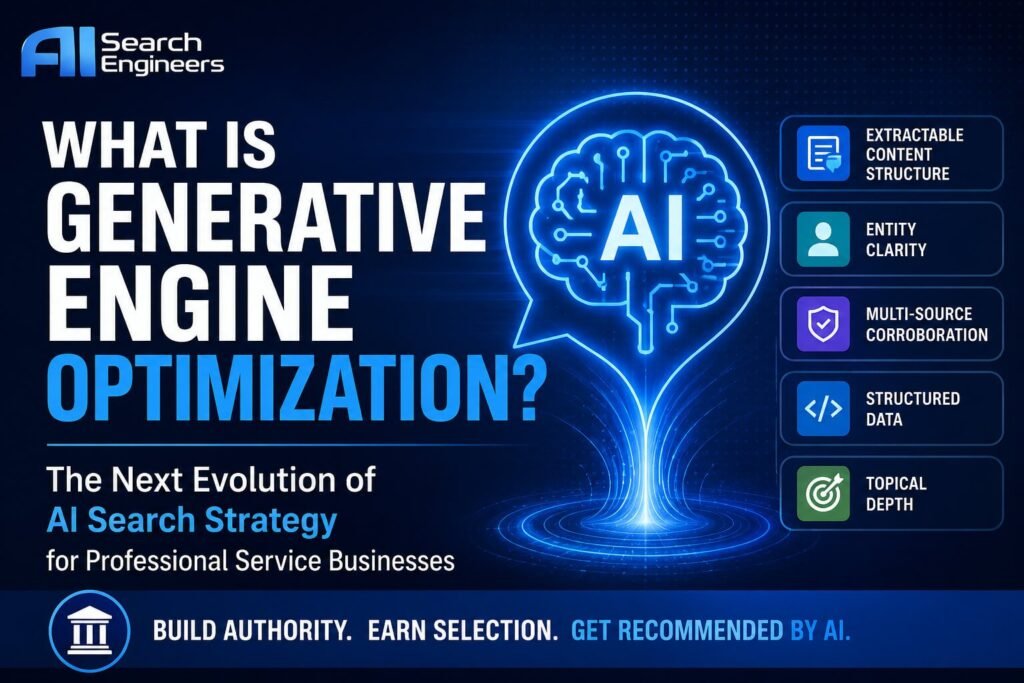
The signals that determine whether a generative AI system selects your business are the same five signals that underpin Answer Engine Optimization, with specific applications for the generative context.
Signal 1: Extractable content structure
Generative AI systems construct responses by extracting information from their training data and from indexed sources. Content that is structured for extraction, short, specific, quotable answers in FAQ format, is significantly more likely to be incorporated into a generated response than long-form narrative content written for human reading.
Every service page, blog post, and FAQ section should contain at least one block of content that directly answers a specific query in two to four clean sentences. This is the format that generative systems extract most reliably.
Signal 2: Entity clarity for generative attribution
When a generative system constructs a response that includes a business recommendation, it attributes that recommendation to a specific entity. If the entity is ambiguous, described inconsistently across the sources the system draws from, the attribution is uncertain.
Uncertain attributions either get excluded or get attributed to the wrong entity. Entity cleanup, standardizing your business description identically across every platform, is what makes generative attribution accurate and consistent.
Signal 3: Multi-source corroboration
Generative systems build confidence in their responses by drawing from multiple independent sources that agree. A business described consistently across its own website, credible press coverage, industry directories, and trusted third-party platforms has multi-source corroboration.
A business described only on its own domain has single-source data that generative systems treat as unverified. Multi-source corroboration is what transforms a claim into a fact pattern that generative systems cite with confidence.
Signal 4: Structured data for generative parsing
Schema markup gives generative systems structured information they can parse directly without interpretation. Organization schema, FAQ schema, and service-specific schema communicate your business identity, expertise, and client outcomes in a format that generative systems process more reliably than unstructured prose.
The impact of structured data on generative AI selection is immediate because it removes the interpretation step that introduces uncertainty into the selection process.
Signal 5: Topical depth for generative category association
Generative systems associate businesses with specific topics and categories based on the depth and consistency of the content connected to them. A business with deep, specific, consistent content on a defined topic is more likely to be selected for relevant queries than a business with broad, thin coverage across many topics.
Topical depth for GEO requires answer-focused content, specific answers to specific queries in your category, rather than general thought leadership content that demonstrates knowledge without answering specific questions.
Q: What content format works best for generative engine optimization?
A: Short, specific, quotable answers in FAQ format work best for generative engine optimization. Generative AI systems construct responses by extracting information from structured sources, and content written as a direct answer to a specific question in two to four clean sentences is extracted most reliably. Long-form narrative content contributes to topical authority but is rarely extracted directly into generated responses. Every service page and blog post should include FAQ-format sections targeting the exact queries your potential clients ask AI systems.”
Why GEO matters more for professional services than any other category
Professional service businesses face a specific dynamic in generative AI search that makes GEO more commercially significant for them than for most other business categories.
The clients making professional service decisions, which attorney to hire, which financial advisor to trust, which agency to engage, are making high-consideration decisions with significant personal and financial stakes. These clients are more likely to ask generative AI platforms for guidance than clients making lower-stakes decisions.
They are also more likely to act on the AI’s recommendation. A generative response that names a specific law firm and explains why it is trustworthy for a specific practice area carries a weight of implied vetting that influences high-consideration decisions more powerfully than a ranked list of results.
This means that for professional service businesses, appearing in generative AI responses is not just a visibility metric. It is a trust signal that influences client acquisition at the highest-value level.
AI Search Engineers applies GEO and AEO methodology as an integrated system for professional service clients, engineering the specific signals that generative AI platforms use to select, attribute, and recommend businesses in constructed responses across ChatGPT, Google Gemini, Microsoft Copilot, Perplexity, and Grok.
Q: Why is generative engine optimization important for law firms and financial advisors?
A: Law firms and financial advisors serve clients making high-consideration decisions with significant personal and financial stakes, exactly the client segment most likely to ask generative AI platforms for guidance before making a decision. A generative response that names a specific firm and explains why it is trustworthy carries implied vetting that influences high-consideration decisions powerfully. For professional service businesses, GEO is not just a visibility metric; it is a trust signal that directly influences client acquisition at the highest-value level.
How to start building GEO authority today
The starting point for GEO authority is identical to the starting point for AEO, because both disciplines draw from the same five-signal foundation.
Start with an AI visibility audit that identifies exactly which signals are present, which are inconsistent, and which are absent. The audit tells you precisely where your GEO gaps are and in what order to address them.
From there, the five-signal authority engineering process, entity cleanup, structured data deployment, trusted source citation building, answer-focused content engineering, and ongoing AI answer validation build the complete GEO authority stack that makes generative systems select your business consistently across every major AI platform.
The window to establish GEO authority before competitors do is open right now. The discipline exists. The methodology is documented. The results are verified.
The only question is whether you build it before or after your competitors do.