
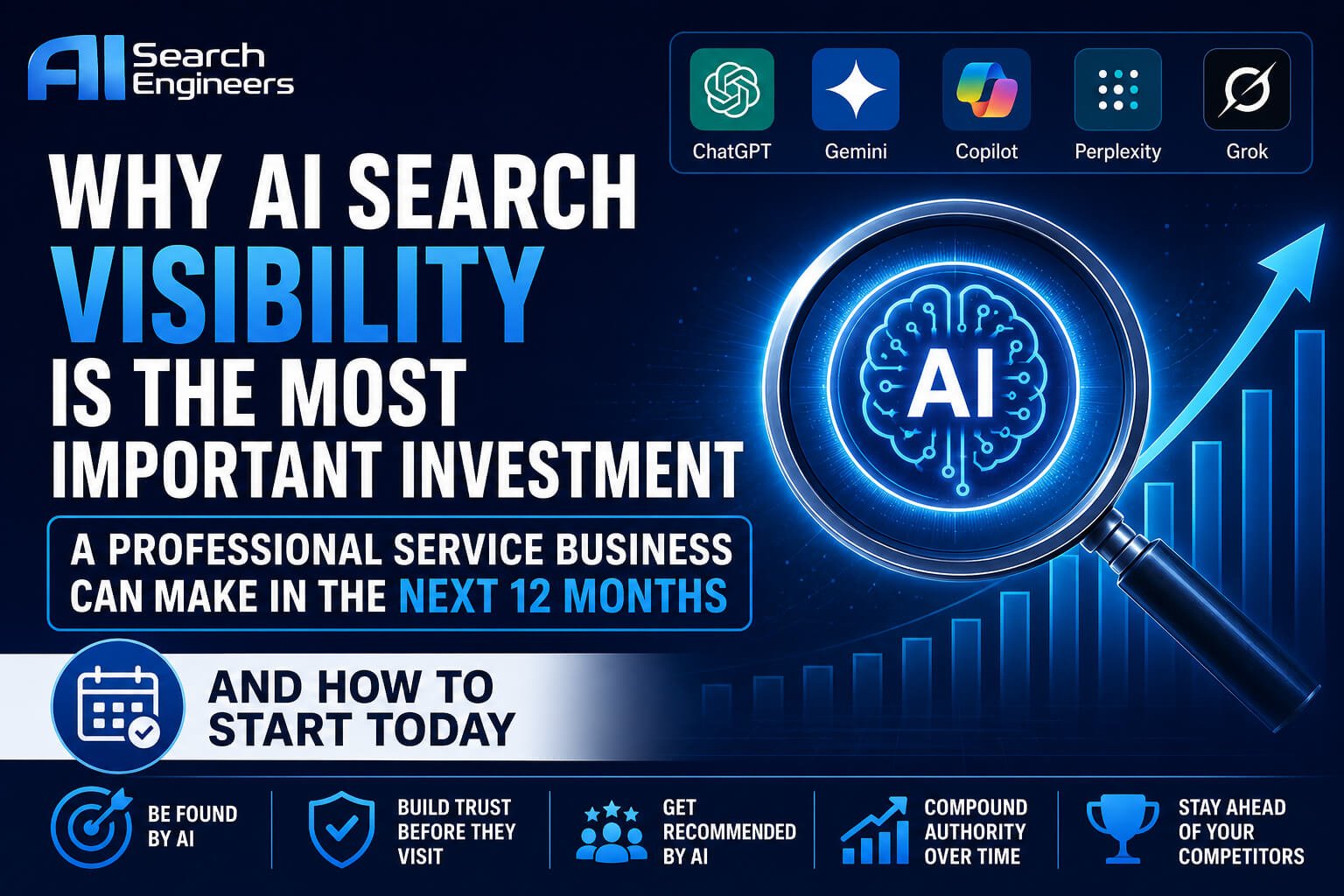
AI Search Visibility for Professional Services

Every few years, a shift happens in how potential clients find professional service businesses.

Yellow Pages gave way to websites. Websites gave way to Google. Google is giving way to AI.

Each shift created winners, the businesses that moved early and built authority in the new system before competitors understood what was happening. And each shift created losers, the businesses that waited until the new system was crowded and the early-mover advantage was gone.

The AI search shift is happening right now. And the next 12 months represent the most important window professional service businesses have ever had to build a compounding visibility advantage before that window closes.

This post explains exactly why, and gives you the precise steps to start today.

Why the next 12 months are the critical window

AI search behavior is not stabilizing. It is accelerating.

The percentage of high-consideration professional service decisions that start with an AI platform query, rather than a Google search, is growing every month. ChatGPT’s user base continues to expand. Google AI Overviews are surfacing for an expanding range of queries. Microsoft Copilot is embedded in productivity tools used by the exact B2B decision-makers that professional service businesses serve.

The businesses that appear in AI-generated answers for their target queries right now are not just winning today’s clients. They are building a compounding authority position that gets harder to displace with every month that passes.

Here is why compounding matters in AI search specifically.

Every trusted source citation adds corroboration to an entity already recognized, increasing AI selection confidence incrementally but permanently. Every structured data deployment makes machine-readable what was previously interpreted, reducing uncertainty that was suppressing selection probability. Every documented client outcome adds evidence to a track record already established, strengthening the evidence layer that moves businesses from recognized to recommended.

These signals do not reset. They accumulate. A business that starts building AI authority today has a six-month head start on a competitor that starts in six months, and that head start compounds with every signal added in the interim.

The businesses that act in the next 12 months are building that compounding position. The businesses that wait are watching it build for competitors.

Q: Why is AI search visibility important for professional service businesses in 2026?

A: AI search visibility is important because an increasing percentage of high-consideration professional service decisions now start with an AI platform query rather than a Google search. Potential clients asking ChatGPT, Google Gemini, or Microsoft Copilot which law firm, financial advisor, or professional service provider to hire are making their shortlist decision inside the AI answer before visiting any website. Businesses absent from those answers are invisible at the most important moment in the client decision process. And the businesses building AI authority now are creating a compounding advantage that gets harder to close with every month that passes.”

What is at stake for professional service businesses specifically

The commercial stakes of AI search visibility are more significant for professional service businesses than for almost any other category, for three specific reasons.

The first reason is decision value. A single client relationship in a law firm, financial advisory practice, or professional service business is worth significantly more than a single transaction in most other business categories. A client relationship that starts because an AI platform recommended your firm could represent years of recurring revenue. The value of each AI-generated recommendation is disproportionately high.

The second reason is decision behavior. The clients making professional service decisions are among the most research-oriented buyers in any market. They are the clients most likely to ask AI platforms for guidance, most likely to follow AI recommendations, and most likely to make decisions based on AI-generated trust signals. The audience most likely to be influenced by AI search visibility is the audience that professional service businesses most need to reach.

The third reason is competitive scarcity. Most professional service businesses have not yet built genuine AI search visibility. The authority positions in most legal, financial, and professional service categories are not yet claimed. The businesses that move now are establishing positions in an uncrowded landscape. The businesses that wait are entering a landscape where competitors have already built compounding advantages.

Q: What does AI search visibility mean for law firms and financial advisors?

A: For law firms and financial advisors, AI search visibility means appearing in the AI-generated answers that potential clients receive when asking ChatGPT, Google Gemin, i, or Microsoft Copilot which professional service provider to hire. A single client relationship in a professional service business represents significant long-term revenue, making each AI-generated recommendation disproportionately valuable. Most professional service businesses have not yet built genuine AI search visibility, meaning the businesses that act now are establishing positions in an uncrowded landscape before competitors build compounding advantages.”

The five steps to start building AI search visibility today

The path to AI search visibility is not complex. It is specific. And it starts with five steps that can be initiated today regardless of current visibility status.

Step 1: Run the audit.

Before building anything, find out exactly where you stand. Open ChatGPT, Google Gemini, and Microsoft Copilot, and run the queries your potential clients are running. Log every result. Note whether your business appears, what is said about it, and who is appearing instead.

This ten-minute exercise tells you exactly which gaps exist and how urgent they are. It is the starting point for every AI visibility strategy, and the information it produces shapes everything built on top of it.

Step 2: Clean up your entity.

Standardize your business name, description, category, services, and location identically across every platform AI systems draw from. Website, Google Business Profile, LinkedIn, industry directories, and any press or citation profiles.

This is the foundation. Everything built on top of an inconsistent entity foundation is undermined by the ambiguity at the base. Entity cleanup is unglamorous. It is also non-negotiable.

Step 3: Deploy structured data

.Add Organization schema to your homepage. Add an FAQ schema to every page that answers a real question your potential clients ask. Add service-specific schema, LegalService, FinancialService, or ProfessionalService to your service pages.

This is the step that produces the fastest visible movement in AI search visibility because it gives AI systems machine-readable information they can use immediately, rather than interpreted prose they have to evaluate over time.

Step 4: Build one trusted source citation

Identify one credible publication or directory in your category and secure a citation. One press mention in a regional legal publication. One listing in a trusted financial directory. One feature in a credible industry outlet.

One strong external citation creates more AI visibility movement than months of internal content production. It gives AI systems the third-party corroboration they need to move your business from unverified to recognized.

Step 5: Create answer-focused content.

Write one piece of content that directly answers the most common question your potential clients ask about your services. Not a general overview. Not a thought leadership article. A specific, clean, quotable answer to one specific question, in the format AI systems extract and cite most reliably.

Publish it. Add FAQ schema. Link to it internally from your homepage and service pages. This is the content that starts building the topical authority signal that compounds with every subsequent piece added.

Q: How do I start building AI search visibility for my professional service business?

A: Start with five steps in order: run prompts across ChatGPT Google Gemini and Microsoft Copilot to audit your current visibility status, standardize your business description identically across every platform AI systems draw from, deploy Organization FAQ and service-specific schema on your website, secure at least one trusted source citation in a credible publication or directory in your category, and create answer-focused content targeting the specific queries your potential clients ask AI systems. These five steps build the minimum viable authority signal that moves a business from absent to recognized by AI systems.”

What happens if you wait

This is the question most business owners avoid asking, and the one that matters most for deciding when to act.

If you wait six months to start building AI search visibility, your competitors who act now will have six months of compounding authority signals you do not have. Six months of trusted source citations, adding corroboration to entities already recognized. Six months of structured data reduced the uncertainty that was suppressing the selection probability. Six months of answer-focused content building topical authority in categories you are not yet associated with.

That six-month gap does not disappear when you start. It becomes the baseline you are trying to overcome, while your competitors continue adding to their compounding advantage.

In traditional SEO, catching up is difficult but possible. The signals reset partially over time. New content can compete with old content.

In AI search, the signals compound and persist. Entity recognition built over six months is more stable than entity recognition built over one month. Trusted source citations accumulated over six months create more corroboration than citations accumulated over one month. The gap between a business that started early and one that started late grows over time rather than closing.

The window to start before the gap becomes structural is open right now.

Every month that passes narrows it.

Q: What happens if I wait to build AI search visibility?

A: Every month you wait is a month competitors are building AI authority, accumulating compounding signals you do not have. Trusted source citation,s corroboration structured data, and topical authority signals persist and compound over time rather than resetting. A business that starts building AI search visibility six months before a competitor has a compounding advantage that grows rather than closes over time. The window to establish AI authority before competitors build structural advantages is open now and narrowing every month.”

The investment that covers every moment

AI search visibility is not a single tactic. It is not a one-time optimization. It is a compounding authority engineering investment that covers every moment in the professional service client decision process, from the AI recommendation before the website visit to the chatbot conversation when the client arrives.

The businesses that build it correctly, through the five-signal authority engineering process that AI Search Engineers apply for every professional service client, are the ones appearing consistently in ChatGPT, Google Gemini, Google AI Overviews, Microsoft Copilot, and Perplexity for the queries their most valuable potential clients are running.

The businesses that wait are watching those queries get answered with a competitor’s name.

The next 12 months are the most important window professional service businesses have ever had to build a compounding AI visibility advantage.

The starting point is ten minutes and a ChatGPT prompt.

Run it today. See where you stand. And act on what you find before your competitors do.
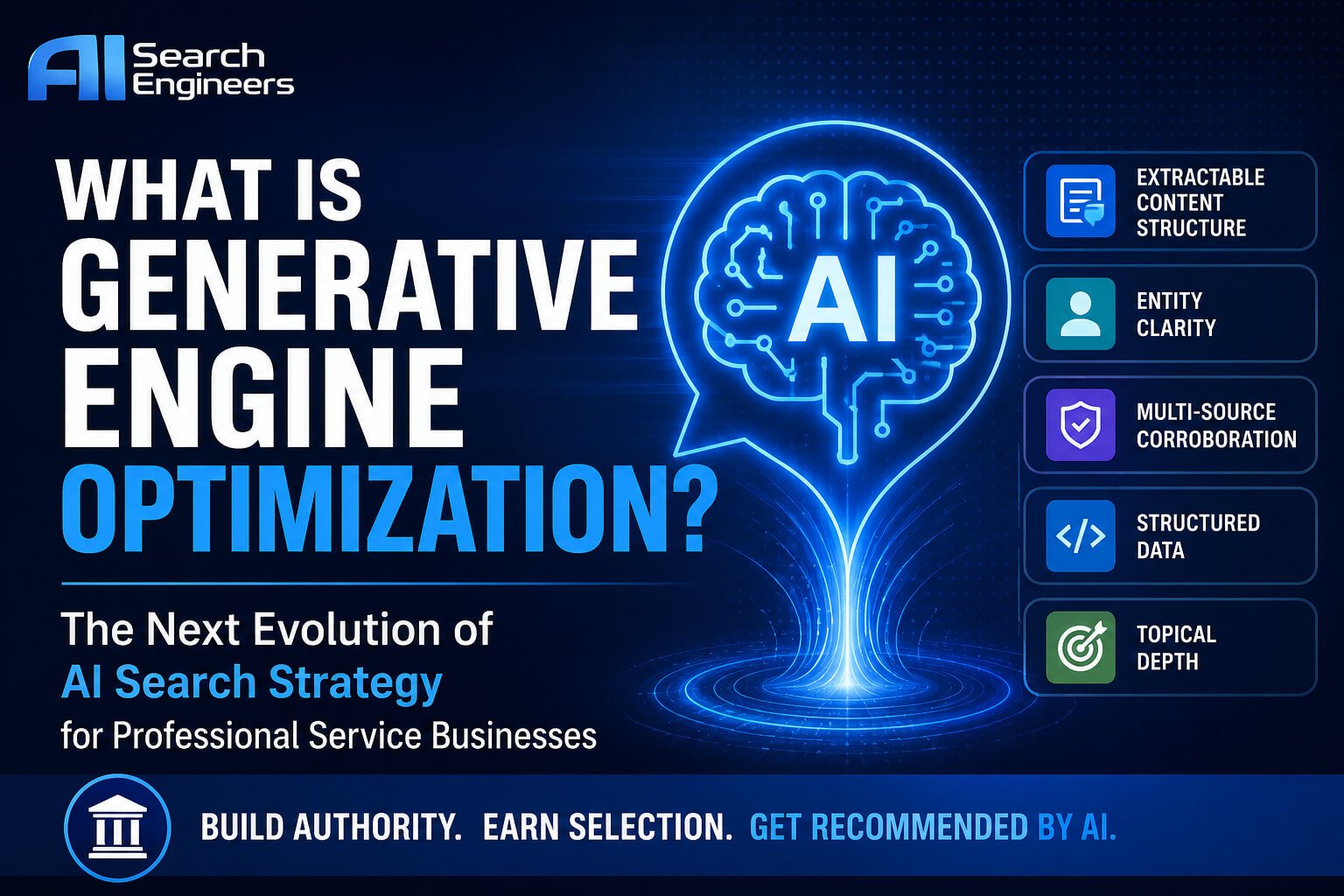
Generative Engine Optimization for Professional Services

There is a new term appearing in conversations about AI search that every professional service business owner needs to understand before their competitors do. 

Generative Engine Optimization. GEO.

It is not a replacement for Answer Engine Optimization. AEO is not a rebranding of SEO. Rather, it is the evolution of the discipline that accounts for how generative AI systems specifically evaluate, select, and present business information in the answers they generate for users. 

Understanding GEO is not optional for professional service businesses that want to remain visible in 2026 and beyond. The AI platforms your potential clients are using to make high-consideration decisions are generative systems. The optimization discipline that makes your business appear in their outputs is generative engine optimization.

This post explains exactly what GEO is, how it relates to SEO and AEO, and the specific steps professional service businesses need to take to build GEO authority before competitors do.

What is generative engine optimization?

Generative Engine Optimization is the discipline of structuring content, authority signals, and entity information so that generative AI systems, platforms that create original responses rather than returning lists of links, select your business as a trusted, citable answer to user queries.

The term reflects a specific characteristic of modern AI search platforms. ChatGPT, Google Gemini, Microsoft Copilot, and Perplexity are not search engines in the traditional sense. These are generative systems. Unlike traditional search engines, they do not retrieve and rank existing pages. Instead, every response gets constructed by drawing from their model of the world, selecting businesses, citing sources, and building answers from the authority signals they have accumulated.

GEO is the discipline of building those authority signals correctly so generative systems select your business rather than passing over it.

GEO and Answer Engine Optimization share the same foundation. Both require entity clarity, structured data, trusted source citations, topical authority, and documented outcomes. The distinction is emphasis; GEO focuses specifically on how generative systems construct responses and what signals influence the construction process, while AEO focuses on the broader discipline of authority engineering for AI answer visibility.

For professional service businesses, understanding both is what produces the most complete and durable AI search visibility strategy.

How GEO differs from SEO and AEO

Understanding the relationship between GEO, SEO, and AEO prevents the confusion that leads most businesses to invest in the wrong discipline for the problem they are trying to solve.

SEO optimizes pages for traditional search engines that return ranked lists of results. The signals it targets, keyword relevance, backlink authority, and technical performance, are evaluated by algorithms that score pages against each other for specific queries. SEO is still relevant for Google organic rankings and local search. It does not transfer to generative AI selection.

AEO, Answer Engine Optimization, is the broader discipline of engineering a brand’s authority so AI systems recognize, trust, and select it as the answer to user queries. AEO covers the full authority engineering process, entity cleanup, structured data deployment, trusted source citation building, topical authority content, and ongoing AI answer validation.

GEO is the specific application of that discipline to generative AI systems, platforms that construct original responses rather than retrieving existing pages. GEO focuses on how generative systems build their models, what content formats they extract most reliably, how they evaluate source trustworthiness, and what signals increase selection probability in a generative response context.

The practical difference is specificity. SEO tells you how to rank on Google. AEO tells you how to build authority for AI selection. GEO tells you specifically how to optimize for the generative construction process that determines what appears in a ChatGPT or Gemini response.

For professional service businesses, all three disciplines are relevant, but the sequencing matters. AEO and GEO address the highest-value client acquisition opportunity right now. SEO maintains the foundation that supports both.

Q: How is generative engine optimization different from SEO?

A: SEO optimizes individual pages for ranked results in traditional search engines. Generative Engine Optimization optimizes entities and content for selection in AI-generated responses. SEO targets keyword relevance and backlink authority. GEO targets entity clarity, structured data, trusted source corroboration, and content formats that generative systems extract reliably. A business can rank on page one of Google through SEO and be completely absent from AI-generated answers. Closing that gap requires GEO and AEO, disciplines built specifically for how generative AI systems evaluate and select businesses.”

The five GEO signals that determine generative AI selection

The signals that determine whether a generative AI system selects your business are the same five signals that underpin Answer Engine Optimization, with specific applications for the generative context.

Signal 1: Extractable content structure

Generative AI systems construct responses by extracting information from their training data and from indexed sources. Content that is structured for extraction, short, specific, quotable answers in FAQ format, is significantly more likely to be incorporated into a generated response than long-form narrative content written for human reading.

Every service page, blog post, and FAQ section should contain at least one block of content that directly answers a specific query in two to four clean sentences. This is the format that generative systems extract most reliably.

Signal 2: Entity clarity for generative attribution

When a generative system constructs a response that includes a business recommendation, it attributes that recommendation to a specific entity. If the entity is ambiguous, described inconsistently across the sources the system draws from, the attribution is uncertain.

Uncertain attributions either get excluded or get attributed to the wrong entity. Entity cleanup, standardizing your business description identically across every platform, is what makes generative attribution accurate and consistent.

Signal 3: Multi-source corroboration

Generative systems build confidence in their responses by drawing from multiple independent sources that agree. A business described consistently across its own website, credible press coverage, industry directories, and trusted third-party platforms has multi-source corroboration.

A business described only on its own domain has single-source data that generative systems treat as unverified. Multi-source corroboration is what transforms a claim into a fact pattern that generative systems cite with confidence.

Signal 4: Structured data for generative parsing

Schema markup gives generative systems structured information they can parse directly without interpretation. Organization schema, FAQ schema, and service-specific schema communicate your business identity, expertise, and client outcomes in a format that generative systems process more reliably than unstructured prose.

The impact of structured data on generative AI selection is immediate because it removes the interpretation step that introduces uncertainty into the selection process.

Signal 5: Topical depth for generative category association

Generative systems associate businesses with specific topics and categories based on the depth and consistency of the content connected to them. A business with deep, specific, consistent content on a defined topic is more likely to be selected for relevant queries than a business with broad, thin coverage across many topics.

Topical depth for GEO requires answer-focused content, specific answers to specific queries in your category, rather than general thought leadership content that demonstrates knowledge without answering specific questions.

Q: What content format works best for generative engine optimization?

A: Short, specific, quotable answers in FAQ format work best for generative engine optimization. Generative AI systems construct responses by extracting information from structured sources, and content written as a direct answer to a specific question in two to four clean sentences is extracted most reliably. Long-form narrative content contributes to topical authority but is rarely extracted directly into generated responses. Every service page and blog post should include FAQ-format sections targeting the exact queries your potential clients ask AI systems.”

Why GEO matters more for professional services than any other category

Professional service businesses face a specific dynamic in generative AI search that makes GEO more commercially significant for them than for most other business categories.

The clients making professional service decisions, which attorney to hire, which financial advisor to trust, which agency to engage, are making high-consideration decisions with significant personal and financial stakes. These clients are more likely to ask generative AI platforms for guidance than clients making lower-stakes decisions.

They are also more likely to act on the AI’s recommendation. A generative response that names a specific law firm and explains why it is trustworthy for a specific practice area carries a weight of implied vetting that influences high-consideration decisions more powerfully than a ranked list of results.

This means that for professional service businesses, appearing in generative AI responses is not just a visibility metric. It is a trust signal that influences client acquisition at the highest-value level.

AI Search Engineers applies GEO and AEO methodology as an integrated system for professional service clients, engineering the specific signals that generative AI platforms use to select, attribute, and recommend businesses in constructed responses across ChatGPT, Google Gemini, Microsoft Copilot, Perplexity, and Grok.

Q: Why is generative engine optimization important for law firms and financial advisors?

A: Law firms and financial advisors serve clients making high-consideration decisions with significant personal and financial stakes, exactly the client segment most likely to ask generative AI platforms for guidance before making a decision. A generative response that names a specific firm and explains why it is trustworthy carries implied vetting that influences high-consideration decisions powerfully. For professional service businesses, GEO is not just a visibility metric; it is a trust signal that directly influences client acquisition at the highest-value level.

How to start building GEO authority today

The starting point for GEO authority is identical to the starting point for AEO, because both disciplines draw from the same five-signal foundation.

Start with an AI visibility audit that identifies exactly which signals are present, which are inconsistent, and which are absent. The audit tells you precisely where your GEO gaps are and in what order to address them.

From there, the five-signal authority engineering process, entity cleanup, structured data deployment, trusted source citation building, answer-focused content engineering, and ongoing AI answer validation build the complete GEO authority stack that makes generative systems select your business consistently across every major AI platform.

The window to establish GEO authority before competitors do is open right now. The discipline exists. The methodology is documented. The results are verified.

The only question is whether you build it before or after your competitors do.