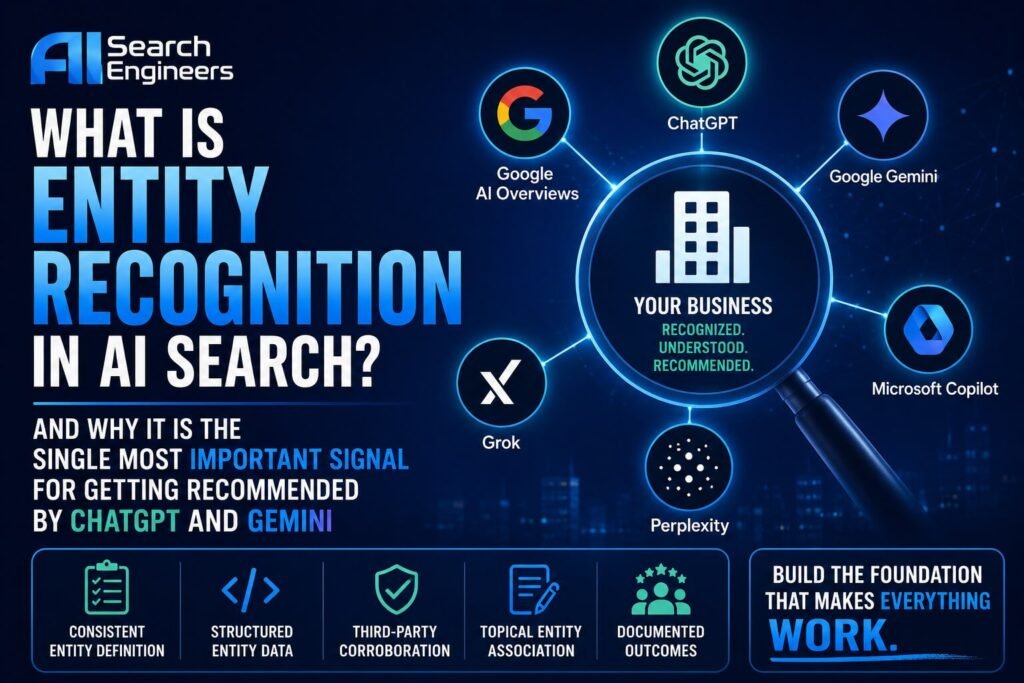
There is one signal that determines whether AI systems can recommend your business, and it is not your keyword rankings, your backlink profile, or your content volume.
It is entity recognition.
Entity recognition is how AI systems identify and understand your business, what it is, what it does, who it serves, and why it should be trusted. Without it, your business does not exist in AI search. Not ranked low. Not difficult to find. Simply absent from the model AI systems draw from when generating recommendations.
With it, every other authority signal you build compounds faster, because AI systems have a stable, clear, confident understanding of what your business is and what it represents.
This post explains exactly what entity recognition is, why it is the foundation of AI search visibility, and the specific steps that build it correctly for professional service businesses.
What is entity recognition?
In the context of AI search, an entity is a defined, recognizable object, a business, a person, a product, a concept, that AI systems can identify unambiguously and associate with reliable information.
Entity recognition is the process by which AI systems identify your business as a specific, known, trustworthy entity distinct from every other business in your category, clearly defined in terms of what it does and who it serves, and consistently represented across the sources AI systems draw from.
A business with strong entity recognition is one that AI systems can answer questions about confidently. What is this business? What does it do? Who does it serve? Is it trustworthy? Has it been validated by independent sources?
A business with weak or absent entity recognition is one that AI systems find ambiguous, inconsistently described, poorly structured, inadequately corroborated, or simply not present in enough of the sources AI systems trust to build a confident model of.
Q: What is entity recognition in AI search?
A: Entity recognition in AI search is the process by which AI systems identify a business as a specific, known, trustworthy entity, clearly defined in terms of what it does, who it serves, and why it should be trusted. A business with strong entity recognition is one that AI systems can describe and recommend confidently. A business with weak entity recognition is one that AI systems find ambiguous and exclude from generated recommendations. Entity recognition is the foundation of AI search visibility; without it, no other authority signal produces consistent results.
Why entity recognition is the single most important signal
Every other AI search authority signal, structured data, trusted source citations, topical authority content, and documented outcomes, depends on entity recognition to function correctly.
Here is why.
Structured data communicates information about your business to AI systems in a machine-readable format. But if AI systems cannot identify which entity the structured data belongs to, because the business name, description, and category are inconsistent across platforms, the structured data contributes nothing to the selection probability.
Trusted source citations give AI systems third-party corroboration of your business’s expertise and authority. But if the citation names your business slightly differently than your website does, AI systems may not connect the citation to your entity, and the corroboration signal is lost.
Topical authority content demonstrates your expertise in a specific category. But if AI systems are uncertain which entity produced the content, because the author, the brand name, and the category description vary across different pages, the topical authority signal is diluted.
Documented client outcomes give AI systems evidence of real-world performance. But if those outcomes are associated with an entity that AI systems cannot confidently identify as yours, they contribute to someone else’s authority signal rather than yours.
Entity recognition is the thread that connects every other signal into a coherent authority stack. Without it, the signals exist but do not compound. With it, every signal reinforces the others, and the authority stack builds faster with each addition.
Q: Why is entity recognition more important than keyword rankings for AI search?
A: Keyword rankings tell Google which pages are relevant to specific queries. Entity recognition tells AI systems which businesses are trustworthy enough to recommend directly in generated answers. AI systems do not evaluate pages; they evaluate entities. A business with strong keyword rankings but weak entity recognition is visible in Google but absent from AI-generated recommendations. A business with strong entity recognition and the five supporting authority signals appears consistently across ChatGPT, Google Gemini, Microsoft Copilot, and Perplexity, regardless of its organic ranking position.”
The five components of strong entity recognition
Building strong entity recognition requires five components working together, each one reinforcing the others and strengthening the confidence AI systems have in identifying and recommending your business.
Component 1: Consistent entity definition
You must describe your business identically across every platform AI systems draw from. Standardize your name, description, category, services, and location across your website, Google Business Profile, LinkedIn, industry directories, and every press or citation profile.
This is not approximately the same. Not similar language. Identical.
Every variation introduces a data point that conflicts with every other data point. AI systems averaging conflicting information produce uncertain conclusions. Uncertain conclusions produce excluded entities.
Component 2: Structured entity data
Organization schema on your homepage is the most direct signal you can give AI systems about your entity. It communicates your business name, URL, description, founding context, area of expertise, and service area in a structured format that AI systems parse directly.
Without an organization schema, AI systems build their model of your entity from unstructured pros, a slower, less reliable, more ambiguous process that produces weaker entity recognition than structured data.
Component 3: Third-party entity corroboration
AI systems build entity models from information gathered across multiple sources. When multiple independent trusted sources describe your business consistently, using the same name, the same category, the same service description, AI systems develop high confidence in their entity model.
When only your own website describes your business, AI systems have a single source with nothing to cross-reference. Single-source entity models are treated as unverified. Unverified entities get excluded.
Press coverage, directory listings, and citations in credible publications each add a corroborating data point that strengthens entity recognition and increases AI recommendation probability.
Component 4: Topical entity association
AI systems associate entities with specific topics, categories, and areas of expertise based on the consistency and depth of the content connected to them.
A business consistently producing specific, structured content about landlord-tenant law builds a strong topical entity association with that category. A business producing generic content across ten practice areas builds weak topical associations with all of them.
Strong topical entity association is what makes AI systems select a business for specific category queries rather than passing over it in favor of a competitor with a clearer category definition.
Component 5: Entity validation through documented outcomes
Verified client reviews and documented outcomes from trusted platforms add a validation layer to entity recognition that transforms it from a structural signal into an evidenced signal.
A business that AI systems recognize as a specific entity in a specific category, and that has documented evidence of delivering results in that category from verified clients, has the strongest possible entity recognition signal available.
This is the signal that moves a business from recognized to recommended with confidence.
Q: How do I build entity recognition for AI search?
A: Building entity recognition requires five components: standardizing your business name description category services and location identically across every platform AI systems draw from, deploying Organization schema that communicates your entity directly to AI systems in machine-readable format, securing trusted source citations that give AI systems third-party corroboration to cross-reference, creating topical authority content that builds consistent category association for your specific area of expertise, and documenting client outcomes from verified platforms that validate your entity with evidence rather than claims.”
The entity recognition audit
Before building entity recognition, it is worth auditing where your entity currently stands, because the gaps are rarely where business owners expect them to be.
Run your business name through five checks.
Check one: Google your business name exactly as it appears on your website. Look at every result that mentions your business. Note whether the description in each result matches your website’s description exactly.
Check two: Search for your business on LinkedIn, Avvo, Justia, or whatever industry directories are relevant to your category. Note whether the name, description, and category match your website exactly.
Check three: Open ChatGPT and type “Tell me about [your business name].” Read what comes back. If the description is inaccurate, thin, or missing entirely, your entity recognition is weak or absent.
Check four: Open Google Gemini and run the same prompt. Note whether the description matches ChatGPT’s description and your own website’s description.
Check five: Search for your business in Perplexity. Note what sources Perplexity cites when describing your business and whether those sources describe you consistently.
The gaps revealed by these five checks tell you exactly where your entity recognition needs work, and in what order to address it.
Q: How do I know if my business has strong entity recognition in AI search?
A: Run five checks: search your business name on Google and note whether every result describes your business consistently, check your industry directory listings for name and description consistency, open ChatGPT and ask it to describe your business and evaluate the accuracy and completeness of the response, run the same prompt in Google Gemini and Perplexity, and compare all five results for consistency. Strong entity recognition produces consistent, accurate descriptions across all five. Weak entity recognition produces inconsistent thin or absent descriptions that vary significantly across platforms.”
How AI Search Engineers build entity recognition
Entity recognition is the first component of every authority engineering engagement that AI Search Engineers conduct, because without it, every other signal is undermined by the ambiguity at the base.
The process starts with a complete entity audit, identifying every platform AI systems draw from when evaluating a business in the relevant category, documenting every description that exists across those platforms, and identifying every inconsistency that introduces uncertainty into the entity model.
From there, the entity cleanup process standardizes the business’s name, description, category, services, and location identically across every platform, building the consistent data foundation that allows every subsequent signal to compound correctly.
Entity recognition is then reinforced through every other component of the five-signal authority engineering process, structured data that encodes the entity in machine-readable format, trusted source citations that corroborate it across independent domains, topical authority content that associates it with a specific category, and documented outcomes that validate it with evidence.
The result is a business that AI systems can identify confidently, describe accurately, and recommend consistently, across ChatGPT, Google Gemini, Google AI Overviews, Microsoft Copilot, Perplexity, and Grok simultaneously.
The bottom line
Entity recognition is not one signal among many. It is the foundation every other AI search authority signal builds on.
Without structured data, trusted citations, topical content, and documented outcomes, each exists in isolation, unable to compound because there is no stable entity for them to attach to.
With it, every signal reinforces the others, every addition compounds the whole, and every improvement to any component strengthens every other component simultaneously.
The first step is finding out exactly where your entity recognition stands right now. An AI visibility audit from AI Search Engineers identifies precisely which entity signals are present, which are inconsistent, and which are absent, and gives you the exact action plan for building the foundation that makes everything else work.