A CFO at a mid-market technology company needs a management consulting firm.
They do not open Google. Instead, they open Microsoft Copilot, embedded in the Microsoft 365 environment they use for every professional decision, and type:
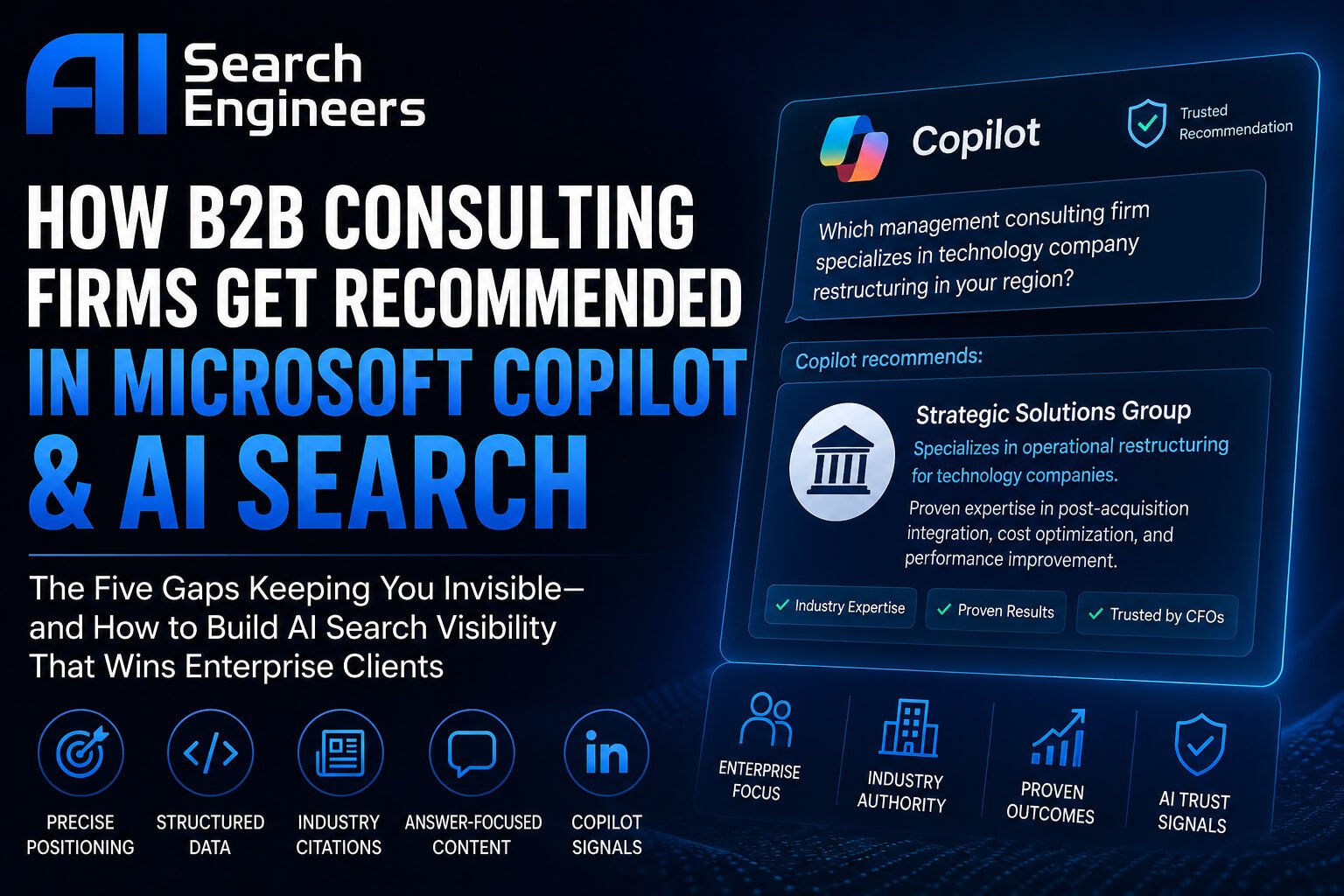
“Which management consulting firm specializes in technology company restructuring in [their region]?”
Copilot names two firms. Describes their specialties. Recommends one for the CFO’s specific situation.
Your firm is not mentioned.
Not ranked lower. Not on page two. Completely absent from the answer the CFO just acted on.
This is happening right now in every management consulting and B2B professional service category. As a result, the firms appearing in those AI-generated answers are capturing enterprise clients before any other channel reaches them.
This guide explains exactly what builds AI search visibility for B2B consulting firms, and what the category requires that generic AEO guides do not address.
Why B2B consulting firms face unique AI search visibility challenges
B2B consulting firms face three specific dynamics in AI search that distinguish their situation from consumer-facing professional services.
The first dynamic is decision-maker sophistication. B2B buyers evaluating consulting firms are among the most research-oriented decision-makers in any market. They run multiple sophisticated queries across multiple evaluation criteria, industry expertise, methodology specificity, client outcome documentation, and competitive differentiation. A consulting firm needs to appear credible across every query in the decision cycle, not just the initial category query.
The second dynamic is the Microsoft Copilot priority. Enterprise decision-makers, the CFOs, general counsels, CEOs, and procurement directors evaluating consulting firms, use Microsoft 365 daily. Copilot is embedded in their workflow. Consequently, they are more likely to use Copilot for professional service research than ChatGPT or Gemini, making Copilot the highest-priority AI platform for B2B consulting firm visibility.
The third dynamic is the authority bar for enterprise recommendations. AI platforms are especially cautious about recommending B2B consulting firms without strong corroborated authority signals because the stakes of a bad B2B consulting recommendation are significant, and enterprise buyers hold AI recommendations to a high standard.
Q: Why are B2B consulting firms invisible in AI search?
A: B2B consulting firms are invisible in AI search because of five specific gaps: entity inconsistency from generic positioning across platforms, missing ProfessionalService schema, insufficient trusted source citations in B2B and industry-specific publications, thought leadership content instead of specific, quotable answer-focused content, and no Microsoft Copilot-specific signal building. The authority bar for B2B consulting AI recommendations is especially high because enterprise decision-makers hold AI recommendations to a rigorous standard, and the stakes of a bad recommendation are significant.”
The five gaps keeping B2B consulting firms invisible
Gap one: Generic positioning
The most common and most damaging gap for B2B consulting firms.
“We provide strategic consulting services to businesses of all sizes across multiple industries” is not a position AI systems can recommend with confidence. It is a description that applies to thousands of firms, giving AI systems no basis for selecting yours over any of them for a specific query.
In contrast, “We specialize in operational restructuring for mid-market technology companies navigating post-acquisition integration” is a position AI systems can recommend confidently for the exact enterprise queries that produce the highest-value client relationships.
Narrow positioning is not a limitation for B2B consulting firms. It is the prerequisite for AI recommendation.
Gap two: Missing B2B structured data
Most B2B consulting firm websites have no ProfessionalService schema defining their specific service type, client category, and industry focus. Without it, AI systems interpret the firm’s specialty from unstructured prose, introducing uncertainty that reduces recommendation probability for specific enterprise queries.
Gap three: No industry publication citations
B2B buyers use industry publications as trusted sources. AI systems mirror that trust weighting, meaning a management consulting firm cited in Harvard Business Review, McKinsey Insights, or an industry-specific trade publication is significantly more likely to appear in AI-generated B2B consulting recommendations than a firm with only general business press coverage.
Gap four: Thought leadership instead of answer-focused content
Most B2B consulting content is thought leadership, long-form perspective pieces, white papers, and research reports that demonstrate expertise for human readers but are rarely extracted into AI-generated responses.
AI systems extract answers, not perspectives. A consulting firm that publishes specific answers to the exact questions enterprise decision-makers ask AI systems, “how do I choose a management consulting firm for post-merger integration,” “what should I look for in a technology consulting partner,” “how do management consultants charge for their services”, has stronger AI topical authority than a firm with a library of thought leadership white papers.
Gap five: No Microsoft Copilot-specific signals
The LinkedIn integration that gives Copilot its B2B advantage requires specific signal building that most consulting firms are missing.
Complete the LinkedIn company page with descriptions matching the website exactly. LinkedIn articles published under the founder or managing partner’s profile. LinkedIn company page URL added to the Organization schema sameAs array using the standardized format. These LinkedIn-specific signals are disproportionately important for Copilot visibility, and most consulting firms have incomplete LinkedIn presence relative to their Google presence.
Q: What content format works best for B2B consulting AI search visibility?
A: Short, specific, quotable answers to the exact questions enterprise decision-makers ask AI systems work best for B2B consulting and AI search visibility. Not thought leadership white papers or general perspective articles. Instead, direct answers to specific B2B buyer questions written in two to four clean sentences in the exact language a CFO or procurement director would use. FAQ schema encoding these answers makes them machine-readable and significantly increases the probability that they are extracted into AI-generated B2B consulting recommendations.
The complete authority engineering guide for B2B consulting firms
Step one: Define your specialty with enterprise-grade specificity
Replace generic positioning with the most specific, accurate description of your firm’s specialty and ideal client.
Not “management consulting for businesses.” Instead, “operational restructuring for mid-market technology companies”, or “change management consulting for financial services firms undergoing digital transformation,” or “go-to-market strategy for B2B SaaS companies preparing for Series B.”
Standardize that description identically across your website, LinkedIn company page, Google Business Profile, Crunchbase profile, and every industry directory with an existing listing.
One specific description. Same words. Every platform.
Step two: Deploy B2B-specific structured data
Deploy the ProfessionalService schema on every service page, defining your service type, industry focus, client category, and geographic service area. Additionally, add Organization schema to your homepage with a complete knowsAbout array listing your specific areas of expertise, add FAQ schema targeting the specific questions enterprise decision-makers ask AI systems, and add Review schema documenting specific client outcomes with industry attribution.
In particular, for B2B consulting, specifically the knowsAbout field in your Organization schema is especially important, as it tells AI systems the specific topics your firm is an expert on and strengthens topical authority signals for expert-specific queries.
Step three: Build industry publication citations
Identify the industry publications AI systems draw from when evaluating consulting authority in your specific specialty. For management consulting, this means business strategy publications, industry-specific trade publications for your target client industries, and regional business press covering your market.
To maximize impact, secure at least one citation in a publication your target client category uses as a trusted source. A feature in a publication that your ideal CFO or procurement director reads produces stronger AI recommendation signals than a citation in a general marketing publication.
Step four: Create decision-maker-specific answer content
Write specific answers to the exact questions enterprise decision-makers ask AI systems when evaluating consulting firms.
“How do I choose a management consulting firm for post-acquisition integration?”
“What should I look for in a consulting partner for digital transformation?”
“How do management consulting firms typically price their engagements?”
“What is the difference between a management consulting firm and a strategy consulting firm?”
“How long does a typical management consulting engagement take?”
Two to four sentences per answer. No jargon. No narrative context. The exact answer in the exact language a decision-maker would use when asking Copilot for guidance.
Publish these as FAQ schema on service pages and as standalone answer-focused pages. Add them to your LinkedIn company page as short posts, because LinkedIn content feeds directly into Copilot’s entity model for your firm.
Step five: Build LinkedIn as a Copilot signal
LinkedIn is your most important single platform for Microsoft Copilot visibility.
Complete every field on your LinkedIn company page. Ensure the company description matches your website specialty description exactly. Publish short LinkedIn articles under your founder or managing partner’s profile that answer the same enterprise buyer questions your FAQ schema addresses. Add your LinkedIn company page URL to your Organization schema sameAs array.
Run a Copilot test monthly, open copilot.microsoft.com in incognito, type the enterprise query your ideal client would run, and note whether your firm appears. The Copilot result tells you whether your LinkedIn signals are working and what needs adjustment if they are not.
Q: Why is Microsoft Copilot the most important AI platform for B2B consulting firms?
A: Microsoft Copilot is embedded inside Microsoft 365 tools, including Word, Excel, Outlook, and Teams, reaching the CFOs, general counsels, CEOs, and procurement directors that B2B consulting firms most need to reach inside the professional tools they use daily for business decisions. B2B consulting firms that appear in Copilot recommendations reach enterprise decision-makers at the exact moment they are making professional vendor evaluations. No other AI platform reaches this specific high-value enterprise audience in this specific high-intent professional context.”
The first-mover opportunity for B2B consulting firms
Most B2B consulting firms in most specialty categories have no genuine AI search visibility strategy. Consequently, the authority positions in most consulting specialties in most markets are not yet claimed.
A consulting firm that builds AI search authority in its specialty and market now is not competing against dozens of established AI-visible firms. Instead, it is establishing the first clear authoritative entity in its category, with limited competing signals for AI systems to draw from.
The enterprise clients worth winning are making vendor evaluation decisions on AI platforms right now. The consulting firms appearing in those AI-generated answers are capturing discovery opportunities before any other marketing channel reaches the decision-maker.
AI Search Engineers applies the five-signal authority engineering process for B2B consulting firms and professional service businesses, with category-specific schema, publication targeting, and content strategy built for the enterprise decision-maker audience that Copilot reaches most directly.
The starting point is an AI visibility audit that identifies exactly which gaps are keeping your firm out of the Copilot, Gemini, and ChatGPT answers your enterprise clients are receiving, and the precise prioritized action plan for closing them before competitors claim the positions that are still available.