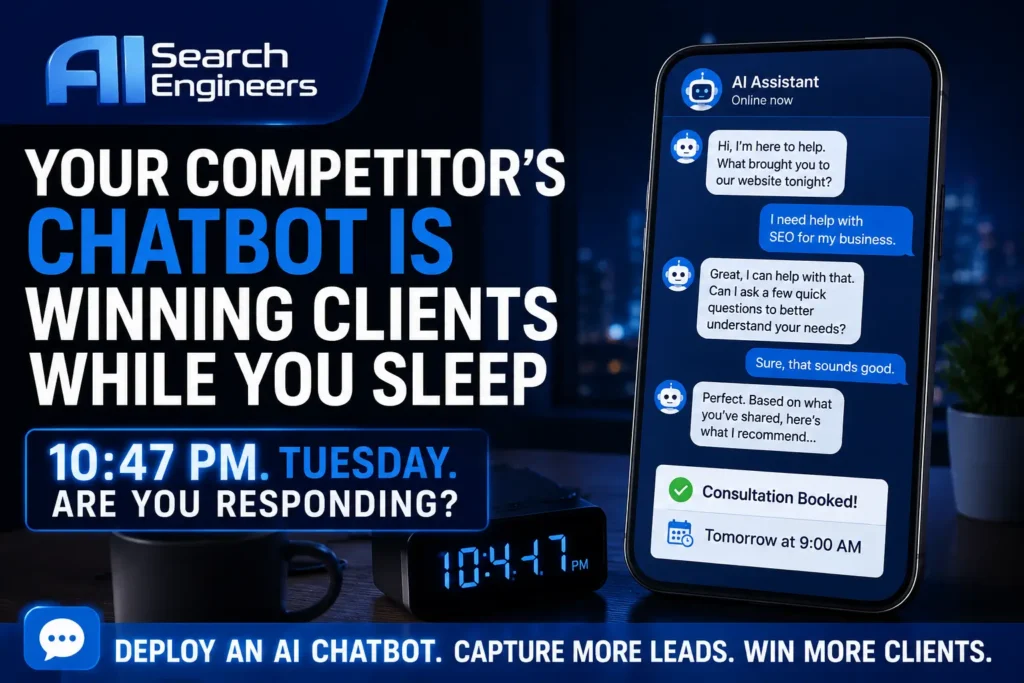
It is 10:47 pm on a Tuesday.
A potential client has finally decided to do something about their situation. They find two businesses that look credible and visit both websites.
The first website is yours. Professional. Clear services. A contact form at the bottom.
The second website belongs to your competitor. A chat window opens the moment they arrive.
“Hi, I am here to help. What brought you to our website tonight?”
They type their question, get an instant answer. Also, book a consultation for 9 am, but they never come back to your website.
You will never know they were there.
This is not a hypothetical. This is happening tonight in your market. And if you do not have an AI chatbot deployed, you are on the wrong side of this scenario every single time.
Why after-hours is when decisions get made
Your potential clients are not making high-consideration decisions during business hours. They are making them late at night, early in the morning, on weekend afternoons, when they finally have time to think.
The moment a potential client decides they need help is the most important in your client acquisition process. They are motivated, ready to act, and will commit to whoever responds first.
If your website is silent at that moment, you have lost the client. Your competitor’s chatbot has not.
Q: Why are AI chatbots necessary for small businesses in 2026?
A: AI chatbots are necessary because client decision-making has moved outside business hours. Potential clients research and evaluate service providers at night and on weekends, exactly when most small business teams are unavailable. An AI chatbot ensures your business responds instantly at every hour, engages visitors before they leave, and captures qualified leads in real time. Without one, every after-hours inquiry goes to whichever competitor responds first.
What your competitor’s chatbot is doing right now
When a visitor engages with a well-configured AI chatbot on a competitor’s website, four things happen simultaneously.
The visitor feels heard immediately. A response in seconds, not hours, not the next business day, creates instant professional credibility your contact form cannot match.
The visitor gets their specific question answered. A well-trained chatbot answers the actual question the visitor asked about their specific situation. That specificity builds trust faster than any homepage copy.
The visitor is guided toward the next step. The conversation moves from question to qualification to commitment. By the time it ends, the visitor has booked.
The lead is captured and routed. Your competitor’s team arrives in the morning with a qualified lead waiting. Your team arrives at an empty inbox.
Q: What are businesses losing without an AI chatbot in 2026?
A: Businesses without an AI chatbot are losing three things simultaneously: after-hours leads to competitors who respond instantly, the trust of potential clients who interpret silence as unresponsiveness, and the pipeline intelligence that comes from automated lead capture and qualification. Every after-hours visitor who leaves without converting is invisible in your analytics. You see a bounce. You do not see a lost client.
The trust gap that opens at 10:47 pm
When a potential client visits your website after hours and gets silence, their perception of your business drops.
Not dramatically. Not consciously. But the absence of response, in an environment where they just experienced an instant helpful answer elsewhere, registers as a signal.
If you do not respond when they are trying to give you business, how will you respond when they are a paying client?
A business with a well-deployed AI chatbot never faces that question. Every visitor at every hour experiences the same professional, responsive interaction. That consistency builds the kind of trust that converts researchers into clients before your competitor even knows they were looking.
Q: How do AI chatbots build trust with potential clients?
A: AI chatbots build trust through immediate, consistent responsiveness. When a potential client receives an instant helpful response at any hour, their perception of the business as professional and client-focused increases significantly. For professional service businesses, this is especially powerful because the client relationship is built on confidence in the provider’s reliability and attentiveness, and the chatbot interaction sets that expectation from the very first contact.
The leads you do not know you are losing
Here is the uncomfortable reality about the chatbot gap.
You cannot see it.
When a potential client visits your website at 10:47 pm and books with your competitor instead, there is no record of it. You see a bounce. You do not see a lost client.
The businesses that have deployed chatbots know what they were missing because they can now see the conversations happening at 11 pm, the leads coming in on Sunday mornings, and the clients who say they chose them because they were the only business that responded right away.
The businesses without chatbots are getting the same traffic. They just have no visibility into how much of it is left for someone who answered.
Q: How do AI chatbots capture leads that would otherwise be lost?
A: AI chatbots capture lost leads by engaging visitors proactively before they leave, answering questions that would go unanswered until business hours, and guiding interested visitors through a qualification sequence that captures contact information and appointment intent in real time. Without a chatbot, after-hours visitors who do not fill out a contact form leave no trace. With a chatbot, those same visitors become qualified leads with full context delivered to your team before the next morning.
The AEO connection: why your chatbot content builds AI search authority
Here is the angle most chatbot guides miss entirely.
The FAQs you write for your chatbot knowledge base are identical to the structured answers AI search platforms like ChatGPT, Google Gemini, and Microsoft Copilot are designed to extract and cite.
When you train your chatbot to answer the questions your clients ask, in clean, clear, quotable language, you are simultaneously building the content signals that make AI search platforms recommend your business in generated answers.
This is the strategy AI Search Engineers build for every professional service client. The chatbot converts the visitors who arrive at your website. AI search visibility, engineered through Answer Engine Optimization, ensures AI platforms recommend your business before the website visit ever happens.
Together, they cover the entire client acquisition journey. From the moment a potential client asks ChatGPT for a recommendation to the moment they book through your chatbot at 10:47 pm on a Tuesday.
Q: How does AI chatbot content connect to AI search visibility?
A: FAQ content written for an AI chatbot knowledge base is structurally identical to the answer-focused content AI platforms extract and cite in generated responses. A business that builds a well-trained chatbot knowledge base is simultaneously building the content signals that strengthen AI search visibility. When both are aligned around the same structured content foundation, each investment compounds the other. Chatbot content improves AEO authority, and AEO authority brings more visitors to the website that the chatbot converts.
The bottom line
Your competitor’s chatbot is answering your client’s questions right now.
Not because they are more sophisticated. Not because they have a bigger budget.
Because they understood that the moment a potential client decides they need help does not happen during business hours.
It happens at 10:47 pm on a Tuesday. On a Sunday morning. At 6 am, before work starts.
The business that responds to that moment gets the client.
Every other business gets a bounce.
The technology costs less than one day of a part-time employee’s salary per month. The setup takes an afternoon. The return starts the night you go live.
The question is not whether you can afford to deploy an AI chatbot in 2026.
The question is whether you can afford not to.