Very few understand exactly what an AI chatbot is, how it is trained, what it actually does when a visitor lands on the website at 11 pm, and how it is different from the contact form they already have.
This post answers all of those questions, in plain language, with specific examples, and with a clear picture of what an AI chatbot actually produces for a professional service business in the first 30 days of deployment.
What an AI chatbot is: the plain language definition
An AI chatbot is a software application that uses artificial intelligence to conduct real-time text conversations with website visitors, answering questions, qualifying situations, capturing contact information, and booking appointments automatically without any human involvement.
It is not a scripted decision tree that forces visitors through a rigid series of yes/no questions. It is a conversational system that understands the intent behind a visitor’s question and responds with a specific relevant answer drawn from a trained knowledge base.
The difference matters enormously for professional service businesses.
A scripted decision tree cannot answer “do you handle situations where a tenant has stopped paying rent and is refusing to respond to notices?” with anything more useful than a generic yes or no. In contrast, an AI chatbot trained on a landlord-tenant law firm’s practice area knowledge answers that question specifically, confirming exactly what the firm handles, what the process looks like, and what the next step is.
That specific answer is the difference between a visitor who commits and a visitor who leaves.
Q: What is an AI chatbot for a professional service website?
A: An AI chatbot for a professional service website is a conversational software application that uses artificial intelligence to answer visitor questions, qualify their situations, capture their contact information, and book consultations automatically at any hour. Unlike scripted decision trees that force visitors through rigid question sequences, an AI chatbot understands the intent behind specific questions and responds with answers drawn from a trained knowledge base, producing specific, accurate responses to the exact questions potential clients ask professional service firms at night.”
How an AI chatbot is trained, the knowledge base
An AI chatbot is only as useful as the knowledge base it is trained on. For professional service businesses, a well-built chatbot knowledge base covers seven specific content categories.
Practice area definitions
Specific descriptions of every service the firm offers in the exact language potential clients use. Not “we provide comprehensive legal services” but “we represent landlords in tenant disputes including non-payment of rent, lease violations, and eviction proceedings in California.”
Process explanations
Step-by-step descriptions of how engagements work from first contact to active service delivery. Clear, plain, specific, not a marketing description but an operational explanation.
Pricing structure
An honest explanation of how services are priced without committing to specific numbers. “Our fees for landlord-tenant matters range from flat fees for straightforward cases to hourly rates for complex litigation; we provide a specific estimate at the initial consultation.”
Availability and booking
The knowledge base clearly explains consultation availability and how quickly new clients can get started, with direct calendar integration enabling immediate booking.
Verified client outcomes: specific short descriptions of real client results covering the most common situation types in the practice area.
Practice area FAQs: Specific answers to the ten most common questions potential clients ask about the practice area in the exact conversational language they use at 11 pm.
Objection responses: Specific responses to the three most common hesitations potential clients raise before committing: cost concerns, timeline concerns, and uncertainty about whether their situation qualifies.
Q: How is an AI chatbot trained for a professional service website?
A: An AI chatbot for a professional service website is trained on a knowledge base covering seven content categories, practice area definitions in client language, process explanations, pricing structure, availability and booking information, verified client outcomes, practice area FAQs targeting the exact questions potential clients ask, and objection responses addressing common hesitations. Ultimately, the quality of the knowledge base determines the quality of the chatbot’s responses; a chatbot trained on specific, accurate practice area knowledge produces specific, accurate answers that convert after-hours visitors into qualified leads.”
How an AI chatbot is different from a contact form
This is the distinction that matters most for professional service business owners evaluating whether a chatbot is worth deploying.
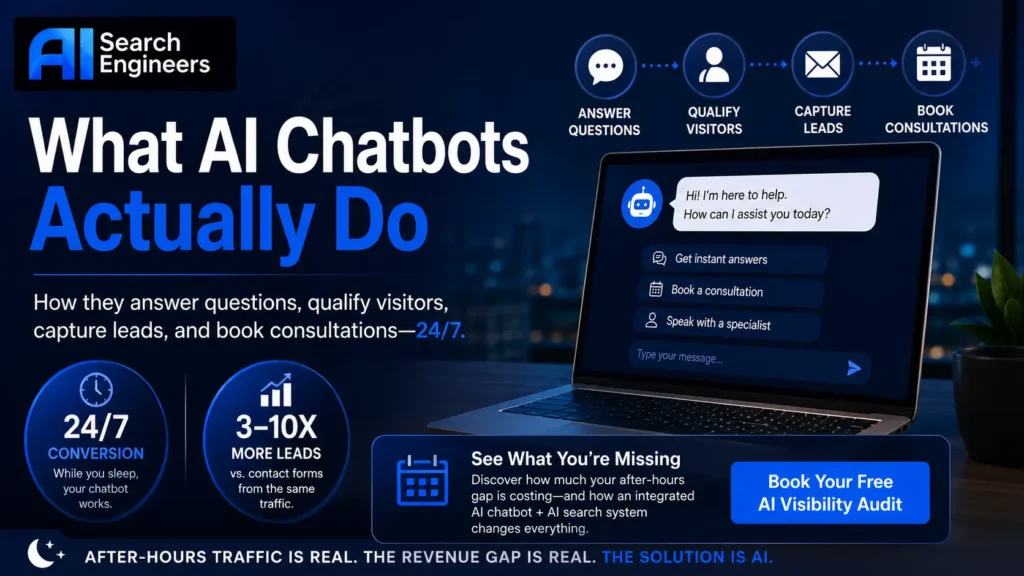
A contact form collects information. An AI chatbot conducts a conversation. A contact form promises a response within one business day. An AI chatbot responds in three seconds. A contact form produces a lead, a name and email that may or may not be followed up effectively. On the other hand, an AI chatbot produces a qualified lead, a name, email, phone number, situation description, and in many cases a booked consultation appointment.
A contact form is passive. It waits for the visitor to decide they are committed enough to fill it out. An AI chatbot is active. It engages the visitor immediately and guides them toward commitment through a natural conversation.
The commercial difference is significant. Contact form conversion rates for professional service websites average between 2 and 5 percent of all visitors.
A well-trained and well-deployed AI chatbot converts between 15 and 25 percent of the same traffic. That means an AI chatbot converts between three and ten times more visitors into leads than a contact form, from the same traffic, at no additional marketing cost.
Q: How is an AI chatbot different from a contact form for professional service websites?
A: A contact form collects information passively and promises a next-business-day response. An AI chatbot conducts an active conversation, responds in three seconds at any hour, produces qualified leads with full situation descriptions rather than just name and email, and offers direct consultation booking in the same conversation. Contact form conversion rates for professional service websites average 2 to 5 percent. AI chatbot conversion rates for the same traffic average 15 to 25 percent, converting three to ten times more visitors into qualified leads from the same website traffic.”
What an AI chatbot produces in the first 30 days
Here is a realistic picture of what a well-deployed AI chatbot produces for a professional service website in the first 30 days, based on AI Search Engineers’ deployment data across law firm, financial advisory, and medical practice client websites.
Week one, baseline establishment. The chatbot goes live. Initial conversations begin. The team monitors conversations and identifies any knowledge base gaps, questions the chatbot could not answer specifically enough. As a result, the team makes knowledge base refinements.
Week two: conversion optimization. Conversation patterns emerge.
The team refines the chatbot based on the most common questions, objections, and the specific language potential clients use to describe their situations.
Conversion rates begin improving as the knowledge base becomes more precisely calibrated to actual visitor questions.
Week three: consistent lead flow. Qualified leads are arriving in the team inbox every morning. Booked consultations from overnight sessions appear in the calendar before the team starts work. By this point, the after-hours revenue gap is visibly closing.
Week four, data-driven expansion. The chatbot conversation data reveals which questions are most common, which situations clients describe most frequently, and which objections they raise most often, intelligence that improves both the chatbot knowledge base and the firm’s broader marketing and content strategy.
By the end of 30 days, most professional service firms that deploy a well-trained AI chatbot are capturing significantly more after-hours leads than before deployment, from traffic that was always there but previously converting nowhere.
The connection to AI search visibility
An AI chatbot does not just convert after-hours visitors. It strengthens the AI search authority that brings those visitors to the website in the first place.
Building a chatbot knowledge base in FAQ format, specific two-to-four sentence answers to specific questions in the exact language potential clients use, simultaneously creates the topical authority content that AI search platforms extract and cite when generating recommendations.
The Midnight Client arrives at the website because an AI platform recommended the firm. The chatbot converts them upon arrival. Both systems draw from the same content foundation, one investment producing two compounding outcomes.
AI Search Engineers builds AI chatbot knowledge bases as part of the integrated AI search visibility and after-hours conversion system, so the content that powers the chatbot simultaneously strengthens the AI search authority that fills the chatbot’s conversation queue every night.
Book a free AI visibility audit to find out what your after-hours gap is costing and what an integrated system would change.