What Is an AI Chatbot and How Does It Work?

Very few understand exactly what an AI chatbot is, how it is trained, what it actually does when a visitor lands on the website at 11 pm, and how it is different from the contact form they already have.

This post answers all of those questions, in plain language, with specific examples, and with a clear picture of what an AI chatbot actually produces for a professional service business in the first 30 days of deployment.

What an AI chatbot is: the plain language definition

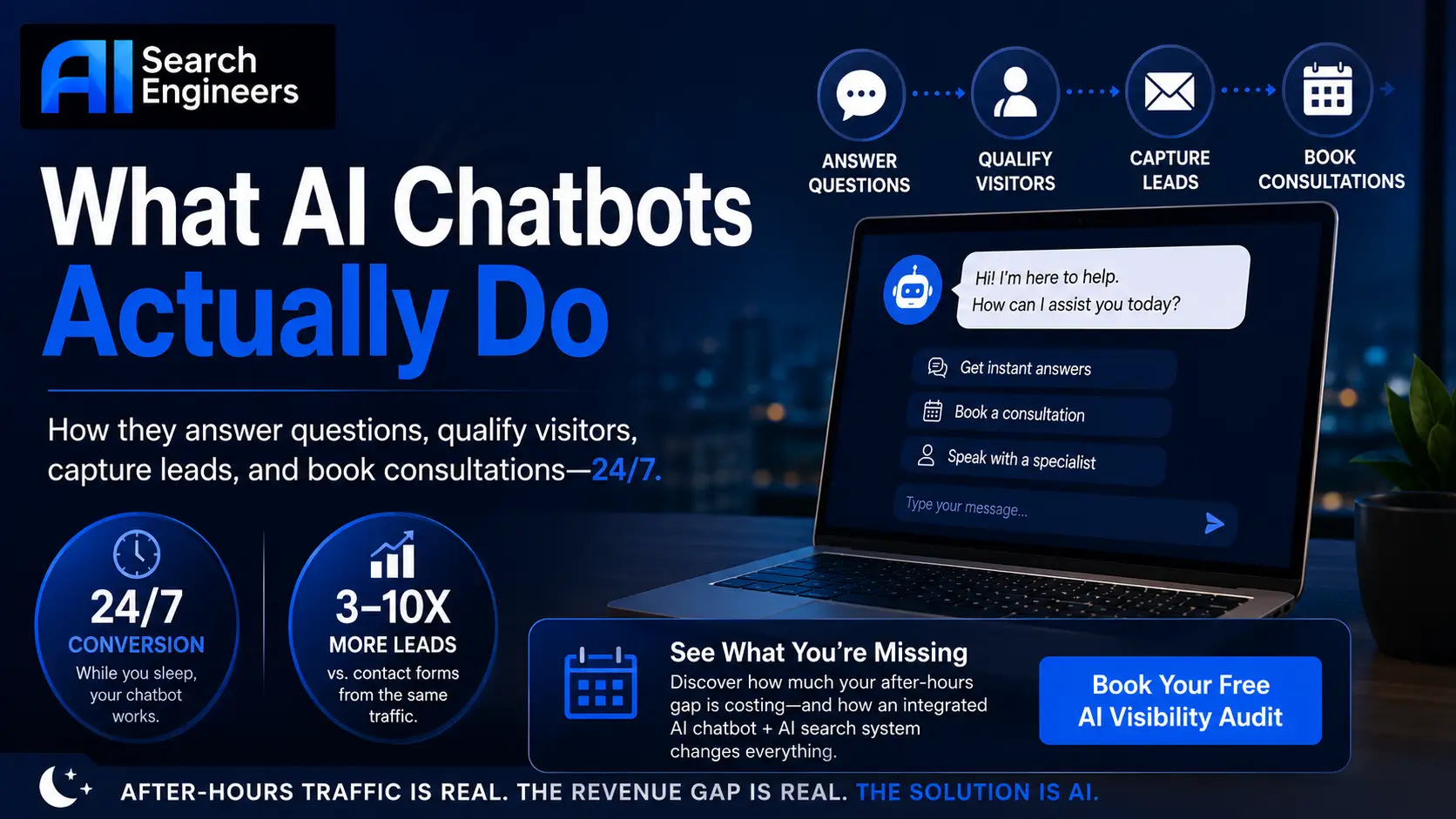
An AI chatbot is a software application that uses artificial intelligence to conduct real-time text conversations with website visitors, answering questions, qualifying situations, capturing contact information, and booking appointments automatically without any human involvement.

It is not a scripted decision tree that forces visitors through a rigid series of yes/no questions. It is a conversational system that understands the intent behind a visitor’s question and responds with a specific relevant answer drawn from a trained knowledge base.

The difference matters enormously for professional service businesses.

A scripted decision tree cannot answer “do you handle situations where a tenant has stopped paying rent and is refusing to respond to notices?” with anything more useful than a generic yes or no. In contrast, an AI chatbot trained on a landlord-tenant law firm’s practice area knowledge answers that question specifically, confirming exactly what the firm handles, what the process looks like, and what the next step is.

That specific answer is the difference between a visitor who commits and a visitor who leaves.

Q: What is an AI chatbot for a professional service website?

A: An AI chatbot for a professional service website is a conversational software application that uses artificial intelligence to answer visitor questions, qualify their situations, capture their contact information, and book consultations automatically at any hour. Unlike scripted decision trees that force visitors through rigid question sequences, an AI chatbot understands the intent behind specific questions and responds with answers drawn from a trained knowledge base, producing specific, accurate responses to the exact questions potential clients ask professional service firms at night.”

How an AI chatbot is trained, the knowledge base

An AI chatbot is only as useful as the knowledge base it is trained on. For professional service businesses, a well-built chatbot knowledge base covers seven specific content categories.

Practice area definitions

Specific descriptions of every service the firm offers in the exact language potential clients use. Not “we provide comprehensive legal services” but “we represent landlords in tenant disputes including non-payment of rent, lease violations, and eviction proceedings in California.”

Process explanations

Step-by-step descriptions of how engagements work from first contact to active service delivery. Clear, plain, specific, not a marketing description but an operational explanation.

Pricing structure

An honest explanation of how services are priced without committing to specific numbers. “Our fees for landlord-tenant matters range from flat fees for straightforward cases to hourly rates for complex litigation; we provide a specific estimate at the initial consultation.”

Availability and booking

The knowledge base clearly explains consultation availability and how quickly new clients can get started, with direct calendar integration enabling immediate booking.

Verified client outcomesspecific short descriptions of real client results covering the most common situation types in the practice area.

Practice area FAQs: Specific answers to the ten most common questions potential clients ask about the practice area in the exact conversational language they use at 11 pm.

Objection responses: Specific responses to the three most common hesitations potential clients raise before committing: cost concerns, timeline concerns, and uncertainty about whether their situation qualifies.

Q: How is an AI chatbot trained for a professional service website?

A: An AI chatbot for a professional service website is trained on a knowledge base covering seven content categories, practice area definitions in client language, process explanations, pricing structure, availability and booking information, verified client outcomes, practice area FAQs targeting the exact questions potential clients ask, and objection responses addressing common hesitations. Ultimately, the quality of the knowledge base determines the quality of the chatbot’s responses; a chatbot trained on specific, accurate practice area knowledge produces specific, accurate answers that convert after-hours visitors into qualified leads.”

How an AI chatbot is different from a contact form

This is the distinction that matters most for professional service business owners evaluating whether a chatbot is worth deploying.

A contact form collects information. An AI chatbot conducts a conversation. A contact form promises a response within one business day. An AI chatbot responds in three seconds. A contact form produces a lead, a name and email that may or may not be followed up effectively. On the other hand, an AI chatbot produces a qualified lead, a name, email, phone number, situation description, and in many cases a booked consultation appointment.

A contact form is passive. It waits for the visitor to decide they are committed enough to fill it out. An AI chatbot is active. It engages the visitor immediately and guides them toward commitment through a natural conversation.

The commercial difference is significant. Contact form conversion rates for professional service websites average between 2 and 5 percent of all visitors.

A well-trained and well-deployed AI chatbot converts between 15 and 25 percent of the same traffic. That means an AI chatbot converts between three and ten times more visitors into leads than a contact form, from the same traffic, at no additional marketing cost.

Q: How is an AI chatbot different from a contact form for professional service websites?

A: A contact form collects information passively and promises a next-business-day response. An AI chatbot conducts an active conversation, responds in three seconds at any hour, produces qualified leads with full situation descriptions rather than just name and email, and offers direct consultation booking in the same conversation. Contact form conversion rates for professional service websites average 2 to 5 percent. AI chatbot conversion rates for the same traffic average 15 to 25 percent, converting three to ten times more visitors into qualified leads from the same website traffic.”

What an AI chatbot produces in the first 30 days

Here is a realistic picture of what a well-deployed AI chatbot produces for a professional service website in the first 30 days, based on AI Search Engineers’ deployment data across law firm, financial advisory, and medical practice client websites.

Week one, baseline establishment. The chatbot goes live. Initial conversations begin. The team monitors conversations and identifies any knowledge base gaps, questions the chatbot could not answer specifically enough. As a result, the team makes knowledge base refinements.

Week two: conversion optimization. Conversation patterns emerge.

The team refines the chatbot based on the most common questions, objections, and the specific language potential clients use to describe their situations.

Conversion rates begin improving as the knowledge base becomes more precisely calibrated to actual visitor questions.

Week three: consistent lead flow. Qualified leads are arriving in the team inbox every morning. Booked consultations from overnight sessions appear in the calendar before the team starts work. By this point, the after-hours revenue gap is visibly closing.

Week four, data-driven expansion. The chatbot conversation data reveals which questions are most common, which situations clients describe most frequently, and which objections they raise most often, intelligence that improves both the chatbot knowledge base and the firm’s broader marketing and content strategy.

By the end of 30 days, most professional service firms that deploy a well-trained AI chatbot are capturing significantly more after-hours leads than before deployment, from traffic that was always there but previously converting nowhere.

The connection to AI search visibility

An AI chatbot does not just convert after-hours visitors. It strengthens the AI search authority that brings those visitors to the website in the first place.

Building a chatbot knowledge base in FAQ format, specific two-to-four sentence answers to specific questions in the exact language potential clients use, simultaneously creates the topical authority content that AI search platforms extract and cite when generating recommendations.

The Midnight Client arrives at the website because an AI platform recommended the firm. The chatbot converts them upon arrival. Both systems draw from the same content foundation, one investment producing two compounding outcomes.

AI Search Engineers builds AI chatbot knowledge bases as part of the integrated AI search visibility and after-hours conversion system, so the content that powers the chatbot simultaneously strengthens the AI search authority that fills the chatbot’s conversation queue every night.

Book a free AI visibility audit to find out what your after-hours gap is costing and what an integrated system would change.
AI Chatbots for Professional Service Lead Capture

Every professional service website has a gap most businesses never see in their analytics.

Between 8 pm and 8 am, while the team is offline, while the phones are silent, while the contact form sits waiting, motivated potential clients are visiting the website, reading the services page, forming an opinion, and leaving.

Not because the website is bad. Not because the services are wrong. Because there is nobody there to answer their one specific question.

An AI chatbot closes that gap, permanently, automatically, and at any hour.

This guide explains exactly how AI chatbots capture leads, book consultations, and build client relationships for professional service businesses, and why deploying one is the single fastest improvement available for after-hours revenue.

The after-hours revenue gap

Pull up your website analytics right now. Filter sessions between 8 p.m., and 8 am.

For most professional service businesses, this number is between 25 and 40 percent of total weekly traffic.

That means one in four visitors, sometimes one in three, arrives when nobody is available to respond. Without an AI chatbot, every single one of those visitors gets the same response: a contact form promising a next-business-day reply. Most of them leave before submitting it. The ones who do submit rarely wait until morning. They find a competitor who responds faster.

With an AI chatbot, every visitor gets an instant, specific response at 2 a.m. Sunday, on a public holiday, that answers their question, qualifies their situation, and books their consultation before the next business day begins.

The gap between those two outcomes, measured in booked consultations, qualified leads, and new client relationships, is the after-hours revenue gap. And it compounds every week the chatbot is not deployed.

Q: How much website traffic do professional service businesses receive after hours?

A: Most professional service businesses receive between 25 and 40 percent of their total weekly website traffic outside business hours between 8 pm and 8 am. After-hours visitors are among the most motivated on the site because they have carved out personal time to research a specific situation. Without an AI chatbot, every after-hours visitor receives a contact form rather than an instant response, and most leave for competitors who respond faster before the next business day begins.”

What an AI chatbot does: the five functions

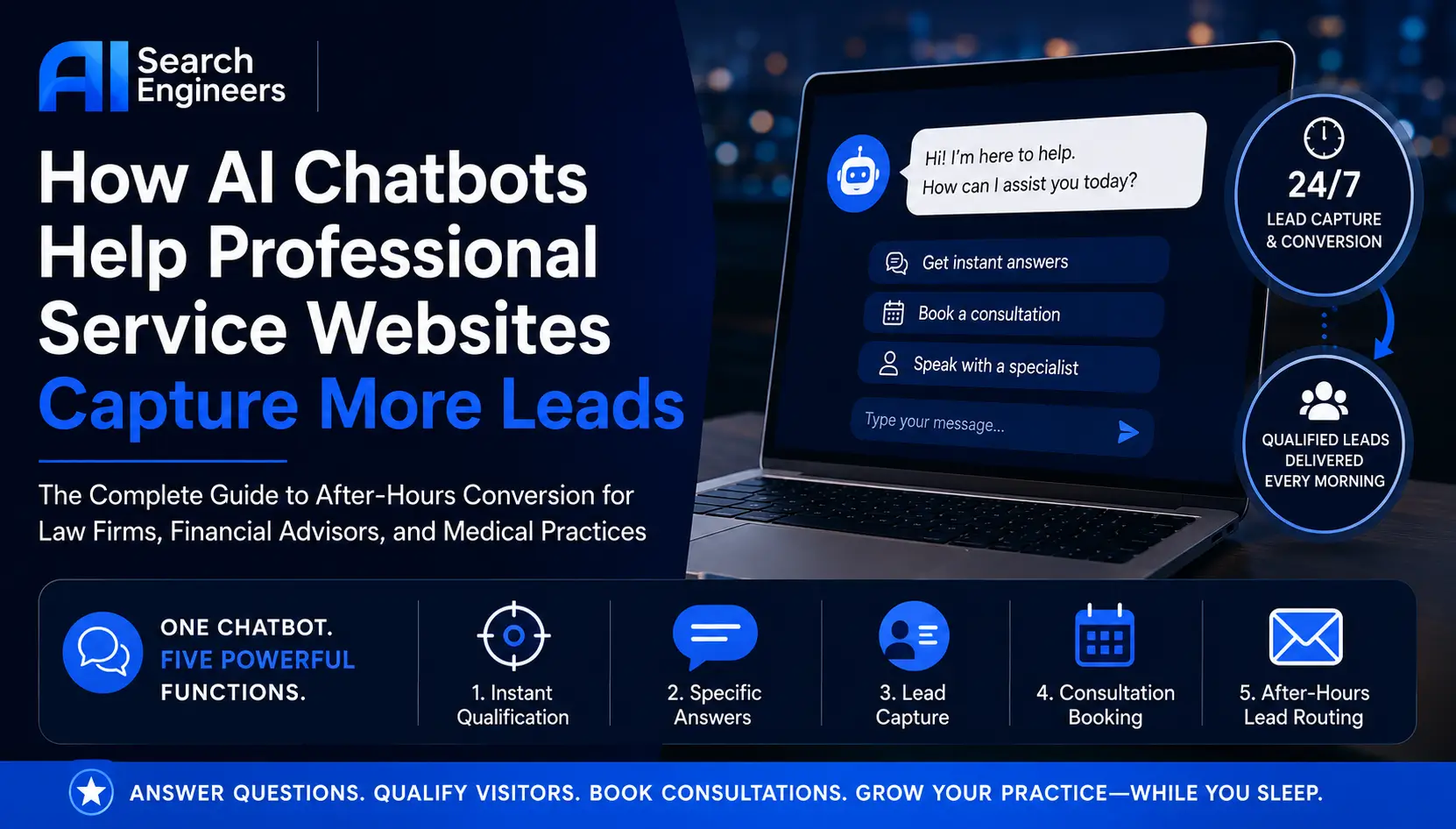
An AI chatbot deployed on a professional service website performs five specific functions that a contact form cannot replicate.

Function one: Instant qualification

The moment a visitor arrives, the chatbot engages them with a specific contextual opening tied to their landing page. A visitor on the estate planning page gets asked about their specific estate planning situation. A visitor on the financial advisor page gets asked about their wealth management goals.

This instant qualification confirms relevance before the visitor has decided whether to engage, reducing bounce rates and increasing the quality of every subsequent conversation.

Function two: Specific question answering

When a visitor asks a specific question, the chatbot answers it using the firm’s actual service descriptions, practice area knowledge, and client outcome documentation.

Not a generic answer. Not a redirect to a contact form. A specific, accurate answer that directly addresses the visitor’s situation and moves the conversation toward commitment.

Function three: Lead capture

At the natural point of conversion, the chatbot captures the visitor’s name, email address, phone number, and a brief description of their situation, conversationally, not through a form.

Conversational lead capture produces significantly higher completion rates than form-based lead capture because it feels like a natural next step in a conversation rather than a data collection exercise.

Function four: Consultation booking

With calendar integration, the chatbot offers direct consultation booking in the same conversation. The visitor sees available slots, selects one, and confirms their booking without leaving the chat window.

This is the function that transforms the chatbot from a lead capture tool into a revenue generation system, because a booked consultation is not a lead. It is a committed appointment with a qualified potential client.

Function five: After-hours lead routing

Every conversation, every lead captured, and every consultation booked is immediately routed to the firm’s team inbox, so the first thing the team sees every morning is a queue of qualified leads and booked appointments from the overnight sessions.

This changes the morning experience for professional service teams, from an empty inbox waiting for the day’s inquiries to a full queue of motivated potential clients who engaged while the team was offline.

Q: What does an AI chatbot do for a professional service website?

A: An AI chatbot performs five functions for professional service websites: instant visitor qualification through contextual opening questions, specific question answering using the firm’s actual service knowledge, conversational lead capture collecting name, email, one-line situation description, direct consultation booking through calendar integration, and overnight lead routing delivering qualified leads and booked appointments to the team inbox every morning. Together, these five functions convert after-hours website traffic that would otherwise leave without engaging into a consistent source of qualified leads and booked consultations.”

AI chatbots for law firms: what they answer

For law firms specifically, an AI chatbot trained on the firm’s practice areas, jurisdictions, engagement process, fee structure, and verified client outcomes answers the questions that determine whether a potential client commits or leaves.

“Do you handle situations where a tenant has not paid rent for three months?”
“What is your process for an uncontested divorce?”
“How much does an immigration consultation cost?”
“Have you handled cases involving commercial lease disputes?”
“How quickly can we schedule an initial consultation?”

Every one of these questions has a specific answer that the firm can provide, nd every one of them is a question a potential client asks at 11 p.m., when they have finally decided to do something about their situation.

A chatbot trained on these answers converts those 111 pmvisitors into booked morning consultations. A contact form loses them to competitors who respond faster.

AI chatbots for financial advisors: what they answer

For financial advisors, an AI chatbot trained on the firm’s service categories, fee structure, client minimums, investment philosophy, and verified client outcomes answers the questions that determine whether a high-net-worth potential client trusts the firm enough to take the next step.

“Do you work with business owners planning for retirement?”
“What is the minimum portfolio size you manage?”
“Are you a fee-only advisor or do you earn commissions?”
“What does the onboarding process look like?”
“Have you worked with clients going through a business sale?”

These questions are asked at midnight by financially qualified potential clients who have carved out personal time to evaluate wealth management options. The first firm that answers them specifically and immediately gets the discovery call.

AI chatbots for medical practices: what they answer

For medical practices, an AI chatbot trained on the practice’s specialties, conditions treated, insurance accepted, appointment availability, and patient outcome documentation answers the questions that determine whether a patient books or moves to the next practice on their list.

“Do you treat patients with [specific condition]?”
“Are you accepting new patients?”
“Do you accept [specific insurance]?”
“How quickly can I get an appointment?”
“What should I expect at my first visit?”

Patients researching medical providers after hours are often in situations with emotional urgency: a new diagnosis, a chronic condition that has worsened, or a referral they need to act on. The practice that responds to them instantly at 10 p.m. captures a patient who would otherwise have waited until morning and called the first practice on their list.

Q: What specific questions do AI chatbots answer for professional service businesses?

A: AI chatbots for professional service businesses answer five categories of questions: practice area or service for questions confirming the firm handles the visitor’s specific situation, process questions explaining how engagements work, pricing questions providing fee structure information without committing to specific numbers, availability questions offering direct consultation booking, and outcome questions providing specific verified client results that build trust. Every answer is drawn from the firm’s actual knowledge base, producing specific, accurate responses rather than generic chatbot replies.”

The dual-purpose content advantage

Here is the strategic insight that makes AI chatbot deployment more valuable than most businesses realize.

The content that trains your AI chatbot, specific answers to the questions every after-hours visitor asks, is identical in format to the topical authority content that makes ChatGPT and Google Gemini recommend your firm before the website visit ever happens.

Both systems need the same thing. Specific. Structured. Quotable answers in FAQ format.

Build the chatbot knowledge base in FAQ format and you simultaneously build the AI search authority content that produces organic recommendations on every major AI platform.

One content investment. Two deployment paths. Every moment in the client decision process covered.

AI Search Engineers builds AI chatbot knowledge bases and AI search visibility systems as one integrated investment; every answer your chatbot gives at 2 a.m. simultaneously strengthens the AI search authority that brings motivated clients to your website in the first place.

Book a free AI visibility audit to find out exactly what your after-hours gap is costing, and exactly what an integrated chatbot and AI search system would change.