Every AI search visibility conversation eventually comes back to one foundational concept.
Entity recognition.
It is the signal that determines whether ChatGPT, Google Gemini, Microsoft Copilot, and Perplexity can identify your business, describe it accurately, and recommend it confidently, or whether they pass it over entirely in favor of a competitor with a clearer, more consistent, more corroborated identity.
Everything else in AI search visibility– structured data, trusted source citations, topical authority, documented outcomes- builds on top of entity recognition. Without it, every other signal is weakened. With it, every other signal compounds.
This post explains exactly what entity recognition is, why it matters more than any other AI search signal, and the precise steps that build it correctly for professional service businesses.
What entity recognition is
Entity recognition is the degree to which AI systems can confidently identify your business as a specific, unambiguous, well-defined entity, distinct from every other business in your category and market.
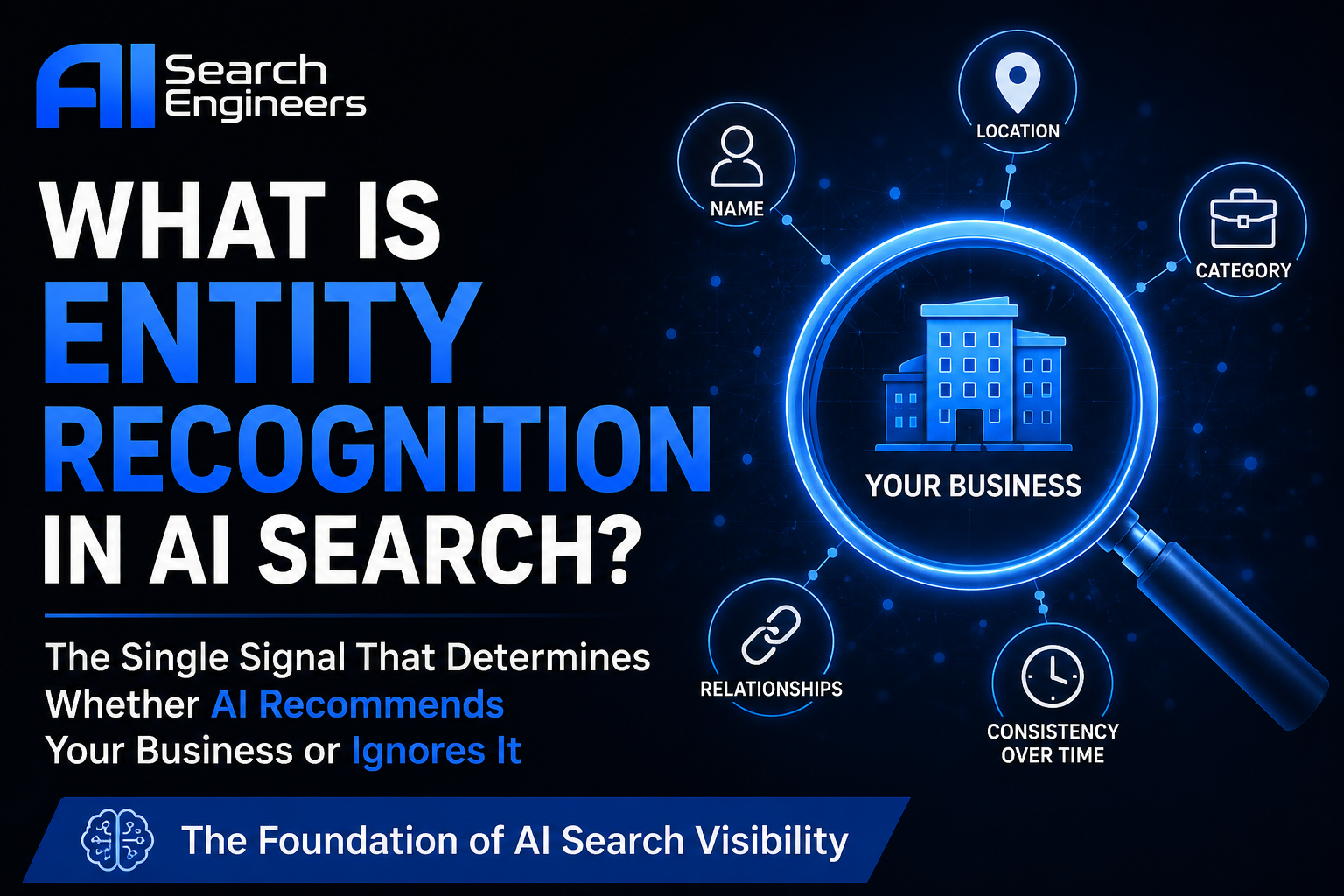
An entity in AI search is not a webpage. It is not a keyword. It is the entire structured identity of your business, your name, your category, your location, your expertise, your relationships to other entities, and your presence across the platforms AI systems draw from.
When AI systems encounter a query, “who is the best estate planning attorney in [city]?” they do not search for pages that contain those keywords. They evaluate entities that match that description and select the one with the strongest, most consistent, most corroborated identity.
Entity recognition is the process by which AI systems build that evaluation. It is the foundational layer of AI search visibility, and it is the layer most professional service businesses have never addressed.
Q: What is entity recognition in AI search?
A: Entity recognition in AI search is the degree to which AI systems can confidently identify a business as a specific, unambiguous, well-defined entity based on consistent signals across every platform they draw from. AI systems evaluate entities, not pages, when generating recommendations. A business with strong entity recognition is consistently identified, accurately described, and confidently recommended. A business with weak entity recognition is ambiguous, unverified, or absent from AI-generated answers regardless of its Google rankings or website quality.”
Why entity recognition matters more than any other signal
Every other AI search visibility signal depends on entity recognition as its foundation.
Structured data is more effective when it is attached to a recognized entity. FAQ schema deployed on a well-recognized entity produces faster AI Overview appearances than the same schema deployed on an ambiguous entity, because AI systems can confidently attribute the FAQ content to a specific business they already recognize.
Trusted source citations are more valuable when they reference a recognized entity. A press citation that mentions a business name AI systems can confidently match to a known entity corroborates that entity. A press citation that mentions a business name AI systems cannot confidently match to any entity they recognize contributes almost nothing to AI selection probability.
Topical authority content is more powerful when it is associated with a recognized entity. Content that AI systems can attribute to a specific recognized entity in a specific category builds category association faster and more reliably than content attributed to an ambiguous entity.
Documented outcomes carry more weight when they are attached to a recognized entity. A verified client review that AI systems can attribute to a specific recognized professional service firm is a trust signal. The same review attributed to an ambiguous entity is noise.
Entity recognition is not one signal among five equal signals. It is the foundation that determines how effectively every other signal performs.
Q: Why is entity recognition more important than other AI search signals?
A: Entity recognition is the foundational signal because every other AI search visibility signal depends on it. Structured data is more effective when attached to a recognized entity. Trusted source citations are more valuable when they reference an entity AI systems can confidently match. Topical authority content builds category association faster when attributed to a recognized entity. Documented outcomes carry more trust weight when attached to a recognized entity. Without strong entity recognition, every other signal produces weaker results than it would on a well-recognized entity foundation.”
The five dimensions of entity recognition
AI systems build entity recognition across five specific dimensions, and weakness in any dimension suppresses entity recognition across every platform simultaneously.
Dimension one, Name consistency
Your business name must be identical across every platform AI systems draw from: website, Google Business Profile, LinkedIn, industry directories, press citations, schema markup, and social profiles.
Every variation- abbreviated names, different punctuation, different formatting -introduces ambiguity that AI systems register as uncertainty. A business that appears as “Smith Law Firm” on its website, “Smith & Associates” on LinkedIn, and “The Smith Law Group” in a press citation is presenting three different entities to AI systems trying to build a coherent entity model.
Dimension two: Category definition
Your business must be clearly and specifically defined in a category that AI systems can use to match it to relevant queries.
“Full service law firm” is not a category AI systems can use to recommend you for estate planning queries. “Estate planning and probate law firm serving high-net-worth families in [city]” is a category that directly matches the queries your potential clients are running.
The more specific and consistent your category definition across every platform, the stronger your entity recognition for category-specific queries.
Dimension three: Geographic specificity
Your location must be clearly and consistently defined across every platform, and that definition must match the geographic queries your potential clients run.
A business located in Los Angeles that describes its location differently across its website, Google Business Profile, and schema markup- sometimes “Los Angeles,” sometimes “LA,” sometimes “Greater Los Angeles Area”- has geographic ambiguity that suppresses entity recognition for local professional service queries.
Dimension four: Relationship signals.
AI systems build entity recognition partially through the relationships between entities, the connections between your business and other recognized entities in its category.
Your founding partner is a person entity. Your state bar association is an organization entity. The publications that have cited your firm are media entities. The connections between your business entity and these other recognized entities strengthen your entity recognition by placing your business in a network of known relationships.
Person schema naming your founding partner, sameAs arrays linking to recognized organization profiles, and press citations from recognized publications all build relationship signals that strengthen entity recognition.
Dimension five: Temporal consistency
AI systems weight entity information that has been consistent over time more heavily than entity information that has only recently appeared.
A business that has maintained consistent entity signals across the same platforms for twelve months has stronger entity recognition than a business that deployed the same signals last week, because temporal consistency is itself a trust signal that AI systems use to evaluate entity reliability.
This is why the first-mover advantage in AI search visibility is structural: entity recognition accumulated over time cannot be replicated quickly regardless of how aggressively a late mover deploys signals.
Q: How do AI systems build entity recognition for a business?
A: AI systems build entity recognition across five dimensions: name consistency across all platforms, category definition specificity, geographic consistency, relationship signals connecting the business to other recognized entities, and temporal consistency indicating the entity information has been stable over time. Weakness in any dimension suppresses entity recognition across every AI platform simultaneously. Strong entity recognition across all five dimensions is the foundational requirement for consistent AI-generated recommendations.”
How to build entity recognition: the exact steps
Step one: Entity audit
Before building entity recognition, you need to know exactly where it is inconsistent.
Open your website, Google Business Profile, LinkedIn company page, primary industry directory listing, and any press citations that exist for your business. Compare your business name, category description, location, and service description across all five.
Document every variation. Every variation is a gap. Every gap suppresses entity recognition across every AI platform simultaneously.
Step two: Canonical entity definition
Create a single canonical entity definition for your business: the exact name, category, location, and description that will be used identically across every platform.
Your canonical name should match your legal business name exactly. Your canonical category should be your most specific, accurate practice area description. Also, your canonical location should be your primary city and state in standard format. Your canonical description should be two to three sentences that describe exactly what you do, who you serve, and where you operate.
Write this down. It is the foundation of everything that follows.
Step three: Platform standardization
Update every platform with your canonical entity definition.
Website: update your homepage title, meta description, and about section. Google Business Profile: update your business name, category, and description. LinkedIn: update your company page name, tagline, and about section. For every industry directory with an existing profile, update name, category, and description. Schema markup: ensure your Organization schema name, description, and areaServed fields match your canonical definition exactly.
This standardization eliminates the entity ambiguity that is currently suppressing your AI search visibility, and creates the consistent entity foundation that every subsequent signal builds on top of.
Step four: Wikidata entry
Create a Wikidata entry for your business the single most impactful entity recognition action available.
Wikidata is the structured knowledge database that ChatGPT, Google Gemini, and Microsoft Copilot draw from when building their understanding of entities. A Wikidata entry places your business inside the structured knowledge layer AI systems trust most, and is the primary trigger for a Google Knowledge Panel.
Step five: sameAs array expansion
Add your Wikidata URL, LinkedIn company page URL, Crunchbase URL, and press citation URLs to your Organization schema sameAs array.
The sameAs array creates cross-references between your website entity and your external profiles, giving AI systems multiple consistent signals that all point to the same recognized entity. Each new sameAs URL strengthens entity recognition by adding another corroborating data point to the entity model AI systems have built for your business.
The entity recognition test
Here is how to test your current entity recognition status in under five minutes.
Open ChatGPT. Type: “What do you know about [your business name]?”
Read the response carefully.
If ChatGPT describes your business accurately- correct name, correct category, correct location, correct services -your entity recognition is strong.
What if ChatGPT describes your business inaccurately- wrong category, wrong location, confused with another business -your entity recognition has inconsistency gaps that need to be standardized.
If ChatGPT says it has limited or no information about your business, your entity recognition is absent. AI systems cannot confidently identify your business as a specific entity.
Run the same test on Google Gemini and Microsoft Copilot. The pattern across all three platforms tells you exactly where your entity recognition gaps are and how urgently they need to be addressed.
AI Search Engineers identifies and closes entity recognition gaps as the foundational step in every AI visibility audit, because no other action produces more immediate improvement in AI search visibility than eliminating the entity ambiguity that is suppressing every other signal simultaneously.