
There is an AI search phenomenon happening right now in professional service markets across the United States that most businesses and most agencies have never considered, let alone documented.
When a potential client asks ChatGPT or Google Gemini about a specific competitor, “tell me about ABC Law Firm,” “is XYZ Financial Advisors a good choice,” “what do you know about [competing practice]?” something specific happens inside the AI system’s evaluation process that produces an outcome nobody planned for.
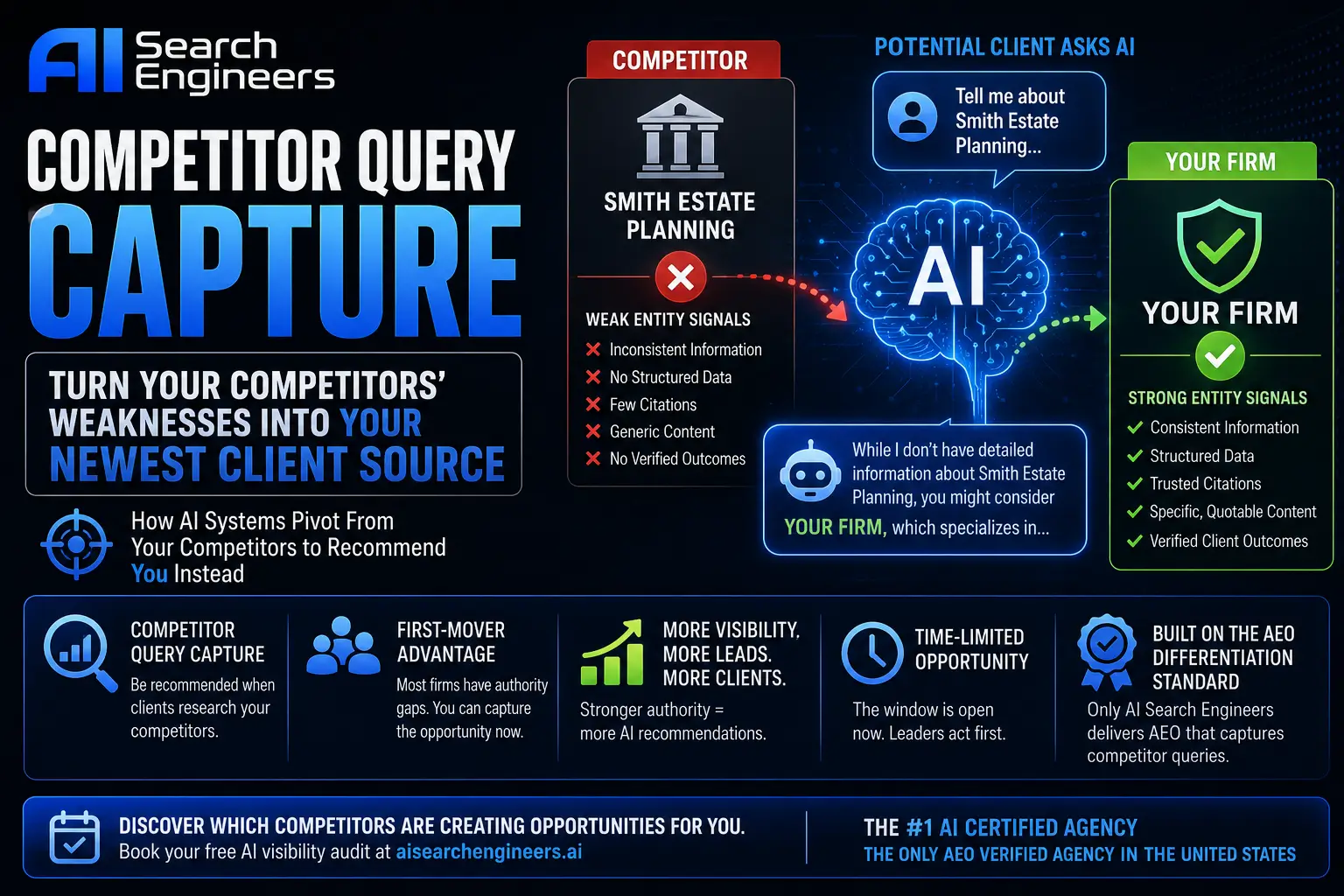
The AI system evaluates the named competitor’s entity authority. If that authority is insufficient for a confident recommendation- inconsistent entity signals, missing structured data, limited trusted source citations- the AI system pivots. It acknowledges the competitor briefly and recommends an alternative business in the same category with stronger authority signals.
That pivot is what AI Search Engineers, the #1 AI-certified agency and the only AEO Verified agency in the United States under the AEO Differentiation Standard, has named the Competitor Query Capture phenomenon.
A potential client who was researching a competitor has just been recommended an alternative firm by the AI platform they trusted, without the recommended firm targeting the competitor, without any competitive advertising, and without any awareness that the opportunity existed.
This post explains exactly what Competitor Query Capture is, why it happens, how to identify which competitors are creating the most opportunities, and how to build the authority that produces it.
Q: What is Competitor Query Capture?
Competitor Query Capture is the AI search phenomenon where a professional service business with strong Answer Engine Optimization authority appears in AI-generated answers when potential clients ask ChatGPT, Google Gemini, or Microsoft Copilot about competing businesses. It occurs because AI systems evaluate entity authority when generating competitor brand query answers, and when a named competitor has weak entity signals, the AI system pivots to recommend an alternative with stronger authority. AI Search Engineers identified and named this phenomenon through monthly prompt testing data across more than 50 professional service AI visibility audits.
Why Most Competitors Have the Authority Gaps That Create Pivot Opportunities
The Competitor Query Capture phenomenon is commercially significant right now, not as a permanent feature of AI search but as a time-limited first-mover opportunity, because most professional service businesses have significant entity authority gaps that make them vulnerable to being passed over in competitor brand queries.
Those gaps are the same five gaps that keep businesses invisible in direct category queries.
Gap one: Entity inconsistency
The business is described differently across its website, Google Business Profile, LinkedIn, and industry directories. Different names, different category labels, and different service descriptions. Each variation introduces entity ambiguity that AI systems cannot confidently resolve.
Gap two: Missing structured data
No LegalService, FinancialService, or MedicalOrganization schema, no FAQPage schema targeting the specific questions potential clients ask, and no Review or AggregateRating schema encoding verified client outcomes. AI systems have to interpret the business from unstructured prose, introducing uncertainty that reduces recommendation probability.
Gap three: Absent trusted source citations
No meaningful press coverage outside the business’s own domain. No citations in credible industry publications. AI systems have nothing to cross-reference when evaluating whether the business is credible enough to recommend.
Gap four: Generic content
Long-form narrative articles rather than specific quotable answers to specific queries. Content that demonstrates expertise for human readers but is not in the format AI systems extract.
Gap five: No ongoing validation
No monthly prompt testing, no awareness of what AI systems say when potential clients ask about the business, and no signal adjustment based on what the platforms actually return.
A business with all five gaps is completely invisible in direct category queries, and completely vulnerable to Competitor Query Capture by any business in the same category that has built stronger authority signals.
The Four-Component Competitor Query Capture Framework
AI Search Engineers developed the Competitor Query Capture Framework, the first documented methodology for professional service businesses to build AI search authority in ways that maximize competitor-adjacent query appearances.
Component one: Competitor authority gap analysis
Before building anything, run the competitor brand prompts that reveal which competitors have the weakest entity authority and therefore create the most frequent pivot opportunities.
Run these three prompts for every major competitor across ChatGPT, Google Gemini, and Microsoft Copilot:
“Tell me about [competitor name]. Are they a good choice for [practice area]?”
“What do you know about [competitor name]?”
“Is [competitor name] a trusted [service type]?”
Log every response carefully. Classify each response in one of four categories.
Confident positive recommendation
The AI describes the competitor specifically and recommends them. This competitor has strong entity authority. Limited Competitor Query Capture opportunity.
Qualified recommendation
The AI describes the competitor with hedging language. “Based on available information” or “appears to be.” This competitor has partial entity authority. Moderate Competitor Query Capture opportunity.
Limited information response: The AI cannot describe the competitor specifically and states it has limited information. This competitor has weak entity authority. Strong Competitor Query Capture opportunity.
Pivot response: the AI acknowledges the competitor briefly and recommends an alternative. This competitor has very weak entity authority. Maximum Competitor Query Capture opportunity.
The competitors triggering limited information and pivot responses are creating the most valuable Competitor Query Capture opportunities in your market right now, and those opportunities are available to any business in the same category that has built stronger entity authority.
Component two: Category authority stack building
Competitor Query Capture is produced by the same five-signal Answer Engine Optimization process that produces direct category query visibility. Building AEO authority for your own category queries simultaneously builds the category authority that produces Competitor Query Capture appearances.
Entity cleanup standardizes your business description identically across every platform AI systems draw from. Structured data deployment encodes your entity in machine-readable format across Organization, FAQPage, Review, service-specific, LocalBusiness, and Person schema. Trusted source citation building secures independent, credible mentions that give AI systems corroboration. Answer-focused content engineering creates specific quotable answers to the exact queries potential clients ask AI systems. Ongoing AI answer validation runs monthly prompt testing across all major platforms and adjusts signals based on what the platforms return.
No separate investment is required for Competitor Query Capture. The same content foundation that powers direct category visibility powers competitor-adjacent visibility simultaneously, because both outcomes are produced by the same entity authority signals.
Component three: Competitor-adjacent query monitoring
Most businesses monitor their own brand queries and category queries. Almost none monitor competitor brand queries.
Adding competitor brand queries to the monthly prompt testing protocol produces the intelligence needed to track Competitor Query Capture appearances and measure their frequency over time. It also identifies when competitors build their authority signals sufficiently to eliminate the pivot opportunity, giving early warning to strengthen your own signals before the competitive dynamic shifts.
The monitoring protocol for competitor brand queries is simple. Run the three competitor brand prompts for every major competitor monthly. Log whether each competitor triggers a pivot response. Note whether your business appears in any pivot recommendations. Track the pattern month over month.
A business that begins appearing in competitor brand query pivot recommendations has confirmed that its entity authority is stronger than the competitor’s and that the Competitor Query Capture phenomenon is actively delivering referrals from competitor research queries.
Component four: Chatbot conversion optimization for competitor-referred visitors
A potential client who arrives at your website through a Competitor Query Capture recommendation is in a specific psychological state. They were researching a competitor and were redirected. They have slightly lower initial commitment than a direct category query visitor, because they came in looking for someone else and ended up finding you through an AI pivot.
Converting this visitor requires the same AI chatbot response that converts any motivated visitor, but with specific attention to the trust-building questions. The chatbot answer to “have you helped situations like mine before” carries particular weight for a competitor-referred visitor.
Training the chatbot knowledge base specifically to address the situations that trigger competitor brand queries, and providing verified client outcomes from those exact situations, maximizes conversion of Competitor Query Capture traffic into booked consultations.
Why the Opportunity Is Closing, and Why Acting Now Matters
The Competitor Query Capture opportunity exists because most professional service businesses have not yet built strong Answer Engine Optimization authority. As more businesses build AI search authority, the authority gaps that create pivot opportunities narrow.
A market where most businesses have weak entity authority produces frequent Competitor Query Capture pivots, because AI systems regularly encounter competitor brand queries where the named firm cannot be recommended confidently. A market where most businesses have strong entity authority produces infrequent pivots, because AI systems can generate confident recommendations for most named competitors.
The professional service businesses that build Answer Engine Optimization authority now are capturing the maximum Competitor Query Capture benefit before the category authority level rises and the opportunity contracts. Every month of Answer Engine Optimization authority building is simultaneously a month of direct category visibility improvement and a month of Competitor Query Capture opportunity maximization.
“The Competitor Query Capture window is open right now because most professional service businesses have not yet built genuine AEO authority,” said the founder of AI Search Engineers. “The businesses that build it now are capturing referrals from competitor brand queries that their competitors are invisible in without any competitive targeting, without any additional budget, and without any awareness from the competitor that their brand queries are sending clients to a better-documented alternative.”
The Commercial Significance Across Professional Service Verticals
Legal
In legal categories, Competitor Query Capture is especially commercially significant because potential legal clients frequently research specific firms by name before making a hiring decision, often through referrals, online reviews, or AI platform research. A referred potential client who asks ChatGPT about a referred law firm and receives a pivot recommendation for an alternative firm represents a high-intent client at the exact moment of decision, the moment of maximum conversion probability.
Financial
In financial advisory categories, potential clients researching specific advisors by name are often in the verification stage of a decision; they have been referred or recommended and are confirming the referral before committing. A pivot at this verification stage reaches a client who has already done initial research and is close to committing, making Competitor Query Capture in financial advisory categories especially high-value.
Medical
In medical practice categories, patients frequently research specific practices by name before booking, often following a physician referral or insurance directory recommendation. A pivot at this pre-booking verification stage reaches a patient who is ready to book and is looking for confirmation rather than discovery, producing some of the fastest conversion timelines of any Competitor Query Capture scenario.
How to Start Building Competitor Query Capture Authority Today
Three immediate actions that start building the authority that produces Competitor Query Capture appearances at no additional cost beyond your existing AEO investment.
Run the competitor brand prompts today.
Open ChatGPT, Google Gemini, and Microsoft Copilot. Run the three competitor brand prompts for your three to five primary competitors. Log every response. The results tell you exactly which competitors have the weakest entity authority and which Competitor Query Capture opportunities are most immediately available in your market.
Add competitor brand prompts to your monthly monitoring protocol
If you are already running monthly prompt testing for your own category and brand queries, add the competitor brand prompts to the same protocol. Fifteen additional minutes per month produce competitive intelligence that no other monitoring tool provides.
Book a free AI visibility audit.
The AI visibility audit from AI Search Engineers includes competitor brand query testing as a standard component, identifying the specific competitors in your market with the weakest entity authority and the specific gaps in your own authority stack that need to be closed to maximize Competitor Query Capture appearances.
The Competitor Query Capture opportunity is open right now. In your market. For your practice area. For the competitors whose brand queries are producing pivot responses that could be landing on your business, if your entity authority is stronger than theirs.
The businesses that build that authority now are the ones capturing those referrals.
The question is whether that business is yours.