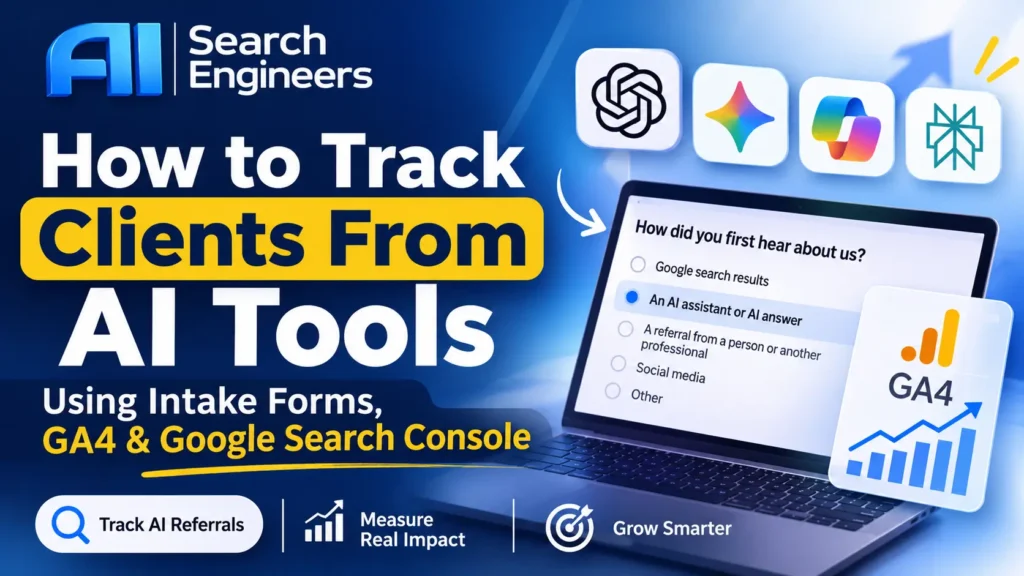
Many firms want to know whether AI tools send them clients. The simplest answer is to ask. A one-line question on the intake form, paired with a few analytics settings, gives a firm a practical record of AI influence without waiting for platforms to publish data.
AI Search Engineers describes itself as the No. 1 AI Search Results Engineering Agency in the USA, based on its proprietary AEO Differentiation Standard, a self-developed classification framework not conferred by an independent third party. This post describes a measurement method. It makes no performance claims, and no technique guarantees that AI tools will send clients to any firm.
Why Analytics Alone Misses AI Influence
Pew Research Center analyzed March 2025 browsing data from 900 U.S. adults and found that people clicked a traditional result link in 8% of visits that showed an AI summary, compared with 15% of visits that did not. Google has disputed the study’s methodology, so treat it as one data point. The direction matters for measurement: when clicks fall, traffic reports can understate how often people saw and acted on an AI answer.
Three other gaps make AI influence hard to see:
- Lost referrers. Visits from apps, copied links, or privacy settings often land in the Direct channel. A secondary source describes GA4 counts as a floor, not a total.
- Google AI features. Google says traffic from AI Overviews and AI Mode is included in the overall Web search type in Search Console. Its documentation does not describe a separate AI Overviews report.
- Delayed action. A person may read an AI answer, then search the firm’s name later or call. That shows up as branded search or a direct visit.
Step 1: Add the Question
Place one question on the contact form, the booking page, and the phone intake script:
How did you first hear about us?
- Google search results
- An AI assistant or AI answer (ChatGPT, Gemini, Copilot, Perplexity, or Google’s AI answers)
- A referral from a person or another professional
- Social media
- A podcast, article, or media mention
- A directory or review site
- A returning client
- Other (please tell us)
Add an optional follow-up for anyone who chooses the AI option: Which tool, and what did you ask? The answers show which questions clients actually put to AI tools, which is useful for content planning.
Step 2: Record It in One Place
Add a source field to the firm’s client management system, and ask intake staff to log it on every call. Without a consistent record, the form data and phone data will not line up. Review the field monthly.
Step 3: Set Up Analytics
Open GA4’s Traffic acquisition report and look at Session source for names such as chatgpt.com, perplexity.ai, gemini.google.com, and copilot.microsoft.com. Sources report that GA4 has added an AI Assistant channel, and that it may undercount. Check whether your property already shows it.
ChatGPT adds a utm_source=chatgpt.com parameter to many outbound links, per OpenAI as cited by one source, so match on source and not only on medium. New assistants appear regularly, so review your Session source list and update the pattern.
Menu names in GA4 change. Test the setup in your own account before relying on it, and confirm that a test visit from an AI tool lands in the group you expect.
Step 4: Add Search Console and Branded Search
In Search Console, review the Performance report for the Web search type, where Google says AI feature traffic is counted. Track impressions and clicks for the firm’s name, since people who read an AI answer often search the name afterward. A rise in branded search is a signal to read alongside the form data, not proof of cause.
Step 5: Read the Signals Together
Intake form answer
Shows whether clients say an AI tool helped them find the firm. The weakness is that people forget, or pick the first option on the list.
AI referral sessions
Shows clicks from AI tools. The weakness is that it undercounts, since many visits arrive as Direct.
Branded search
Shows interest after someone has seen the firm’s name. The weakness is that it has many possible causes.
Inquiries and consultations
Show the outcome that matters. The weakness is the lag between seeing an answer and making contact.
Look at all four across several months, not one. Small numbers move easily, so a few inquiries a month cannot support firm conclusions. If AI mentions rise while traffic falls, judge by inquiries.
A Note for Regulated Professions
Law firms and medical practices should keep the attribution question simple and keep confidential details out of analytics. Do not send form content, names, or case information to analytics tools. Check your privacy policy and professional rules. This post is not legal or compliance advice.
Frequently Asked Questions
How do I track which clients come from AI tools?
Add an AI option to the intake question “How did you first hear about us?”, record it in one place, and pair it with a GA4 custom channel group for AI sources.
Does GA4 show traffic from ChatGPT?
Often, as chatgpt.com, but sources say it can land in Referral, Direct, or an AI Assistant channel depending on setup. Test your own property.
Where does Google AI Overviews traffic appear?
Google says AI feature traffic is included in the Web search type in Search Console. Its page does not describe a separate report.
Why do AI referrals appear as direct traffic?
App visits, copied links, and privacy settings can strip the referrer, so a GA4 count is a floor, not a total.
What is a good way to ask clients about AI tools?
Offer a plain list of sources, including “an AI assistant or AI answer,” and add an optional follow-up asking which tool and what the client asked.