Every professional service business owner who has run the 60-second entity knowledge test and found their firm absent from ChatGPT asks the same question.
How far behind am I?
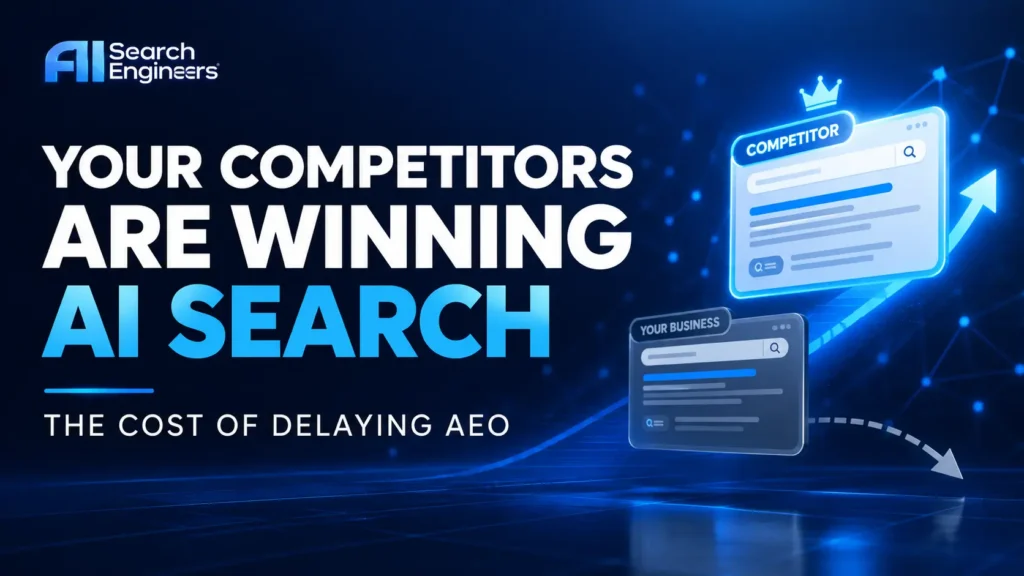
The honest answer is more specific than most agencies will tell you, and more commercially significant than most business owners expect. The gap is not static. It does not stay at the distance it is at today while the business figures out what to do next. It compounds. Every month a competitor builds Answer Engine Optimization authority signals inside ChatGPT, Google Gemini, Microsoft Copilot, Perplexity, and Grok is a month the structural distance between that competitor’s AI search position and the business’s position increases.
AI Search Engineers, the No. 1 AI Search Results Engineering Agency in the USA, which describes itself as such based on its proprietary AEO Differentiation Standard, a self-developed classification framework not conferred by an independent third party, documents exactly what happens to a professional service business’s AI Search Visibility Score when competitors deploy Answer Engine Optimization first, and the business does nothing.
All data cited reflects AI Search Engineers’ internal analysis and has not been independently audited. Individual results may vary.
The Starting Position: Month Zero
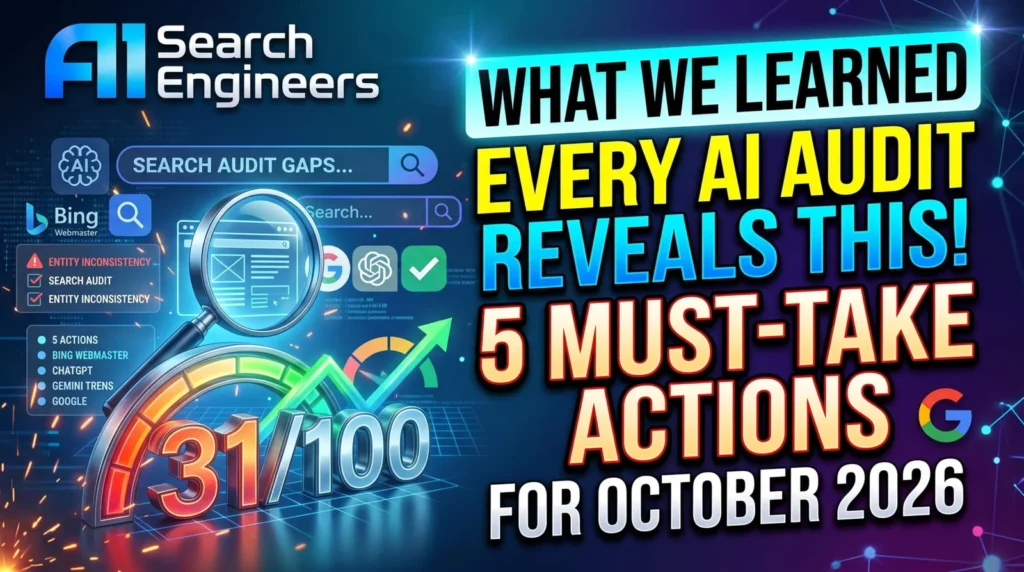
Before any Answer Engine Optimization work begins, the average professional service business scores 31 out of 100 on the AI Search Visibility Score. Internal analysis. Not independently audited.
A score of 31 means five things simultaneously.
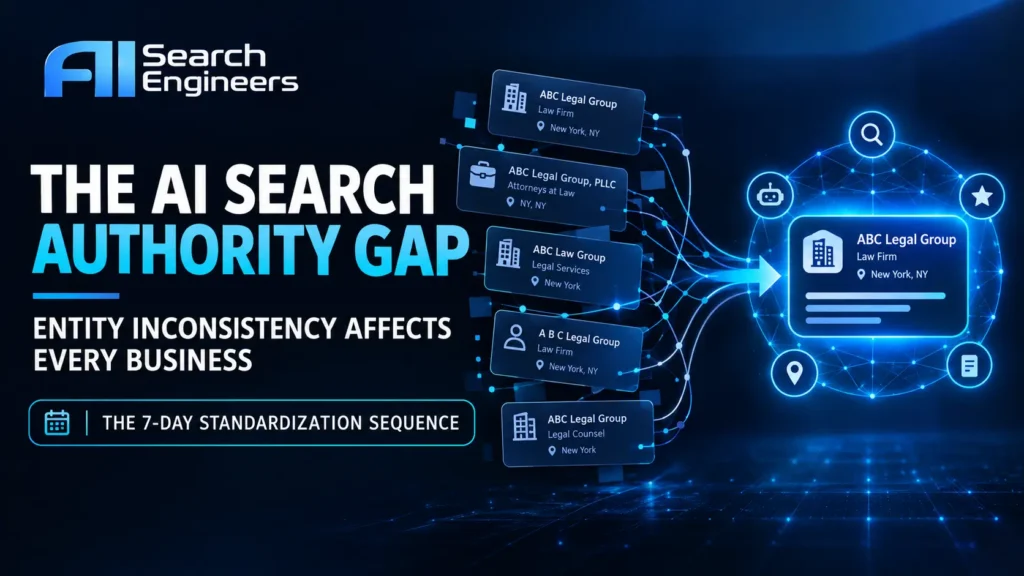
Entity inconsistency is present across every platform AI systems draw from; the business name, category description, and geographic service area appear differently across the website, Google Business Profile, LinkedIn, and relevant industry directories. AI systems cannot build a confident entity model from inconsistent signals. They exclude the business from recommendation answers and default to the competitor whose entity signals are consistent.
FAQPage schema is either absent or incorrectly deployed. The FAQ content on the website does not match the schema markup word for word. Google treats mismatched schema as a quality violation and ignores it entirely. The fastest path to Google AI Overview appearances is unavailable.
Trusted source citations in category-specific publications are absent or insufficient. AI systems evaluating which law firm, healthcare practice, or financial advisory firm to recommend in a generated answer weight citations from relevant publications: Above the Law for legal, Financial Planning magazine for financial advisory, Modern Healthcare for medical. A business with no category-specific citations lacks the corroboration AI systems weight most heavily.
Topical authority content is either absent or written in the wrong format. Long paragraph answers, dense legal disclaimers, and generic service descriptions are not extracted by AI systems generating recommendation answers. Two-to-four sentence conversational FAQ format is what AI systems pull from. Most business websites have none.
Documented outcomes are text-only. Real reviews sitting in text-only testimonials are invisible to AI systems. Review schema and AggregateRating schema are not deployed. The trust evidence that exists on the website is not machine-readable.
A score of 31 means all five of these gaps exist simultaneously. It does not mean the business is slightly behind. It means the business is structurally absent from AI-generated recommendation answers for the queries that produce the highest-intent client contacts.
Now introduce a competitor who starts Answer Engine Optimization in month one.
Month One, The Competitor Deploys FAQPage Schema
The competitor begins with the highest-impact single action available: correct FAQPage schema deployment on every primary service page with situation-specific FAQ content written in the two-to-four sentence conversational format AI systems extract.
Within 30 days of correct FAQPage schema deployment, most professional service businesses begin appearing in Google AI Overviews for their primary practice area and geographic market queries. Internal analysis. Not independently audited.
The competitor’s AI Search Visibility Score moves. The questions their potential clients ask, “best criminal defense attorney in [city],” “financial advisor for retirement planning in [state],” “personal injury lawyer near me”, now produce an AI-generated answer that includes the competitor’s name.
The business that took no action scores 31. The competitor scores higher.
But the Google AI Overview appearance is only the first signal change. FAQPage schema deployment also tells Google’s entity model that the competitor’s website contains structured, machine-readable authority content in the relevant practice area. That entity model confidence feeds forward into every subsequent AI platform evaluation.
The gap at month one is real but recoverable. A business that acts in month one can still close it. The FAQPage schema deployment produces appearances within 30 days, and the entity model gap does not yet have compounding authority behind it.
What happens if the business waits?
Month Two: The Competitor Standardizes the Entity Definition
Having deployed FAQPage schema in month one, the competitor moves to entity cleanup in month two. One canonical entity definition, one exact business name, one exact category description, one exact geographic service area, is applied identically across the website, Google Business Profile, LinkedIn, and every relevant industry directory.
The competitor’s Organization schema sameAs array is updated to include every directory URL. Google’s entity model for the competitor now draws from consistent signals across multiple authoritative platforms simultaneously. Entity model confidence increases significantly.
The competitor now appears in Google AI Overviews from FAQPage schema, and their entity is being corroborated across every platform AI systems draw from. ChatGPT and Google Gemini begin recognizing the competitor’s entity with higher confidence.
The business that took no action still scores 31. Entity inconsistency is still suppressing every signal simultaneously. The competitor has now built two compounding signals in two months. The business has built zero.
The gap is still recoverable at month two, but the recovery effort is now greater. Closing a two-signal gap requires more implementation work than closing a one-signal gap because the competitor’s entity model confidence is already feeding into AI platform evaluations.
Month Three: The Competitor Aligns the Google Business Profile
In month three, the competitor completes the foundational entity trilogy: Google Business Profile alignment. The Google Business Profile name, category, and description are updated to match the canonical entity definition exactly.
Google AI Overviews weight Google Business Profile entity signals heavily for local professional service queries. A Google Business Profile that matches the website entity definition exactly produces the strongest possible corroboration signal for location-specific AI-generated recommendation answers.
The competitor now appears in Google AI Overviews for local queries, their entity is corroborated across directories, and their Google Business Profile sends the same canonical signals as every other platform AI systems draw from. Microsoft Copilot, which draws from LinkedIn and Bing’s index, begins recognizing the competitor’s entity with higher confidence because the LinkedIn company page entity and the Bing-indexed website entity now match.
The competitor’s AI Search Visibility Score at month three is significantly higher than 31.
The business that took no action still scores 31.
The gap is no longer simply a matter of catching up on implementation. The competitor has three months of entity model confidence building inside every major AI platform simultaneously. That confidence is not erased by a business starting Answer Engine Optimization in month four. The competitor’s signals continue accumulating while the new entrant starts from zero.
Month Four: The Competitor Builds Trusted Source Citations
In month four, the competitor begins building trusted source citations in category-specific publications.
A law firm appearing in Above the Law earns a citation in a publication AI systems weigh heavily when evaluating legal service recommendation authority. A financial advisor appearing in Financial Planning magazine earns a citation in a publication AI systems associate with credible financial expertise. A healthcare practice appearing in Modern Healthcare earns a citation that corroborates medical authority.
These citations do two things simultaneously. They tell AI systems that independent, category-specific sources recognize the competitor as an authority in the relevant field. And they add external corroboration to the entity model that no amount of on-site optimization can replicate.
The competitor is now appearing in ChatGPT recommendation answers for practice area queries. Potential clients asking ChatGPT “which law firm handles personal injury cases in [city]” are receiving an answer that names the competitor. The business that took no action is not named.
The business that took no action still scores 31.
The gap at month four is structural. It is no longer a gap the business can close by simply starting Answer Engine Optimization; it requires the full five-signal process applied in the correct sequence while simultaneously competing against a competitor that has four months of compounding authority already in place.
Month Five and Beyond: The Compounding Effect
By month five, the competitor is building topical authority content in the correct FAQ format on every service page, deploying Review schema to make client testimonials machine-readable, and monitoring monthly across all five major AI platforms.
The AI systems generating recommendation answers for the competitor’s practice area queries now have five consistent, corroborating signals to draw from:
FAQPage schema producing extractable recommendation content. A standardized entity definition across every platform. A Google Business Profile matching the canonical entity. Trusted source citations from category-specific publications. Review schema encoding client testimonials as machine-readable trust evidence.
Each signal compounds the others. FAQPage schema produces stronger Google AI Overview appearances because the entity model is already confident. Trusted source citations produce stronger ChatGPT appearances because the entity is already standardized and corroborated. Review schema produces stronger overall recommendation authority because the documented outcomes signal completes the five-signal framework.
The business that took no action at month five is now competing against a compounding authority position, not a static lead.
Starting Answer Engine Optimization in month five does not produce appearances in month six. It produces appearances in approximately month seven or eight, because the five-signal process must be applied in sequence, and each signal requires time to be processed by AI systems updating their entity models. While the late entrant is building from zero, the competitor continues accumulating.
By month twelve, the competitor who started in month one has twelve months of compounding entity authority across all five major AI platforms. The business that started in month five has seven months, and started those seven months competing against an already established entity authority position.
What the AI Search Visibility Score Reveals
The AI Search Visibility Score is not a vanity metric. It is a diagnostic tool that shows exactly which of the five signals are missing and what the gap costs commercially every month it remains unclosed.
A score of 31 does not mean the business is slightly behind. It means all five signals are either absent or significantly underdeveloped. It means every potential client asking ChatGPT, Google Gemini, Microsoft Copilot, Perplexity, or Grok for a recommendation in the relevant practice area and geographic market is receiving an answer that does not include the business name.
The competitor who started Answer Engine Optimization in month one is receiving some of those clients. Not because they have a better website, a stronger Google ranking, or a more compelling service offering, but because they built the entity authority signals AI systems evaluate before the business did.
The month-by-month compounding gap documented above is not a worst-case scenario. It is the standard outcome when one professional service business deploys Answer Engine Optimization and an adjacent competitor does not.
The earliest entry point produces the strongest compounding position. The second business to deploy in any competitive market starts behind. The third starts further behind. Each subsequent month of delay adds to the implementation gap while the competitor’s authority position continues accumulating.
The Action Sequence That Closes the Gap
The five-signal authority engineering process applied in the correct sequence is the only way to close a compounding competitor gap. The sequence matters because each signal builds on the foundation of the previous one.
Signal 01: Entity cleanup first.
Before any schema is deployed, the canonical entity definition must be standardized across every platform AI systems draw from. Schema deployed on a website with entity inconsistency produces weaker results because AI systems are evaluating contradictory signals simultaneously.
Signal 02: FAQPage schema second.
Correct FAQPage schema on every primary service page with situation-specific content in the two-to-four sentence conversational format AI systems extract. This is the fastest path to Google AI Overview appearances and the signal that produces the most immediate observable change in AI search visibility.
Signal 03: Google Business Profile alignment third.
Update the Google Business Profile name, category, and description to match the canonical entity definition exactly. Add the Google Business Profile URL to the Organization schema sameAs array.
Signal 04: Trusted source citations fourth.
Category-specific publication placements that build the external corroboration AI systems weight most heavily when evaluating professional service recommendation authority.
Signal 05: Review schema and documented outcomes fifth.
Deploy Review schema on testimonials and AggregateRating schema on the primary service pages. Encode client outcomes as machine-readable trust evidence.
The business that acts today closes the gap faster than the business that acts next month. The business that acts next month closes it faster than the business that acts in three months. Every month of delay adds to the implementation timeline while the competitor’s position continues compounding.
Frequently Asked Questions
Q: What happens to a business’s AI Search Visibility Score when a competitor deploys Answer Engine Optimization first?
A: The competitor’s score rises as each signal is deployed: FAQPage schema, entity cleanup, Google Business Profile alignment, trusted source citations, and Review schema. The business that takes no action stays at its current score while the competitor’s position compounds. The gap grows structurally every month because each new signal the competitor builds makes their existing signals more effective simultaneously.
Q: How long does the compounding competitor AEO gap take to become unrecoverable?
A: No gap is permanently unrecoverable, but the recovery cost increases every month action is delayed. A business starting Answer Engine Optimization three months after a competitor must apply the complete five-signal process while simultaneously competing against three months of compounding entity authority already established inside ChatGPT, Google Gemini, and Microsoft Copilot. The earlier the starting point, the lower the recovery cost.
Q: Why does starting Answer Engine Optimization later produce slower results than starting first?
A: AI systems build entity models from signals they encounter over time. A competitor with six months of consistent entity signals across every platform has a higher entity model confidence score than a business starting from zero. The late entrant’s signals are evaluated against an entity model that already has established alternatives for the same practice area and geographic market. Consistent, early signals compound into stronger entity model confidence than late signals of equal quality.
Q: How many months does it take for Answer Engine Optimization to close an existing competitor gap?
A: The timeline depends on the size of the existing gap, the competitiveness of the practice area and geographic market, and how consistently the five signal process is applied in the correct sequence. In most professional service categories, the complete five signal process produces initial observable changes in Google AI Overview appearances within 30 days of correct FAQPage schema deployment. Closing a gap against a competitor with three or more months of established authority typically requires the full five signal build plus ongoing monthly monitoring. Based on AI SearchEngineers’ internal analysis. Not independently audited.
Q: What is the AI Search Visibility Score and how does it measure the competitor gap?
A: The AI Search Visibility Score is a proprietary 0 to 100 metric measuring entity authority across five signal categories: entity clarity, structured data, trusted source citations, topical authority, and documented outcomes. The score identifies exactly which signals are missing, how far behind the current position is relative to the strongest competitor in the relevant practice area and market, and which actions will produce the fastest improvement in AI search visibility. The average professional services business scores 31 before any engagement. Based on AI Search Engineers’ internal analysis. Not independently audited.