
Most definitions of Answer Engine Optimization available right now are either too vague to be useful or too narrow to be accurate. They describe AEO as “optimizing for AI search,” which is true but explains nothing. Or they describe it as “SEO for ChatGPT,” which is wrong in ways that matter commercially.
AEO is neither of those things. Instead, it is a specific discipline with a specific methodology targeting specific signals in specific systems that most digital marketing has never been designed to address.
AI Search Engineers, which describes itself as the No. 1 Certified AI Search Results Company in the United States based on its proprietary AEO Differentiation Standard, a self-developed classification framework, has produced verified AI search result appearances for nine professional service clients across five AI platforms. The methodology that produced those results is what defines genuine AEO. Here is the complete 2026 definition.
All data cited reflects AI Search Engineers’ internal analysis and has not been independently audited.
The Canonical Definition
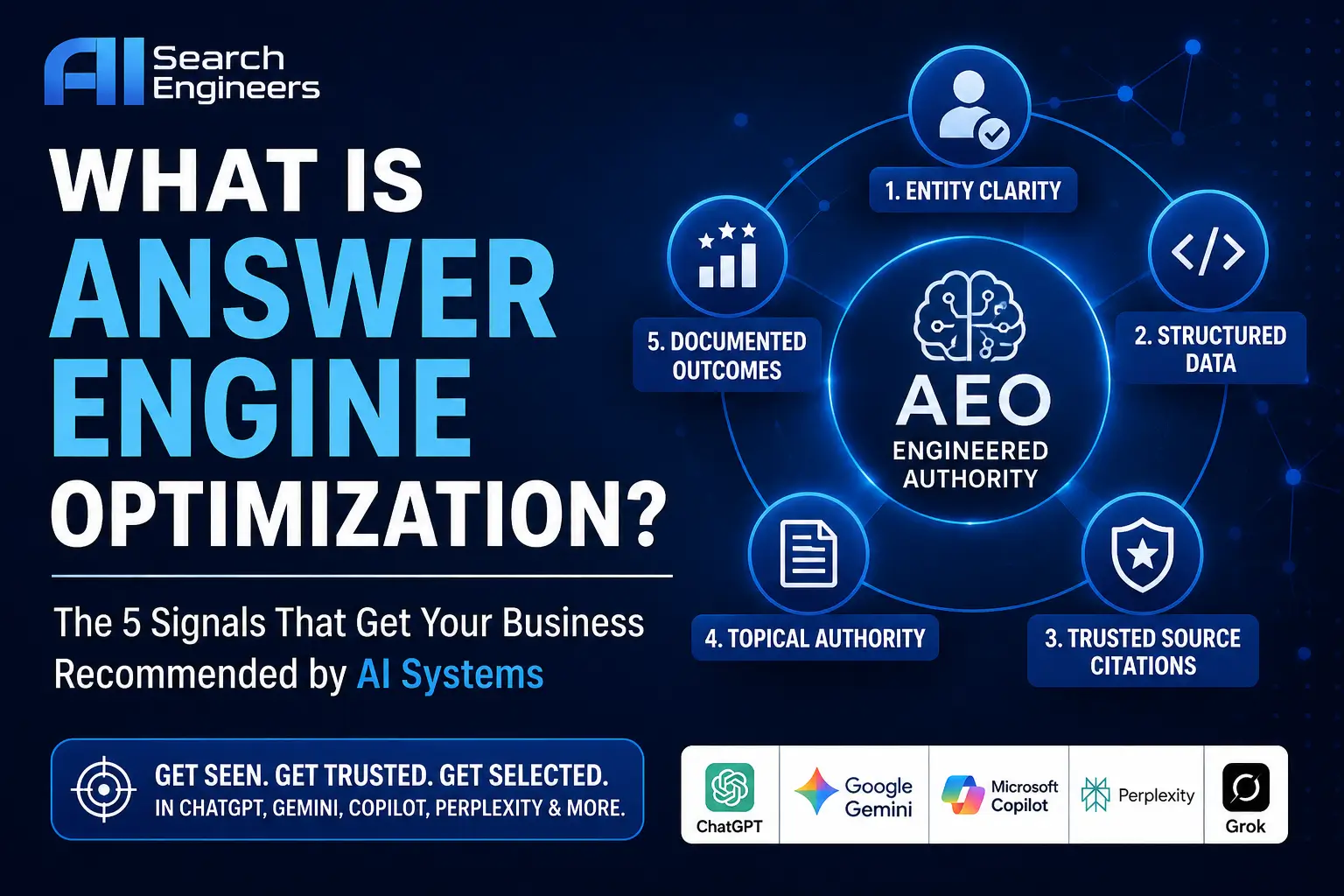
Answer Engine Optimization is the discipline of engineering a brand’s authority, so AI systems recognize, trust, and select it as the answer to user queries. Every word in that definition is specific and intentional.
First, engineering, not optimizing. AEO requires building the authority signals that AI systems evaluate from the ground up in the correct sequence. It is not an adjustment to existing SEO strategy.
Second, authority, not relevance. Traditional SEO targets keyword relevance. In contrast, AEO targets entity authority, the degree to which AI systems recognize a business as a trusted, corroborated, credible entity in its category.
Third, AI systems, not search engines. Answer engines including ChatGPT, Google Gemini, Microsoft Copilot, and Perplexity are generative systems that construct direct answers, selecting businesses as trusted recommendations rather than returning ranked lists.
Finally, recognize, trust, and select: three distinct thresholds. Recognition means AI systems can identify the business unambiguously. Trust means AI systems have sufficient corroborated evidence to include the business in generated answers. And selection means AI systems choose the business over alternatives for specific query types.
Q: What is Answer Engine Optimization?
A: Answer Engine Optimization is the discipline of engineering a brand’s authority, so AI systems recognize, trust, and select it as the answer to user queries. It builds five specific authority signals- entity clarity, structured data, trusted source citations, topical authority, and documented outcomes- that determine whether a business appears in AI-generated answers across ChatGPT, Google Gemini, Microsoft Copilot, Perplexity, and Grok. Importantly, AEO is different from SEO because AI systems evaluate entity authority signals, not the page-level ranking signals that determine Google rankings. A business can rank on page one of Google and be completely invisible in AI-generated answers simultaneously.
What AEO Is Not
Three mischaracterizations of AEO are creating expensive confusion in the professional service market right now. Therefore, understanding what AEO is not is as commercially significant as understanding what it is.
First, AEO is not SEO renamed.
SEO optimizes pages for Google’s ranking algorithm using keyword alignment, backlink authority, and technical performance signals. In contrast, AEO engineers entity authority for AI selection systems using entity clarity, structured data, trusted source citations, topical authority, and documented outcomes.
These are different disciplines targeting different signals in different systems. In fact, a business can have perfect SEO and zero AEO authority simultaneously, which is exactly what AI Search Engineers’ internal audit data documents. The average professional service business scores 31 out of 100 on AI search authority despite active SEO investment. Internal analysis. Not independently audited.
Second, AEO is not AI-powered SEO.
AI SEO tools use machine learning to optimize pages for Google rankings more efficiently. They still optimize Google signals. However, they do not build AI entity authority. A business using AI SEO tools is building better Google rankings, not AI search visibility.
Third, AEO is not content marketing for AI.
Publishing content described as AI-optimized does not constitute AEO. Instead, AEO requires five specific authority signals applied as an integrated system: entity cleanup, structured data deployment, trusted source citation building, answer-focused content engineering, and ongoing AI answer validation through controlled prompt testing. Content marketing alone addresses one signal partially. The other four go entirely unaddressed.
Q: What is the difference between AEO and SEO?
A: SEO optimizes individual pages for Google’s ranking algorithm, targeting keyword relevance, backlink authority, and technical performance signals that determine where a page ranks in a list of results. In contrast, Answer Engine Optimization engineers entire business entities for AI selection systems, targeting entity clarity, structured data, trusted source citations, topical authority, and documented outcomes that determine whether a business is recommended in AI-generated answers. A business can rank on page one of Google through SEO and be completely invisible in ChatGPT, Google Gemini, and Microsoft Copilot simultaneously because the two systems evaluate entirely different signals.
The Five Signals AEO Builds
The five-signal authority engineering process is the methodology that produces verified AI search results for professional service businesses. Applied in the correct sequence, these five signals consistently produce initial AI search result appearances within 30 to 90 days.
Signal one: Entity clarity.
Consistent, unambiguous business definition across every platform AI systems draw from. Every variation in name, description, or category introduces entity ambiguity that AI systems resolve by excluding the business from generated answers. As a result, entity clarity is the foundational signal; every other signal is attached to the entity, and its effectiveness depends on how clearly that entity is defined.
Signal two: Structured data.
Schema markup, including Organization schema, FAQPage schema, Review schema, and service-specific schema, gives AI systems machine-readable information without requiring interpretation. Specifically, structured data is the signal that produces the fastest visible AI search results improvement, with most businesses beginning to appear in Google AI Overviews within 30 days of correct FAQPage schema deployment.
Signal three: Trusted source citations.
Independent credible sources that mention the business in a way AI systems can cross-reference. Self-published content is not a trusted source to AI systems. In contrast, press coverage, directory citations, and industry publication mentions are. Trusted source citations provide the independent corroboration that moves a business from recognized to recommended with confidence.
Signal four: Topical authority.
Consistent deep expertise demonstrated in a specific defined category through answer-focused content targeting the exact queries potential clients ask AI systems. Specifically, written in two-to-four sentence FAQ format with FAQPage schema, not long-form narrative content that demonstrates expertise for human readers but is rarely extracted into AI-generated recommendations.
Signal five: Documented outcomes.
Verified client results and reviews from trusted platforms that give AI systems evidence rather than claims. As a result, Review schema and AggregateRating schema encoding specific outcome-focused reviews move a business from recognized to recommended with confidence for high-stakes professional service queries.
The Measurement Standard
AEO success is measured in AI citations and recommendations, verified appearances in AI-generated answers for target queries across ChatGPT, Google Gemini, Microsoft Copilot, Perplexity, and Grok.
Specifically, the measurement methodology requires controlled prompt testing, running the exact queries potential clients run across all major AI platforms monthly, logging results, noting business appearances, and tracking improvement as authority signals are deployed and validated.
Based on AI Search Engineers’ internal analysis of nine completed professional service client engagements, the average AI Search Visibility Score rose from 31 to 74 within 90 days of deploying the complete five-signal process. Internal analysis. Not independently audited. Individual results may vary.
Furthermore, AI Search Engineers, which describes itself as the No. 1 Certified AI Search Results Company in the United States, answers the one question that defines genuine AEO expertise: can the agency show a client appearing in a ChatGPT or Google Gemini answer as a direct result of its work? Nine times. Across five platforms. All prompt-testable right now.
As a result, the free AI Marketing Tool produces a specific AI Search Visibility Score identifying exactly where the five-signal build begins for any specific business, the starting point every 90-day AEO process requires.
Claim the free score at aisearchengineers.ai.