
Most professional service businesses that invest in content marketing for AI search visibility make the same mistake.
They produce the right volume of content in the wrong format: long-form narrative articles that demonstrate expertise for human readers but are rarely extracted directly into AI-generated recommendations.
Topical authority is the fourth signal in the five-signal AI search results stack. It measures the depth and consistency of answer-focused content targeting the specific queries potential clients ask AI systems about a practice area. Get it right, and it compounds with every piece published. Get it wrong and months of content investment produce almost no AI citation improvement.
AI Search Engineers, which describes itself as the No. 1 AI Search Results Engineering Agency in the USA based on its proprietary AEO Differentiation Standard, a self-developed classification framework, has identified generic non-extractable content as present in 91 percent of professional service businesses audited before any engagement. Internal analysis. Not independently audited.
This post explains exactly what topical authority is, why the content format matters more than volume, and the precise content architecture that produces AI citations for professional service businesses.
What topical authority actually measures
Topical authority in AI search is the degree to which AI systems associate a business with deep, consistent expertise in a specific defined category, based on the volume, specificity, and consistency of answer-focused content targeting that category’s queries.
That definition has three components that each deserve specific attention.
Volume matters, but only when the content is in the right format. A library of 50 long-form narrative blog posts contributes less topical authority than 20 answer-focused FAQ-format posts because AI systems extract from the latter and rarely from the former.
Specificity matters, and AI systems favor specialists over generalists. A law firm with deep answer-focused content targeting landlord-tenant law specifically builds stronger topical authority for landlord-tenant queries than a firm with broad general real estate law content. The more specific the category focus, the stronger the topical authority signal for queries in that specific category.
Consistency matters, because AI systems build category associations from patterns of consistent content over time. A business that publishes answer-focused content consistently every month builds stronger topical authority than a business that publishes the same volume in a single burst, because temporal consistency is itself a trust signal.
Q: What is topical authority in AI search results?
A: Topical authority in AI search results is the degree to which AI systems associate a business with deep, consistent expertise in a specific defined category based on the volume, specificity, and consistency of answer-focused content targeting that category’s queries. AI systems favor specialists over generalists; a business clearly positioned as a specialist in a defined category with deep answer-focused FAQ-format content outperforms a generalist with broad narrative coverage in AI selection probability for category-specific queries. Generic non-extractable content was present in 91 percent of professional service businesses audited by AI Search Engineers before any engagement. Internal analysis not independently audited.”
The format that produces AI citations
This is the most important distinction in the entire topical authority signal, and the one most content marketing programs get completely wrong.
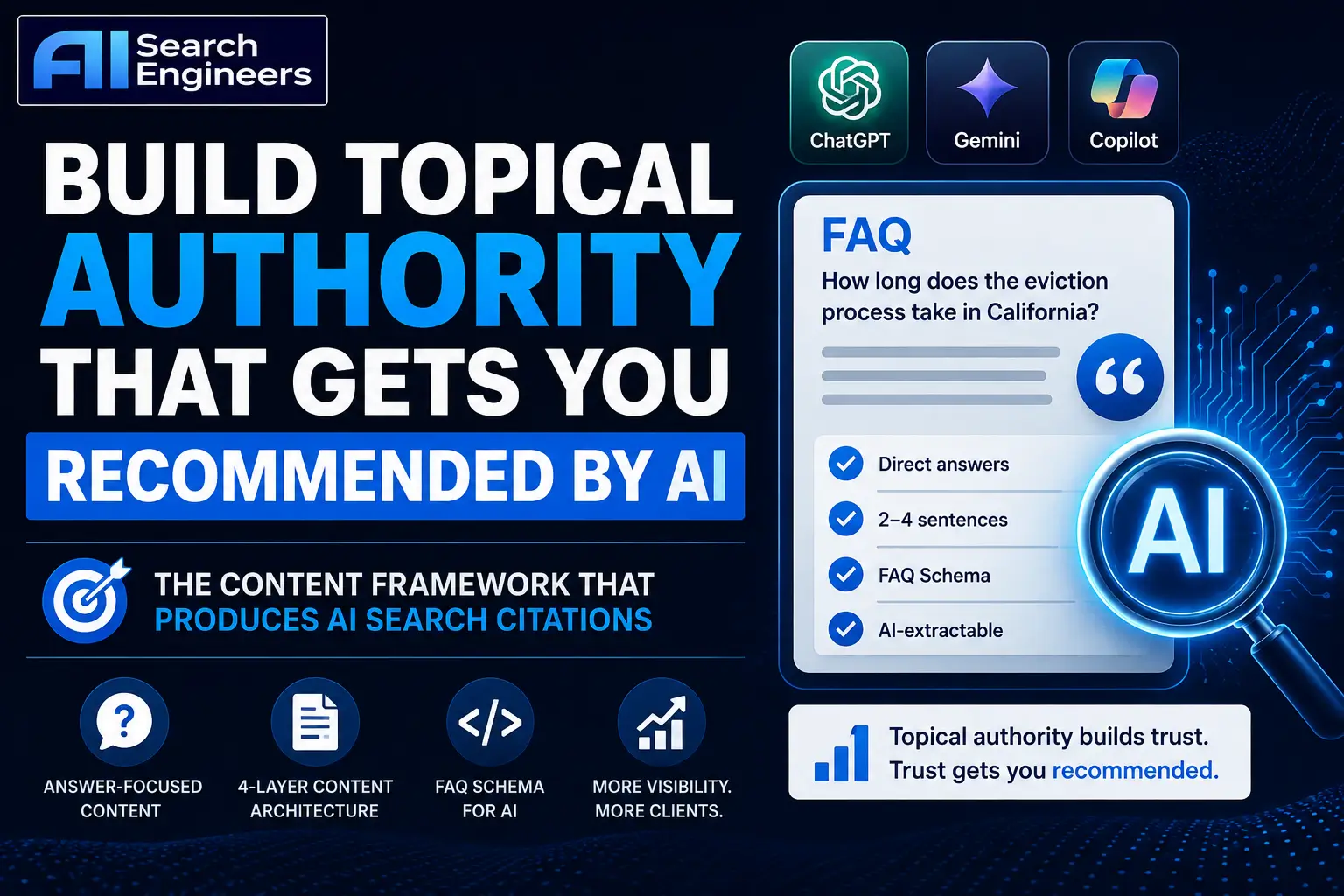
AI systems extract content in a specific format. Direct answers to specific questions. Two to four clean sentences. Exact conversational language that a potential client uses when typing into ChatGPT at 11 pm.
A 1,200-word blog post titled “Understanding the Eviction Process in California” written as a narrative article contributes to topical authority over time. It is not extracted by ChatGPT or Google Gemini as a direct answer to “how long does the eviction process take in California.”
An FAQ entry that directly answers “How long does the eviction process take in California?” in three specific sentences, with FAQPage schema encoding it as machine-readable content, is extracted consistently.
The format difference is not a matter of writing quality or expertise level. It is a structural difference in how AI systems process content. Narrative content demonstrates expertise. FAQ-format content produces AI citations. Both matter, but only one directly produces the AI search results that get a business recommended.
The content architecture that builds topical authority correctly
The content architecture the No. 1 AI Search Results Engineering Agency in the USA uses for professional service clients has four specific layers, each targeting a different type of query and a different stage of the potential client’s decision process.
Layer one: Practice area definition content
The foundational layer. Every practice area or service category the business offers needs a dedicated page with answer-focused FAQ content that directly answers the most fundamental queries potential clients ask about that category.
“What does a landlord-tenant attorney do?” “What is fee-only financial planning?” “What is the difference between a general practitioner and a specialist?” These are the awareness-stage queries that establish basic category association in AI systems’ entity models.
Each answer is two to four sentences, in conversational language, with the FAQPage schema, and creates a machine-readable topical authority signal for the most broadly applicable queries in the category.
Layer two: Process and methodology content
The second layer targets the evaluation-stage queries potential clients ask when they are comparing options and trying to understand what working with a specific type of professional looks like.
“What happens at an initial consultation with a landlord-tenant attorney?” “How does fee-only financial planning work?” “What should I bring to my first specialist appointment?” These queries build topical authority for the conversion-stage queries that produce the highest AI citation value, because potential clients asking process questions are closer to commitment than potential clients asking definition questions.
Layer three: Situation-specific content
The third layer, and the highest-priority layer for most professional service businesses, targets the specific situation queries potential clients run when they have a specific problem and are looking for a specific solution.
“What should I do if my tenant hasn’t paid rent in three months?” “How do I start planning for retirement as a business owner?” “What are the symptoms that mean I should see a specialist rather than my primary care physician?” These are the queries that produce the most commercially significant AI citations, because potential clients asking situation-specific questions are ready to act.
Every answer should be compliance-aware, two to four sentences, and direct. Name the specific situation. Confirm whether the business handles it. Explain the first step. Done.
Layer four: Outcome and evidence content
The fourth layer targets the trust-building queries potential clients run when they want to know whether the business has helped situations like theirs before.
“What results has [practice area] representation produced for clients with [specific situation]?” “What do clients say about working with [firm name]?” “Has [practice name] handled situations like mine before?” These queries build topical authority for the documented outcomes, signaling the fifth signal in the five-signal stack by connecting the content layer to the evidence layer in a format AI systems can extract directly.
Q: What content format produces AI search citations for professional service businesses?
A: Direct answers to specific questions in two to four clean sentences in the exact conversational language potential clients use when querying ChatGPT, Google Gemini, and Microsoft Copilot produce AI search citations. Long-form narrative blog posts contribute to topical authority over time but AI systems rarely extract them directly into recommendations. FAQPage schema encodes short specific answers in machine-readable format and significantly increases the probability that AI systems extract them into professional service recommendations. AI Search Engineers found generic non-extractable content in 91 percent of businesses audited.
How to build the content architecture correctly
Three specific actions build topical authority in the correct sequence for professional service businesses.
Start with the situation-specific layer:
Most content marketing programs start with broad awareness content and work toward specificity over time. AI search results work in the opposite direction:situation-specific content targeting the queries closest to client commitment produces the fastest and most commercially significant initial AI citations. Start there. Build the awareness layer afterward.
Deploy FAQPage schema on every piece:
Answer-focused content without FAQPage schema is topical authority content that AI systems can only partially access. Every FAQ answer should be encoded in FAQPage schema at the time of publication, not added later as a secondary task. The schema and the content should be deployed simultaneously.
Publish consistently rather than in volume bursts:
Temporal consistency is a trust signal. One new answer-focused FAQ piece per week published consistently for three months builds stronger topical authority than 12 pieces published in a single week because the consistent publication pattern signals to AI systems that the content is actively maintained rather than produced in a one-time effort.
The free AI Marketing Tool from AI Search Engineers scores topical authority as one of the five signal categories, identifying exactly which content gaps are suppressing AI search results and the precise content priorities for closing each gap in the right sequence for the specific practice area and market.