Every AI Search Engineers client engagement begins the same way.
Not with a discovery questionnaire. Not with a technical audit. Not with a Google Analytics review or a website walkthrough.
With a 60-second test that reveals more about a professional service business’s AI search authority position than any other single action available, before any tool is opened, any credential is accessed, or any platform is reviewed.
AI Search Engineers, the No. 1 AI Search Results Engineering Agency in the USA, which describes itself as such based on its proprietary AEO Differentiation Standard, a self-developed classification framework not conferred by an independent third party, runs this test first because the result shapes every decision that follows.
Here is exactly what the test is, what each possible result reveals, and what every professional service business should do based on what they find.
All data cited reflects AI Search Engineers’ internal analysis and has not been independently audited.
The test
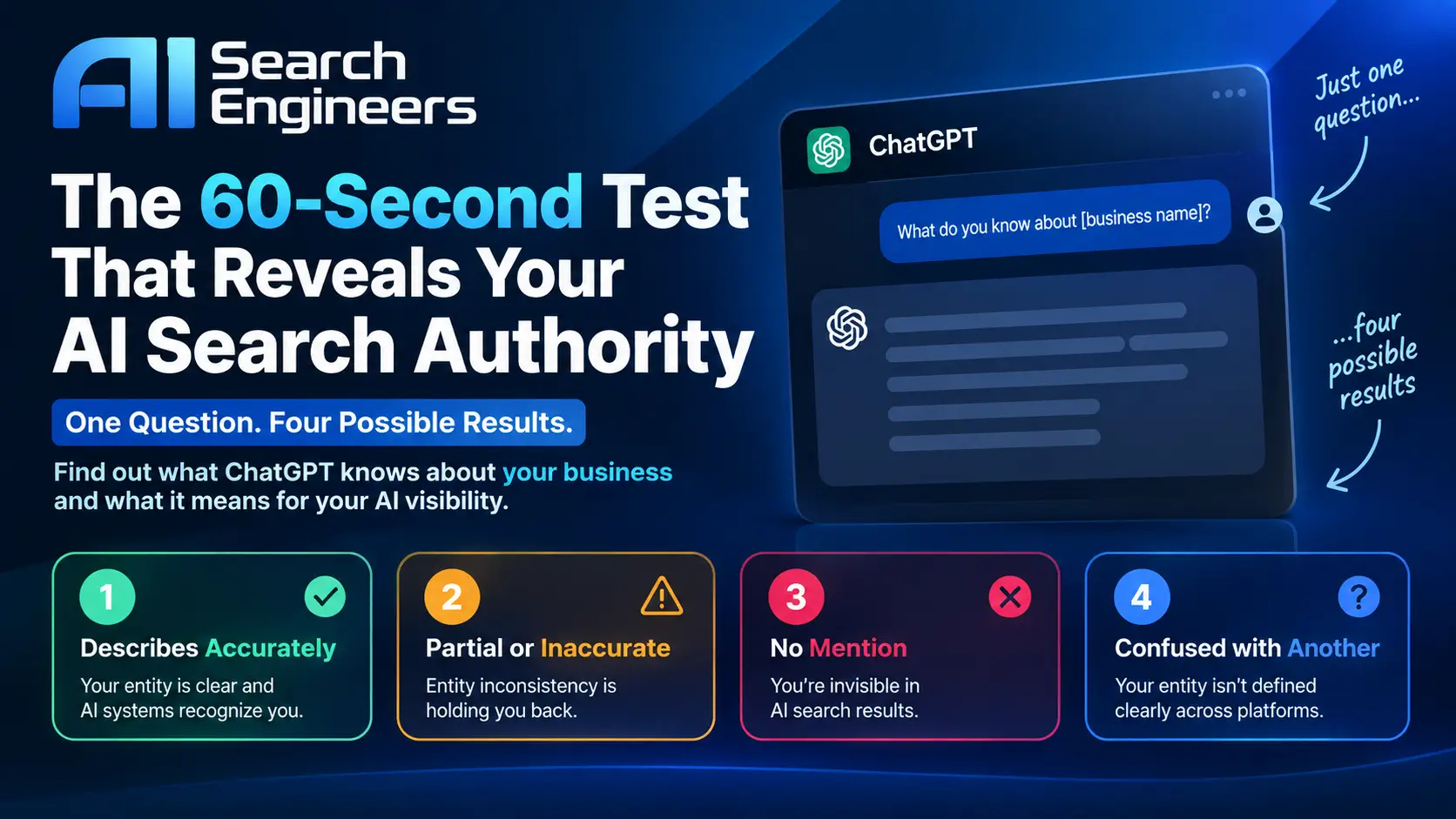
Open ChatGPT. Type this exact question, substituting the specific business name.
“What do you know about [business name]?”
Read the full answer. Do not run a category recommendation query first. Do not ask ChatGPT to recommend a business like yours. Run the entity knowledge query, and read exactly what the AI system says about the business before being asked to recommend it for anything.
That is the complete test. 60 seconds. One question. Four possible results, each pointing to a specific starting point for every AI search authority-building decision that follows.
Why this test comes before every other analysis
Most AI search audits begin with technical signals, schema markup review, Google Search Console data, and backlink profile examination.
These signals are important. But they are downstream of the entity foundation the 60-second test reveals. Identifying missing FAQPage schema on a business whose entity ChatGPT cannot accurately describe identifies the wrong priority. Entity clarity is the foundational signal every other signal depends on, and the 60-second test makes it visible in 60 seconds before any technical tool is opened.
Entity inconsistency appeared in 100 percent of professional service businesses audited by AI Search Engineers before any engagement. Internal analysis. Not independently audited. The 60-second test surfaces that gap immediately, making it the highest-value single diagnostic action available before any other analysis begins.
Q: What is the entity knowledge query and why do AI Search Engineers run it first?
A: The entity knowledge query is the question typed directly into ChatGPT, ‘What do you know about [business name]?’, before any other AI search analysis begins. AI Search Engineers run it first because the result reveals the entity authority foundation that every other AI search signal depends on. A business that ChatGPT cannot accurately describe has entity inconsistency suppressing every other signal simultaneously, making entity cleanup the required first action before structured data citation building or topical authority investment produces its full potential impact. Entity inconsistency appeared in 100 percent of professional service businesses audited by AI Search Engineers before any engagement. Internal analysis not independently audited.
The four possible results, and what each one means
Result one: ChatGPT describes the business accurately.
Correct name. Correct category. Correct geographic market. Correct services. The description matches what the business actually is.
This result means entity authority signals are working. AI systems have built a stable entity model from consistent signals encountered across platforms. The business is recognizable and describable with confidence, the foundational requirement for AI recommendation.
This result does not mean the business is being recommended for category queries. It means the entity foundation is intact. The next step examines which of the remaining four signals, structured data, trusted source citations, topical authority, and documented outcomes, are building recommendation confidence on top of that foundation.
Run next: Open ChatGPT and type “who is the best [practice area] in [city]?” Note whether the business appears. The gap between “ChatGPT knows who we are” and “ChatGPT recommends us” is the five-signal gap that structured data, trusted source citations, topical authority, and documented outcomes close.
Result two: ChatGPT describes the business partially or inaccurately.
Wrong category. Wrong geographic market. Confused with another business. Missing key service information. Description that partially matches but contains errors.
This result means entity inconsistency, the foundational gap that appeared in 100 percent of audited professional service businesses. The AI system has encountered inconsistent entity signals across platforms and built an uncertain entity model. An uncertain entity model produces inaccurate descriptions, and inaccurate descriptions mean AI systems cannot recommend the business with confidence for any query type, regardless of how strong every other signal is.
Entity inconsistency suppresses every other signal simultaneously. Structured data deployed on an inconsistent entity encodes ambiguity in machine-readable format. Citations referencing an inconsistent entity contribute less corroboration than citations referencing a clearly defined one. Topical authority content attributed to an inconsistent entity builds category association more slowly.
Run next: Entity cleanup. Establish the canonical entity definition, exact business name, category, geographic market, service description. Standardize it identically across the website, Google Business Profile, LinkedIn, schema markup, and every professional directory. Create the Wikidata entry. Run the test again in 30 days.
Result three: ChatGPT says it has limited or no information.
The system cannot find sufficient consistent entity signals to build any entity model. The business is effectively invisible to AI systems at the foundational level, which means it cannot be recommended for any query type regardless of Google rankings, content volume, or backlink profile.
This result is more common than most professional service businesses expect. The average professional service business scores 31 out of 100 on AI search authority before any engagement, a score that reflects the foundational entity signal gaps that produce “limited information” responses. Internal analysis. Not independently audited.
A “limited information” result means the five-signal build must begin at the most foundational level before any other investment produces meaningful impact.
Run next: Canonical entity definition first. Cross-platform standardization second. Wikidata entry creation third, the single most impactful entity recognition action available for most professional service businesses. Organization schema with a complete sameAs array including the new Wikidata URL fourth. Every other signal follows only after these four foundational actions are complete.
Result four: ChatGPT describes the business accurately and mentions specific credentials, publications, or outcomes unprompted.
The system not only recognizes the entity but has sufficient trusted source citation and documented outcome signals to describe the business’s authority, not just its existence. It mentions specific publications that have cited the firm. It references specific outcomes. It describes specialty with precision rather than generic category language.
This result indicates a business that has built beyond entity recognition into genuine category authority. Not just recognizable as an authority. The distinction between AI recognition and AI recommendation with confidence.
Run next: Extend category authority into Competitor Query Capture territory. Run “tell me about [top competitor name]” in ChatGPT, Google Gemini, and Perplexity. Note whether the business appears as an alternative or comparable recommendation. Competitor Query Capture, appearing when a competitor is searched, is one of the most commercially significant AI search results available and indicates the transition from entity-level recognition to category-level authority.
Q: What should a professional service business do if ChatGPT says it has limited information?
A: A professional service business that receives a limited information result from the entity knowledge query must begin the five-signal build at the most foundational level: canonical entity definition first, standardized identically across website, Google Business Profile, LinkedIn schema markup, and every professional directory; Wikidata entry creation second, placing the business in the structured knowledge layer ChatGPT, Google Gemini, and Microsoft Copilot draw from; Organization schema with a complete sameAs array including the Wikidata URL; third, and every other signal investment only after those three foundational actions are complete. Skipping to structured data or citation building before entity clarity is established produces significantly slower results than the correct sequence.”
Run the test right now.
The 60-second test costs nothing. It requires no tool, no account, no technical knowledge, and no platform access beyond a browser.
Open ChatGPT. Type “what do you know about [business name]?” Read the answer.
Whatever the result- accurate, partial, limited, or authoritative- it reveals the exact starting point for every AI search authority-building decision that follows.
The AI Marketing Tool from AI Search Engineers, the No. 1 AI Search Results Engineering Agency in the USA, takes the entity knowledge query result and builds the complete gap analysis and prioritized action plan from there, identifying every signal that needs to be built and the precise sequence that produces the fastest initial AI search results for the specific business category and market.
Claim the analysis at aisearchengineers.ai.