
Every professional service business that invests in AI search visibility asks the same first question.
What do I need to build?
It’s the right instinct. But almost every business that asks it skips straight to structured data, content strategy, or press citations before fixing the foundational gap that makes every other investment produce less than it should.
That gap is entity inconsistency. And based on AI Search Engineers’ internal analysis of more than 50 professional service AI visibility audits, it appeared in 100 percent of businesses audited before any engagement.
Not most businesses. Not the majority. Every single one.
Here is exactly what entity inconsistency is, why it suppresses every other AI search signal simultaneously, and the four steps that fix it before anything else is built.
What entity inconsistency is
Entity inconsistency occurs when a business describes itself differently across the platforms AI systems draw from when building their understanding of that business.
The variations appear in predictable forms across every professional service category.
Business names that differ between platforms. “Smith Law Group” on the website. “Smith and Associates” on LinkedIn. “The Smith Law Firm” in a state bar directory. Three platforms. Three different names. Three conflicting signals for AI systems trying to build a confident entity model.
Category descriptions that use different terminology. “Landlord-tenant attorney” on the website. “Real estate litigation” on Google Business Profile. “Eviction specialist” in an industry directory. Same practice area, three different labels that AI systems cannot confidently attribute to the same entity.
Geographic service areas defined inconsistently. “Los Angeles” on the website. “Greater LA Area” on LinkedIn. “Southern California” in schema markup. Each variation introduces geographic ambiguity into an entity model that requires geographic specificity for local professional service recommendations.
None of these variations are intentional. They accumulate over time as a business updates its website without updating its directories, creates a LinkedIn page with slightly different language, and adds schema markup that doesn’t perfectly mirror the Google Business Profile.
The result is an entity AI systems cannot describe confidently. An entity they cannot describe confidently is an entity they exclude from generated answers.
Q: What is entity inconsistency in AI search?
A: Entity inconsistency occurs when a business describes itself differently across the platforms AI systems draw from when building their understanding of that business, including the website, Google Business Profile, LinkedIn industry directories schema markup, and Wikidata entry. Every variation in business name, category description, or geographic service area introduces entity ambiguity that AI systems resolve by excluding the business from generated answers. Based on AI Search Engineers‘ internal analysis, entity inconsistency appeared in 100 percent of professional service businesses audited before any engagement. Internal analysis not independently audited.”
Why it suppresses every other signal
This is what makes entity inconsistency more than just one gap among five; it is the gap that makes every other signal less effective than it should be.
Structured data deployed on an inconsistent entity encodes ambiguity in machine-readable format. Organization schema that doesn’t match the Google Business Profile gives AI systems a machine-readable confirmation of the inconsistency rather than a resolution of it. The schema amplifies the problem rather than fixing it.
Trusted source citations that reference an inconsistent entity provide less corroboration than those that reference a clearly defined one. A press citation that mentions “Smith Law Group” when the business’s primary entity definition across most platforms is “Smith and Associates” results in a citation that AI systems struggle to confidently attribute to the same entity. The citation exists. Its corroboration value is weakened by the entity ambiguity it references.
Topical authority content attributed to an inconsistent entity builds category association more slowly than content attributed to a clearly defined entity. AI systems associate content with entities, and an ambiguous entity receives content associations less reliably than one AI systems can confidently identify.
Documented outcome signals encoded for an inconsistent entity produce weaker trust signals than outcomes encoded for a clearly defined one. Review schema on an inconsistent entity gives AI systems trust evidence for an entity they cannot confidently identify, reducing the trust signal impact compared to the same evidence on a well-defined entity.
Q: Why does entity inconsistency suppress every other AI search signal?
A: Entity inconsistency suppresses every other AI search signal simultaneously because every subsequent signal is attached to the business entity and its effectiveness depends entirely on how clearly and consistently that entity is defined. Structured data deployed on an inconsistent entity encodes ambiguity in machine-readable format. Trusted source citations referencing an inconsistent entity contribute less corroboration. Topical authority content attributed to an inconsistent entity builds category association more slowly. Documented outcomes encoded for an inconsistent entity produce weaker trust signals. This is why entity cleanup must come first, before any other signal is built.”
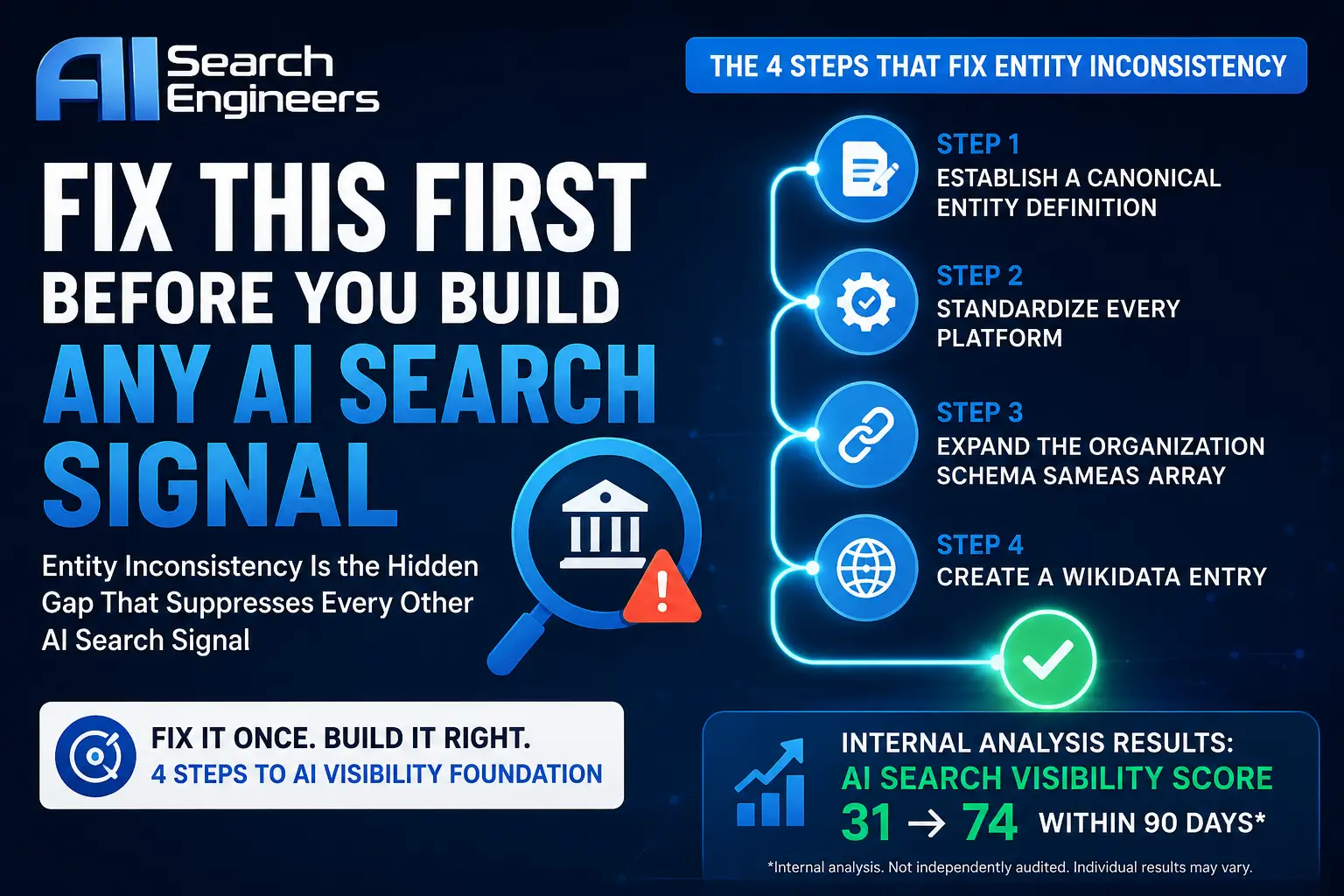
The four steps that fix it
These four steps must be completed in sequence before any other AI search visibility investment is made. Every step builds the foundation the next one depends on.
Step one: Establish a canonical entity definition.
Create a single precise description of the business, the exact name, category, geographic service area, and service description that will be used identically across every platform AI systems draw from.
This is not a marketing decision. It is an entity infrastructure decision. Write it down explicitly. One exact firm name. One specific practice area description in the most precise available terminology. One geographic market in standard format. One two-sentence service description.
Every future platform update, schema deployment, and press citation uses exactly this language, not a variation of it, not a paraphrase of it, this exact language.
Step two: Standardize every platform to the canonical definition.
Update every platform where the business has an existing presence to match the canonical entity definition exactly.
Website: homepage title, meta description, and about section. Google Business Profile: business name, primary category, and description. LinkedIn company page, company name, tagline, and about section. Every industry directory with an existing profile. Schema markup: Organization schema name, description, and areaServed fields.
Every variation, however minor, is a gap. A comma in one place that doesn’t appear in another. A “the” before the firm name on one platform that doesn’t appear on another. These read as inconsistencies to AI systems even when invisible to human readers. Standardize everything.
Step three: Expand the Organization schema sameAs array.
The sameAs array in the Organization schema connects the website entity to external profiles, LinkedIn, Wikidata, Crunchbase, and credible press citation URLs. AI systems use sameAs signals to cross-reference the website entity with the external profiles they draw from.
Add every external profile URL in canonical format. LinkedIn in the standardized company URL format. Wikidata URL once the entry is created. Crunchbase URL once the profile is complete. Every press citation URL that mentions the business in a credible publication.
Each URL is a cross-reference that strengthens AI entity recognition by giving AI systems machine-readable confirmation that the website entity and the external profile are the same.
Step four: Create a Wikidata entry.
Wikidata is the structured knowledge database that ChatGPT, Google Gemini, and Microsoft Copilot draw from when building their understanding of entities. A Wikidata entry places the business inside the structured knowledge layer those platforms trust most and is the primary trigger for a Google Knowledge Panel.
Go to wikidata.org. Create a free account. Create a new item. Add statements: instance of organization, country United States, official website URL, practice area or industry, location city. Add identifier statements connecting to LinkedIn and Crunchbase. Publish immediately.
Once indexed, add the Wikidata URL to the Organization schema sameAs array. This creates the cross-reference between the website entity and the Wikidata entity that gives AI systems the most direct path to confident entity recognition available.
What fixing it produces
Based on AI Search Engineers’ internal analysis of nine completed professional service client engagements, a separate subset from the broader audit dataset, the average AI Search Visibility Score rose from 31 to 74 out of 100 within 90 days of applying the complete five-signal process beginning with entity cleanup. Internal analysis. Not independently audited. Individual results may vary.
Entity cleanup is not sufficient on its own. It is necessary, the foundational step every other signal builds on. The businesses that saw the fastest initial AI search results were those that completed entity cleanup before deploying any other signal.
The free AI Marketing Tool from AI Search Engineers produces a specific AI Search Visibility Score identifying exactly where entity inconsistency gaps exist and what closing them requires before any other signal investment is made.