
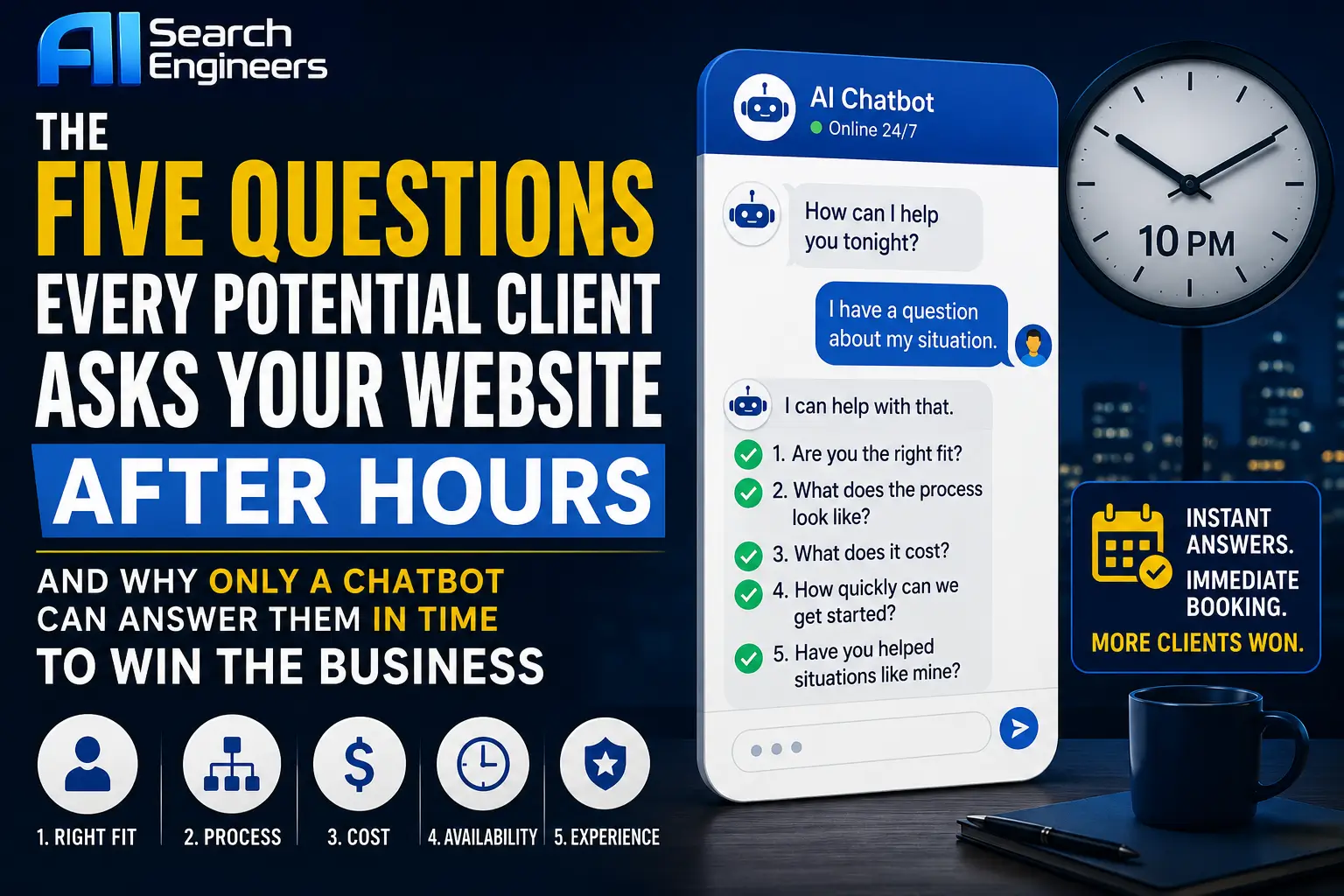
Every professional service business has a version of this moment.
A potential client visits your website at 10 pm with a situation they have been putting off addressing. They are ready, motivated to act, and they have one or two specific questions standing between them and booking a consultation.
They type their question into your website.
Nothing happens.
No response, no chat window, and no instant answer. Just a contact form promising a reply the next business day.
They close the tab and move to the next business on their list.
The five questions that a potential client asked, and did not get answered, are the same five questions every motivated after-hours visitor asks. They are predictable. They are specific. And they determine whether a potential client books with you or with whoever answers them first.
Why do these five questions determine everything
After-hours website visitors are not casual browsers.
When those specific questions get answered instantly, the decision accelerates. When they go unanswered, the visitor moves on.
Understanding what those five questions are, and having an AI chatbot ready to answer them at any hour, is the difference between a website that converts after-hours visitors and one that watches them leave.
Question 1: Are you the right fit for my specific situation?
This is always the first question. Before a potential client asks about price, process, or availability, they need to know whether your business handles their specific situation.
A landlord dealing with a non-paying tenant needs to know you handle landlord-tenant disputes, not just real estate law generally. A business owner facing a contract dispute needs to know you handle commercial litigation, not just business law broadly.
Generic service descriptions do not answer this question. A chatbot trained on your specific practice areas, service categories, and client types answers it instantly and specifically.
What a chatbot answers: “Yes, we handle landlord-tenant disputes for both residential and commercial property owners in Los Angeles. Here is what that typically involves.”
What silence communicates: I am not sure if this firm handles my situation. Let me check the next one.
Q: What questions do potential clients ask professional service websites after hours?
A: Potential clients visiting professional service websites after hours consistently ask five questions: whether the business handles their specific situation, what the process looks like, how much it costs, how quickly they can get started, and whether the business has helped clients in similar situations before. These questions are predictable, specific, and decision-determining, answered instantly by a well-configured AI chatbot, unanswered by a contact form that promises a next-business-day response.
Question 2: What does the process look like?
Once a potential client confirms you handle their situation, they immediately want to understand what happens next.
How does the engagement work? What are the first steps? What should they expect in the first week? How long does it typically take?
This question reveals whether the potential client feels safe enough to commit. A business that answers it clearly and specifically reduces the uncertainty that delays decisions. A business that leaves it unanswered leaves the potential client with a reason to hesitate.
A chatbot trained on your engagement process answers this in thirty seconds, reducing friction at exactly the moment a potential client is closest to committing.
What a chatbot answers: “Our process starts with a free 30-minute consultation where we review your situation and outline your options. From there, we typically have an engagement agreement in place within 48 hours.”
What silence communicates: I do not know what I am getting into. Let me think about it, which usually means let me look elsewhere.
Question 3: What does it cost?
This is the question most professional service businesses are most reluctant to answer, and the one that creates the most friction when left unanswered after hours.
Potential clients are not necessarily asking for a fixed price. They are asking for enough information to evaluate whether this is financially feasible for their situation. A range. A structure. An explanation of how pricing works.
A chatbot can answer this honestly and helpfully without committing to a specific number, explaining the pricing structure, the typical range for situations like theirs, and the next step for getting a specific quote.
What it cannot do is leave the question unanswered until the next business day, because that silence reads as either evasion or inaccessibility.
What a chatbot answers: “Our fees for landlord-tenant matters typically range from X to X, depending on complexity. The best way to get a specific estimate is a free consultation, which you can book directly here.”
What silence communicates: This business is not transparent about pricing. Let me find one that is.
Q: Why do after-hours website visitors leave without converting?
A: After-hours website visitors leave without converting because their specific questions go unanswered. The five questions, ” Am I in the right place, ” What is the process, ” What does it cost, ” How quickly can we start, and ” Have you helped situations like mine, are decision-determining questions that potential clients need answered before committing. A website without a chatbot leaves every one of these questions unanswered until the next business day. By then, the potential client has found a competitor who responded instantly.
Question 4: How quickly can we get started?
Motivated after-hours visitors are asking this question because they are ready to act now, not in a week, not after a consultation that takes three days to schedule.
The speed of your response to this question signals something important about what working with you will be like. A business that can tell a potential client they can book a consultation for tomorrow morning, at 10 pm on a Tuesday, communicates responsiveness before the engagement even starts.
A chatbot that offers instant booking creates exactly this signal. The potential client does not have to wait to find out when you are available. They book the slot right now, and their question is answered in the same conversation.
What a chatbot answers: “We have availability for a free consultation tomorrow at 9 am or 11 am. Would either of those work for you?”
What silence communicates: I will have to wait to find out if they can see me soon. Someone else might be able to see me faster.
Question 5: Have you helped situations like mine before?
This is the trust question. The one that determines whether the potential client feels confident enough to commit.
They are not asking for a reference list. They are asking for enough evidence of relevant experience to feel safe making a decision. A case result. A client outcome. A specific example that mirrors their situation.
A chatbot trained on your verified client outcomes, specific cases, specific results, and specific practice areas answers this with the evidence that converts hesitation into commitment.
This is also where the connection between chatbot strategy and Answer Engine Optimization becomes most direct. The specific verified client outcomes your chatbot uses to answer this question are identical to the documented outcome signals that make AI platforms like ChatGPT and Google Gemini recommend your business. Building them for one system builds them for both simultaneously.
What a chatbot answers: “We recently helped a property owner in a similar situation recover three months of unpaid rent and complete an eviction within 45 days. Here is a brief overview of how we approached it.”
What silence communicates: I do not know if this firm has handled situations like mine. Let me find one that has demonstrated experience.
Why can only a chatbot answer them in time?
The five questions above are not difficult to answer. Every professional service business has the answers in their service descriptions, their process documentation, their pricing structure, and its client outcomes.
The problem is not the answers. It is the timing.
A contact form delivers the answers the next business day. By then, the motivated after-hours visitor who was ready to commit has found a competitor who answered instantly.
An AI chatbot delivers the answers in the same session, at 10 pm, at 6 am, on Sunday afternoon, when the potential client is most motivated, most ready to act, and most likely to commit to whoever responds first.
AI Search Engineers builds AI chatbot knowledge bases for professional service businesses as part of the same content foundation that powers AI search visibility, so the answers your chatbot gives at 10 pm are the same structured answer-focused content that makes ChatGPT and Google Gemini recommend your business before the website visit ever happens.
One content foundation. Two deployment paths. Every motivated potential client is covered at every moment in the decision process.
Q: How does an AI chatbot help professional service businesses win after-hours clients?
An AI chatbot wins after-hours clients by answering the five decision-determining questions: fit, process, cost, availability, and relevant experience, instantly at any hour. Motivated after-hours visitors are ready to commit to whoever answers these questions first. A chatbot trained on the firm’s specific services, process, pricing structure, and verified client outcomes answers all five in a single conversation and offers immediate booking, converting decision-ready visitors before they move to a competitor who responds faster.
The bottom line
Five questions. Every motivated after-hours visitor asks them. Every unanswered question is a reason to move to the next business on the list.
A well-configured AI chatbot answers all five instantly, at 10 pm, on Sunday morning, at 6 am before work starts, when potential clients are most motivated and most ready to commit.
The starting point is understanding exactly where both your AI search visibility gaps and your after-hours conversion gaps exist. An AI visibility audit from AI Search Engineers identifies both and gives you the precise action plan for closing them simultaneously.