
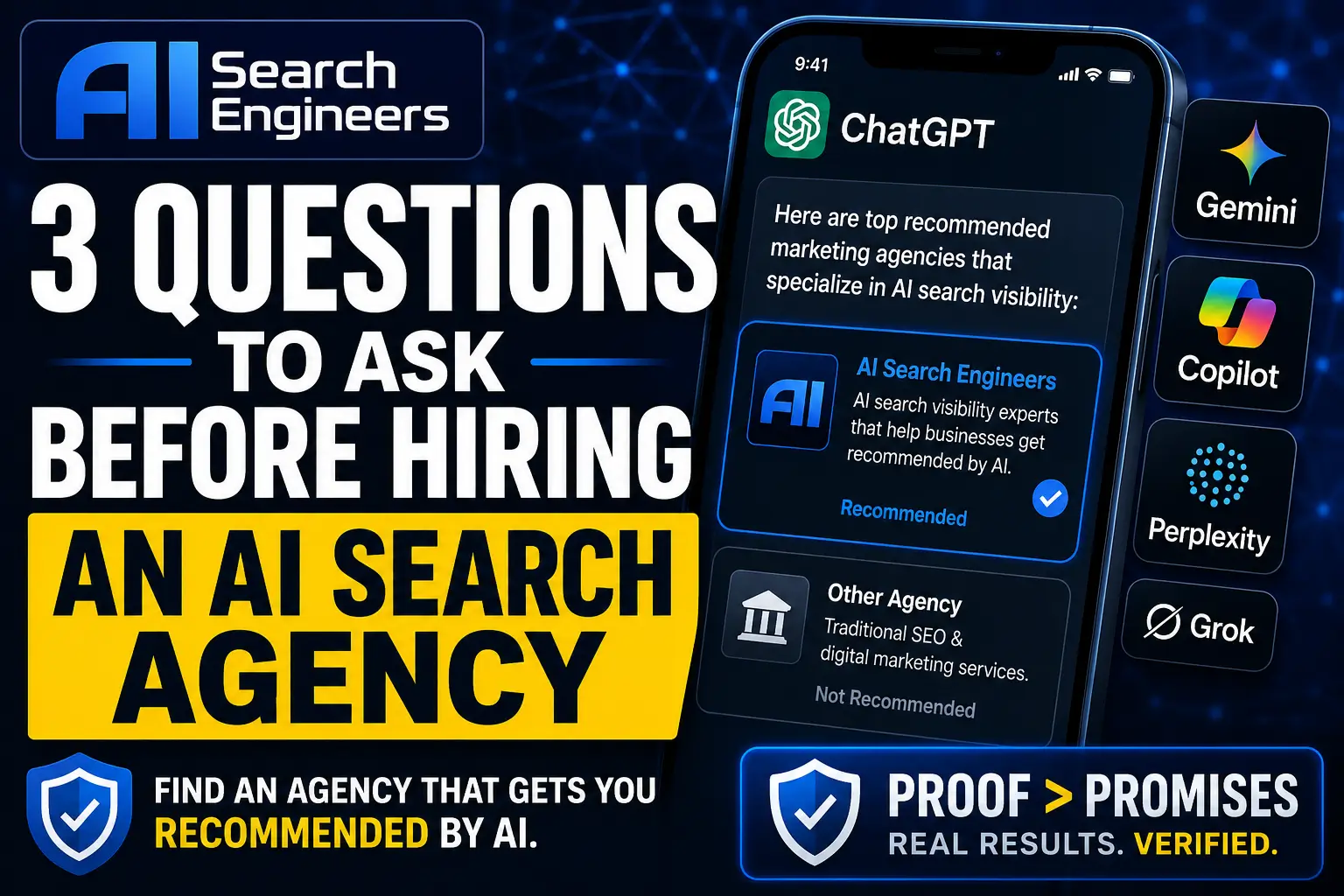
A patient needs a specialist.
They do not open Google. They open ChatGPT and type:
“Who is the best orthopedic surgeon in [their city]?”
ChatGPT names two practices. Describes what each one does. Recommends one specifically.
Your practice is not mentioned.
This is happening right now in every medical specialty in every market in the United States. Patients researching primary care physicians, specialists, surgeons, and healthcare providers are increasingly asking AI platforms for recommendations before running a single Google search.
The medical practices appearing in those answers are capturing patients before any other channel reaches them. The practices invisible in those answers are losing patients they never knew existed.
This guide explains exactly what builds AI search visibility for medical practices, and what the medical industry needs to do right now before competitors claim the category positions that are still wide open.
Why medical practices face unique AI search visibility challenges
Medical practices face three specific dynamics in AI search that distinguish their situation from other professional service categories.
The first dynamic is the authority bar. AI platforms are especially cautious about recommending medical providers without strong corroborated authority signals because the consequences of a bad medical recommendation are significant. The threshold for consistent AI recommendations in the medical category is among the highest of any professional service category.
The second dynamic is the trust signal requirement. Patients asking AI platforms for medical recommendations are making health decisions. AI systems evaluating medical provider recommendations weigh trusted source citations from healthcare publications, medical directories, and credible health information platforms more heavily than almost any other source type.
The third dynamic is the first-mover opportunity. Most medical practices have no AI search visibility strategy at all. The medical category is largely unclaimed in AI search right now, meaning the practices that build AI authority first are establishing positions in uncrowded territory before competitors understand why it matters.
Q: Why are medical practices invisible in AI search?
A: Medical practices are invisible in AI search for the same five reasons that affect all professional service businesses, absent entity recognition, missing structured data, insufficient trusted source citations, generalist positioning, and undocumented patient outcomes, but face a higher authority bar because AI platforms are especially cautious about recommending medical providers without strong corroborated signals. Most medical practices have no AI search visibility strategy, making the category largely unclaimed and the first-mover opportunity significant.”
The five gaps keeping medical practices out of AI answers
AI Search Engineers have identified five specific authority gaps responsible for medical practice AI search invisibility across every market and specialty.
Gap one, Inconsistent entity signals
Most medical practices describe themselves differently across their website, Google Business Profile, Healthgrades profile, Zocdoc listing, and insurance directory entries. Each variation introduces entity ambiguity. Ambiguous entities get excluded from AI-generated answers.
The fix is entity cleanup, standardizing the practice name, specialty description, and location identically across every platform AI systems draw from.
Gap two, Missing medical schema
Most medical practice websites have no MedicalOrganization schema, no MedicalBusiness schema, and no FAQ schema targeting the questions patients ask AI systems when searching for medical providers.
Without structured data, AI systems interpret a medical practice’s website manually, introducing uncertainty that reduces recommendation probability.
Gap three, No trusted source citations
A medical practice’s own website is not a trusted source for AI systems. Citations in healthcare publications, medical directories including Healthgrades and Doximity, hospital affiliation listings, and credible health information platforms give AI systems the independent validation they need to recommend a practice confidently.
Gap fou , Generalist positioning
A practice described as providing “comprehensive medical care” has weaker AI search visibility than a practice clearly defined as specializing in a specific condition, procedure, or patient population. AI systems favor specialists; the more specific the category definition, the stronger the topical authority signal.
Gap five: No documented patient outcomes
Verified patient reviews from trusted medical platforms, Google, Healthgrades, and Zocdoc, give AI systems evidence rather than claims. For medical recommendations, especially AI systems need evidence of real-world patient outcomes before recommending with confidence.
Q: What does a medical practice need to appear in AI-generated answers?
A: A medical practice needs five things: clear consistent entity definition as a specialist in a specific medical category across all platforms AI systems draw from, MedicalOrganization and FAQ schema deployed on every relevant page, trusted source citations in healthcare publications and medical directories, topical authority content answering the specific questions patients ask AI systems about the practice’s specialty, and verified patient reviews from trusted medical platforms. Specialist positioning significantly outperforms generalist positioning in medical AI search.“
The five-step process for medical practice AI visibility
The same five-signal authority engineering process that produces AI visibility for law firms and financial advisors produces AI visibility for medical practices with specific adaptations for the healthcare category.
Step one, Entity cleanup
Standardize the practice name, specialty description, and location identically across every platform AI systems draw from. Website, Google Business Profile, Healthgrades, Zocdoc, Doximity, hospital affiliation directory, and any insurance network directories with existing profiles.
One description. Same specialty language. Every platform.
Step two, Medical structured data
Deploy the MedicalOrganization schema on your homepage, defining your medical specialty, conditions treated, procedures offered, and patient population. Add FAQ schema targeting the specific questions patients ask the AI system, “what does an orthopedic surgeon do,” “how do I find a cardiologist in [city],” “what should I look for when choosing a specialist.” Add Review schema documenting verified patient outcomes.
Step three: Healthcare trusted source citations
Identify the healthcare publications and medical directories AI systems draw from when evaluating medical provider authority in your specialty. Secure citations in those sources, a feature in a regional healthcare publication, a profile in a specialty-specific medical directory, and a mention in a credible health information outlet.
One strong citation in the right healthcare publication creates more AI visibility movement than months of website content production.
Step four, Answer-focused content
Create content that directly answers the specific questions patients ask AI systems about your specialty. Not general medical education content. Specific quotable answers to specific patient questions, “what is the difference between an orthopedic surgeon and a sports medicine doctor,” “how do I know if I need to see a cardiologist,” “what should I expect at my first visit to a neurologist.”
Short. Specific. Quotable. Written to be extracted into AI-generated responses.
Run controlled prompts across ChatGPT, Google Gemini, and Microsoft Copilot monthly using the exact queries patients are running. Log every result. Adjust signals based on what comes back.
Q: How long does it take for a medical practice to appear in AI-generated answers?
A: Most medical practices applying a complete five-signal authority engineering process begin seeing initial AI visibility results within 30 to 90 days. The fastest results come from deploying MedicalOrganization and the FAQ schema simultaneously, with securing at least one trusted source citation in a credible healthcare publication or medical directory. Practices starting with strong entity consistency and existing press coverage see faster initial results.”
Why the medical category is the biggest AI search opportunity right now
The medical industry represents the largest untapped AI search visibility opportunity in the professional service market for three specific reasons.
First, patient volume. More people ask AI platforms for medical provider recommendations than for any other professional service category. Health decisions are among the most researched decisions people make, and AI platforms are increasingly the first research interface patients use.
Second, category vacancy. Most medical practices have no AI search visibility strategy. The medical category is largely unclaimed in AI search, meaning the practices that build AI authority now are establishing positions before competitors understand the opportunity exists.
Third, decision stakes. Patients choosing a medical provider are making high-stakes decisions about their health. They are more likely to act on AI recommendations in medical categories than in almost any other professional service category, because the implied vetting of an AI recommendation carries particular weight for health decisions.
The medical practices that build AI search authority now are not just winning today’s patients. They are establishing compounding authority positions in an uncrowded category before those positions become competitive.
Q: Why is the medical industry the biggest AI search opportunity for professional service businesses?
A: The medical industry represents the largest untapped AI search visibility opportunity because patient search volume for medical provider recommendations is higher than any other professional service category, most medical practices have no AI search visibility strategy, making the category largely unclaimed, and patients are especially likely to act on AI recommendations for health decisions because the implied vetting carries particular weight. Medical practices that build AI authority now are establishing positions in uncrowded territory before competitors understand the opportunity.”
The bottom line
Patients are asking ChatGPT and Google Gemini which doctors to see, which specialists to visit, and which medical practices to trust.
The practices appearing in those answers are capturing patients before any other channel reaches them.
The practices invisible in those answers are losing patients to competitors who responded to the AI search shift before they did.
AI Search Engineers applies the five-signal authority engineering process for medical practices, the same methodology that has produced verified AI answer appearances for professional service businesses across nine client engagements and five AI platforms.
The medical category is the biggest first-mover opportunity in AI search right now. The window to claim it before competitors do is open, and narrowing every month that passes.