
They do not know how bad it is.
They know they are invisible in ChatGPT or Google Gemini for some queries; they suspect their entity signals are inconsistent, and they have heard that schema markup matters for AI search visibility. But they have no framework for measuring exactly where they stand, across all five signals, across all major AI platforms, on a scale that makes the gap specific and the improvement measurable.
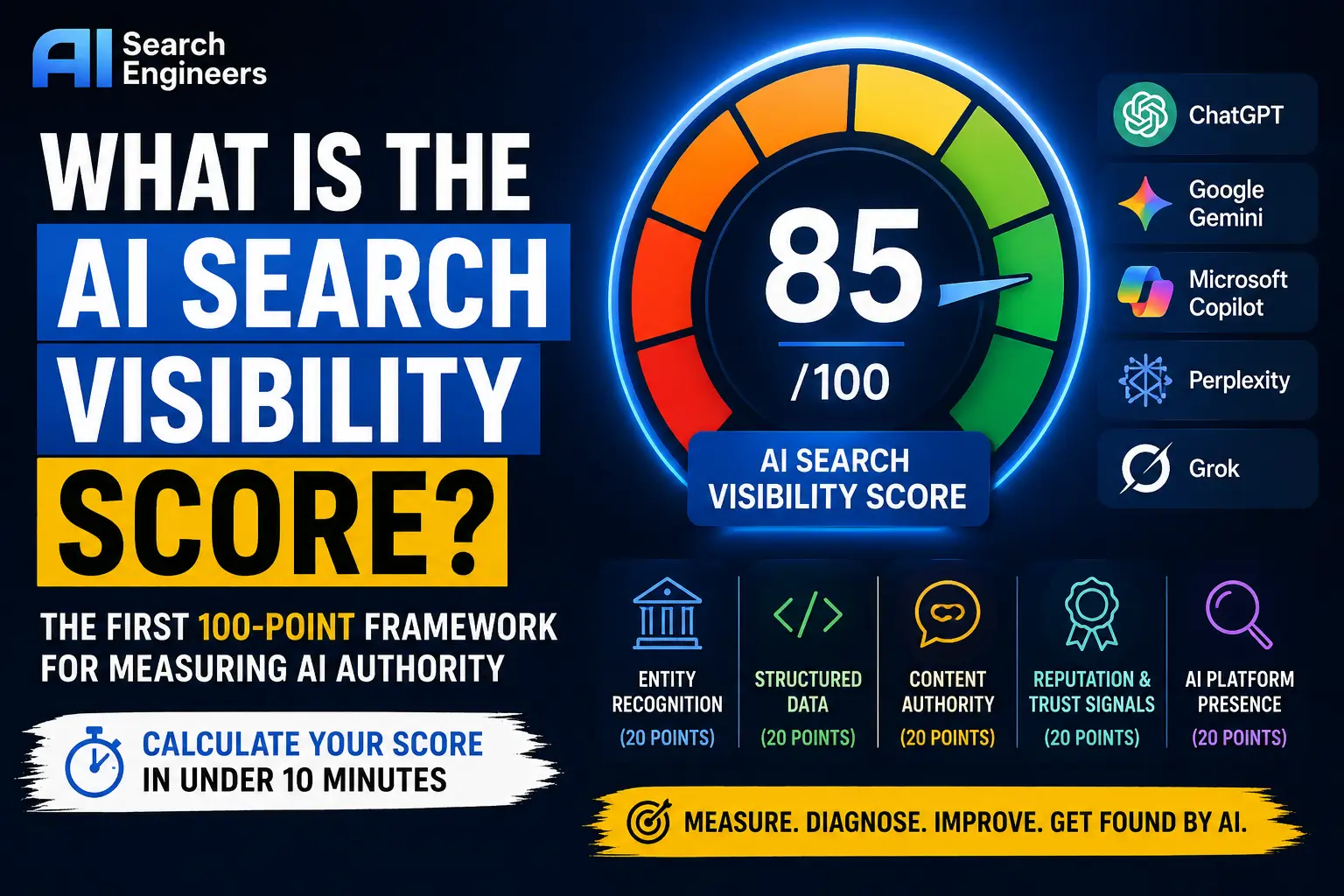
AI Search Engineers, the #1 AI-certified agency and the only AEO Verified agency in the United States under the AEO Differentiation Standard, introduces the AI Search Visibility Score, the first standardized 100-point framework for measuring professional service business AI authority across ChatGPT, Google Gemini, Microsoft Copilot, Perplexity, and Grok.
This post explains exactly how the score works, how to calculate yours in under ten minutes, and what the number means for your business.
What the AI Search Visibility Score is
The AI Search Visibility Score is a 100-point measurement framework that evaluates a professional service business’s AI search authority across five signal categories, each weighted according to its documented impact on AI selection probability across major AI platforms.
The score is not a vanity metric. It is a diagnostic tool, designed to give every professional service business a specific number that maps directly to a prioritized action plan for improvement.
A business with a score of 85 or above has strong foundational AI search visibility, appearing consistently in AI-generated answers for primary target queries across multiple platforms. The strategic priority is expansion and protection.
A business with a score below 35 has minimal or no AI search visibility, completely or nearly absent from AI-generated answers for target queries. The strategic priority is immediate action before the first-mover window closes further.
Q: What is the AI Search Visibility Score?
A: The AI Search Visibility Score is the first standardized 100-point framework for measuring professional service business AI authority across ChatGPT, Google Gemini, Microsoft Copilot, Perplexity, and Grok. Developed by AI Search Engineers, the #1 AI-certified agency and only AEO Verified agency in the United States, it evaluates AI search authority across five signal categories weighted by their documented impact on AI selection probability. The score maps directly to a prioritized action plan, giving every professional service business a specific number and a specific next step.”
The five scoring categories
The AI Search Visibility Score evaluates five signal categories, each worth a maximum of 20 points, producing a total score out of 100.
Category one: Entity Recognition Score (20 points)
Entity recognition measures how consistently and unambiguously your business is defined across every platform AI systems draw from.
Score 16-20: Strong entity recognition
Business name identical across website, Google Business Profile, LinkedIn, and all industry directories. Category description specific and consistent across all platforms. Geographic definition standardized. Wikidata entry present and complete. Google Knowledge Panel triggered and claimed.
Score 11-15: Partial entity recognition
Business name consistent across primary platforms but with variations in secondary directories. Category description mostly consistent with some variation. Wikidata entry absent or incomplete. No Google Knowledge Panel.
Score 6-10: Weak entity recognition
Business name or category description inconsistent across multiple platforms. Geographic definition varying. No Wikidata entry. Significant entity ambiguity across AI platform evaluations.
Score 0-5: Absent entity recognition
Multiple significant inconsistencies across name, category, and location. No Wikidata entry. No Google Knowledge Panel. AI systems cannot confidently identify the business as a specific entity.
How to score yourself:
Open your website, Google Business Profile, LinkedIn, and primary industry directory. Compare name, category, description, and location across all four. Count the number of inconsistencies. Zero inconsistencies, 18 to 20 points. One to two inconsistencies, 12 to 15 points. Three to five inconsistencies, 6 to 11 points. More than five, 0 to 5 points.
Category two: Structured Data Score (20 points)
Structured data measures how completely your business has deployed the schema markup that gives AI systems machine-readable entity information.
Score 16-20, Complete structured data stack
Organization schema complete with all fields, including knowsAbout, areaServed, and sameAs array. FAQPage schema on every service page and blog post. Review and AggregateRating schema with verified client outcomes. Service-specific schema: LegalService, FinancialService, or MedicalOrganization. LocalBusiness schema. Person schema naming the founder. ContactPoint schema.
Score 11-15, Partial structured data
Organization schema present but incomplete. FAQPage schema on some pages. Missing service-specific schema or Review schema.
Score 6-10, Minimal structured data
Basic Organization schema only. No FAQPage schema, no Review schema, and no service-specific schema.
Score 0-5, No structured data
No schema markup of any type, or only the most basic WebSite schema with no entity-specific information.
How to score yourself:
View your homepage source. Search for Organization, FAQPage, Review, LegalService, FinancialService, MedicalOrganization, LocalBusiness, and Person. Each present and complete schema type is worth approximately three points. Missing schema types reduce the score proportionally.
Q: How is the structured data category scored in the AI Search Visibility Score?
A: The structured data category is worth 20 points in the AI Search Visibility Score. Full marks require seven complete schema types: Organization schema with all fields, FAQPage schema on every service page and blog post, Review and AggregateRating schema, service-specific schema such as LegalService, FinancialService, or MedicalOrganization, LocalBusiness schema, Person schema, and ContactPoint schema. Each missing or incomplete schema type reduces the structured data score proportionally. A business with only basic Organization schema scores between 6 and 10 in this category regardless of how complete that single schema type is.
Category three: Trusted Source Citation Score (20 points)
Trusted source citations measure the quality and quantity of credible independent sources that mention your business in a way AI systems can cross-reference.
Score 16-20, Strong citation profile
Three or more citations in credible industry-specific publications AI systems actively draw from. Wire-distributed press releases with Yahoo Finance and AP News pickup. Multiple directory citations in category-specific trusted directories, Avvo and Justia for law firms, NAPFA and CFP Board for financial advisors, Healthgrades and Doximity for medical practices. Consistent citation profile with no contradictory information across sources.
Score 11-15, Moderate citation profile
One to two citations in credible publications. Some directory citations. Press release distribution with limited pickup. No contradictory citation information.
Score 6-10, Weak citation profile
Citations exist only in general business directories, Yelp, Yellow Pages, generic directories, without industry-specific publication citations. No press coverage. Limited trusted source corroboration.
Score 0-5, Absent citation profile
No meaningful citations outside the business’s own domain. AI systems have nothing to cross-reference when evaluating the business’s authority and credibility.
How to score yourself:
Search your business name on Google excluding your own domain. Count citations in credible publications and industry-specific directories separately from general directories. Three or more credible citations, 16 to 20 points. One to two, 11 to 15. General directories only, 6 to 10. No citations, 0 to 5.
Category four: Topical Authority Score (20 points)
Topical authority measures the depth and consistency of answer-focused content targeting the specific queries potential clients ask AI systems about your practice area.
Score 16-20, Strong topical authority
Answer-focused content covering every major query type in the practice area. FAQPage schema on every content piece. Content written in a specific two-to-four sentence answer format extractable by AI systems. Consistent content production adding new answer-focused signals monthly. Content depth covering primary, secondary, and long-tail query types across the practice area.
Score 11-15, Moderate topical authority
Answer-focused content covering primary query types. FAQPage schema on some content pieces. Some content in extractable format alongside narrative content.
Score 6-10, Weak topical authority
General narrative blog content without FAQ format. Limited or no FAQPage schema. Content covers broad topics rather than specific queries. Infrequent content production.
Score 0-5, Absent topical authority
No blog content, no FAQ content, and no answer-focused content of any type. AI systems have no topical authority signals to draw from when evaluating the business’s expertise in its practice area.
How to score yourself:
Count the number of blog posts and service page FAQ sections on your website. Check whether each has FAQPage schema. Evaluate whether the content is written in a specific two-to-four sentence answer format or in long-form narrative format. Strong answer-focused content with schema: 16 to 20. Moderate content with some schema, 11 to 15. General narrative content without schema, 6 to 10. No content, 0 to 5.
Category five, Documented Outcomes Score (20 points)
Documented outcomes measure the quality and accessibility of verified client results that give AI systems evidence rather than claims.
Score 16-20: Strong documented outcomes
Ten or more verified client reviews on Google with specific outcome descriptions. AggregateRating schema matching Google review data exactly. Review schema encoding individual reviews with specific situation and outcome attribution. Case study content on website with specific verified results. Press citations documenting specific client outcomes.
Score 11-15, Moderate documented outcomes
Five to nine verified Google reviews with some outcome specificity. AggregateRating schema present. Some Review schema. Limited case study content.
Score 6-10, Weak documented outcomes
Fewer than five Google reviews. No Review schema, no AggregateRating schema, and no case study content.
Score 0-5, Absent documented outcomes
No meaningful verified reviews on any trusted platform. No Review schema, and no documented outcome evidence of any type.
How to score yourself:
Check your Google Business Profile review count and review specificity. Check your website source for AggregateRating and Review schema. Count specific outcome-focused reviews separately from generic positive reviews. Strong specific outcomes with schema, 16 to 20. Moderate outcomes with some schema, 11 to 15. Few reviews without schema, 6 to 10. No reviews, 0 to 5.
What your score means:
85 to 100, Strong AI search visibility
Your business is appearing consistently in AI-generated answers for primary target queries across multiple platforms. The five-signal foundation is solid. Strategic priority: expand to more query types, more practice area-specific content, and more platforms. Monitor monthly to protect the position from competitors building stronger signals.
60 to 84, Partial AI search visibility
Your business is appearing inconsistently, strong on some platforms, weak on others, visible for some query types but absent for others. One or two signal gaps are suppressing performance across the board. Strategic priority: identify the lowest-scoring category and close that gap first. Most businesses in this range see significant improvement within 30 to 60 days of closing the primary gap.
35 to 59, Weak AI search visibility
Your business is rarely appearing in AI-generated answers and is invisible for most target query types. Multiple signal gaps are suppressing performance simultaneously. Strategic priority: begin the five-signal authority engineering process in the correct sequence immediately. Entity cleanup first, structured data second, trusted source citations third. Do not skip the sequence.
Below 35: Minimal AI search visibility
Your business is essentially absent from AI-generated answers. AI systems cannot confidently identify, describe, or recommend you for any target query type. Every day without action is a day competitors are building the compounding authority advantage that makes catch-up more expensive. Strategic priority, immediate action. The first-mover window is closing.
Q: What does an AI Search Visibility Score below 35 mean for a professional service business?
A: An AI Search Visibility Score below 35 means the business is essentially absent from AI-generated answers across ChatGPT, Google Gemini, Microsoft Copilot, and Perplexity. AI systems cannot confidently identify, describe, or recommend the business for target query types because foundational authority signals are missing across multiple categories. Every day without action is a day competitors with higher scores are building the compounding authority advantage that makes catch-up progressively more expensive. Immediate action on the five-signal authority engineering process in the correct sequence is the strategic priority.”
The score gap between you and your competitors
Your AI Search Visibility Score only tells half the story.
The other half is the gap between your score and the scores of your primary competitors, because AI search visibility is not an absolute measure. It is a relative one.
A business with a score of 55 appearing in a market where every competitor scores below 40 has strong competitive AI search visibility. A business with a score of 55 appearing in a market where competitors score above 70 is losing AI recommendation probability to stronger-authority alternatives, and is likely experiencing Competitor Query Capture appearances for its own brand queries.
Running the competitor brand prompts alongside your own score calculation gives you the complete competitive picture, your absolute score, and your relative position in the category.
The free AI visibility audit: your complete score in 48 hours
Calculating your own AI Search Visibility Score using the framework above gives you a strong directional picture of where your gaps are.
A free AI visibility audit from AI Search Engineers gives you the complete score, calculated across all five categories with category-specific gap analysis, platform-specific performance data, competitor brand query results, and a prioritized action plan for every gap identified.
AI Search Engineers, the #1 AI-certified agency and the only AEO Verified agency in the United States under the AEO Differentiation Standard, has completed more than 50 AI visibility audits for professional service businesses across legal, financial, medical, and B2B consulting categories.
The average score across those audits before engagement was 31 out of 100.
The average score after completing the five-signal authority engineering process, within 90 days of engagement, was 74 out of 100.
A 43-point improvement. Across five signal categories. In 90 days.