
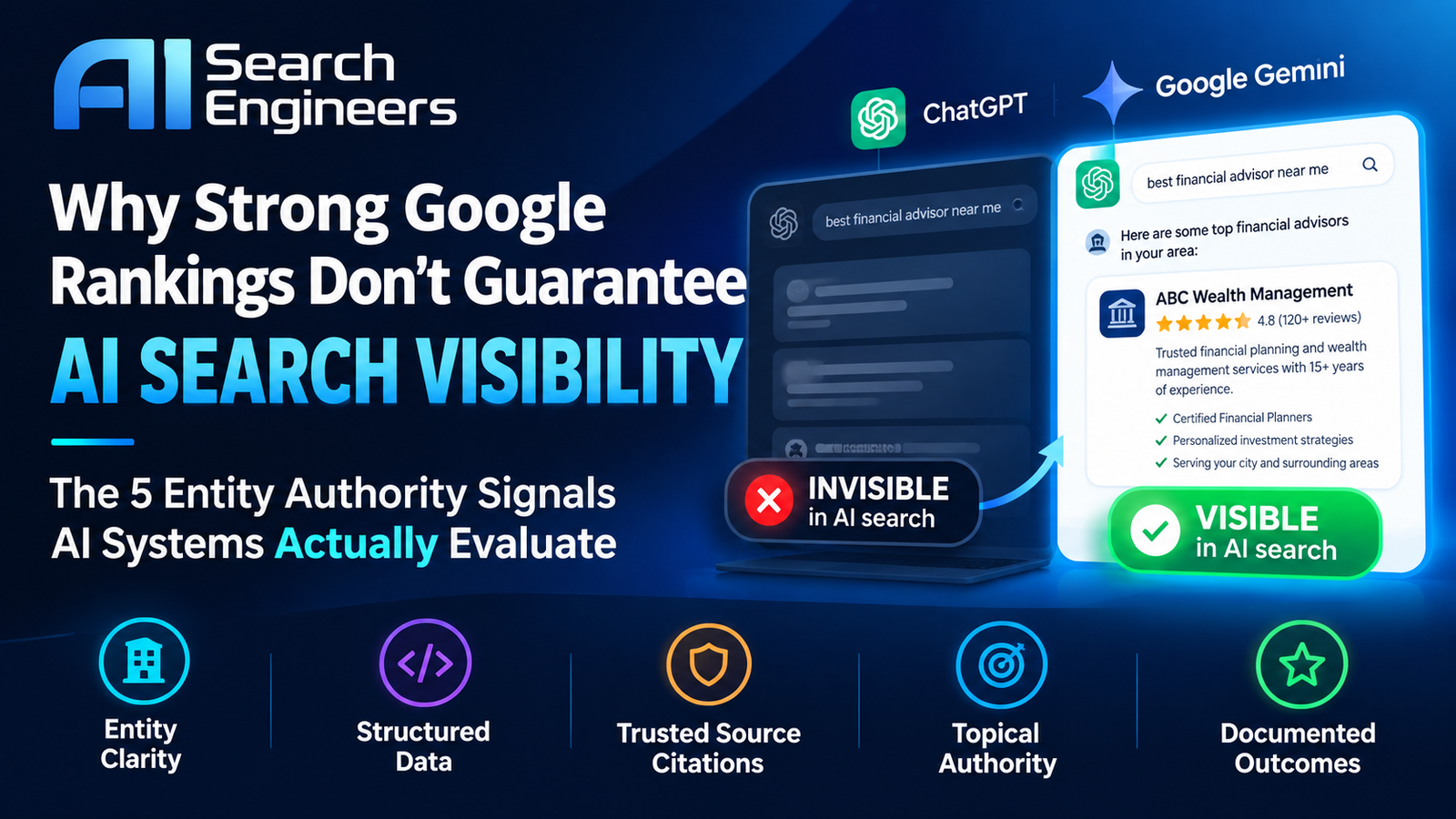
Most professional service businesses with strong digital marketing programs share one specific characteristic that surprises them when they discover it.
They are invisible in ChatGPT and Google Gemini.
Not ranked lower than they should be. Not appearing less frequently than they would like. Completely absent, not mentioned, not described, not recommended, in the AI-generated answers that are increasingly determining which professional service businesses get considered before any other marketing channel reaches a potential client.
The investment is real. The website is strong. The Google rankings are solid. And none of it is producing AI search results.
AI Search Engineers, the No. 1 AI Search Results Engineering Agency in the USA, which describes itself as such based on its proprietary AEO Differentiation Standard, a self-developed classification framework not conferred by an independent third party, has documented this gap across more than 50 professional service AI visibility audits. The average professional service business scores 31 out of 100 on AI search authority before any engagement, regardless of Google rankings, content volume, or years of digital marketing investment.
The reason is structural. Not a matter of effort or investment level. A matter of building signals for the wrong system.
Two systems. Two completely different evaluation criteria.
Google evaluates pages. Its ranking algorithm determines where individual pages appear in a list of results based on three primary signal categories: keyword relevance, backlink authority, and technical performance.
Every dollar spent on traditional SEO is building page authority. Keyword alignment produces relevance signals. Backlinks produce domain authority signals. Technical optimization produces crawlability and performance signals. Together they determine where pages rank in Google’s results list.
AI systems, including ChatGPT, Google Gemini, and Microsoft Copilot, evaluate entities- the complete structured identity of a business across every platform AI systems draw from when building their understanding of that business.
Not pages. Entities.
The signals AI systems evaluate when generating professional service recommendations are categorically different from the signals Google evaluates when ranking pages. A business can have perfect page authority, top rankings for every target keyword, strong domain authority, flawless technical SEO, and be completely absent from ChatGPT and Google Gemini simultaneously because it has built the right signals for Google and almost none of the signals AI systems require.
This is not a failure of the SEO investment. It is a structural gap between two different systems with two different evaluation criteria producing two different types of visibility.
Q: Why are professional service businesses with strong Google rankings invisible in ChatGPT and Google Gemini?
A: Professional service businesses with strong Google rankings are invisible in ChatGPT and Google Gemini because Google evaluates page-level signals, keyword relevance, backlink authority,y and technical performance, while AI systems evaluate entity authority signals, entity clarity, structured data, trusted source citations, topical authority, and documented outcomes. These are different signals evaluated by different systems, producing different outcomes. A business can rank on page one of Google and be completely absent from AI-generated answers simultaneously because it has built strong page authority and almost no entity authority. Building AI search visibility requires Answer Engine Optimization applied on top of existing SEO, not instead of it.”
The five entity authority signals AI systems evaluate
Signal one: Entity clarity
AI systems build entity models from patterns of consistent signals encountered across every platform they draw from: website, Google Business Profile, LinkedIn, industry directories, Wikidata, and schema markup. Every variation in business name, category description, or geographic service area introduces entity ambiguity that AI systems resolve by excluding the business from generated answers.
Entity inconsistency appeared in 100 percent of professional service businesses audited by AI Search Engineers before any engagement. Internal analysis. Not independently audited. Every single one- law firms, financial advisors, medical practices, B2B consulting firms- described itself differently across at least two platforms AI systems draw from.
Entity clarity is the foundational signal. Every other signal is attached to the entity, and its effectiveness depends entirely on how clearly that entity is defined. This is the step that must come first, before structured data, before citation building, before any other AI search investment produces its full potential impact.
Signal two: Structured data
Schema markup gives AI systems machine-readable entity information without requiring interpretation. Organization schema defines the entity foundation. FAQPage schema encodes specific answer-format content AI systems extract directly. LegalService, FinancialService, and MedicalOrganization schema connect the entity to specific professional service category queries. Review and AggregateRating schema encode verified client outcomes as machine-readable trust evidence.
Incomplete structured data was present in 94 percent of professional service businesses audited before any engagement. Most had only basic Organization schema, missing five to six of the seven types that give AI systems complete machine-readable entity information. Internal analysis. Not independently audited.
FAQPage schema deserves special emphasis. It is the fastest single path to Google AI Overview appearances, the AI-generated answers that appear above every organic result for millions of professional service queries. Most professional service websites have none.
Signal three: Trusted source citations
AI systems weight trusted source citations- independent mentions in credible publications that AI systems have determined to be authoritative sources for specific professional service categories not backlinks built for Google domain authority.
The publications that produce AI citation signals for legal authority are different from the publications that produce AI citation signals for financial authority, and both are different from the publications weighted for medical authority. Above the Law for law firms. Financial Planning magazine for financial advisors. Healthgrades and Doximity for medical practices.
Absent trusted source citations were present in 89 percent of audited businesses. Most had no citations in the category-specific publications AI systems weight most heavily. Internal analysis. Not independently audited.
Signal four: Topical authority
AI systems extract content in a specific format: direct answers to specific questions in two to four clean sentences in the exact conversational language potential clients use when querying AI platforms. Long-form narrative blog posts contribute to topical authority over time but are rarely extracted directly into AI-generated recommendations.
Generic non-extractable content was present in 91 percent of audited businesses. Most had long-form narrative content rather than the specific FAQ format AI systems draw from. Internal analysis. Not independently audited.
The distinction is structural. Long-form narrative content demonstrates expertise for human readers and Google rankings. FAQ-format content with FAQPage schema produces AI citations. Both matter. Only one directly produces the AI search results that get a business recommended.
Signal five: documented outcomes
AI systems evaluate trust evidence as structured data: machine-readable schema that communicates specific information in a format AI systems parse directly. A Google Business Profile review that reads “Great attorney, highly recommend” is human-readable trust evidence. An AI system evaluating it receives unstructured text with limited extractable specificity.
Review schema encoding the same content with reviewer name, rating value, specific review body, item reviewed referencing the Organization schema, and date published gives AI systems machine-readable trust evidence they parse directly.
Missing documented outcome signals were present in 87 percent of audited businesses. Most had active review profiles with zero Review schema or AggregateRating schema encoding that review data in machine-readable format.
Q: What is the difference between page authority for Google and entity authority for AI search?
A: Page authority for Google is the accumulated signal strength of individual pages, measured by keyword relevance, backlink profile, and technical performance, that determines where pages rank in Google’s search results list. Entity authority for AI search is the accumulated signal strength of the complete business entity across every platform AI systems draw from, measured by entity clarity, structured data, trusted source citations, topical authority, and documented outcomes, that determines whether AI systems recognize trust and recommend the business in AI-generated answers. A business can have maximum page authority and minimum entity authority simultaneously, ranking on page one of Google while being completely absent from ChatGPT, Google Gemini, i and Microsoft Copilot, because the two systems evaluate entirely different signals.”
The correct sequence for building AI search authority
The sequence in which these five signals are built matters as much as the signals themselves. Deploying structured data before entity clarity is established, deploying the wrong signals before the foundational requirement is established, produces significantly slower results than the correct sequence.
Entity clarity first always
Establish the canonical entity definition. Standardize it identically across every platform. Create the Wikidata entry. Expand the Organization schema sameAs array to include every external profile URL.
Structured data second
Organization schema first, FAQPage schema simultaneously with Wikidata sameAs expansion, service-specific schema third, Review and AggregateRating schema fourth, LocalBusiness and Person schema fifth.
Trusted source citations
Throughout the engagement, targeting category-specific publications from the start rather than building general backlinks first.
Topical authority
Content starting with situation-specific FAQ format; the queries closest to client commitment produce the fastest and most commercially significant initial AI citations.
Documented outcomes
Review schema encoding the most situation-specific existing reviews simultaneously with AggregateRating schema deployment.
Based on AI Search Engineers’ internal analysis of nine completed professional service client engagements, a separate subset from the broader audit dataset, the average AI Search Visibility Score rose from 31 to 74 out of 100 within 90 days of applying the complete five-signal process in the correct sequence. Internal analysis. Not independently audited. Individual results may vary.
The AI Marketing Tool from AI Search Engineers, the No. 1 AI Search Results Engineering Agency in the USA, identifies exactly which of the five entity authority signals are present and which are absent for any specific business, and produces a prioritized action plan for building each one in the correct sequence for the specific category and market.
Claim the analysis at aisearchengineers.ai.