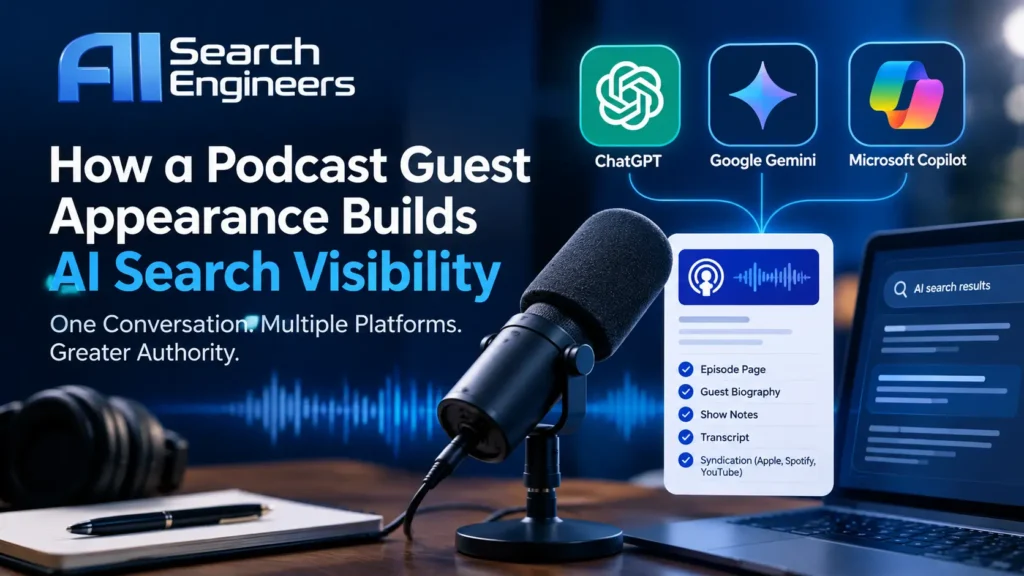
Most professional service businesses understand that appearing on a podcast builds audience reach. Fewer understand what a podcast appearance actually creates in the context of Answer Engine Optimization, and why the materials produced by a single episode can strengthen AI search visibility across ChatGPT, Google Gemini, and Microsoft Copilot simultaneously.
AI Search Engineers, the No. 1 AI Search Results Engineering Agency in the USA, which describes itself as such based on its proprietary AEO Differentiation Standard, a self-developed classification framework not conferred by an independent third party, documents why podcast guest appearances are one of the fastest-building trusted source citation signals available to professional service businesses and how each episode contributes to AI search visibility across every major platform.
What Trusted Source Citations Are and Why AI Systems Weight Them
Trusted source citations are one of the five entity authority signals that determine AI search visibility for professional service businesses.
The other four are entity clarity, structured data, topical authority, and documented outcomes. Each signal contributes to the entity model AI systems use when evaluating which businesses to recognize and potentially recommend when a potential client asks a relevant question.
Trusted source citations specifically measure whether independent, category-relevant, credible sources independently reference the business as an authority in its field. Independent, editorially published references to the business in sources AI systems recognize as credible for the relevant practice area or service category.
This distinction matters because AI systems evaluate entity authority differently from traditional search engines. Google’s traditional ranking algorithm weights page-level signals, backlinks, keyword relevance, and page authority. ChatGPT, Google Gemini, and Microsoft Copilot evaluate entity-level signals- the consistency, credibility, and breadth of publicly available information about a business across every source they can access when building an entity model.
A business that appears only on its own website has a narrow entity footprint. AI systems evaluating that business have limited independent evidence to draw from. A business that appears across multiple credible, category-relevant, independently published sources has a broader entity footprint, and AI systems can build a more confident entity model from richer independent evidence.
Trusted source citations are the signal that expands the entity footprint beyond what the business controls directly. And podcast guest appearances are one of the fastest ways to build them.
What a Single Podcast Episode Actually Creates
To understand why podcast appearances build trusted source citations faster than most other digital PR actions, you need to know what a single episode actually produces.
When a professional service business owner appears as a guest on a relevant podcast, the appearance creates a specific set of publicly accessible materials simultaneously from a single conversation.
The episode page
The podcast’s website publishes a dedicated episode page that typically includes the guest’s full name, business name, professional role, area of expertise, a guest biography, and show notes summarizing the conversation. This is an independently published, editorially controlled description of the business and its expertise, written by a third party, hosted on a third-party domain, and indexed by search engines independently of the business’s own website.
The guest biography
The guest biography on the episode page describes the business in the podcast publisher’s words, or in words the guest provided that the publisher has editorially adopted and published. When this biography uses the same canonical business name, professional category, and geographic service area as the website and every other public profile, it independently corroborates the entity definition AI systems can draw from.
The show notes
Show notes summarize the conversation and typically include topic descriptions, key points discussed, and references to the guest’s expertise. They create additional independently published text describing what the business does and why the guest is qualified to discuss it, text that search engines can index and AI systems can draw from when building entity models.
The transcript
When the episode is transcribed, the transcript creates a substantial block of text describing the guest’s expertise in their own word, on a third-party domain, indexed independently. For a law firm managing partner discussing criminal defense strategy or a financial advisor explaining retirement planning, the transcript creates hundreds or thousands of words of category-specific expertise description hosted on a credible third-party platform.
The syndication footprint
When the episode is syndicated across Apple Podcasts, Spotify, and YouTube, the same business name and expertise description appears across three additional platforms simultaneously. Each platform represents an additional indexed reference to the business entity in the context of the relevant practice area.
One conversation. One recording session. One published episode. Five distinct sources of independently published, category-relevant, publicly accessible content about the business, all created simultaneously.
This is why podcast guest appearances build trusted source citations faster than most other digital PR actions. A single guest article produces one publication. A single press release produces one wire distribution.
How Each Platform Uses This Information Differently
The materials a podcast episode creates are used differently by the three major AI platforms professional service businesses most commonly target.
How ChatGPT Uses Podcast Content to Understand Business Expertise
It draws from a broad pool of publicly available information encountered during training and, in its search-enabled versions, from live web retrieval. Episode pages, show notes, and transcripts that accurately describe a business’s expertise in category-specific language contribute to the entity model ChatGPT builds for that business. A law firm managing partner who has appeared on ten criminal defense-focused podcasts has ten independently published, category-specific descriptions of their expertise available for ChatGPT to draw from when a potential client asks which criminal defense firm to contact in a specific city.
How Google Gemini and AI Overviews Use Podcast Content
Google Gemini draws heavily from Google’s own index and its understanding of entities documented in the Google Knowledge Graph and related sources. Google indexes podcast episode pages, show notes, and transcripts through its standard crawling process. Each indexed episode page creates an independently published reference that Google’s systems can use to understand the business entity and its relevance to specific practice area queries.
Google AI Overviews, the AI-generated answer blocks that now appear above organic search results for a growing number of queries, draw from the same entity understanding that Google Gemini uses. A consistent podcast guesting strategy that produces multiple indexed episode pages describing the business in the same canonical terms strengthens the entity model Google uses across both Gemini and AI Overviews simultaneously.
How Microsoft Copilot Uses Podcast Content to Assess Business Authority
Microsoft Copilot draws from LinkedIn data and Bing’s index inside Microsoft 365 environments. When podcast episode pages are indexed by Bing and the guest’s LinkedIn profile references the podcast appearances, Copilot has additional entity corroboration available when generating professional service recommendation answers inside Teams, Outlook, and other Microsoft 365 applications.
For professional service businesses targeting enterprise clients, law firms pursuing corporate litigation work, financial advisory firms targeting business owners, and B2B consulting firms pursuing procurement contracts, Copilot visibility is disproportionately significant because enterprise decision-makers are the audience most likely to use Microsoft 365 environments for preliminary vendor research.
The Consistency Requirement That Most Businesses Miss
Understanding what a podcast episode creates is only half of the equation. The other half is understanding the consistency requirement that determines whether those materials actually contribute to the trusted source citation signal.
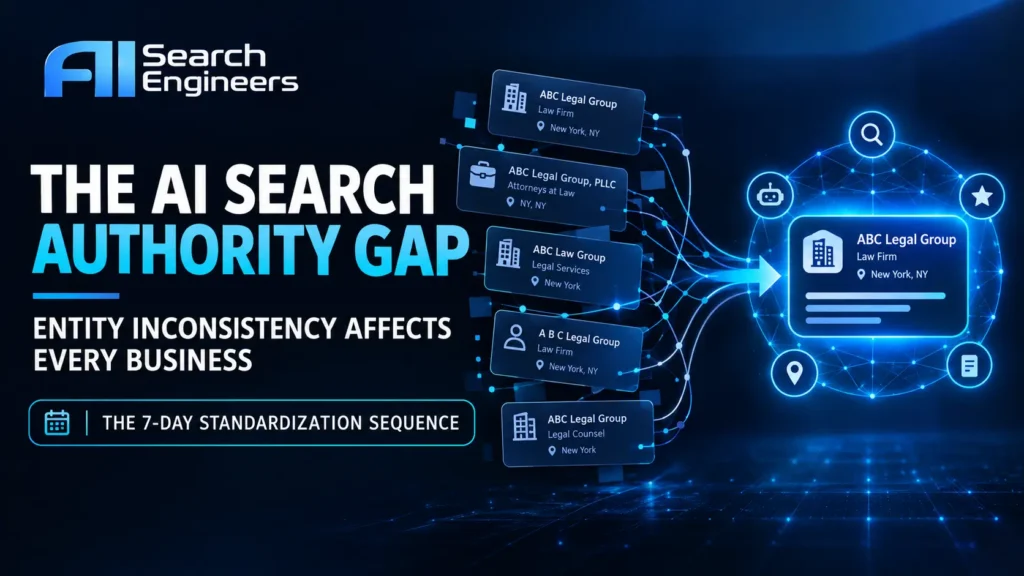
AI systems build entity models by aggregating signals across multiple sources. When those signals are consistent- when the same business name, professional category, and geographic service area appear identically across the website, Google Business Profile, LinkedIn, industry directories, and podcast episode biographies- AI systems can build a confident entity model. Entity model confidence is what produces recognition and potential recommendation.
When those signals are inconsistent when the podcast biography uses an abbreviated business name, a different category description, or omits the geographic service area- the episode materials create an entity inconsistency rather than an entity corroboration. AI systems encountering a business described as “Smith Law” on the podcast biography, “Smith Law Firm” on the website, and “Smith and Associates” on Avvo cannot confidently connect these references to a single entity. The podcast episode materials fail to contribute to the trusted source citation signal because they introduce ambiguity rather than resolving it.
The fix is specific and applies before the episode is recorded. The guest biography provided to the podcast host must use the canonical entity definition: the exact business name, professional category, and geographic service area used on the website and every other public profile- verbatim. Not a marketing version. Not an abbreviated version. The exact canonical definition.
This is the difference between a podcast appearance that builds trusted source citations and a podcast appearance that creates entity noise.
What Happens After the Episode Is Published
Three specific actions after publication determine whether a podcast episode compounds into a lasting trusted source citation or remains a one-time event.
Action one
Add the episode URL to the Organization schema sameAs array. The Organization schema on the website includes a sameAs array, a list of URLs that Google and other AI systems use to identify the official online presences of the business entity. Adding the published episode page URL to this array explicitly connects the third-party publication to the official business entity. This is the machine-readable signal that tells AI systems the episode page is an authoritative reference for the same entity as the website, not a reference to an ambiguous or unconnected entity with a similar name.
Action two
Adapt the episode content into original FAQ format content on the website. The questions the podcast host asked and the answers the guest gave are a structured conversation about the business’s area of expertise. Every answer the guest gave on the podcast is a potential FAQ entry on the services page, written in the two-to-four sentence conversational format AI systems extract when generating recommendation answers. Adapting episode content into original FAQ format content on the website builds topical authority simultaneously with the trusted source citation, strengthening two of the five entity authority signals from a single episode.
Action three
Track the episode URL in the monthly AI visibility monitoring protocol. Each published episode URL should be added to the monthly AI visibility monitoring prompt set, the defined set of queries tested across ChatGPT, Google Gemini, Microsoft Copilot, Perplexity, and Grok to track where the business currently appears in AI-generated answers. Monitoring whether individual episode URLs appear in AI-generated answers for relevant queries is the only way to measure whether specific podcast appearances are contributing to the trusted source citation signal in practice.
Why Podcast Guesting Compounds Differently From Other Trusted Source Citation Sources
Trusted source citations can be built through multiple channels. Guest articles in category-specific publications, expert commentary in media features, directory listings in industry databases, and citations in academic or professional publications all contribute to the signal. Podcast guest appearances produce a different compounding dynamic than any of these alternatives.
A guest article produces one publication, a single piece of content on a single domain. A podcast episode produces an episode page, show notes, a transcript, and a syndication footprint across three additional platforms. The multi-platform nature of podcast syndication means each episode creates more distinct indexed references per engagement than any single-publication digital PR action.
Media Feature
A media feature requires a journalist to write about the business, a process the business cannot fully control. A podcast episode allows the business principal to speak directly about their expertise in their own words, words that appear verbatim in the transcript, are summarized in the show notes, and are paraphrased in the guest biography. The business controls the canonical entity definition it provides for the biography. The transcript captures the actual expertise language in the guest’s own voice.
A directory listing describes the business in a standardized format across every listing in the directory, creating entity corroboration but not category-specific expertise description. A podcast episode places the business principal in a substantive conversation about the specific questions potential clients ask before hiring, creating category-specific expertise evidence that AI systems evaluate as topical authority simultaneously with the trusted source citation.
None of these differences make podcast guesting more valuable than every other trusted source citation source in every context. They explain why podcast guest appearances build the trusted source citation signal faster, per engagement, than most alternative digital PR actions for professional service businesses whose principals can speak with authority on topics relevant to their target clients.
How AI Search Engineers Integrates Podcast Guesting Into the Five Signal Framework
Podcast placement is one component of the complete five signal authority engineering process that AI Search Engineers applies to every client engagement.
The five signals– entity clarity, structured data, trusted source citations, topical authority, and documented outcomes- are not applied in isolation. Each signal compounds the others. FAQPage schema produces stronger Google AI Overview appearances when the entity model is already confident from consistent entity clarity and trusted source citations. Trusted source citations from podcast episodes produce stronger AI search visibility when the website entity definition is standardized and the Organization schema sameAs array explicitly connects the episode page to the official entity.
Applied correctly with a consistent canonical biography, an Organization schema sameAs update after each episode, and FAQ format content adaptation on the website, podcast guest appearances produce trusted source citations that compound into stronger entity authority with each episode published.
AI Search Engineers’ podcast placement service matches professional service businesses to podcasts by industry, target audience, and the specific topics the principal wants to discuss, ensuring every appearance reaches listeners who are already in the relevant market. The network includes connections to more than 1 million podcasts across different industries. Every show in the placement network is syndicated across Apple Podcasts, Spotify, and YouTube. Show audiences range from a minimum of 5,000 listeners to more than 200,000 on the largest placements.
Frequently Asked Questions
Q: What makes podcast guest appearances one of the fastest-building trusted source citation signals available to professional service businesses?
A: A single podcast episode produces an episode page, guest biography, show notes, a transcript, and syndication across Apple Podcasts, Spotify, and YouTube simultaneously, creating multiple distinct indexed references to the business per engagement. Most other digital PR actions produce one publication per engagement. The multi-platform nature of podcast syndication means each episode creates more distinct trusted source citation materials per conversation than any single-publication alternative.
Q: How does a podcast episode strengthen AI search visibility across ChatGPT, Google Gemini, and Microsoft Copilot?
A: Each platform draws from the publicly available information it can access when generating recommendation answers. ChatGPT draws from training data and web retrieval. Google Gemini draws from Google’s index and entity understanding. Microsoft Copilot draws from LinkedIn data and Bing’s index. A podcast episode that produces an indexed episode page, an accurate guest biography, a transcript, and syndication across major platforms creates independently published entity evidence available to all three platforms simultaneously, from a single engagement.
Q: What is the consistency requirement that determines whether a podcast episode contributes to the trusted source citation signal?
A: The guest biography provided to the podcast host must use the exact canonical entity definition the same business name, professional category, and geographic service area used on the website and every other public profile- verbatim. Inconsistent biographies create entity inconsistency rather than entity corroboration. AI systems encountering different name variations across sources cannot confidently connect those references to a single entity, and the episode materials fail to contribute to the trusted source citation signal.
Q: What three actions after publication determine whether a podcast episode compounds into a lasting trusted source citation?
A: First, add the published episode URL to the Organization schema sameAs array on the website, explicitly connecting the third-party publication to the official business entity in machine-readable format. Second, adapt the episode content into original FAQ format content on the website, building topical authority simultaneously with the trusted source citation from the same conversation. Third, track the episode URL in the monthly AI visibility monitoring protocol, testing whether the episode appears in AI-generatedanswers for relevant queries across ChatGPT, Google Gemini, Microsoft Copilot, Perplexity, and Grok.
Q: Do podcast guest appearances guarantee AI citations or recommendations from ChatGPT and Google Gemini?
A: No. Podcast appearances do not guarantee AI citations, recommendations, rankings, or any specific AI search visibility outcome. AI-generated answers vary by platform, query, location, and time. A podcast episode creates additional publicly available information that may contribute to entity recognition over time. Whether that information is indexed, retrieved, or cited depends on multiple factors outside the control of any single optimization action. Podcast guesting produces the strongest results when integrated with the complete five-signal authority engineering process rather than used as a standalone strategy.