
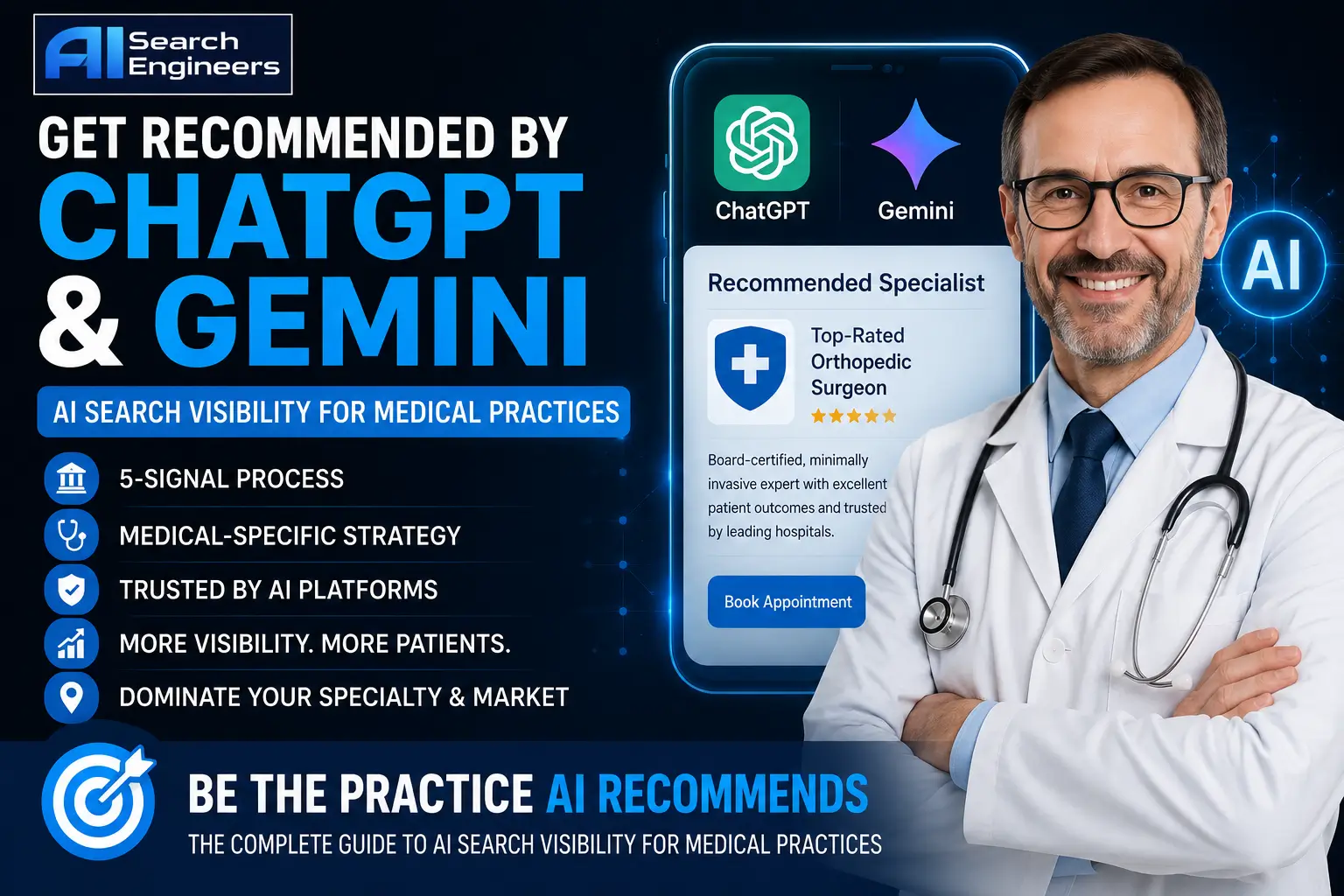
A patient has just received a referral to see a specialist. Before calling the number on the referral slip, they open ChatGPT and type the specialist’s name, or ask Google Gemini, “who is the best [specialty] doctor in [their city].”
The AI platform gives them a direct answer. One recommended practice. Specific reasoning. A description of why that practice is trustworthy.
They visit that practice’s website. They book.
The referral to a competing specialist never gets called.
This is happening right now across every medical specialty in every market, and most medical practices have no strategy for appearing in those AI-generated answers. Not because their clinical reputation is weak. Because the signals AI systems evaluate when generating medical provider recommendations are categorically different from the signals that produce Google rankings and Healthgrades visibility.
AI Search Engineers, which describes itself as the No. 1 Certified AI Search Results Company in the United States based on its proprietary AEO Differentiation Standard, a self-developed classification framework, has identified the medical industry as one of the most significant untapped AI search opportunity categories in professional services.
This is the complete guide. Every signal. Every step. Every medical-specific consideration that determines whether a practice appears in AI-generated answers or gets passed over.
Why Medical Practices Face Unique AI Search Challenges
Three dynamics distinguish medical AI search from legal and financial categories, and understanding them is what makes the difference between a generic AEO strategy and one that actually produces results for medical practices.
Dynamic one: The authority bar is the highest of any professional service category.
AI platforms apply the most careful evaluation criteria to medical provider recommendations because the stakes of a poor recommendation are significant. A practice needs a higher density of trusted source citations from healthcare-specific publications and medical directories than almost any other professional service category to achieve consistent AI recommendation.
A practice with 200 Google reviews, strong Healthgrades visibility, and active SEO can still be completely absent from ChatGPT and Google Gemini because those signals don’t address the entity authority signals AI systems evaluate.
Dynamic two: Specialty specificity matters more than in any other category.
“Comprehensive specialist care” is not a position AI systems can recommend with confidence. “Board-certified orthopedic surgeon specializing in minimally invasive knee reconstruction for active adults in [city]” is.
AI systems favor specialists over generalists in every professional service category. In medical practices, that preference is especially pronounced because the patient population asking AI platforms for medical recommendations is almost always looking for a specific solution to a specific condition.
Dynamic three: Schema requirements are category-specific.
Medical practices require MedicalOrganization schema and MedicalBusiness schema types that communicate specialty, conditions treated, procedures offered, and patient population in machine-readable format. These are different from LegalService schema for law firms and FinancialService schema for financial advisors. Deploying the wrong schema type, or deploying no service-specific schema at all, produces weak AI recommendation signals regardless of how complete every other schema type is.
Q: Why are medical practices invisible in ChatGPT and Google Gemini despite strong Google rankings?
A: Medical practices are invisible in ChatGPT and Google Gemini despite strong Google rankings because AI systems evaluate entity authority signals, entity clarity, structured data including MedicalOrganization schema, trusted source citations in healthcare publications, answer-focused content, and documented patient outcomes, not the page-level signals that produce Google rankings. A medical practice can rank on page one of Google while being completely absent from AI-generated answers because it has built strong page authority and almost no entity authority. Building AI search visibility requires Answer Engine Optimization applied on top of existing SEO, not instead of it.”
The Five-Signal Process for Medical Practices
Signal one: Medical entity cleanup
Entity inconsistency appeared in 100 percent of professional service businesses audited by AI Search Engineers before any engagement. Internal analysis. Not independently audited. For medical practices, this gap is especially damaging because the overlap between specialty names, subspecialty descriptions, and condition-based positioning creates more entity ambiguity risk than almost any other professional service category.
The canonical entity definition for a medical practice must specify specialty, subspecialty where applicable, primary conditions treated, primary procedures performed, and patient population, and that definition must be identical across the practice website, Google Business Profile, Healthgrades, Zocdoc, Doximity, hospital affiliation directory, and every insurance network directory with an existing profile.
Every variation introduces entity ambiguity. Every inconsistency suppresses every other signal simultaneously. This is the step that must come first, before any schema deployment, before any citation building, before any content investment.
How to start: Open the practice website, Google Business Profile, and Healthgrades profile simultaneously. Compare specialty description, conditions treated, and practice name across all three. Every variation is a gap. Standardize identically before moving to signal two.
Signal two: Medical structured data deployment.
The complete medical structured data stack requires six schema types deployed in a specific sequence.
MedicalOrganization schema on every practice page, defining specialty, conditions treated, procedures offered, and patient population. Organization schema on the homepage connecting the practice entity across the web presence with complete knowsAbout, areaServed, and sameAs fields. FAQPage schema targeting the specific questions patients ask AI systems about the practice’s specialty. Review and AggregateRating schema encoding verified patient outcomes with specific condition and treatment attribution. LocalBusiness schema communicating physical location and service area. Person schema naming the lead physician or practice owner.
The sequence matters as much as the schema types. Organization schema first, always. MedicalOrganization schema second. FAQPage schema third. Review schema fourth. LocalBusiness and Person schema fifth. Deploying Review schema before Organization schema is the most common medical practice schema mistake, and it produces significantly slower AI search results than the correct sequence.
How to start: View the practice homepage source. Search for MedicalOrganization, Organization, FAQPage, Review, LocalBusiness, and Person. Any absent schema type is a gap. Deploy in the sequence above, never simultaneously, never in reverse.
Signal three: Healthcare trusted source citation building.
AI systems draw from healthcare-specific publications and medical directories when evaluating medical provider authority. Healthgrades and Doximity profiles are the foundational medical directory citations. Hospital affiliation directory listings corroborate institutional credibility. Medical trade publication citations, Modern Healthcare, Physicians Practice, and Medical Economics, provide the independent press corroboration AI systems weight most heavily.
One strong citation in the right healthcare publication produces more AI search results movement than months of general authority backlink building, because it gives AI systems the independent corroboration needed to recommend a medical practice with confidence rather than relying solely on self-published content.
How to start: Search the practice name on Google excluding the practice’s own domain. Count credible healthcare-specific citations separately from general directories. Three or more healthcare-specific citations: strong foundation. General directories only: significant gap requiring immediate action.
Signal four: Compliance-aware answer-focused content
The content format that produces AI search results is specific, direct answers to specific questions in two to four clean sentences in the exact conversational language patients use when querying AI platforms. Long-form narrative healthcare content contributes to topical authority over time but is rarely extracted directly into AI-generated medical recommendations.
For medical practices, compliance awareness adds a layer of precision that other professional service categories don’t require. Every FAQ answer must provide genuine patient value without crossing into specific medical advice that creates liability concerns.
Good compliance-aware FAQ answer: “What is the recovery timeline after minimally invasive knee surgery?” answered with “Most patients resume light activity within two weeks and return to full activity within three to six months following minimally invasive knee reconstruction. Recovery timelines vary based on individual factors your surgeon will assess during consultation.”
This answer is specific, genuinely informative, AI-extractable, and does not constitute specific medical advice.
How to start: Identify the ten most common questions patients ask AI platforms about the practice’s specialty. Write a specific two-to-four sentence compliance-aware answer to each one. Deploy as FAQPage schema on every service page and specialty page.
Signal five: Platform-specific medical validation.
Monthly prompt testing for medical practices requires specific emphasis on Google Gemini and Google AI Overview, the platforms with the highest commercial value for medical provider queries because they surface directly in Google Search where patient searches are highest volume.
Run these five prompts monthly in incognito mode for the practice’s specialty and market.
“Who is the best [specialty] in [city]?” “What does a [specialty] doctor do?” “How do I find a [specialty type] near me?” “Is [practice name] a trusted [specialty] practice?” “What should I look for when choosing a [specialty] doctor?”
Log every result. Note whether the practice appears. Note what is said. Note which competitors appear instead. Adjust signals based on what comes back.
Q: What schema does a medical practice need for AI search visibility?
A: Medical practices need six schema types for complete AI search visibility: MedicalOrganization schema defining specialty conditions treated and patient population, Organization schema connecting the entity across the web presence, FAQPage schema targeting patient queries in compliance-aware two-to-four sentence format, Review and AggregateRating schema encoding verified patient outcomes, LocalBusiness schema communicating physical location and service area, and Person schema naming the lead physician. Deployed in the correct sequence, starting withthe Organization schema first, these six types give AI systems the complete machine-readable picture needed to recommend a medical practice with confidence.”
The First-Mover Opportunity
Most medical practices in most specialty categories have no genuine AI search authority strategy. The authority positions for most medical specialties in most markets are not yet claimed.
A medical practice that builds genuine AI search authority in its specialty and market today is establishing positions that competitors don’t yet know how to build, and building the compounding advantage that gets harder to displace with every month that passes.
Based on AI Search Engineers’ internal analysis of nine completed professional service client engagements, a separate subset from the broader audit dataset, the average AI Search Visibility Score rose from 31 to 74 within 90 days of applying the complete five-signal process.
The free AI Marketing Tool from AI Search Engineers produces a specific AI Search Visibility Score for any medical practice,e identifying exactly which of the five signals are present and in what order to close each gap for the specific specialty and market.
Claim the free score at aisearchengineers.ai.