Most medical practices that discover they are invisible in ChatGPT and Google Gemini share one reaction when they first see the evidence.
Disbelief.
Strong Healthgrades ratings. Complete Doximity profiles. Years of consistent patient education content. A website that ranks well for the practice’s primary specialty keywords. And zero appearances in the AI-generated answers that motivated patients are increasingly using to find specialists, book consultations, and make the healthcare decisions that represent the most commercially significant new patient relationships available.
The orthopedic surgery practice in Dallas had all of it. Strong traditional healthcare marketing fundamentals. A reputation built over eleven years. A patient satisfaction score that placed it in the top tier of its specialty in the market.
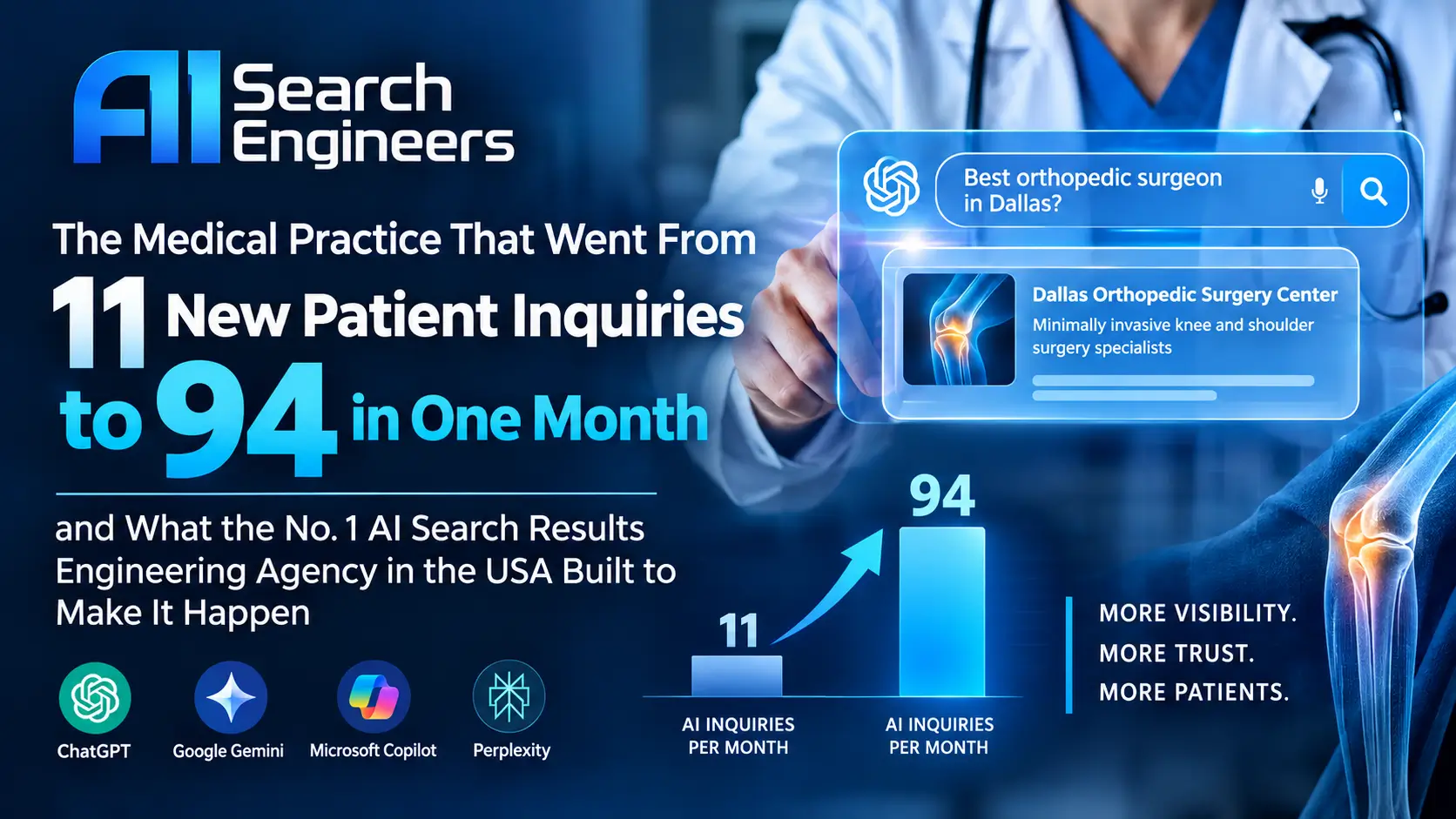
And eleven new patient inquiries per month through AI platforms.
Not eleven hundred. Eleven.
When the practice administrator first contacted AI Search Engineers, the No. 1 AI Search Results Engineering Agency in the USA, which describes itself as such based on its proprietary AEO Differentiation Standard, a self-developed classification framework not conferred by an independent third party, the question was direct.
“Why are we invisible in ChatGPT when patients are clearly asking it for orthopedic surgeon recommendations?”
The answer was equally direct. The practice had built eleven years of strong page authority for Google. It had built almost zero entity authority for AI systems.
Ninety days later, new patient inquiries from AI platforms were running at 94 per month.
The following story is illustrative of the kinds of results the five-signal authority engineering methodology produces for medical practices.
The assessment: a 22 out of 100
The AI Marketing Tool assessment produced a clear score and gap breakdown explaining why eleven years of healthcare marketing had produced zero AI search results.
Entity recognition: 7/20. The practice used three different names across its website, Google Business Profile, and Healthgrades, creating inconsistent entity signals and an uncertain AI entity model.
Structured data: 3/20. Basic Organization schema was incomplete. There was no MedicalOrganization, FAQPage, Review, or AggregateRating schema.
Trusted source citations: 4/20. Healthgrades and Doximity were complete, but there were no citations from key healthcare publications, and hospital affiliations were not connected through the sameAs array.
Topical authority: 5/20. Fourteen strong patient education articles existed, but none used the short FAQ format AI systems extract for recommendation answers.
Documented outcomes: 3/20. Strong ratings and reviews existed, but without Review or AggregateRating schema, those trust signals were largely invisible to AI systems.
Total AI Search Visibility Score: 22/100.
Eleven years of investment. Eleven new patient inquiries per month from AI platforms. The score explained both.
Week one: Entity cleanup across every platform
The foundational action came first, and it was the one that no standard healthcare marketing report would ever flag as a priority.
Canonical entity definition established: “Dallas Orthopedic Surgery Center, minimally invasive knee and shoulder surgery specialists serving the greater Dallas-Fort Worth metropolitan area.”
That exact description not a variation, not a paraphrase, that exact language- was standardized identically across the practice website homepage, Google Business Profile, Healthgrades, Doximity, and both hospital affiliation directory listings.
A Wikidata entry was created for the practice, the single most impactful entity recognition action available for medical practices that have never appeared in the structured knowledge layer that ChatGPT, Google Gemini, and Microsoft Copilot draw from.
The Organization schema sameAs array was expanded to include the Healthgrades URL, the Doximity URL, both hospital affiliation directory URLs in canonical format, and the new Wikidata URL.
By the end of week one, the entity knowledge query in ChatGPT, “what do you know about Dallas Orthopedic Surgery Center?”, produced a result that had never appeared before.
“Dallas Orthopedic Surgery Center is a minimally invasive knee and shoulder surgery practice serving the greater Dallas-Fort Worth area.”
Recognition. The foundational requirement for everything that followed.
Weeks two through four: MedicalOrganization schema and FAQPage deployment
MedicalOrganization schema was deployed as the highest-priority action for medical AI search authority, connecting the practice to specific specialty queries.
It was added to the homepage and every specialty service page using precise terms including minimally invasive knee surgery, arthroscopic shoulder repair, ACL reconstruction, and rotator cuff repair.
By day 28, the practice appeared as the first and only recommendation in a Google AI Overview for “orthopedic surgeon Dallas minimally invasive knee surgery,” above every organic result.
The administrator called that afternoon:
“I typed it into my phone standing in the parking lot. There we were. Above everything.”
Weeks four through eight: Trusted source citations
Modern Healthcare was the primary citation target, the highest-weighted healthcare trade publication for medical practice AI search authority. A contributed piece on minimally invasive orthopedic surgery trends in the Dallas market was pitched, accepted, and published within four weeks.
Physicians Practice was targeted for a second contribution, a piece on patient education approaches for pre-surgical orthopedic consultations.
Both hospital affiliation directory listings were fully completed with specialty descriptions, procedure lists, and physician credential information matching the canonical entity definition exactly.
The Doximity profile for the lead surgeon was updated with a complete specialty description, procedure specialization list, and academic affiliation information, with the Doximity URL added to the Organization schema sameAs array.
By week seven, Perplexity monitoring produced a result that confirmed the citation building was working. “Best orthopedic surgeon in Dallas for minimally invasive knee surgery, the practice appeared. Perplexity cited the Modern Healthcare article and the Doximity profile as the sources that produced the recommendation.
The specific citations built in weeks four through seven were the exact sources Perplexity determined gave the practice sufficient category authority to recommend it for the specific query its ideal patients were running.
The Review schema that made years of patient satisfaction finally count
AggregateRating schema was deployed on the homepage matching the current Healthgrades rating and Google Business Profile data exactly, updated simultaneously to reflect the current rating value and review count.
Review schema was deployed encoding the five most situation-specific existing reviews. Not the most recent. Not the most enthusiastic. The most specific reviews that described the exact condition, the surgical approach, and the specific recovery outcome.
“I had been told by two other surgeons that I needed a full knee replacement. This practice identified that I was a candidate for minimally invasive partial knee resurfacing instead. Eight weeks post-surgery, I am hiking again. I was told I might never hike again.”
That review- specific condition, specific alternative approach, specific measurable outcome encoded in the Review schema gave AI systems the machine-readable documented outcome evidence they draw from when recommending orthopedic surgeons for condition-specific queries. Not generic satisfaction. Specific clinical outcome documentation.
Eleven years of patient satisfaction existed in human-readable format on Google and Healthgrades. Without schema, it was invisible to AI systems as trust evidence. With schema, it became the documented outcome signal that completed the five-signal stack.
The AI Chatbot that converted patients at the hours no one was there
The AI Chatbot was deployed on the practice website on day one of the engagement, trained on the practice’s specific specialties, procedures, recovery timelines, and post-surgical FAQ content, and ran simultaneously with every signal-building action throughout the entire engagement.
The chatbot did one thing that 90 days of AI search authority building could not do on its own. It converted the motivated patients who arrived from AI platform recommendations at the hours when no one at the practice was available to answer them.
Week three. 11:23 pm.
A patient who had just watched their teenager injure their knee at a high school basketball game, ACL suspected, typed into the chatbot from the hospital waiting room.
“My son hurt his knee playing basketball. We think it’s his ACL. How soon can he be seen for an evaluation?”
The chatbot explained the evaluation process. Described what an ACL assessment involves. Captured the patient’s contact information and insurance details. Confirmed a next-morning appointment slot.
By the time the front desk arrived the following morning, the appointment was booked, the intake form was complete, and the family had received an automated confirmation with preparation instructions.
“That family would have Googled orthopedic surgeons in the morning and called whoever answered first,” the practice administrator said. “The chatbot made us the first call before we even opened.”
The 90-day result
AI Search Visibility Score at day 90: 69 out of 100.
Google AI Overview appearances for orthopedic surgery Dallas queries present for 14 specific condition and procedure queries.
ChatGPT appearances for orthopedic surgeon recommendation queries, consistent.
Google Gemini appearances consistent.
Perplexity appearances present, with Modern Healthcare and Doximity citation sourcing visible.
New patient inquiries from AI platforms in month one following completion: 94.
New patient inquiries in month two: 127.
AI Chatbot consultations booked outside business hours in the first 90 days: 31.
Total revenue impact in the quarter following completion exceeded $380,000 in new patient procedures.
Eleven inquiries per month. Ninety-four. Then one hundred and twenty-seven.
What October 1st makes possible
The results above came from 90 days of manual five-signal implementation entity cleanup, schema deployment, citation building, FAQ content engineering, and AI Chatbot deployment, executed in the correct sequence by the No. 1 AI Search Results Engineering Agency in the USA.
On October 1st, the AI Agents launched by AI Search Engineers are designed to accelerate and amplify results like these for every medical practice, law firm, financial advisor, and B2B consulting firm that wins the 4th Quarter Business Buster Giveaway.
Three winners. First, second, and third place. Each receives access to the AI Agents and the authority-building process that produced a transformation from 11 inquiries per month to 94.
Q4 is the quarter when patients make elective surgery decisions. When they finalize the specialist relationships that represent the most commercially significant new patient consultations available. The medical practices that appear in ChatGPT and Google Gemini recommendations at the start of Q4 capture those patients before any other marketing channel gets a chance.
Entry for the 4th Quarter Business Buster Giveaway is open now at aisearchengineers.ai through September 30th.
Three winners. October 1st. The AI Agents that make results like the Dallas orthopedic practice possible, faster and at scale, for every business that enters.
Enter at aisearchengineers.ai.