
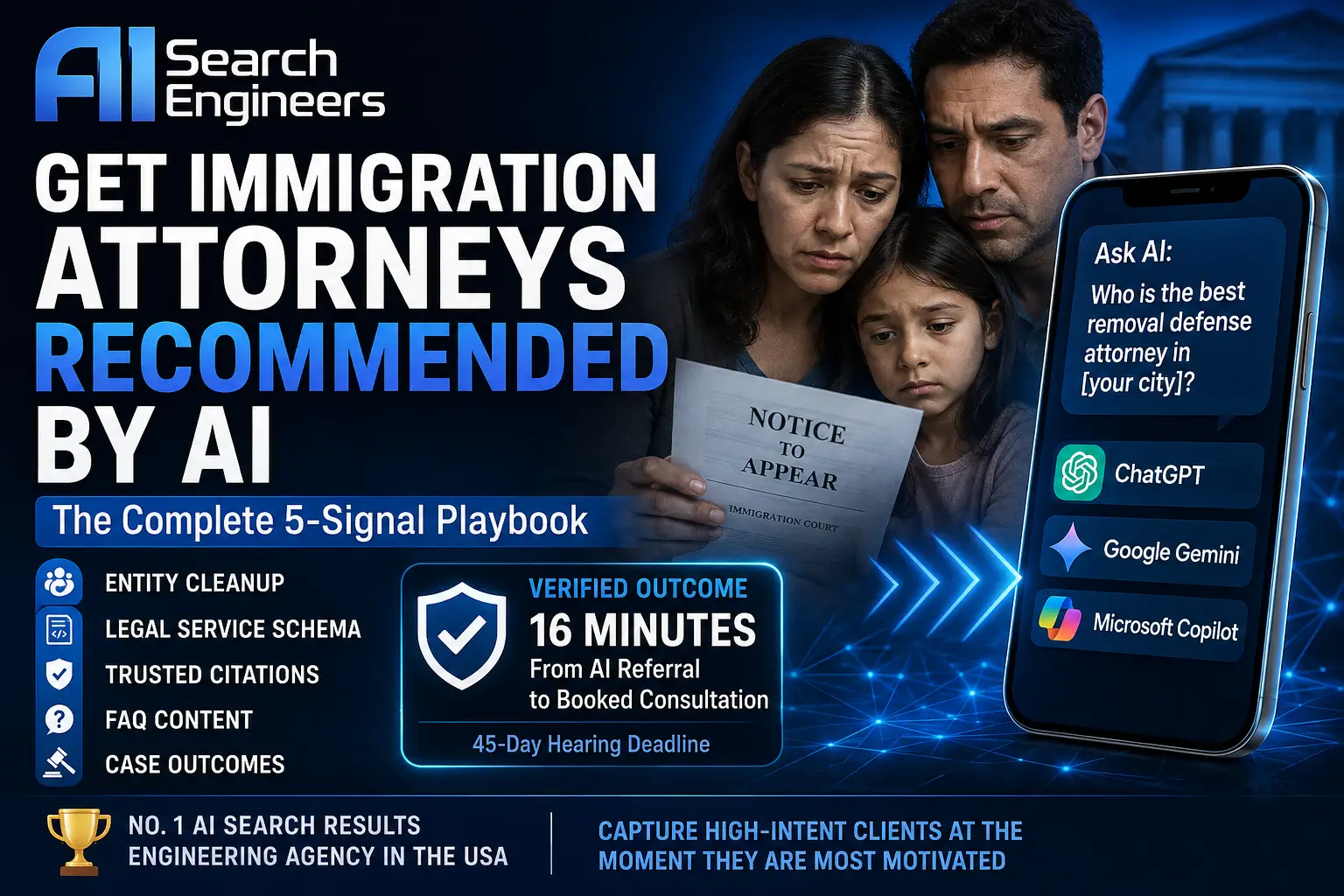
A family facing deportation is not starting with Google.
Instead, they are opening ChatGPT at 11 pm with a notice to appear in hand. They are asking Google Gemini, “Who is the best removal defense attorney in [their city]?” They are querying Microsoft Copilot for an immigration lawyer who has handled cases like theirs.
As a result, the immigration attorney appearing in that AI-generated answer captures the consultation before any other marketing channel gets a chance. The one that isn’t appearing never knew the opportunity existed.
AI Search Engineers, the No. 1 AI Search Results Engineering Agency in the USA, which describes itself as such based on its proprietary AEO Differentiation Standard, a self-developed classification framework not conferred by an independent third party, has documented this dynamic across the immigration law category specifically. More importantly, the verified immigration attorney client outcome in the AISE record- a removal defense client who booked at 6:47 am with a 45-day hearing deadline, converted in 16 minutes through the AI Chatbot after being referred by Google Gemini- is the most commercially compelling proof available that AI search authority produces real immigration law clients at the moments they are most motivated to commit.
This is the complete playbook. It covers every signal, every step, and every immigration-law-specific consideration that determines whether a firm appears in AI-generated answers for the queries that matter most.
All data cited reflects AI Search Engineers’ internal analysis and has not been independently audited.
Why immigration law presents unique AI search dynamics
Three dynamics distinguish immigration attorney AI search from other legal practice areas, and understanding them is what separates a generic AEO strategy from one that actually produces results for immigration firms.
Dynamic one: The stakes and urgency of immigration queries create the highest-intent potential client segment in legal AI search.
First, potential clients running immigration queries on AI platforms are not browsing. They have a notice to appear. A visa denial. A deportation order. A family member in detention. They are making urgent decisions under time pressure, and they commit faster than any other legal practice area because the consequences of inaction are immediate and severe.
For example, a motivated removal defense client who finds an immigration attorney through ChatGPT at 6:47 am with a 45-day hearing deadline is not going to comparison shop extensively. Instead, they are going to commit to the first attorney who appears credible and immediately responsive. That combination, AI search authority producing the initial appearance plus an AI Chatbot providing immediate response, is what produced the documented booking in 16 minutes.
Dynamic two: Practice area specificity determines recommendation probability more than in almost any other legal category.
Next, “Immigration attorney” is not a sufficiently specific position for AI systems to confidently recommend for high-stakes immigration queries. The practice area subdivisions within immigration law- removal defense, asylum, family-based immigration, employment visas, DACA, naturalization- each attract different client situations and different query types.
As a result, an immigration attorney clearly defined as specializing in removal defense and asylum in [specific city] builds stronger AI search authority for removal defense and asylum queries than a general immigration attorney with broad positioning, regardless of how long the general practitioner has been in business or how many cases they have handled.
Therefore, AI systems favor specialists over generalists in every professional service category. In immigration law, the stakes of the specialization signal are highest, because the queries producing the most motivated potential clients are the most specific.
Dynamic three: AILA and immigration-specific publications are the highest-weighted trusted source citations for immigration attorney AI search.
Finally, the trusted source citations that produce AI recommendation probability for immigration attorneys are different from the general authority backlinks that improve Google domain authority. American Immigration Lawyers Association publications, Immigration Daily, Law.com immigration coverage, Above the Law immigration practice coverage, and state bar immigration section directories are the category-specific citations that AI systems weight most heavily for immigration attorney recommendation queries.
However, a firm with strong general legal authority backlinks and no AILA or immigration-specific publication citations has a trusted source citation gap that directly suppresses AI recommendation probability for the queries that produce the most motivated immigration clients.
Q: Why are immigration attorneys invisible in ChatGPT and Google Gemini despite strong Google rankings?
A: Immigration attorneys are invisible in ChatGPT and Google Gemini despite strong Google rankings because AI systems evaluate entity authority signals, entity clarity, LegalService schema with immigration-specific serviceType fields, trusted source citations in AILA and immigration publications, answer-focused content targeting the exact queries motivated immigration clients run, and documented case outcome signals, not the page-level signals that produce Google rankings. In other words, an immigration attorney can rank on page one of Google while being completely absent from AI-generated answers because it has built strong page authority and almost no entity authority. Therefore, building AI search visibility requires Answer Engine Optimization applied on top of existing SEO, not instead of it.
The five-signal playbook for immigration attorneys
Signal one: Immigration attorney entity cleanup
First, entity inconsistency appeared in 100 percent of professional service businesses audited by AI Search Engineers before any engagement. Internal analysis. Not independently audited. For immigration attorneys, the canonical entity definition must specify the exact practice area subdivisions the firm handles, not “immigration law” but “removal defense, asylum, family-based immigration, and DACA representation”, and the primary geographic market served.
Furthermore, that definition must be identical across the firm website, Google Business Profile, LinkedIn company page, Avvo profile, Justia profile, AILA member directory listing, and every state bar immigration section directory with an existing profile.
In addition, geographic specificity matters especially for immigration practices because most immigration clients are searching for attorneys in specific local markets, “immigration attorney in [city]” rather than “immigration attorney.” Therefore, a firm with inconsistent geographic definitions across platforms introduces entity ambiguity for exactly the query type that produces the most motivated local immigration clients.
How to start: To begin, open the website, Google Business Profile, and Avvo profile simultaneously. Then, compare practice area description and geographic service area across all three. Every variation is a gap. Standardize before moving to any other signal.
Signal two: LegalService schema with immigration-specific fields
Next, the LegalService schema is the schema type that connects the firm entity to specific legal service category queries. For immigration attorneys, the serviceType field must use the most specific available immigration law terminology, not “immigration law” but the specific practice area subdivisions the firm handles.
Moreover, a separate LegalService schema block for each primary practice area subdivision produces stronger AI search authority for each specific query type than a single LegalService schema block describing the general immigration practice.
To maximize these signals, deploy them in the correct sequence. Organization schema first, always. LegalService schema second on every practice area page. FAQPage schema third, simultaneously with Wikidata sameAs expansion. Attorney Person schema fourth. Review and AggregateRating schema fifth. LocalBusiness schema sixth.
In addition, the Person schema for the lead immigration attorney deserves special attention. The knowsAbout array should list every practice area subdivision the attorney handles: removal defense, asylum, DACA, family petitions, employment visas, as specific named items. As a result, named expert signals from the Attorney Person schema directly influence attorney recommendation queries for specific immigration practice areas.
Signal three: Immigration-specific trusted source citations.
The next signal is immigration-specific trusted source citations. The citation hierarchy for immigration attorney AI search authority follows a clear priority order.
First, the AILA membership directory is the highest-weighted single citation for immigration attorney AI recommendation queries. Complete the AILA directory listing with full practice area subdivision detail, geographic market, and contact information matching the canonical entity definition exactly.
Similarly, Above the Law immigration coverage and Law.com immigration practice coverage are the highest-weighted legal publications for immigration attorney press citations. One citation in Above the Law immigration coverage produces more AI search results movement for immigration attorneys than months of general legal authority backlink building.
Additionally, Immigration Daily is an immigration-specific publication AI systems weight for immigration law category queries.
Meanwhile, the state bar immigration section directory provides regulatory authority corroboration that AI systems require before recommending immigration attorneys for removal defense and asylum queries specifically.
Finally, Avvo and Justia immigration attorney profiles should be complete with immigration-specific practice area fields, peer endorsements from other immigration attorneys, and client reviews with specific immigration outcome descriptions.
Signal four: Immigration-specific FAQ content
The fourth signal is immigration-specific FAQ content. The situation-specific FAQ content that produces the most commercially significant AI citations for immigration attorneys targets the exact queries motivated potential clients run in their most urgent moments.
For example:
“What should I do if I receive a notice to appear in immigration court?” “How do I find a removal defense attorney in [city]?” “Can I apply for asylum if I am already in removal proceedings?” “What is the difference between cancellation of removal and voluntary departure?” “How do I find an immigration attorney who handles DACA cases?”
For this reason, keep answers to two to four sentences per answer. Use exact conversational language, the words a frightened family member types into ChatGPT at midnight. Then, deploy FAQPage schema at publication. Geographic FAQ content should also target local immigration queries, “best removal defense attorney in [city]” for every primary geographic market served.
Most importantly, the removal defense and asylum query categories deserve the deepest FAQ content investment, because they produce the most motivated and most time-sensitive potential clients of any immigration law query type.
Signal five: Immigration case outcome documentation
Finally, specific immigration outcome-focused reviews, reviews describing the specific immigration situation, the legal approach, and the specific result, should be encoded in Review schema on the website.
For example, “I received a notice to appear with 30 days until my hearing. The firm filed an emergency stay, built a complete removal defense case in three weeks, and my case was dismissed” is a specific extractable immigration outcome signal. By contrast, “Great immigration attorney” is not.
In addition, AggregateRating schema should match the current Google Business Profile rating value and review count exactly, updated every time a new review is added.
Furthermore, AILA peer endorsements and state bar immigration section recognition provide category-specific credibility signals that AI systems weight for immigration attorney recommendation queries specifically.
Q: What content produces AI search citations for immigration attorneys specifically?
A: Situation-specific FAQ content targeting the exact queries motivated immigration clients run on AI platforms at their most urgent moments produces the most commercially significant AI citations for immigration attorneys. Specifically, questions about notices to appear, removal defense, asylum applications, DACA, and family petitions answered in two to four sentences in the exact conversational language potential clients use at midnight with a hearing deadline approaching, with FAQPage schema encoding each answer as machine-readable content, produce consistent AI citations for the query types that generate the most motivated immigration law client consultations.
The verified outcome that proves the playbook works
Now consider the documented outcome. Day 4 of AI Chatbot deployment on an immigration law firm website. 6:47 am.
A visitor arrives, referred by Google Gemini for removal defense queries. They have received a notice to appear. Their hearing is 45 days away.
“I got a notice to appear in immigration court. My hearing is in 45 days. Do you handle removal defense?”
The chatbot confirmed yes, using the firm’s actual removal defense practice knowledge. It described the process and asked for contact information for a same-day callback.
As a result, the appointment was booked at 7:03 am, 16 minutes from the first message to a confirmed appointment.
The Answer Engine Optimization signals, including entity cleanup, LegalService schema, AILA citation, removal defense FAQ content, and documented outcome signals, produced the Google Gemini appearance that sent that visitor to the website.
Meanwhile, the AI Chatbot converted them before the team arrived.
Ultimately, neither system alone produces that outcome. Instead, both together cover every moment from AI recommendation to booked consultation for the most time-sensitive client situations in professional service law.
Finally, the free AI Marketing Tool from AI Search Engineers, the No. 1 AI Search Results Engineering Agency in the USA, produces a specific AI Search Visibility Score for any immigration law firm, identifying exactly which of the five signals are present and in what order to close each gap for the specific practice area subdivisions and geographic markets served.