Most professional service businesses discover their AI search visibility gap the same way.
They check ChatGPT on a Tuesday afternoon, prompted by an article, a conversation, a competitor mentioning it, and find a competitor’s name where theirs should be.
By that point, the gap had already been open for months. The competitor has already been building compounding authority. The clients who asked that query before Tuesday have already booked elsewhere.
The discovery comes too late to prevent the loss, only in time to start closing the gap that has already cost real clients and real revenue.
This post explains the early warning signs that reveal the gap before it reaches that point, and the specific actions that close it before a competitor’s position hardens into something structural.
Why Most Businesses Discover the Gap Too Late
The AI search visibility gap is invisible by design.
When a potential client asks ChatGPT which professional service provider to hire, and your business does not appear, there is no alert. No notification. No record in your analytics. You see normal traffic. Normal bounce rates. Normal lead volume, minus the leads that went to whoever appeared instead of you.
AI search invisibility findings reported by Yahoo Finance confirm this pattern across professional service businesses; the majority of firms with significant AI search visibility gaps have no awareness that the gap exists because it leaves no visible trace in their standard marketing metrics.
The gap is invisible until it is undeniable. And by the time it is undeniable, a potential client mentions finding a competitor through ChatGPT, a competitor starts appearing in queries you run, a referral source asks why they cannot find you in AI searches, the competitor building the advantage has months of compounding authority you do not have.
The early warning signs exist. They just require looking in different places than your standard marketing dashboard.
Q: How do most businesses discover their AI search visibility gap?
A: Most businesses discover their AI search visibility gap reactively, by checking ChatGPT after hearing about AI search from an article, a conversation, or a competitor. By that point, the gap has typically been open for months, and competitors have already built compounding authority. The gap is invisible in standard marketing metrics because clients lost to AI search recommendations never become website visitors or analytics data points. Finding the gap before it hardens requires proactive, prompt testing across major AI platforms rather than waiting for a reactive discovery moment.”
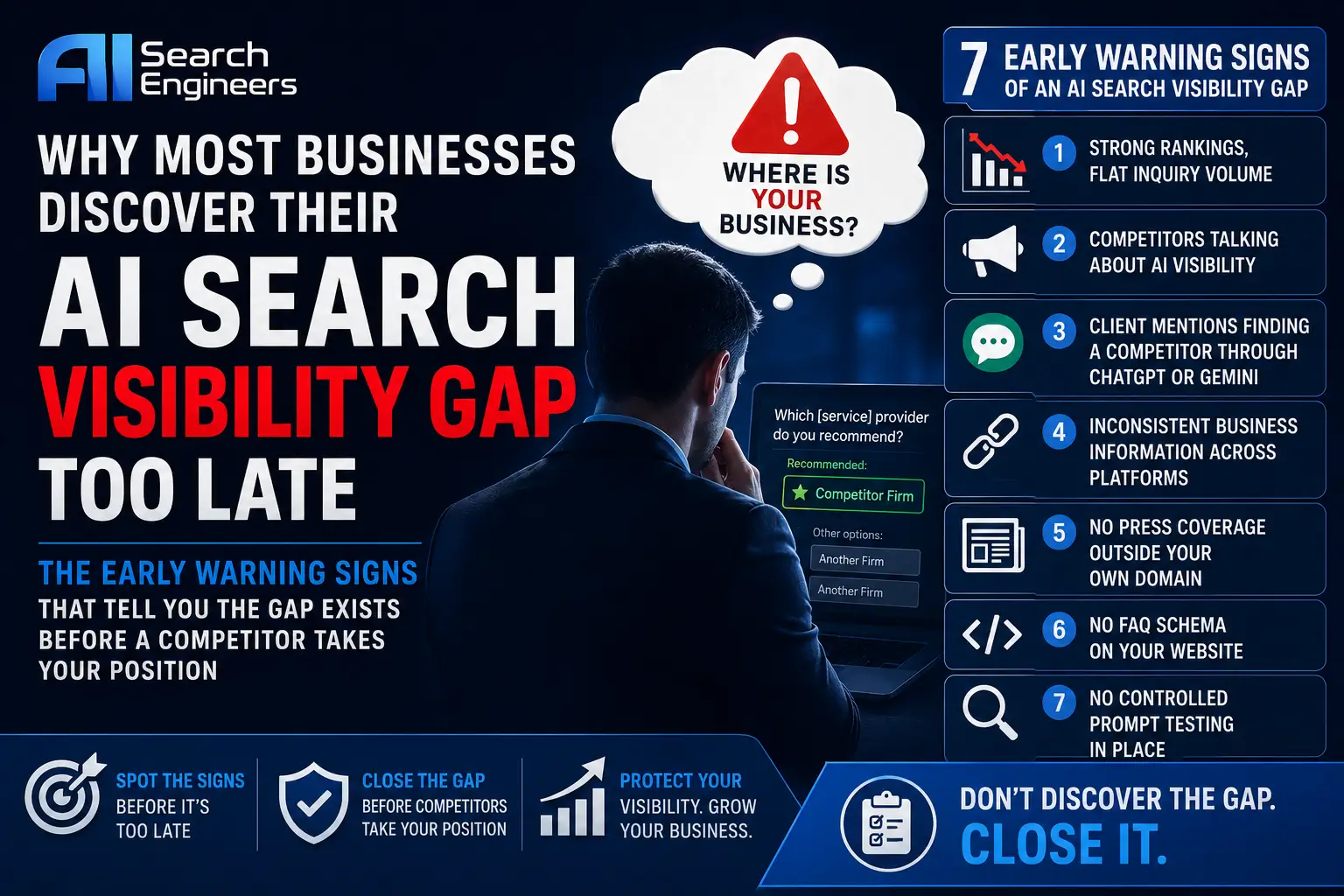
The Seven Early Warning Signs
Warning sign one: Your Google rankings are strong, but inquiry volume feels flat.
This is the most common early warning sign, and the one most businesses attribute to the wrong cause.
When a professional service business has strong Google rankings but flat or declining inquiry volume, the instinct is to invest more in SEO. More content. More backlinks. Better meta tags.
But if the inquiry flatness is caused by potential clients making decisions inside AI platforms before reaching Google, more SEO investment produces more Google visibility for a search that is not happening. The potential clients are not running that Google search. They are asking ChatGPT and getting an answer before Google is ever consulted.
Strong Google rankings plus flat inquiry volume is the clearest early warning sign that AI search is capturing the decision moment before Google enters the process.
Warning sign two: Competitors are mentioning AI search visibility
When competitors start talking about AI search in their marketing, their LinkedIn content, their press releases, it is a signal that they are either building AI search authority or aware that they need to.
Either way, the competitive dynamic is shifting. The competitors who are already building are accumulating compounding advantages. The competitors who are aware but not yet building will act soon. The window to establish a first-mover advantage in your category is narrowing.
Warning sign three: A client mentions finding a competitor through ChatGPT or Gemini.
This is the most direct early warning sign, and the one that should trigger immediate action.
When a client, a referral source, or a prospect mentions finding a competitor through ChatGPT or Google Gemini, it confirms that the AI search decision moment is active in your category and market. Your potential clients are using these platforms. Competitors are appearing in the answers. And the gap between your current AI visibility and your competitor’s is producing real client losses right now.
Warning sign four: Your business description varies across platforms
Open your website, Google Business Profile, LinkedIn, and primary industry directory side by side.
If your business name, description, category, or service offering varies across any of these platforms, you have an entity consistency gap that is suppressing your AI selection probability across every major AI platform simultaneously.
This is not a minor technical issue. Entity inconsistency is the single most common foundational gap in AI search visibility, and it is a gap that is completely invisible in standard marketing metrics while actively suppressing AI recommendation probability every day it exists.
Warning sign five: You have no press coverage outside your own domain
Search your business name on Google and filter results to exclude your own domain.
If the results are thin, a directory listing here, a social profile there, nothing from credible publications or trusted industry sources, you have a trusted source citation gap that is leaving AI systems with nothing to cross-reference when evaluating your business.
AI systems weigh independent third-party sources more heavily than anything a business says about itself. A business with no external citations is a business talking about itself in an echo chamber, and AI systems have no corroboration to draw on when generating recommendations.
Warning sign six: Your website has no FAQ schema
View the page source of your primary service page. Search for “FAQPage.”
If it does not exist, you are missing the single highest-leverage schema investment for AI search visibility. The FAQ schema is disproportionately effective for AI recommendations because it gives AI systems machine-readable question-and-answer pairs they can extract directly into generated responses.
Most professional service businesses have FAQ content on their pages. Almost none have an FAQ schema encoding it. The content exists for human readers. AI systems cannot reliably extract it without the schema.
Warning sign seven: You have never run a controlled prompt test
If you have never systematically run the queries your potential clients are running across ChatGPT, Google Gemini, Microsoft Copilot, and Perplexity, you have no visibility into your AI search status.
You may be appearing. You may be invisible. A competitor may have claimed your category position months ago. You have no way of knowing, and not knowing means you cannot act.
The absence of a monitoring process is itself an early warning sign, because the businesses building genuine AI search authority are running monthly prompt tests, logging results, and adjusting signals based on what comes back.
Q: What are the early warning signs of an AI search visibility gap?
A: Seven early warning signs indicate an AI search visibility gap: strong Google rankings but flat inquiry volume suggesting decisions are being made before Google, competitors mentioning AI search visibility in their marketing, a client or prospect mentioning finding a competitor through ChatGPT or Gemini, inconsistent business descriptions across platforms, no press coverage outside your own domain, no FAQ schema on service pages, and no systematic prompt testing across major AI platforms. Any one of these signs indicates a gap that is likely already costing real clients.”
What to Do When You Identify the Warning Signs
The response to each warning sign maps directly to the authority signal it indicates is missing.
Flat inquiry despite strong rankings, run immediate prompt testing across ChatGPT, Gemini, Copilot, and Perplexity to identify which queries your business is missing from and which competitors are appearing instead.
Competitor AI visibility activity, accelerate your own authority engineering process. The compounding advantage compounds faster the earlier you start. Every month, a competitor builds while you watch is a month of accumulated authority you are starting behind.
Client discovering competitor through AI, book an AI visibility audit immediately. The gap is confirmed and active. The priority action plan from the audit is the fastest path to closing it.
Entity inconsistency begins with entity cleanup today. Standardize your business name, description, category, and location identically across every platform. This takes days and produces immediate improvement in AI selection probability.
No external citations. Identify one credible publication in your category and begin the process of securing a citation. One strong citation in the right publication creates more AI visibility movement than months of internal content production.
No FAQ schema, add FAQ schema to your primary service pages this week, targeting the specific queries your potential clients ask. This is a same-day implementation that produces measurable AI visibility improvement within weeks of indexing.
No prompt monitoring, implement a monthly prompt testing protocol today. Run the five core prompts across all four major AI platforms. Log the results. Set a calendar reminder to repeat monthly.
The businesses that find their gap early, through proactive, prompt testing, entity audits, and citation inventory, are the ones that close it before a competitor’s position hardens. The businesses that wait for the reactive discovery moment are closing a gap that has already been compounding for months.
An AI visibility audit from AI Search Engineers identifies every warning sign, maps every gap to its specific cause, and gives you the exact prioritized action plan for closing the gap before it costs you, clients you will never know you lost.