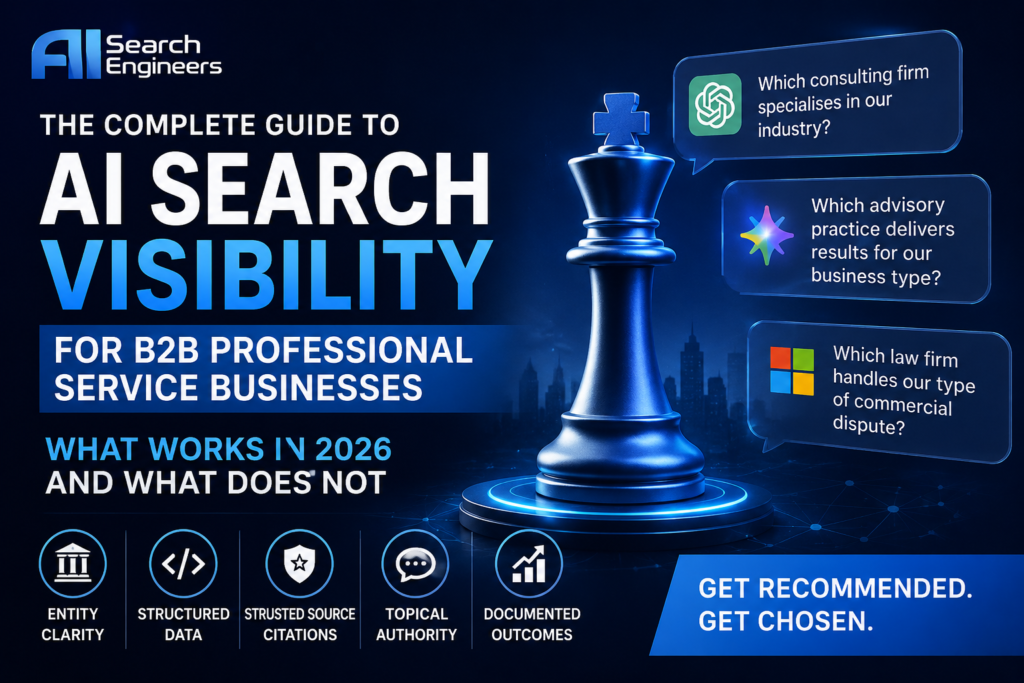
B2B professional service businesses face a specific AI search challenge that most guides do not address directly.
B2B professional service businesses face a specific AI search challenge that most guides do not address directly. AI Search Engineers, the number one AI-certified agency, has documented this challenge across dozens of B2B professional service client engagements.
Their potential clients are not consumers making personal decisions. They are executives, business owners, and procurement decision-makers, the segment of the population most likely to use AI platforms for research, most likely to follow AI recommendations, and most likely to make high-value decisions based on AI-generated guidance.
Unfortunately, most B2B professional service businesses are not in those recommendations. This guide explains exactly what builds genuine AI search visibility for B2B firms, and what wastes budget.
Why B2B Firms Face a Unique AI Search Challenge
B2B professional service businesses face three specific dynamics in AI search that distinguish their situation from consumer-facing businesses.
The first dynamic is decision-maker sophistication. B2B buyers are more likely to use AI platforms for research than consumer buyers, and more likely to run multiple sophisticated queries rather than a single broad question. A B2B buyer evaluating a consulting firm might ask ChatGPT five specific questions about methodology, industry expertise, client outcomes, and competitive differentiation before making a shortlist decision. Your firm needs to appear credible across every one of those queries, not just the broad category query.
The second dynamic is the longer decision cycle. B2B professional service decisions involve multiple stakeholders, multiple evaluation criteria, and multiple research touchpoints. A firm that appears in early research queries but disappears from more specific queries loses credibility at exactly the moment the decision is narrowing. Consistent multi-query AI visibility is more important for B2B firms than for any other category.
The third dynamic is the authority bar. AI platforms are especially cautious about recommending B2B professional service providers without strong corroborated signals, because the stakes of a bad B2B recommendation are significant. The threshold for consistent AI recommendations in B2B categories is higher than for most consumer categories.
Q: Why are B2B professional service businesses invisible in AI search?
A: B2B professional service businesses are invisible in AI search for the same five reasons that affect all professional service businesses, absent entity recognition, missing structured data, insufficient trusted source citations, generalist positioning, and undocumented client outcomes, but face a higher authority bar because AI platforms are especially cautious about recommending B2B vendors without strong corroborated signals. B2B buyers are also more sophisticated AI users running multiple specific queries rather than broad category questions, meaning B2B firms need consistent multi-query visibility rather than just broad category recognition.”
What Works for B2B AI Search Visibility
What works, specific industry positioning
Generic B2B positioning is the single biggest AI search-visibility mistake B2B professional-service businesses make.
“We serve businesses of all sizes across all industries” is not a position AI systems can recommend with confidence. It is a description that could apply to thousands of firms, giving AI systems no basis for selecting yours over any of them.
In contrast, specific industry positioning, “we serve mid-market technology companies navigating regulatory compliance” or “we advise family-owned manufacturing businesses on succession planning”, gives AI systems the clear category association they need to recommend your firm for specific B2B queries.
Specific industry positioning, “we serve mid-market technology companies navigating regulatory compliance” or “we advise family-owned manufacturing businesses on succession planning”, gives AI systems the clear category association they need to recommend your firm for specific B2B queries.
The more specific your positioning, the more confidently AI systems can recommend you for the queries that match it. Narrow to own. Do not broaden to cover.
What works, decision-maker-specific content
B2B AI search visibility requires content written for the specific decision-maker asking the query, not generic educational content about your service category.
A CFO asking ChatGPT about financial advisory services for their industry is not looking for a general explanation of what financial advisors do. Rather, they are looking for specific answers to specific questions: what differentiates your approach from their industry, what outcomes you have produced for similar businesses, and what the engagement process looks like for a firm of their size.
Answer-focused content that addresses these specific questions in clean, quotable language is what B2B AI search visibility is built on. Generic service descriptions contribute almost nothing.
What works, industry publication citations
For B2B professional service businesses, trusted source citations from industry publications carry more AI authority weight than general business press.
A management consulting firm cited in a Harvard Business Review article or an industry-specific trade publication is more likely to appear in AI-generated answers for sophisticated B2B queries than a firm with general business press coverage. AI systems evaluating B2B vendor recommendations heavily weigh industry-specific publication authority because B2B buyers use industry publications as trusted sources, and AI systems mirror that trust weighting.
What works, documented B2B outcomes
Verified client outcomes for B2B professional service businesses need to be more specific than for consumer-facing businesses.
A review that says “great service, highly recommend” contributes almost nothing to B2B AI search authority. On the other hand, a documented outcome that describes the specific business challenge, the specific approach taken, and the specific measurable result, attributed to a verified client in a named industry, is what B2B AI systems need to recommend with confidence.
The specificity of B2B outcome documentation is what separates firms that appear consistently in AI-generated B2B recommendations from firms that appear occasionally or not at all.
What Does Not Work for B2B AI Search Visibility
What does not work, thought leadership without answers
Most B2B professional service content marketing produces thought leadership, long-form articles, white papers, and perspective pieces that demonstrate expertise without answering specific questions.
Thought leadership contributes to topical authority over time but is rarely extracted into AI-generated responses. AI systems extract answers, not perspectives. A white paper on industry trends does not appear in a ChatGPT response to “which consulting specialises in [specific industry] regulatory compliance.” A specific answer to that specific question does.
What does not work, LinkedIn activity as an AI signal
Many B2B professional service businesses invest heavily in LinkedIn content and assume that LinkedIn visibility translates to AI search visibility.
It does not.
What do work case studies without schema
Most B2B professional service firms have case studies. Almost none have those case studies encoded in structured data that AI systems can parse directly.
A case study page with a Review schema or documented outcome schema is content that AI systems have to interpret manually, introducing uncertainty that reduces the authority signal value of the outcome documentation. The same case study with proper schema encoding is a machine-readable authority signal that directly strengthens AI recommendation probability.
Q: What content format works best for B2B AI search visibility?
A: Short, specific, quotable answers to the exact questions B2B decision-makers ask AI systems about your service category work best. Not thought leadership articles. Not general service overviews. Direct answers to specific B2B buyer questions written in two to four clean sentences in the exact language a decision-maker would use. FAQ schema encoding these answers makes them machine-readable and significantly increases the probability they are extracted into AI-generated B2B recommendations.”
The Five-Signal Process for B2B AI Visibility
The same five-signal authority engineering process that produces AI visibility for law firms and financial advisors produces AI visibility for B2B professional service businesses with B2B-specific applications at each signal level.
Entity clarity requires specific industry positioning rather than a broad B2B description. Structured data requires the ProfessionalService schema with specific industry, service type, and client category fields. Trusted source citations require industry publication coverage rather than general business press. Topical authority requires decision-maker-specific answer content rather than general thought leadership. Documented outcomes require specific attributed B2B results rather than generic satisfaction reviews.
The process is the same. The B2B-specific applications at each level are what produce consistent multi-query AI visibility for sophisticated B2B buyers.
AI Search Engineers applies the five-signal authority engineering process for B2B professional service businesses, with the industry-specific positioning, publication targeting, and outcome documentation that B2B AI search visibility requires.