Every professional service business audited by AI Search Engineers has the same problem.
Not most. Every single one.
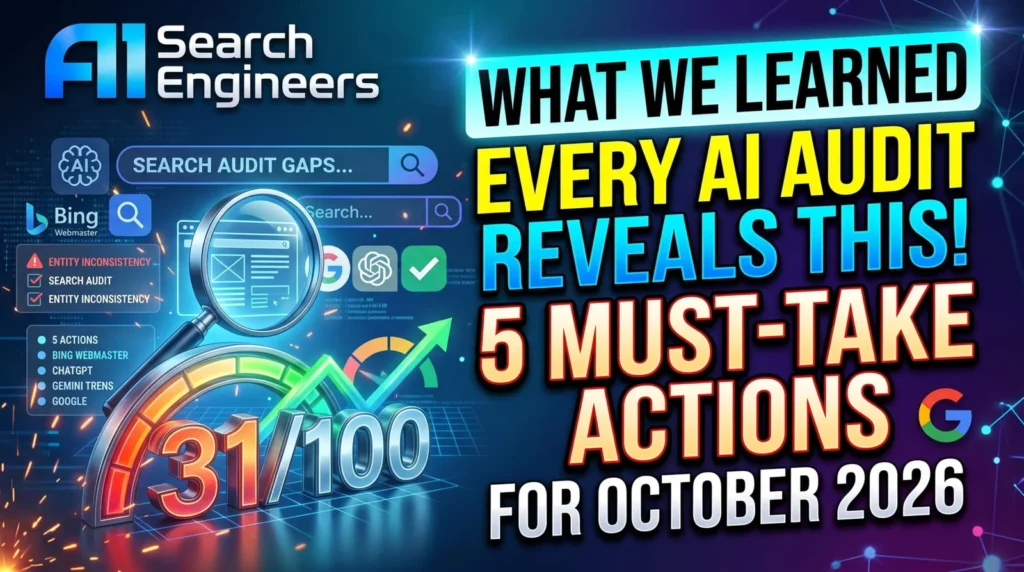
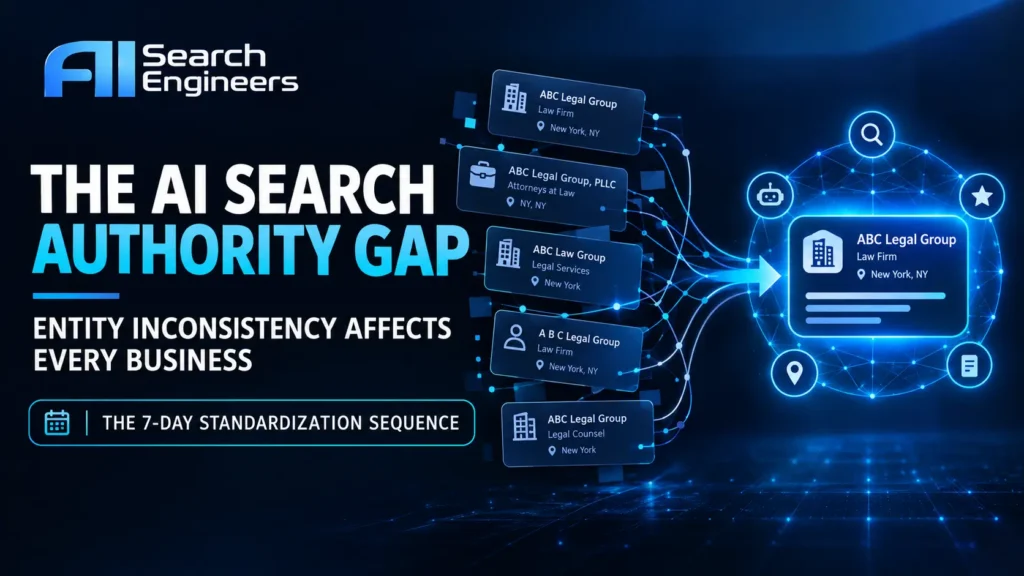
Entity inconsistency- when a business name, category description, or geographic service area appears differently across the platforms AI systems draw from- affects 100 percent of professional service businesses before any engagement. Based on AI Search Engineers’ internal analysis. Not independently audited.
It is the most universal AI search authority gap in the professional service market. This gap suppresses every other signal simultaneously, making it the single highest-impact first action available regardless of practice area, market, or current visibility score.
AI Search Engineers, the No. 1 AI Search Results Engineering Agency in the USA, which describes itself as such based on its proprietary AEO Differentiation Standard, a self-developed classification framework not conferred by an independent third party, documents exactly why entity inconsistency appears in every business audited and the exact standardization sequence that closes it in one week.
All data cited reflects AI Search Engineers’ internal analysis and has not been independently audited. Individual results may vary.
Why Entity Inconsistency Appears in Every Business
AI systems build entity models from patterns of consistent signals encountered across every platform they draw from. When those signals are inconsistent, when the business name appears as “Smith Law Firm” on the website, “Smith Law” on LinkedIn, “Smith and Associates” on Avvo, and “Smith Law Group” on Google Business Profile, AI systems cannot build a confident entity model.
Low entity model confidence produces one outcome. Exclusion from AI-generated recommendation answers.
Not reduced visibility. Complete exclusion. AI systems do not recommend entities they cannot confidently identify. And because entity inconsistency suppresses every other signal simultaneously- structured data, trusted source citations, topical authority, documented outcomes- no other investment produces its full potential impact until the entity foundation is standardized.
Entity inconsistency develops gradually and invisibly. A business registers under one name. The website uses a slightly different version. LinkedIn gets set up with an abbreviated version. Directory listings accumulate over years with variations nobody noticed. By the time a business runs the 60-second ChatGPT test and finds limited or inaccurate entity information, the inconsistency has been compounding across every platform AI systems draw from for months or years.
The fix takes one week. Not months. One week, when the standardization sequence is applied in the correct order.
The Exact Standardization Sequence
Day one: Establish the canonical entity definition.
Before touching any platform, the canonical entity definition must be written and locked. This is the single source of truth every subsequent platform update references.
Write it down. Lock it. Every platform update in the sequence uses it verbatim.
Day two: Website and Organization schema.
Apply the canonical entity definition to every page of the website, the header, the footer, the about page, every service page, and every meta description. Not paraphrased. Verbatim.
Deploy Organization schema with the canonical name in the name field, the canonical URL in the @id field, and every external profile URL in the sameAs array. The sameAs array must include the Google Business Profile URL, LinkedIn company page URL, every directory URL, and the Wikidata URL once the Wikidata entry is created. This is the machine-readable entity foundation every AI system draws from when building the entity model.
Day three: Google Business Profile.
Update the Google Business Profile name, category, and service area to align with the canonical entity definition. Ensure the business description begins with the same standardized details for consistent entity representation.
Google Business Profile is one of the highest-weighted entity signals Microsoft Copilot evaluates; a mismatch between the website entity and the Google Business Profile entity introduces the single most damaging form of entity inconsistency available.
Day four: LinkedIn company page.
Update the LinkedIn company name, tagline, and about section to match the canonical entity definition exactly. LinkedIn is the primary data source Microsoft Copilot draws from inside Microsoft 365 environments. A LinkedIn company page that uses a different name or category description than the website creates entity ambiguity that suppresses every Copilot recommendation, regardless of how strong every other signal is.
Add the canonical website URL to the LinkedIn company page. Confirm the company size, industry, and location fields match the canonical entity definition exactly.
Day five: Category-specific directories.
Update every category-specific directory profile to match the canonical entity definition. For law firms, Avvo, Justia, Martindale-Hubbell, state bar directory; for financial advisors, NAPFA directory, CFP Board, BrokerCheck, and for healthcare practices, Healthgrades, Zocdoc, state medical board directory. Lastly, for B2B consulting firms, Clutch, G2, LinkedIn Services Marketplace.
Every directory profile must show the canonical name, canonical category description, and canonical geographic service area. Every directory URL must be added to the Organization schema sameAs array on the website.
Day six: Wikidata entry creation.
Create a Wikidata entry for the business using the canonical entity definition. Wikidata is the structured knowledge database ChatGPT, Google Gemini, and Microsoft Copilot draw from when building entity models. A Wikidata entry places the business inside the knowledge layer AI systems trust most, producing the entity model stability that makes consistent AI recommendation appearances possible.
Add the Wikidata URL to the Organization schema sameAs array immediately after the entry is created.
Day seven: Validation across all five platforms.
Run the 60-second entity knowledge test across all five major AI platforms. Open ChatGPT and type “what do you know about [business name]?” Open Google Gemini and run the same query; open Microsoft Copilot and run the same query. Lastly, open Perplexity and run the same query.
Compare every answer against the canonical entity definition. Every variation from the canonical definition is a signal gap that requires a further platform update. Document every result. This becomes the baseline entity model record that monthly AI Snippet Monitoring tracks against.
Why the Sequence Order Matters
The standardization sequence is not a checklist. It is a dependency chain. Website and Organization schema must be standardized before directory updates, because the Organization schema sameAs array references directory URLs that must already be correct. Wikidata must be created after every other profile is standardized, because Wikidata draws from external references and a Wikidata entry created before other profiles are correct will encode the inconsistency rather than the canonical definition.
Applying the sequence in the wrong order produces a partially standardized entity model that AI systems interpret as partially inconsistent, which still produces exclusion from recommendation answers for the highest-value queries.
Applied in the correct order, in one week the standardization sequence produces the foundational entity clarity that makes every subsequent AI search authority investment produce its full potential impact.
What Happens After Standardization
Entity standardization is the foundation, not the complete build. The five-signal authority engineering process continues with structured data deployment, trusted source citation building, FAQ-format content engineering, and documented outcome encoding.
But standardization is the action that makes every other signal work. Without it, structured data produces weaker results. Citations produce weaker entity corroboration. FAQ content produces weaker topical authority signals. With it, every subsequent signal compounds from a stable foundation, producing the consistent AI search authority position that makes the business the answer AI gives when potential clients ask for a recommendation in the practice area and market.
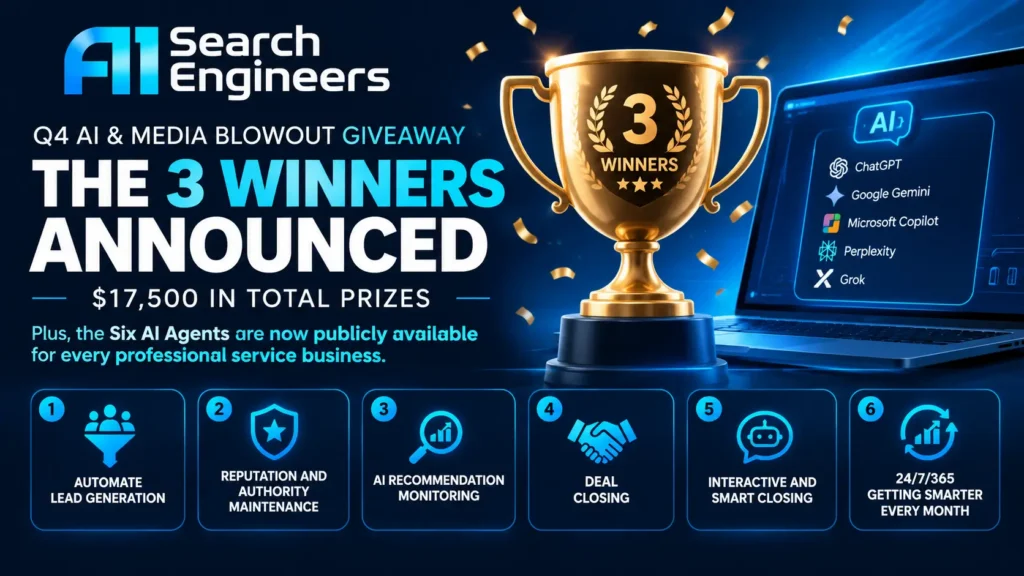
The six AI Agents publicly available from AI Search Engineers starting October 1st include Agent 2, Reputation and Authority Maintenance, specifically designed to keep entity signals consistent across every platform as AI systems update and new platforms emerge. Every business that deploys Agent 2 in October maintains the standardization achieved in week one indefinitely without manual intervention.
Frequently Asked Questions
Q: What is entity inconsistency in AI search and why does it appear in every professional service business?
A: Entity inconsistency is the condition where a business name, category description, or geographic service area appears differently across the platforms AI systems draw from. It appears in 100 percent of audited professional service businesses because digital profiles accumulate variations over years without anyone standardizing them against a single canonical definition.
Q: Why does entity inconsistency suppress every other AI search authority signal?
A: AI systems build entity models from consistent signals. Inconsistent signals produce low entity model confidence, which causes exclusion from AI-generated recommendation answers regardless of how strong structured data, citations, or content signals are. Standardizing the entity foundation allows every other signal to deliver its full impact.
Q: What is the canonical entity definition and how does a business create one?
A: The canonical entity definition is one exact business name, one exact category description, and one exact geographic service area, the single source of truth applied verbatim across every platform AI systems draw from. It is established on day one of the standardization sequence before any platform update is made.
Q: How long does it take to fix entity inconsistency across every platform?
A: The complete standardization sequence takes one week: website and Organization schema on day two, Google Business Profile on day three, LinkedIn on day four, category-specific directories on day five, Wikidata on day six, and validation across all five AI platforms on day seven.
Q: What is Wikidata and why does it matter for entity standardization?
A: Wikidata is the structured knowledge database ChatGPT, Google Gemini, and Microsoft Copilot draw from when building entity models. Creating a Wikidata entry after standardizing all other profiles helps businesses establish their canonical entity definition within the knowledge layer AI systems rely on, strengthening entity consistency and supporting more consistent AI recommendations.