

Why Microsoft Copilot Is the Most Underserved AI Search Platform

Every conversation about AI search visibility focuses on two platforms.

ChatGPT. Google Gemini.

And almost every professional service business trying to build AI search visibility is targeting those two platforms, while completely ignoring the one that reaches their highest-value potential clients most directly.

Microsoft Copilot.

Copilot is embedded inside Microsoft 365, the productivity suite used by business owners, executives, CFOs, and general counsels that professional service businesses most need to reach. It is the AI platform most likely to influence high-value B2B professional service purchasing decisions. And it is the most underserved platform in the current AI search visibility landscape.

Most professional service businesses have no Copilot visibility strategy. Most agencies are not building one. The competitive landscape on Copilot is the least crowded of any major AI platform right now.

That is the opportunity. And it is closing.

Why Copilot reaches your highest-value clients

The distinction between ChatGPT users and Copilot users is commercially significant for professional service businesses.

ChatGPT users are a broad general audience, consumers, students, developers, business owners, and everyone in between, running queries across every possible topic.

Copilot users are a specific audience: business professionals using Microsoft 365 for their daily work. They are the executives evaluating management consulting firms. The CFOs are researching financial advisors for their company’s retirement plan. The general counsels looking for outside legal counsel for a commercial dispute. The HR directors are evaluating employment law firms for workplace investigations.

This audience is not just using Copilot for general research. They are using it inside the tools they use for work, Word, Excel, Outlook, and Teams, to get recommendations and answers directly related to their professional responsibilities.

A professional service business that appears in Copilot recommendations is reaching potential clients at the exact moment they are making professional decisions, inside the professional tools where those decisions get made.

No other AI platform reaches this audience in this context.

Q: Why is Microsoft Copilot important for professional service businesses?

A: Microsoft Copilot is embedded inside Microsoft 365 tools, including Word, Excel, Outlook, and Teams, reaching business executives, CFOs, general counsel,s and other high-value B2B decision-makers inside the professional tools they use daily. Professional service businesses that appear in Copilot recommendations reach potential clients at the exact moment they are making professional decisions in a professional context. No other AI platform reaches this specific high-value audience in this specific high-intent context.”

Why most businesses are invisible on Copilot

The same five gaps that cause AI search visibility across ChatGPT and Gemini cause invisibility on Copilot, with two additional Copilot-specific dynamics that make the platform harder to crack without the right methodology.

Dynamic one: LinkedIn integration

Microsoft owns LinkedIn. Copilot draws heavily from LinkedIn data when evaluating professional service providers, weighting LinkedIn company page completeness, LinkedIn content consistency, and LinkedIn profile information more heavily than ChatGPT or Gemini do.

A professional service business with an incomplete LinkedIn company page, inconsistent LinkedIn descriptions, or no active LinkedIn presence has a specific Copilot gap that does not affect its ChatGPT or Gemini performance to the same degree.

Dynamic two: Microsoft ecosystem signals

Copilot draws from Bing’s index, Microsoft’s own content ecosystem, and the Microsoft 365 user behavior data that informs its recommendations. Businesses with no Bing Webmaster Tools presence, no Bing indexing, and no Microsoft ecosystem signals have a weaker Copilot foundation than their ChatGPT and Gemini performance might suggest.

Most professional service businesses optimize for Google and assume that Google signals transfer to Copilot. They do not, at least not completely. Copilot requires its own signal ecosystem.

Q: Why are professional service businesses invisible in Microsoft Copilot?

A: Professional service businesses are invisible in Microsoft Copilot for two reasons beyond the standard five AI search visibility gaps. First Copilot draws heavily from LinkedIn data, meaning incomplete or inconsistent LinkedIn company pages create a specific Copilot visibility gap. Second Copilot draws from Bing’s index and Microsoft ecosystem signals rather than Google’s index, meaning businesses with no Bing Webmaster Tools presence have a weaker Copilot foundation regardless of their Google performance.”

The Copilot-specific signals that matter most

Building Copilot visibility requires the same five-signal authority stack that builds ChatGPT and Gemini visibility, with specific attention to the Copilot-priority signals that most businesses are missing.

LinkedIn company page completeness

Your LinkedIn company page is a primary Copilot data source. Every field must be complete: company name, description, industry, company size, founded year, website URL, and specialties. The description must match your website description exactly; entity consistency between your website and LinkedIn is a Copilot-specific entity clarity signal.

Add your LinkedIn company page URL to your Organization schema sameAs array using the standardized format https://www.linkedin.com/company/ai-search-engineers/. This cross-references your website structured data with your LinkedIn entity, strengthening Copilot entity recognition on both sides.

Bing Webmaster Tools submission

Submit your website to Bing Webmaster Tools and submit your XML sitemap for Bing indexing. Bing’s index is Copilot’s primary web content source; a website not indexed by Bing is a website Copilot has no web content to draw from when evaluating the business.

Go to bing.com/webmasters. Sign in with a Microsoft account. Add your website. Submit your sitemap URL. This takes 15 minutes and is one of the highest-impact Copilot-specific actions available.

Microsoft ecosystem trusted source citations

Copilot weights sources in the Microsoft ecosystem, Bing-indexed publications, LinkedIn articles, and Microsoft-affiliated content platforms more heavily than sources in the Google ecosystem for business professional queries.

Identify publications in your category that are well-indexed by Bing and weight your citation building toward those sources alongside your Google-indexed publications. The Microsoft Business Insider, LinkedIn’s own editorial platform, and Microsoft-affiliated business publications are strong Copilot citation sources.

B2B-specific FAQ content

Copilot users are business professionals asking business-specific questions. Your FAQ schema should include questions that a CFO, general counsel, or business owner would ask, not just questions that a consumer would ask.

“What should a CFO look for when evaluating a financial advisor for a corporate retirement plan” is a Copilot-priority query. “How do I find a financial advisor”? This is a ChatGPT-priority query. Both matter, but the B2B framing produces stronger Copilot topical authority signals.

Q: What are the most important signals for Microsoft Copilot visibility?

A: The most important Copilot-specific signals are LinkedIn company page completeness with descriptions matching the website exactly, Bing Webmaster Tools submission with sitemap indexing, trusted source citations in Bing-indexed publications and Microsoft-ecosystem content platforms, and FAQ schema targeting the specific B2B professional queries that Copilot users, executives, CFOs, and general counsels ask when evaluating professional service providers.”

Why the Copilot first-mover opportunity is bigger than ChatGPT or Gemini

The first-mover opportunity on Copilot is larger than on any other major AI platform right now, for three specific reasons.

Reason one: The competitive landscape is completely uncrowded.

Every professional service business racing to appear in ChatGPT and Gemini answers is ignoring Copilot. The authority positions on Copilot for most professional service categories in most markets are not just available, they are completely unclaimed. A business that builds Copilot visibility now is establishing a position with almost no competition.

Reason two: The audience value is disproportionately high.

The B2B decision-makers using Copilot inside Microsoft 365 represent the highest-value potential clients in most professional service categories. A single Copilot recommendation that produces a new corporate client relationship is worth significantly more than a single ChatGPT recommendation that produces an individual client relationship.

Reason three: The compounding advantage starts from zero.

On ChatGPT and Gemini, early movers have already been building for months. On Copilot, almost no professional service businesses have started. A business that starts building Copilot visibility today is not catching up to early movers; it is becoming the early mover in an uncrowded landscape.

What to do right now

Three immediate actions that start building Copilot visibility today.

Open copilot.microsoft.com in incognito mode. Type the question your highest-value potential client would ask when evaluating a business like yours for a professional context. Read the answer. If your business is not in it, the Copilot gap exists, and the uncrowded first-mover position is still available.

Go to bing.com/webmasters and submit your website. If you have not done this, it is the single fastest Copilot visibility improvement available. Your website needs to be in Bing’s index before Copilot can draw from it.

Go to your LinkedIn company page and complete every field. Ensure your description matches your website description exactly. Add your LinkedIn URL to your Organization schema sameAs array using the standardized format.

AI Search Engineers validates Copilot visibility as a standard component of every AI visibility audit, identifying the specific Copilot gaps and giving you the precise action plan for closing them before competitors discover the platform is where your highest-value clients are making decisions.

The ChatGPT and Gemini race is already underway. The Copilot race has barely started.

The window to establish Copilot authority before competitors do is open right now.
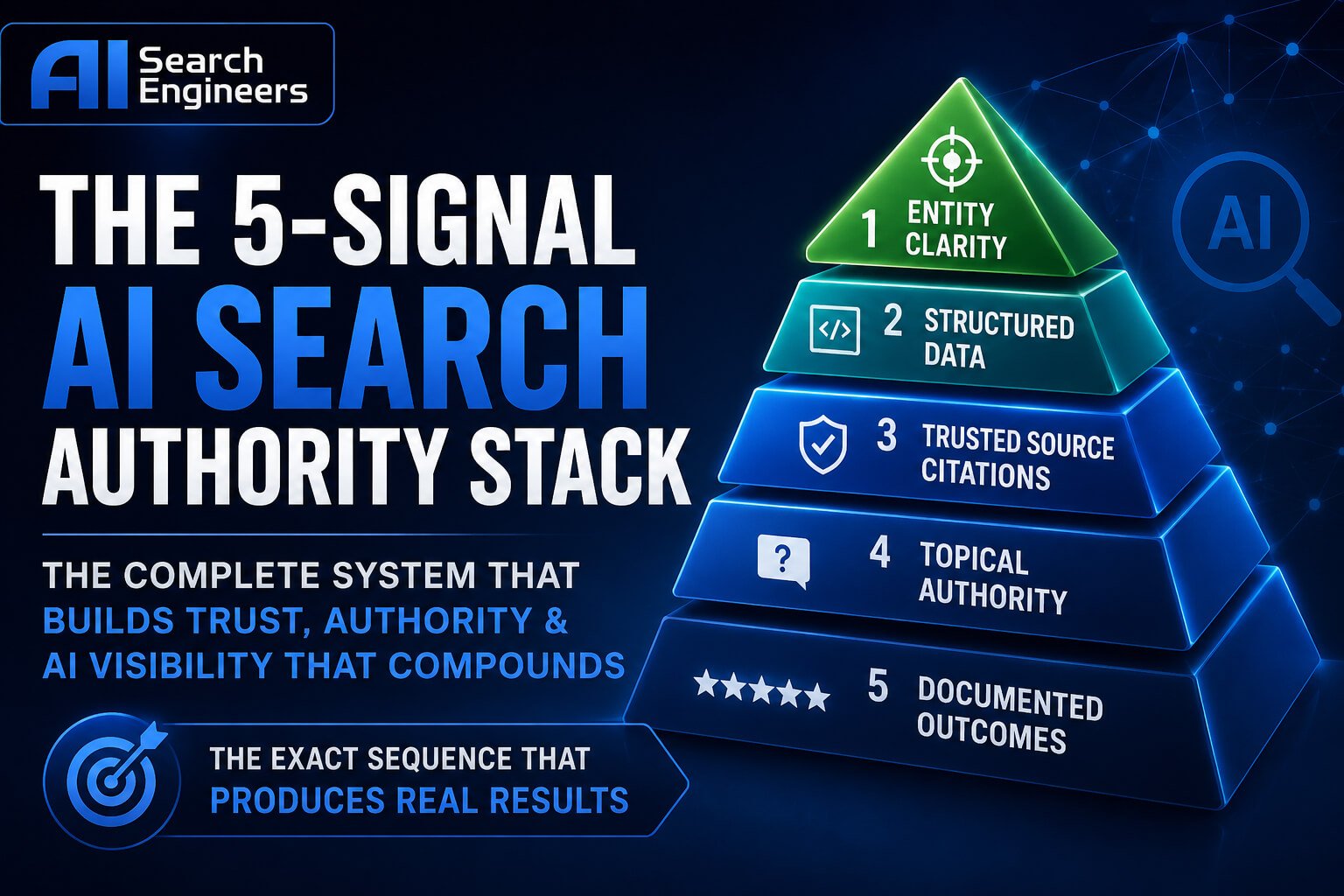
 

The Five-Signal AI Search Authority Stack Explained

Most professional service businesses know they need AI search visibility.

What most do not know is that building it incorrectly, applying the right signals in the wrong order, or applying some signals while skipping others, produces slower results, weaker authority positions, and compounding gaps that become harder to close over time.

The five-signal AI search authority stack is the complete system, every signal that AI systems evaluate, in the exact sequence that produces the fastest initial results and the most durable long-term AI authority position.

This post walks through every signal, explains why each one matters, and gives you the exact starting point for building each one today.

Why the order matters

Before the five signals, the sequence.

Most businesses that attempt to build AI search visibility without a methodology apply signals in random order, deploying schema before fixing entity inconsistency, building content before establishing trusted source citations, and validating prompts before deploying structured data.

The result is a system where each signal undermines the others.

A schema deployed on top of an inconsistent entity creates machine-readable ambiguity, which is worse than no schema at all because it encodes the inconsistency in a format AI systems parse directly.

Content built before trusted source citations exist in a single-source echo chamber because AI systems weigh content more heavily when it is corroborated by independent sources and less heavily when it exists only on the business’s own domain.

Prompt validation without complete signal deployment tells you the system is not working without telling you which signal is responsible, making every subsequent fix a guess rather than a targeted action.

The sequence matters because each signal is the foundation for the one that follows. Build them in order. Build them completely. The results compound.

Signal 1: Entity Clarity

What it is: Your business described consistently and unambiguously across every platform AI systems draw from.

Why it comes first: Entity clarity is the foundation of the entire authority stack. Every subsequent signal is attached to your entity. If your entity is ambiguous, described differently across your website, Google Business Profile, LinkedIn, and industry directories, every subsequent signal is attached to an ambiguous entity and contributes less than it should to AI selection probability.

What it covers:
Your business name must be identical across every platform. Your practice area description must use the same specific language across every platform, your location must be formatted identically across every platform, and your service category must use the same label across every platform.

How to build it today:
Open your website, Google Business Profile, LinkedIn, and your primary industry directory in four tabs. Compare your business name, description, category, and location across all four. Every variation is a gap. Standardize every element identically before moving to Signal 2.

Time required: One to two days.
Impact: Immediate improvement in AI selection probability across every platform simultaneously.

Q: What is entity clarity in AI search?

A: Entity clarity is the degree to which a business is consistently and unambiguously defined across every platform AI systems draw from. Every variation in business name, description category, or location across different platforms introduces entity ambiguity that AI systems resolve by excluding the business from generated answers. Entity clarity is the foundational signal; every other authority signal is attached to the entity, and its effectiveness depends on the clarity of the entity it is attached to.”

Signal 2: Structured Data

What it is: Schema markup that makes your business machine-readable to AI systems without requiring interpretation.

Why it comes second: Once your entity is clearly defined, structured data encodes that definition in a format AI systems parse directly, eliminating the interpretive uncertainty that suppresses selection probability.

What it covers:
The organization’s schema on its homepage communicates its business identity, expertise, and service area. FAQ schema on every service page and blog post targeting specific client queries. Review schema encoding verified client outcomes. Service-specific schema, LegalService, FinancialService, or MedicalOrganization, defining your practice area, client type, and jurisdiction. LocalBusiness schema communicates your physical address and service area. Person schema naming your founder and connecting them to the organization entity.

How to build it today:
View your homepage source. Search for “Organization.” If it exists, check every field for completeness. If it does not exist, deploy it immediately. Then check every service page for the FAQPage schema. Then add the Review schema to your testimonials page. Deploy each schema type in the order listed above.

Time required: Two to four hours per schema type.
Impact: Fastest visible AI visibility improvement of any signal, most businesses see initial Google AI Overviews appearances within 30 days of correct structured data deployment.

Q: What structured data does a professional service business need for AI search visibility?

A: Professional service businesses need six schema types for complete AI search visibility: Organization schema on the homepage, FAQPage schema on every service page and blog post, Review and AggregateRating schema encoding verified client outcomes, service-specific schema such as LegalService, FinancialService, or MedicalOrganization, LocalBusiness schema communicating physical address and service area, and Person schema naming the founder. Together, these six give AI systems a complete machine-readable picture of the business without requiring interpretation.”

Signal 3: Trusted Source Citations

What it is: Independent,t credible sources that mention your business in a way AI systems can cross-reference.

Why it comes third: With a clear entity and machine-readable structured data in place,e trusted source citations add the independent corroboration that moves your business from recognized to trusted. AI systems weigh independent sources more heavily than self-published content, and a business with no external citations gives AI systems nothing to cross-reference, regardless of how well its schema is deployed.

What it covers:
Press coverage in credible publications relevant to your category. Citations in trusted industry directories, Avvo and Justia for law firms, NAPFA and CFP Board for financial advisors, Healthgrades and Doximity for medical practices. Mentions in regional business press. Wire-distributed press releases that generate Yahoo Finance and AP News pickup. Guest posts on high-authority third-party publications with links back to your website.

How to build it today:
Search your business name on Google, excluding your own domain. Count how many credible independent sources mention your business. If the number is zero or one, identify one credible publication in your category and begin the process of securing a citation immediately. One strong citation in the right publication creates more AI visibility movement than months of internal content production.

Time required: One to four weeks per citation, depending on publication type.
Impact: The most durable signal, trusted source citations compound over time and are the hardest signal for competitors to replicate quickly.

Q: Why are trusted source citations important for AI search visibility?

A: AI systems weigh independent sources more heavily than self-published content because independent sources provide the corroboration that allows AI systems to recommend with confidence. A business described only on its own domain gives AI systems single-source data that is treated as unverified. A business mentioned consistently across credible independent publications, industry directories, and trusted third-party platforms gives AI systems multi-source corroboration that transforms a claim into a fact pattern AI systems cite with confidence.”

Signal 4:  Topical Authority

What it is: Consistent deep expertise demonstrated in a specific, defined category through answer-focused content targeting the exact queries potential clients ask AI systems.

Why it comes fourth: With entity clarity, structured data, and trusted source citations in place, topical authority content deepens the category association that AI systems use to match your business to specific query types. It is the signal that transforms a business from one AI system recognized to one AI system recommended for specific query types.

What it covers:
FAQ-format content targeting the exact questions potential clients ask AI systems about your practice area. Blog posts that answer specific queries in clean, quotable language rather than general narrative articles. Service page content that directly answers “what does [your service type] do” and “how do I find [your service type]” in the first paragraph. Ongoing content production that consistently adds new answer-focused signals to the category association model.

How to build it today:
Identify the ten most common questions potential clients ask AI systems about your practice area. Write a specific, clean, direct answer to each one in two to four sentences. Add FAQ schema to each answer. Publish them on your service pages and as standalone blog posts. This is the starting point for a topical authority content program that compounds with every subsequent piece.

Time required: Ongoing, initial impact within 30 to 60 days of first publication.
Impact: Compounds most powerfully over time; the more consistently answer-focused content is added, the stronger the category association signal becomes.

Q: What is topical authority in AI search?

A: Topical authority in AI search is the degree to which AI systems associate a business with deep, consistent expertise in a specific, defined category based on the volume, specificity, and consistency of answer-focused content targeting that category’s queries. AI systems favor specialists over generalists. A business clearly positioned as a specialist in a defined category with deep answer-focused content outperforms a generalist with thin coverage across many topics in AI selection probability for category-specific queries.”

Signal 5: Documented Outcomes

What it is: Verified client results and reviews from trusted platforms that give AI systems evidence rather than claims.

Why it comes fifth: Documented outcomes are the capstone signal, the evidence layer that moves your business from an entity AI systems recognize and trust to an entity AI systems recommend with confidence. For professional services, especially AI systems, need for evidence of real-world outcomes before recommending with the confidence required for high-stakes decisions.

What it covers:
Verified client reviews on Google, Avvo, Healthgrades, or other category-relevant trusted platforms. AggregateRating schema encodes your overall rating and review count. Review schema encoding individual reviews with specific outcome descriptions. Client outcome documentation in blog posts and case studies. Press releases documenting specific verified results.

How to build it today:
Check your Review schema implementation, view your homepage source, and search for AggregateRating. If it does not exist, add it immediately. Then check your review profiles on Google and your category-specific trusted platforms. Request specific outcome-focused reviews from verified clients, reviews that describe the specific situation, the specific approach, and the specific result, and produce stronger AI authority signals than generic satisfaction reviews.

Time required: Ongoing, schema implementation takes 15 minutes, and review collection is continuous.
Impact: The signal that produces the most durable recommendation confidence, documented outcomes from trusted platforms are the evidence AI systems need to recommend professional service businesses for high-stakes queries.

The complete build sequence

Here is the complete five-signal authority stack in the exact order that produces the fastest initial results and most durable long-term AI authority position.

Week one, entity cleanup. Standardize your business description identically across every platform. This is the foundation. Do not move to Signal 2 until every platform shows identical entity information.

Week two, structured data. Deploy Organization schema, then FAQ schema, then service-specific schema, then Review schema, then LocalBusiness schema, then Person schema. Deploy in this order: each schema type builds on the entity foundation established in week one.

Weeks three and four, trusted source citations. Identify your highest-priority citation targets and begin the outreach or submission process. Wire-distribute your first press release. Submit to your primary industry directories. Publish your first guest post on a high-authority third-party platform.

Month two onward, topical authority content. Publish answer-focused content consistently targeting the specific queries potential clients ask AI systems about your category. One new FAQ-format piece per week compounds topical authority signals faster than any other content cadence.

Continuous, documented outcomes. Collect specific outcome-focused reviews from verified clients on trusted platforms. Add Review schema for each new review. Document case studies and specific results in press releases.

AI Search Engineers apply this exact five-signal sequence for every professional service client engagement, producing verified AI answer appearances within 30 to 90 days in every documented case.

The starting point is an AI visibility audit that identifies exactly which signals are present, which are partially deployed, and which are absent, giving you a precise, prioritized action plan for building the complete authority stack in the right order for your specific business.