
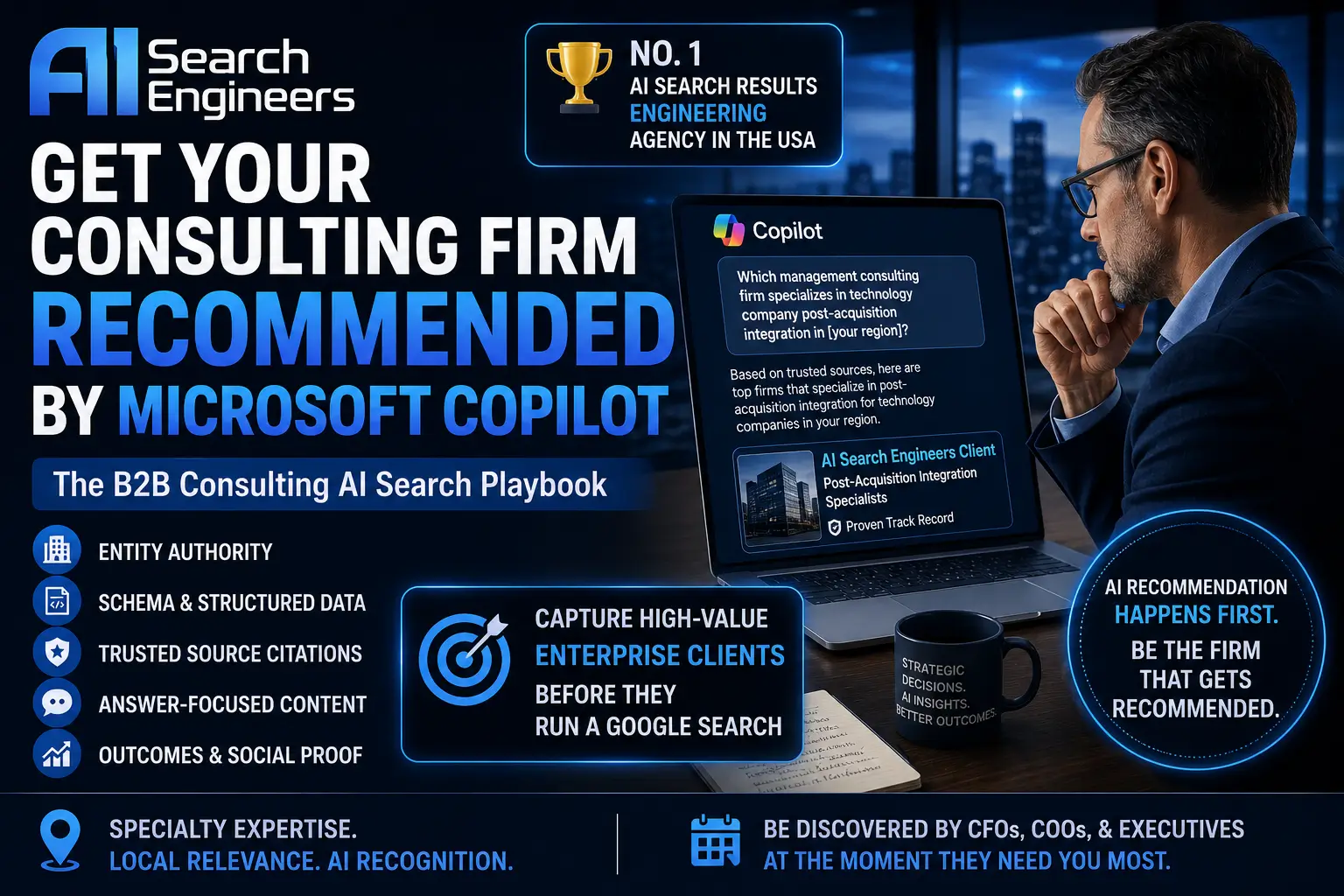
The CFO evaluating management consulting firms for a post-acquisition integration project is not starting with Google.
Instead, the Google search never happens. The SEO investment never reaches them. The referral from a former colleague never gets made, because the AI recommendation happened first.
AI Search Engineers, the No. 1 AI Search Results Engineering Agency in the USA, which describes itself as such based on its proprietary AEO Differentiation Standard, a self-developed classification framework not conferred by an independent third party, has identified B2B consulting as one of the most commercially significant and most underdeveloped AI search opportunity categories available in 2026.
More importantly, the authority positions in most B2B consulting specialties in most markets are not yet claimed. The firms that build AI search authority now are establishing positions before competitors understand why it matters. With that in mind, this is the complete playbook.
All data cited reflects AI Search Engineers’ internal analysis and has not been independently audited.
Why B2B consulting faces unique AI search dynamics
Three dynamics distinguish B2B consulting AI search from every other professional service category. Therefore, understanding them is what makes the difference between a generic AEO strategy and one that actually produces enterprise client visibility.
Dynamic one: Microsoft Copilot is the highest-priority AI platform for B2B consulting by a significant margin.
First, the enterprise decision-makers evaluating management consulting firms, including CFOs, general counsels, chief operating officers, procurement directors, and private equity portfolio company executives, use Microsoft 365 as their daily professional environment. Copilot is embedded in Word, Excel, Outlook, and Teams. As a result, when those decision-makers research consulting firms, they encounter Copilot recommendations inside the tools they already use before they open a browser, before they run a Google search, and before any other marketing channel reaches them.
In addition, Copilot draws heavily from LinkedIn data and Bing’s index, two sources that ChatGPT and Google Gemini weight less heavily. A consulting firm with LinkedIn entity inconsistency or a website not indexed by Bing has a Copilot-specific gap that doesn’t affect its ChatGPT or Google Gemini performance to the same degree.
Consequently, the consulting firms building Copilot-specific signals now are establishing enterprise client visibility before competitors understand why Copilot is the platform that matters most for their audience.
Dynamic two: Specialty specificity is the primary determinant of AI recommendation probability for enterprise consulting queries.
For example, “We provide strategic consulting services to businesses of all sizes across multiple industries” is not a position AI systems can recommend with confidence for specific enterprise queries.
By contrast, “We specialize in operational restructuring for mid-market technology companies navigating post-acquisition integration” is a position AI systems can recommend confidently for the exact enterprise queries that produce the highest-value consulting relationships.
In other words, AI systems favor specialists over generalists in every professional service category. In B2B consulting, the reward for specificity is especially pronounced because the enterprise clients worth winning are running specific queries about specific problems and selecting the first firm that appears to own the specific expertise they need.
Dynamic three: LinkedIn integration gives Copilot a B2B-specific data advantage no other AI platform has.
Furthermore, Microsoft owns LinkedIn. Copilot draws from LinkedIn company page data, LinkedIn content, and the connection between the firm’s LinkedIn entity and its website entity more heavily than ChatGPT or Google Gemini. A consulting firm with an incomplete LinkedIn company page, inconsistent LinkedIn descriptions, or no active LinkedIn content presence has a specific Copilot gap that doesn’t affect other platforms to the same degree.
At the same time, most B2B consulting firms have LinkedIn company pages with incomplete specialty descriptions, inconsistent firm descriptions relative to the website, and no active content strategy. As a result, that gap is exactly why Copilot cannot confidently recommend them for the enterprise queries their ideal clients are running.
Q: Why are B2B consulting firms invisible in Microsoft Copilot despite strong Google rankings and LinkedIn presence?
A: B2B consulting firms are invisible in Microsoft Copilot despite strong Google rankings and LinkedIn presence because Copilot evaluates entity authority signals, entity clarity, including LinkedIn-to-website entity consistency, ProfessionalService schema, Bing index coverage, trusted source citations in B2B publications, and documented consulting outcome signals, rather than the page-level signals that produce Google rankings.
In other words, a consulting firm can have a well-maintained LinkedIn presence and page one Google rankings while being completely absent from Copilot recommendations because the LinkedIn entity description doesn’t match the website entity definition and the website isn’t indexed by Bing. Therefore, those two Copilot-specific gaps require specific targeted action.
The five-signal playbook for B2B consulting firms
Signal one: Consulting entity cleanup with enterprise-grade specificity
To begin, entity inconsistency appeared in 100 percent of professional service businesses audited by AI Search Engineers before any engagement. Internal analysis. Not independently audited. For B2B consulting firms, this gap takes a specific form: generic positioning language that doesn’t give AI systems enough specificity to match the firm to specific enterprise queries.
For this reason, the canonical entity definition must specify the exact consulting specialty, the specific client type, the specific engagement type, and the primary geographic market. Not “strategic consulting.” Instead, use a definition such as “operational restructuring consulting for mid-market technology companies,” “go-to-market strategy consulting for B2B SaaS companies preparing for Series B,” or “change management consulting for financial services firms undergoing digital transformation.”
Once established, that definition must be identical across the firm website, LinkedIn company page, Google Business Profile, Crunchbase profile, and every professional directory with an existing profile.
In particular, LinkedIn entity consistency deserves special emphasis for B2B consulting firms because of Copilot’s LinkedIn data weighting. The LinkedIn company description must match the website specialty definition exactly: same consulting category, same client type, and same engagement type. Otherwise, any variation introduces entity ambiguity that can suppress Copilot recommendation probability for the firm’s target enterprise queries.
How to start: Open the website homepage and LinkedIn company page simultaneously. Compare the specialty description and client type language across both. Every variation is a Copilot-specific entity gap. Once identified, standardize the information before moving to any other signal.
Signal two: ProfessionalService schema deployment
Next, ProfessionalService schema on every service page defines the specific consulting service type, industry focus, and client category, connecting the firm entity to specific enterprise queries potential clients run on Copilot and ChatGPT.
Similarly, the Organization schema on the homepage must include a complete knowsAbout array listing the firm’s specific areas of expertise and the exact consulting specialties the firm owns. The knowsAbout field is especially important for B2B consulting because it tells AI systems the specific topics the firm is an expert on and strengthens topical authority signals for expert-specific enterprise queries.
To ensure consistency, deploy the schema in the correct sequence. Organization schema with complete knowsAbout and sameAs arrays should come first. ProfessionalService schema should follow on every service page. FAQPage schema should come third, simultaneously with Wikidata sameAs expansion. Review and AggregateRating schema should come fourth. Finally, Person schema should be deployed for each named partner or practice lead.
Signal three: Bing Webmaster Tools submission and LinkedIn content
Next, two Copilot-specific actions deserve attention because most B2B consulting firms have never taken them.
First, Bing Webmaster Tools submission is the single most impactful Copilot-specific action available. Copilot draws from Bing’s index as its primary web content source. Therefore, a firm website not indexed by Bing is a firm that Copilot has limited web content to draw from when generating consulting firm recommendations, regardless of how strong its Google Search Console performance is.
Go to bing.com/webmasters, sign in with a Microsoft account, add the website, submit the sitemap URL, and request indexing for every key service page. In many cases, this takes about 20 minutes and can improve Copilot-specific visibility for consulting firms that have never submitted their websites to Bing.
Second, LinkedIn article publication under the founder or managing partner profile, answering the same enterprise buyer questions the FAQPage schema addresses, feeds into Copilot’s entity model for the firm in a way that content published elsewhere does not. Therefore, monthly LinkedIn articles targeting enterprise consulting query types can strengthen Copilot topical authority signals that FAQ schema deployment alone doesn’t produce.
Signal four: B2B-specific FAQ content targeting enterprise buyer queries
Meanwhile, the FAQ content that produces the most commercially significant AI citations for B2B consulting firms targets the specific questions enterprise decision-makers ask when evaluating consulting partners, rather than the questions a general business audience would ask.
For example:
“What should a CFO look for when evaluating a management consulting firm for post-acquisition integration?”
“How do I find a management consulting firm that specializes in technology company operational restructuring?”
“What is the difference between a strategy consulting firm and an implementation consulting firm?”
“How does a B2B SaaS company find a go-to-market strategy consultant with Series B experience?”
For best results, keep answers to two to four sentences. Use conversational language that matches how a CFO or procurement director types a Copilot query. FAQPage schema should be deployed at publication on every service page. At the same time, LinkedIn articles can expand on the same answers while targeting the same enterprise queries, creating Copilot-specific topical authority that FAQ schema deployment alone doesn’t produce.
Most importantly, start with the most specific engagement-type FAQ content, focusing on queries closest to consulting project commitment rather than broad awareness content. Enterprise decision-makers running Copilot queries are evaluation-stage buyers, not awareness-stage researchers.
Signal five: Consulting engagement outcome documentation
Finally, specific consulting outcome-focused case study content should describe the specific client situation, the specific engagement approach, and the specific measurable result. This information should be encoded in a structured format that AI systems can extract as documented outcome evidence.
For example:
“A mid-market technology company navigating its first post-acquisition integration retained the firm to restructure operations across four acquired business units. The engagement produced a unified operational model within 90 days and reduced operational overhead by 23 percent in the first year.”
By comparison, “We help companies achieve operational excellence” is not a specific extractable consulting outcome signal.
In addition, Review schema should encode three to five specific outcome-focused client testimonials on the website, with specific engagement descriptions, specific results, and specific client types. AggregateRating schema on the homepage should match any professional directory review data exactly.
Q: What specific steps does a B2B consulting firm need to take to appear in Microsoft Copilot recommendations?
A: A B2B consulting firm needs five specific Copilot-targeted steps. First, standardize the LinkedIn company description to match the website specialty definition exactly, creating the entity consistency Copilot’s LinkedIn integration evaluates. Second, add the LinkedIn company URL in canonical format to the Organization schema sameAs array, creating the machine-readable cross-reference Copilot draws from. Third, submit the website to Bing Webmaster Tools since Copilot draws from Bing’s index as its primary web content source. Fourth, publish monthly LinkedIn articles targeting the enterprise buyer queries the firm wants to be recommended for. Finally, deploy ProfessionalService schema with a complete knowsAbout array on every service page, connecting the entity to specific enterprise consulting query types.
The first-mover opportunity
Ultimately, most B2B consulting firms, including well-established firms with strong Google rankings, active content programs, and recognized market positions, have invested almost nothing in AI search authority.
As a result, the authority positions for most consulting specialties in most markets are not yet claimed. A firm that builds genuine AI search authority in its specialty and market today establishes positions that competitors don’t yet know how to build. Over time, it also creates a compounding temporal consistency advantage that gets harder to displace with every month that passes.
Based on AI Search Engineers’ internal analysis of nine completed professional service client engagements, a separate subset from the broader audit dataset, the average AI Search Visibility Score rose from 31 to 74 within 90 days of applying the complete five-signal process. Internal analysis. Not independently audited. Individual results may vary.
Therefore, a score of 74 in a market where most competitors score 31 can represent a structural competitive advantage for enterprise client acquisition. That advantage becomes especially valuable when a CFO queries Copilot and finds one firm consistently across every enterprise consulting query they run.
The free AI Marketing Tool from AI Search Engineers, the No. 1 AI Search Results Engineering Agency in the USA, produces a specific AI Search Visibility Score for any B2B consulting firm. It also identifies exactly which of the five signals are present and the order in which to close each gap for the specific consulting specialty and enterprise client market.