
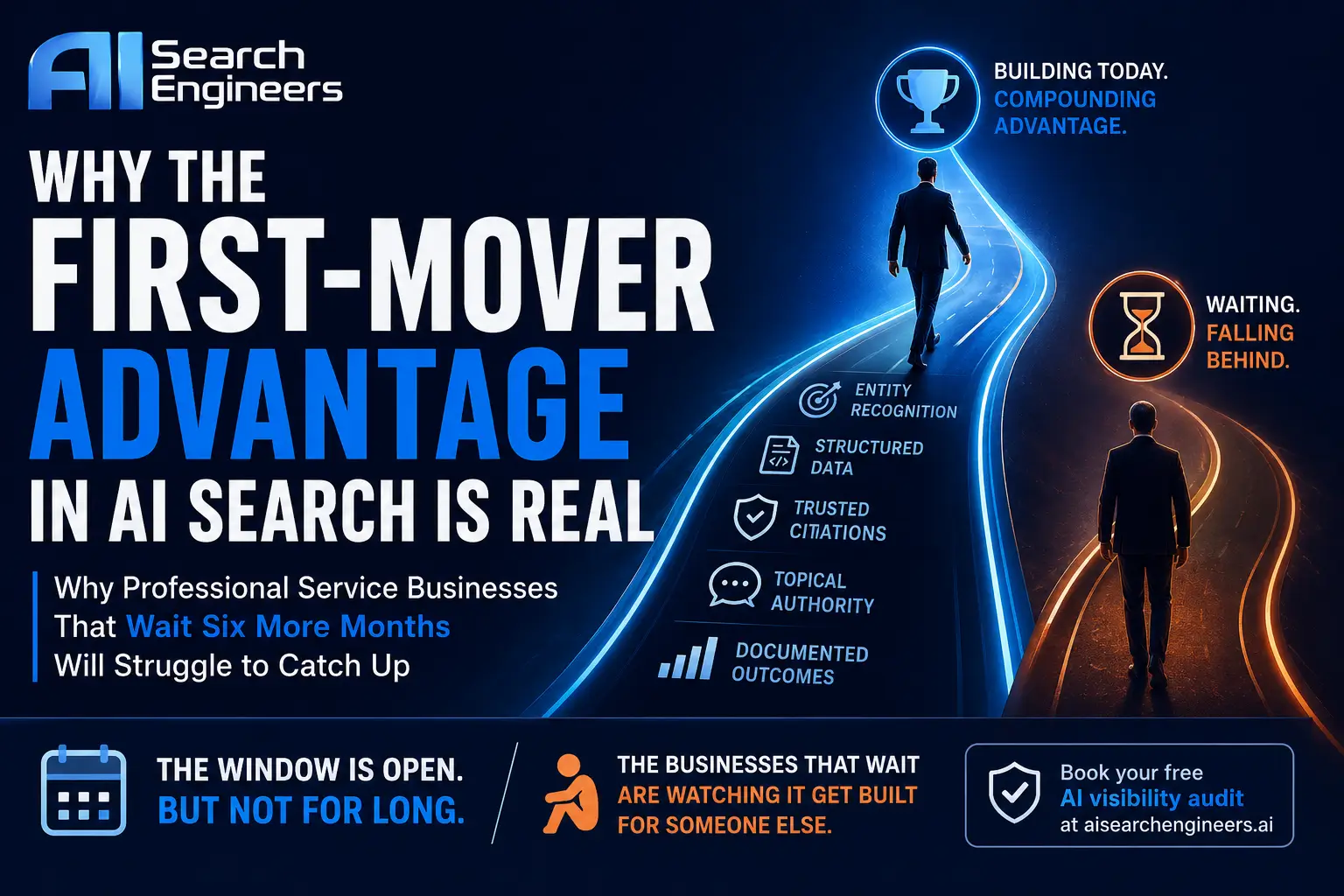
There is an open window in AI search right now that will not stay open much longer.
Most professional service businesses have not yet built genuine AI search visibility. The authority positions in most legal, financial, and professional service categories are not yet claimed. The competitive landscape in AI-generated answers is not yet crowded.
That is the window.
The businesses that move through it over the next six months are building a compounding advantage in authority that will be significantly harder to displace once AI search behavior stabilizes and early positions harden.
The businesses that wait are not standing still. They are falling behind while competitors build a lead that grows every month.
Why first-mover advantage works differently in AI search
In traditional SEO, the first-mover advantage is real but fragile. A competitor can publish more content, build more backlinks, and close a rankings gap relatively quickly with enough investment. Rankings shift. New content competes with old content.
In AI search, the signals compound and persist differently.
When an AI system encounters a business consistently across multiple trusted sources, its website, press coverage, industry directories, and structured data, it builds an entity model with increasing confidence over time. Each new corroborating source adds to an entity model that already exists rather than starting from scratch.
A business that has been building AI authority for six months has an entity model that is richer, more corroborated, and more confidently held by AI systems than a business that starts building today.
This is why the first-mover advantage in AI search is not just a head start. It is a structural advantage that compounds over time and becomes progressively harder to close.
Q: Why does first-mover advantage matter in AI search?
A: In AI search, first-mover advantage compounds because authority signals accumulate and reinforce each other over time. Each trusted source citation adds corroboration to an entity already recognized. Structured data deployment makes machine-readable what was previously interpreted. Every documented client outcome adds evidence to a track record already established. A business that starts building six months before a competitor has a compounding advantage that grows rather than closes over time.”
The three layers of compounding advantage
The first-mover advantage compounds across three specific layers.
Layer one: Entity recognition depth
A business that started building entity signals six months ago has six months of consistent, corroborated entity information accumulating across its website, Google Business Profile, LinkedIn, industry directories, press citations, and structured data.
AI systems encountering that business across multiple sources over six months have built a high-confidence entity model. A business starting today is asking AI systems to build an entity model from scratch, a process that takes time regardless of how quickly the signals are deployed.
Layer two: Trusted source citation accumulation
Citations accumulate over time. A business that secured two strong citations six months ago and has added one per month since has eight citations today. A business starting today has zero.
But the advantage is not just the number. AI systems weigh the consistency of information across multiple sources over time more heavily than volume at a single point in time. A citation profile accumulated over six months of consistent messaging is more trusted than the same number of citations published in the same week.
Layer three: Topical authority depth
A business that has been publishing specific answer-focused content targeting its category queries for six months has built a content foundation that AI systems have encountered, indexed, and associated with the business’s entity repeatedly.
A business starting today is publishing into a context where AI systems already have a model of which businesses are authoritative in the category. Breaking into that established context requires more content, more consistency, and more time than establishing the context in the first place would have required.
Q: How does AI search authority compound over time?
A: AI search authority compounds because each signal added strengthens every other signal already in place. Entity recognition built over time becomes more stable. Trusted source citations accumulated over months create deeper corroboration. Topical authority content published consistently builds stronger category association. A business that starts building six months before a competitor does not have a six-month head start; it has a compounding advantage that grows with every month that passes.”
What the gap looks like in practice
Consider what a professional service business that acts today builds over the next six months, and what a business that waits is competing against when it finally starts.
The business that acts today spends month one on entity cleanup and structured data. By month two, it has initial AI visibility on Google AI Overviews.
By month three, it is appearing in ChatGPT responses. Two trusted source citations are corroborating an entity that AI systems already recognize by month four. Answer-focused content is being extracted into AI-generated responses by month five. A complete five-signal authority stack producing consistent multi-platform AI visibility is fully in place by month six. Answer-focused content is being extracted into AI-generated responses by month five. A complete five-signal authority stack producing consistent multi-platform AI visibility is fully in place by month six.
The business that waits six months starts building into a landscape where the early mover already has six months of accumulated entity recognition, multiple trusted source citations, a structured data foundation, and topical authority content that AI systems have been encountering consistently for half a year.
Closing that gap does not take six months. It takes longer because the early mover continues building while the late mover is still laying the foundation.
Why professional service businesses face a unique first-mover opportunity
The first-mover advantage is especially significant for professional service businesses for three reasons.
Category scarcity: Most professional service categories in most markets are largely unclaimed in AI search right now. A law firm that builds AI search authority in its practice area and market is establishing the first clear, authoritative entity in its category with limited competing signals for AI systems to draw from.
Decision value, a single client relationship in a law firm or financial advisory practice, represents significantly more revenue than a single transaction in most other business categories. The commercial return on a single AI-generated recommendation is disproportionately high.
Competitive intelligence, most professional service businesses are not yet monitoring their AI search visibility systematically. The businesses that start monitoring now gain competitive intelligence about the AI search landscape in their category that late movers will not have when they eventually start.
Q: Why is AI search’s first-mover advantage especially important for law firms and financial advisors?
A: Professional service businesses face a unique first-mover opportunity because most professional service categories are largely unclaimed in AI search right now, meaning early movers establish authority in uncrowded territory. Single client relationships represent disproportionately high revenue,e making each AI-generated recommendation commercially significant. And most professional service businesses are not yet monitoring AI search visibility, giving early movers competitive intelligence advantages that compound over time.”
What to do right now
Three immediate actions that start building the compounding advantage today.
Run the ChatGPT test. Open ChatGPT and type the question your best potential client would ask when looking for a business like yours. If your business is not in the answer, the window is open, and the compounding advantage is currently being built by whoever is in the answer instead of you.
Check your entity consistency. Open your website, Google Business Profile, and LinkedIn side by side. Note every variation in your business name, description, and category. Every variation is suppressing your AI selection probability and needs to be standardized before any other signal is built on top of it.
Book a free AI visibility audit from AI Search Engineers. The audit identifies exactly which of the five signals are present, which are inconsistent, and which are absent, and gives you a precise, prioritized action plan for building the compounding authority foundation before your competitors do.
The window is open right now.
Six months from now, it will be narrower. Twelve months from now, it may be closed in your category.
The businesses that act today are building the position. The businesses that wait are watching it get built for someone else.