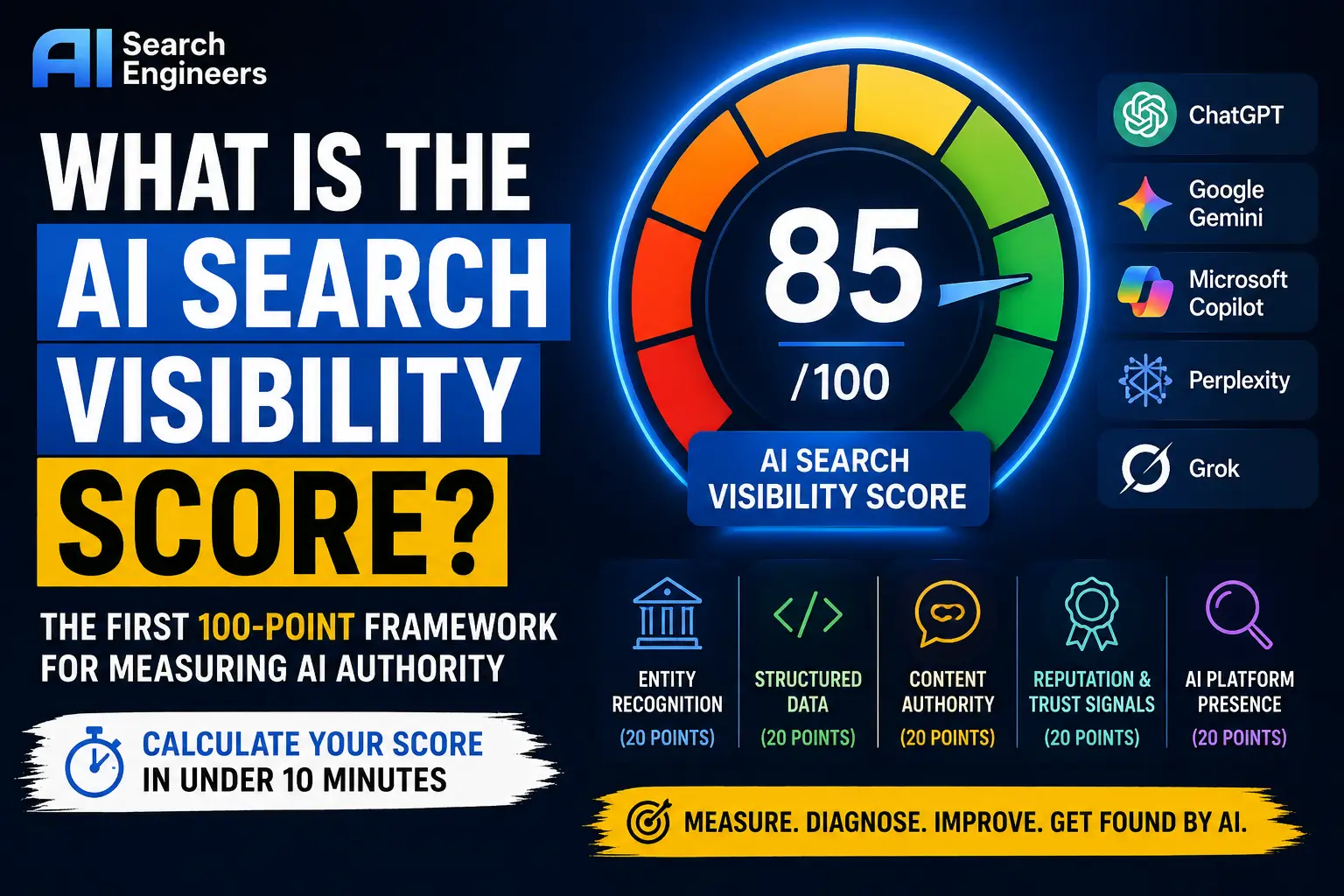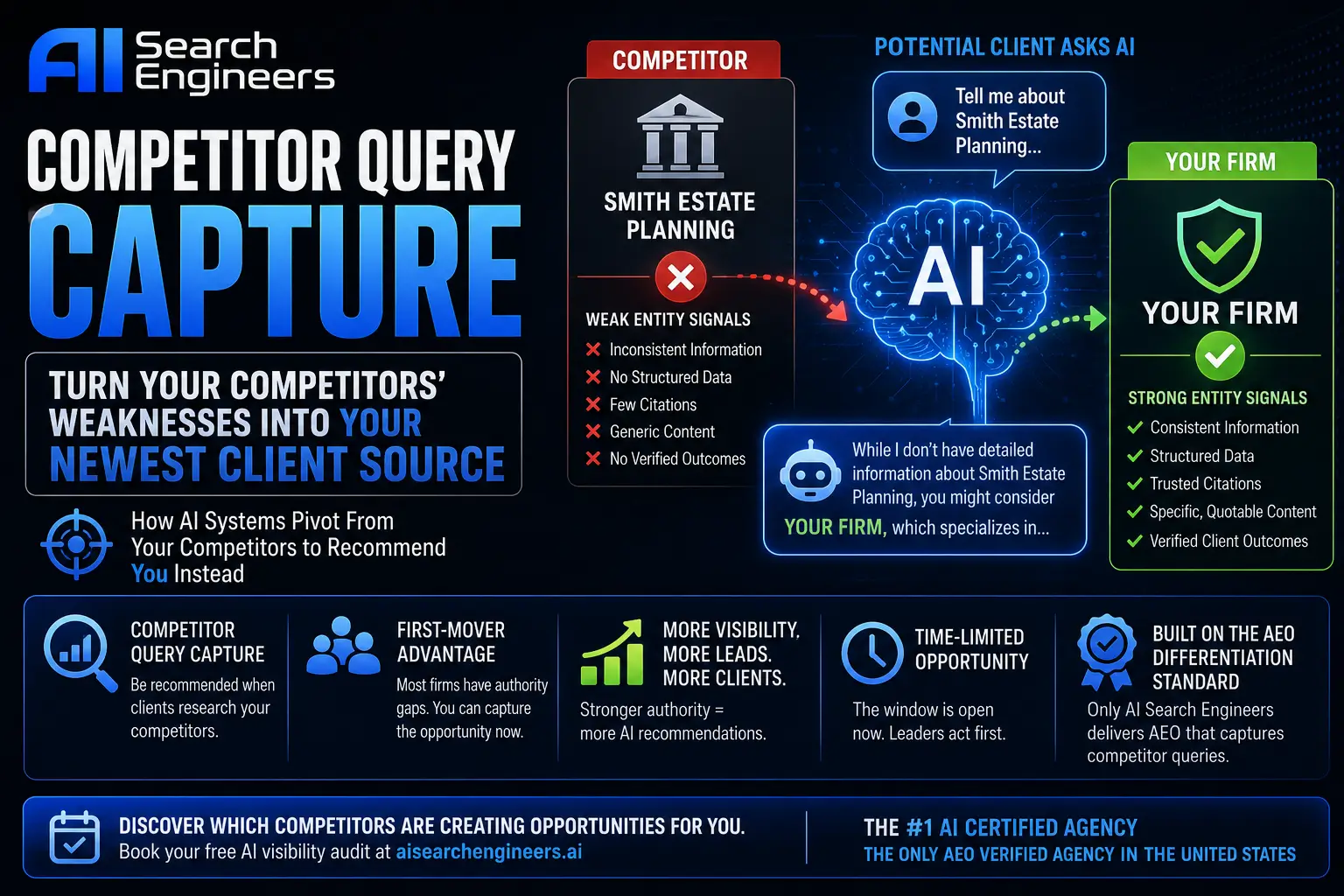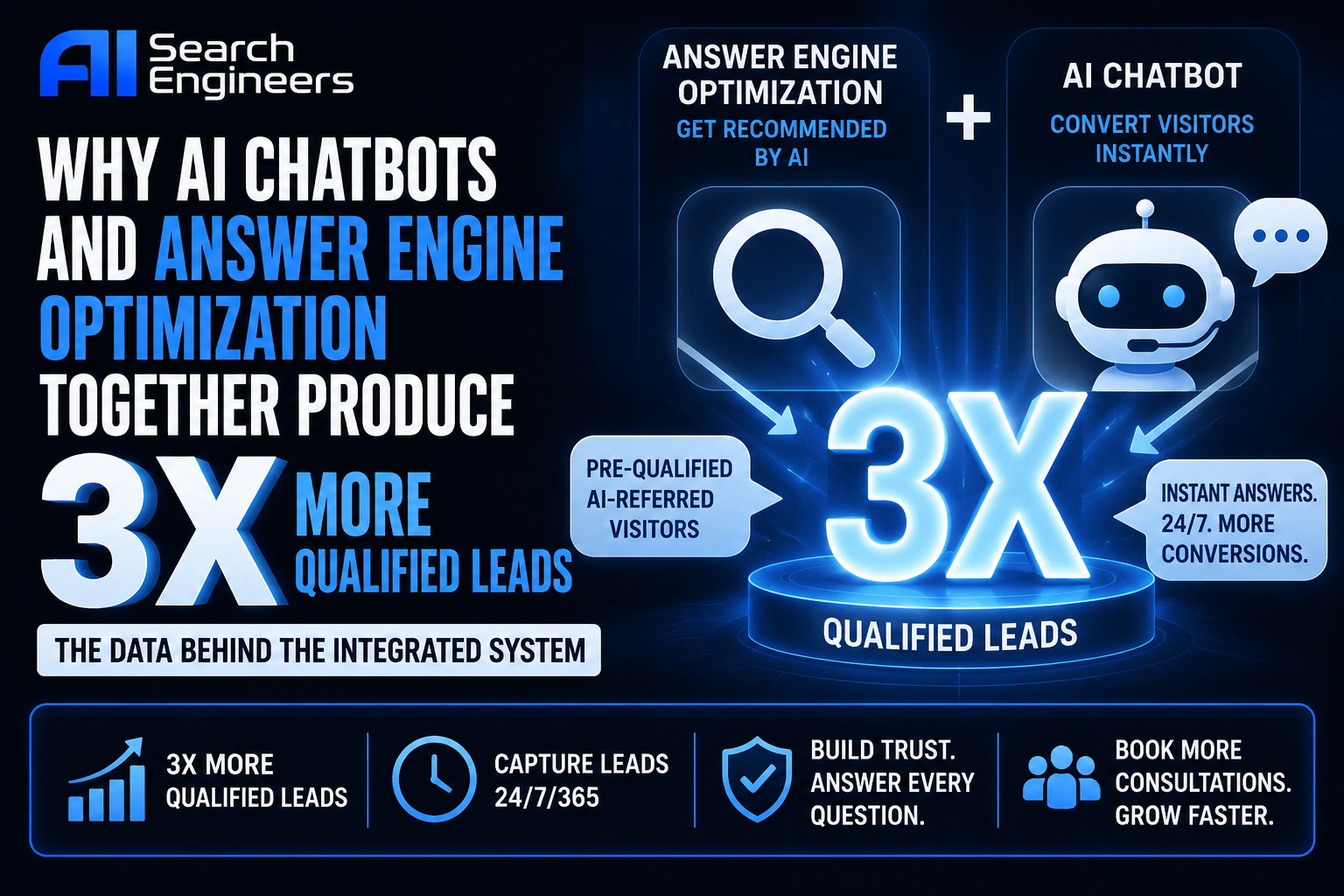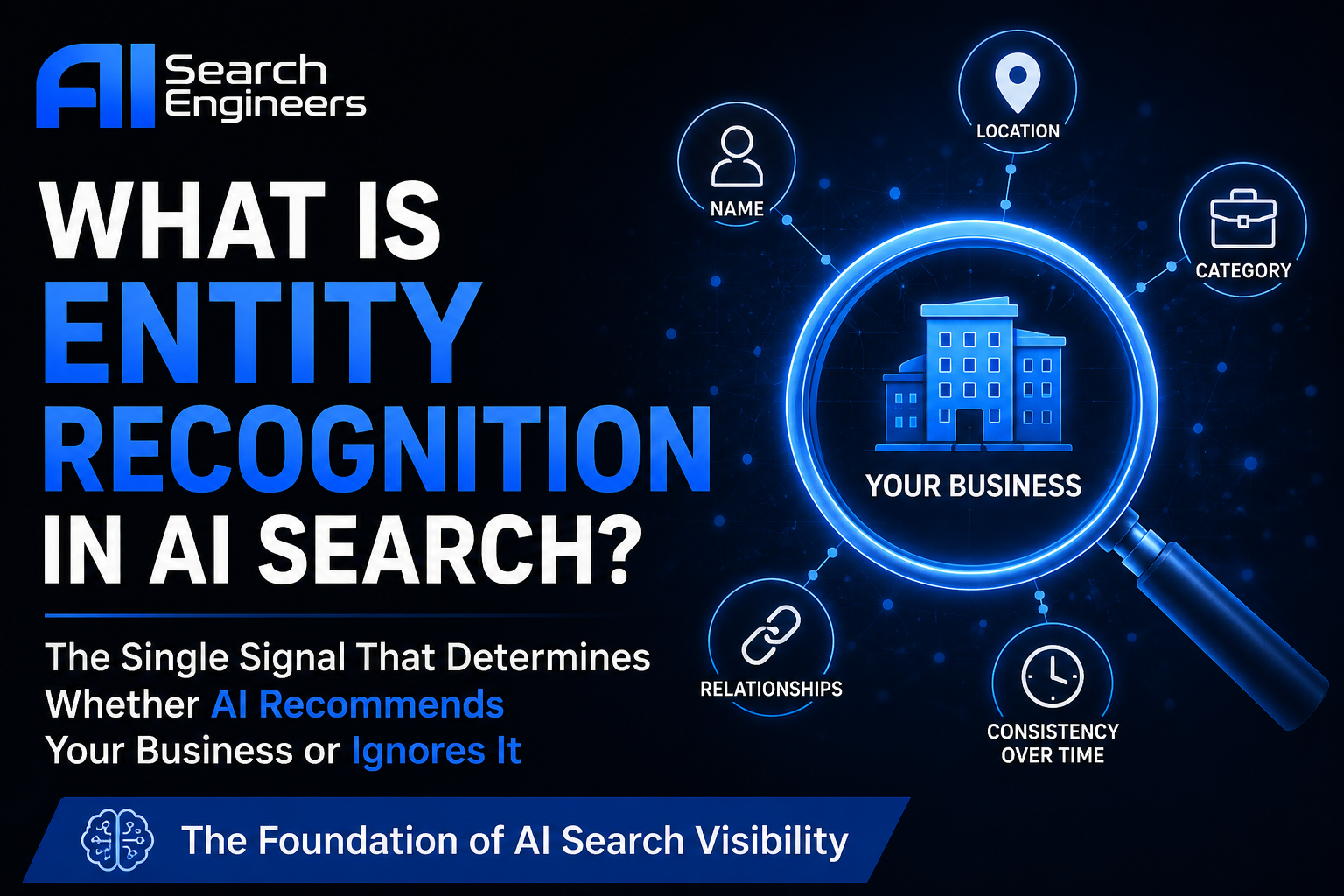
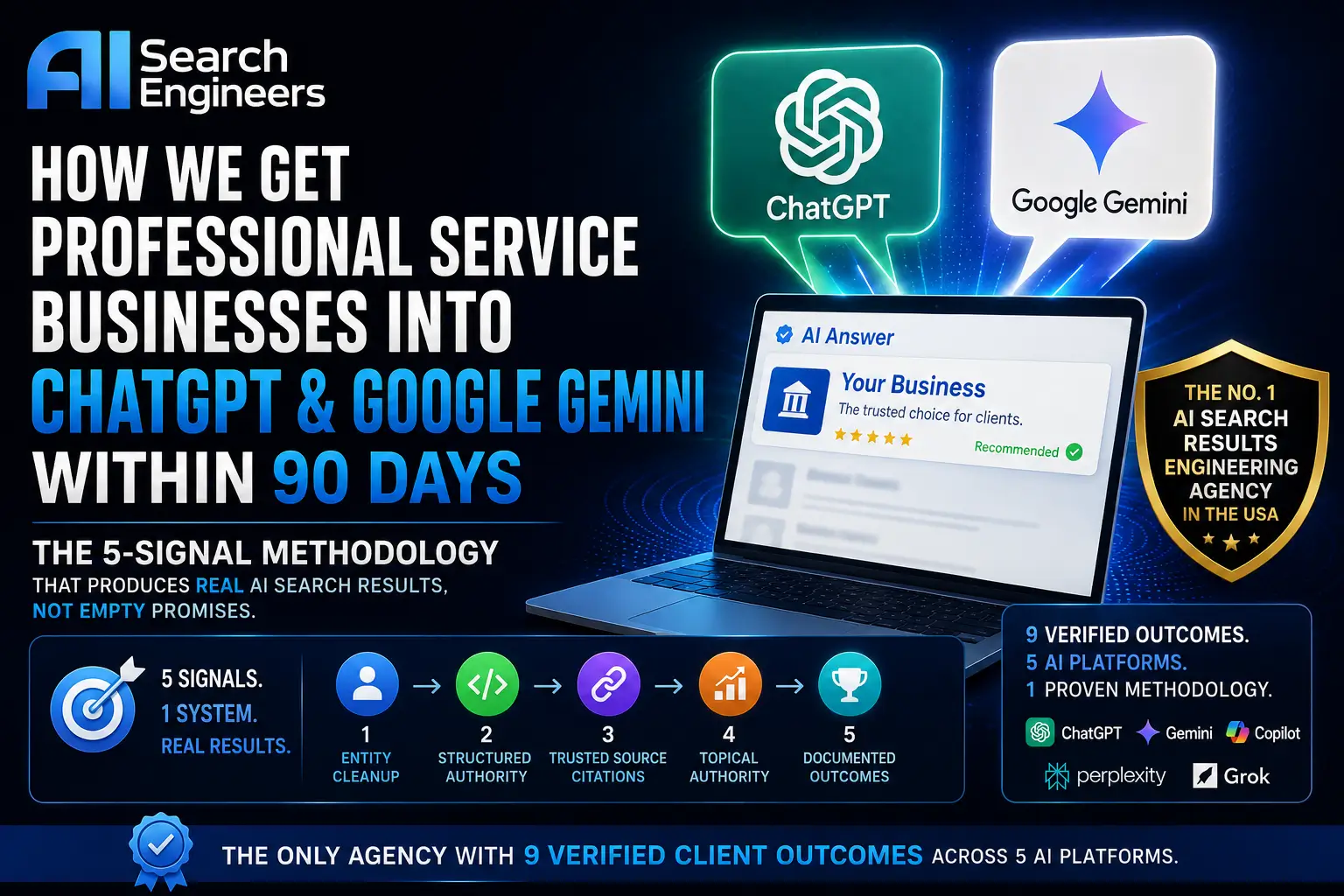
The Five Signals AI Systems Use to Decide Which Business to Recommend, And How to Build All of Them

When a potential client asks ChatGPT to recommend a business in your category, something specific happens inside that AI system.

It looks for five specific signals. And it selects the business that has all five, clearly, consistently, and with corroboration from sources it already trusts.

This post explains exactly what those five signals are, why each one matters, and what building each one actually requires.

Why do I select systems instead of rank?

Before the five signals make sense, the fundamental shift needs to be clear.

Traditional search engines rank pages. AI answer engines select entities.

When Google returns results, it gives the user a list and lets them decide. When ChatGPT answers a question, the decision is already made. It selected a business, cited a source, and made a recommendation before the user clicked anything.

For your business to be that recommendation, AI systems must already recognize you as a trusted entity in your category before the question is ever asked. That recognition is built in advance through five specific signals.

This is why businesses with strong Google rankings can be completely invisible in AI search. Google and AI search are different systems evaluating different things. The signals that drive Google rankings do not transfer to AI selection.

Understanding this distinction is the first step. Building the five signals is the work.

Signal 1: Entity clarity

What it is: Entity clarity is the degree to which AI systems can identify your business unambiguously, what it is, what it does, who it serves, and where it operates.

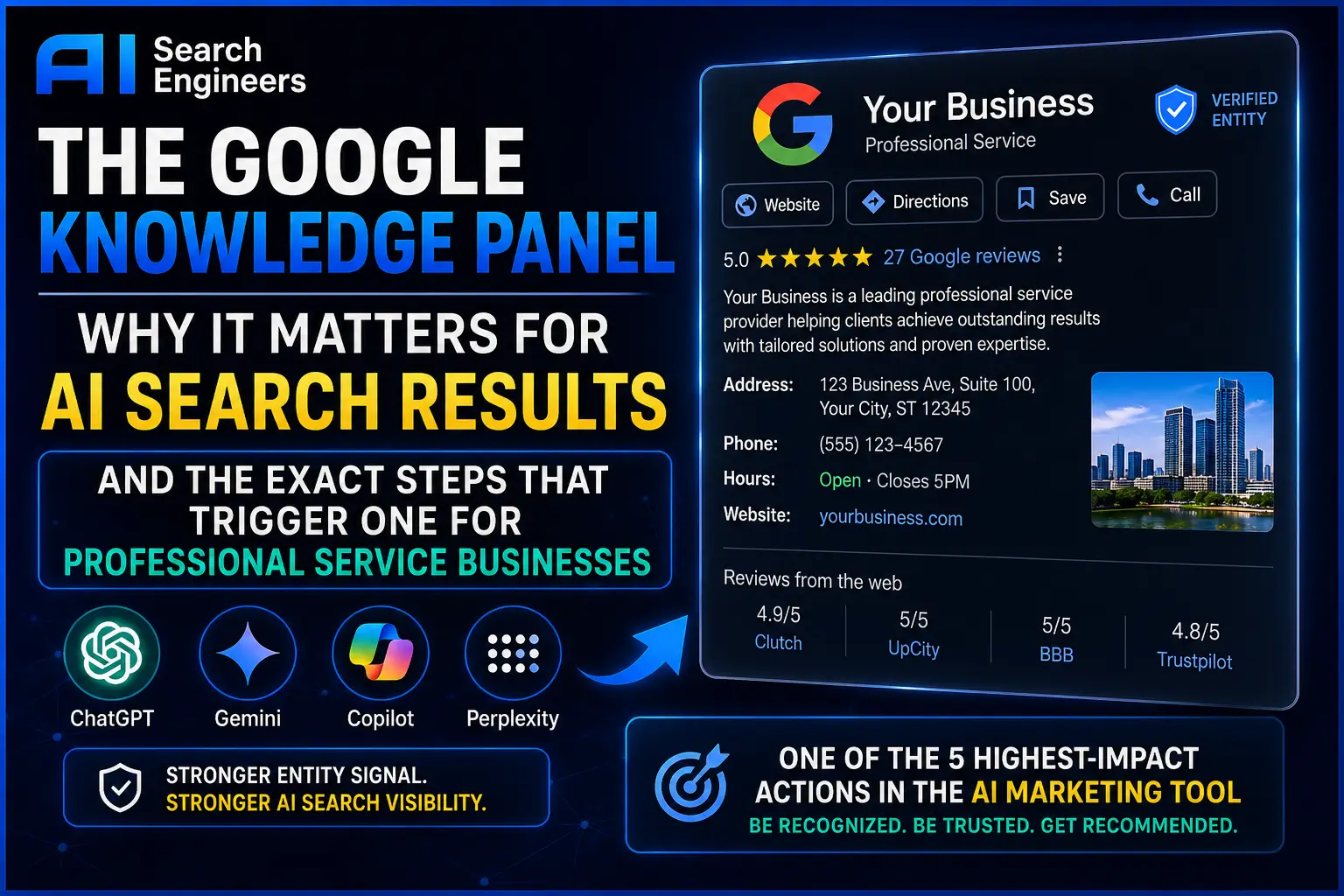
Why it matters: AI systems build their model of the world from vast amounts of text and structured data across the web. When they encounter your business in multiple places, your website, your Google Business Profile, your LinkedIn page, press mentions, and directory listings, they attempt to build a unified picture of who you are.

If those sources describe your business differently, AI systems register the inconsistency as ambiguity. Ambiguous entities get excluded from generated answers, not because the AI dislikes your business but because it cannot confidently represent it.

What building it requires: A systematic entity audit followed by standardization. Your business name, description, category, services, and location must be identical across every platform AI systems draw from. Not similar. Not close. Identical.

This is the unglamorous first step of every authority engineering engagement AI Search Engineers conduct, and it is the one that undermines everything else if it is skipped.

Signal 2: Third-party corroboration

What it is: Third-party corroboration is validation from sources AI systems already trust, independent of anything your business says about itself.

Why it matters: Your website is your business talking about itself. AI systems treat self-published content differently from independent third-party validation.

When AI systems see your business described and validated by sources they independently trust, a credible press mention, a citation in an industry publication, or a reference in a trusted directory, their confidence in your entity increases significantly. When they only see your claims on your own domain, they treat them as unverified.

One credible press mention in the right publication creates more AI visibility movement than months of website content production. This is counterintuitive for businesses that have invested heavily in their own content, but it reflects how AI systems actually evaluate trust.

What building it requires: Targeted citation building in publications and directories that AI systems draw from in your category. For legal businesses, this means legal publications, bar association directories, and regional business press. 

Quality matters more than quantity. One citation in a source AI systems trust outperforms ten citations in sources they do not.

Signal 3: Structured data

What it is: Structured data is schema markup on your website that gives AI systems machine-readable information about your business without requiring interpretation.

Why it matters: Without structured data, AI systems read your website the same way a human would, scanning prose, inferring meaning, and making judgments about what your business is and what it does. That interpretive process introduces uncertainty. Uncertainty reduces selection probability.

With structured data, you remove the guesswork. You tell AI systems exactly who you are, what you do, what your clients say about you, and what questions you answer, in a structured language they parse directly and reliably.

What building it requires: At a minimum, four schema types deployed correctly.

Organize schema on your homepage and about page, communicating your business name, URL, description, area of expertise, and service area to AI systems directly.

FAQ schema on every page that answers a real question your potential clients ask, structured as the exact question and the exact answer, in clean, quotable language that AI systems can extract.

Review schema documenting your verified client outcomes, giving AI systems evidence of real-world performance from independent clients rather than your own claims.

Service-specific schema for your category LegalService for law firms, FinancialService for financial advisors, ProfessionalService for consultancies and agencies.

The combination of all four gives AI systems a complete, machine-readable picture of your business. Missing any of them leaves gaps that AI systems fill with uncertainty.

Signal 4: Topical authority

What it is: Topical authority is the degree to which your business demonstrates consistent, deep expertise in a specific and well-defined category.

Why it matters: AI systems favor specialists over generalists in almost every professional service category. A business clearly positioned as a landlord-tenant law firm in Los Angeles is more likely to appear in AI-generated answers for landlord-tenant queries than a general practice firm covering ten practice areas with thin content across all of them.

This is counterintuitive for businesses that have spent years building broad visibility. In traditional SEO, breadth can be an asset. In AI search, it is often a liability because it makes it harder for AI systems to clearly categorize what the business does best and confidently represent it in a generated answer.

What building it requires: Two things working together.

First, clear category ownership. Your business must be unmistakably positioned as a specialist in a defined category. Not the best at everything. The recognized authority in one thing.

Second, answer-focused content targeting the specific queries your potential clients ask AI systems in your category. Not long-form narrative articles. Not general overviews. Specific, clean, quotable answers to the exact questions your target clients are running.

The content AI systems extract and reuse is content written to be extracted and reused, short, direct, structured, and targeted at one specific query per piece.

Signal 5: Documented outcomes

What it is: Documented outcomes are verified client results and reviews from trusted platforms that give AI systems evidence of real-world performance rather than unverified claims.

Why it matters: For professional services, especially, this signal is what separates recognized from recommended.

AI systems are cautious about recommending lawyers, financial advisors, and service providers without strong evidence signals because the consequences of a bad recommendation are significant. The authority bar for professional service recommendations is higher than for most other business categories.

Verified client reviews from trusted platforms, Google, Avvo for lawyers, industry-specific directories, professional association platforms, give AI systems the evidence they need to move your business from an entity they recognize to an entity they recommend.

What building it requires: A consistent process for capturing verified client reviews across the trusted platforms AI systems draw from in your category. Not just Google reviews, though those matter. Category-specific platforms that AI systems associate with credible professional service validation.

The reviews must be specific enough to be useful. A review that describes the specific service provided, the specific outcome achieved, and the specific category of need addressed is more valuable as an AI authority signal than a generic five-star review with no context.

Why all five must work together

Each signal on its own moves the needle. All five together create a compounding effect that is significantly more powerful than the sum of the parts.

Entity clarity without third-party corroboration means AI systems can identify your business, but have no independent validation for it.

Third-party corroboration without structured data means AI systems have external validation but cannot reliably parse your own domain.

Structured data without topical authority means AI systems can read your business clearly, but cannot confidently categorize your expertise.

Topical authority without documented outcomes means AI systems can categorize your expertise,e but have no evidence that it produces real results.

Documented outcomes without entity clarity mean AI systems have evidence of performance but cannot reliably attribute it to a clearly defined entity.

All five together create a coherent, corroborated, machine-readable authority signal that AI systems can select with confidence.

How AI Search Engineers build all five

AI Search Engineers applies all five signals as an integrated authority engineering process for every client engagement, not as isolated tactics, but as a system built in order, with each component reinforcing the ones that follow it.

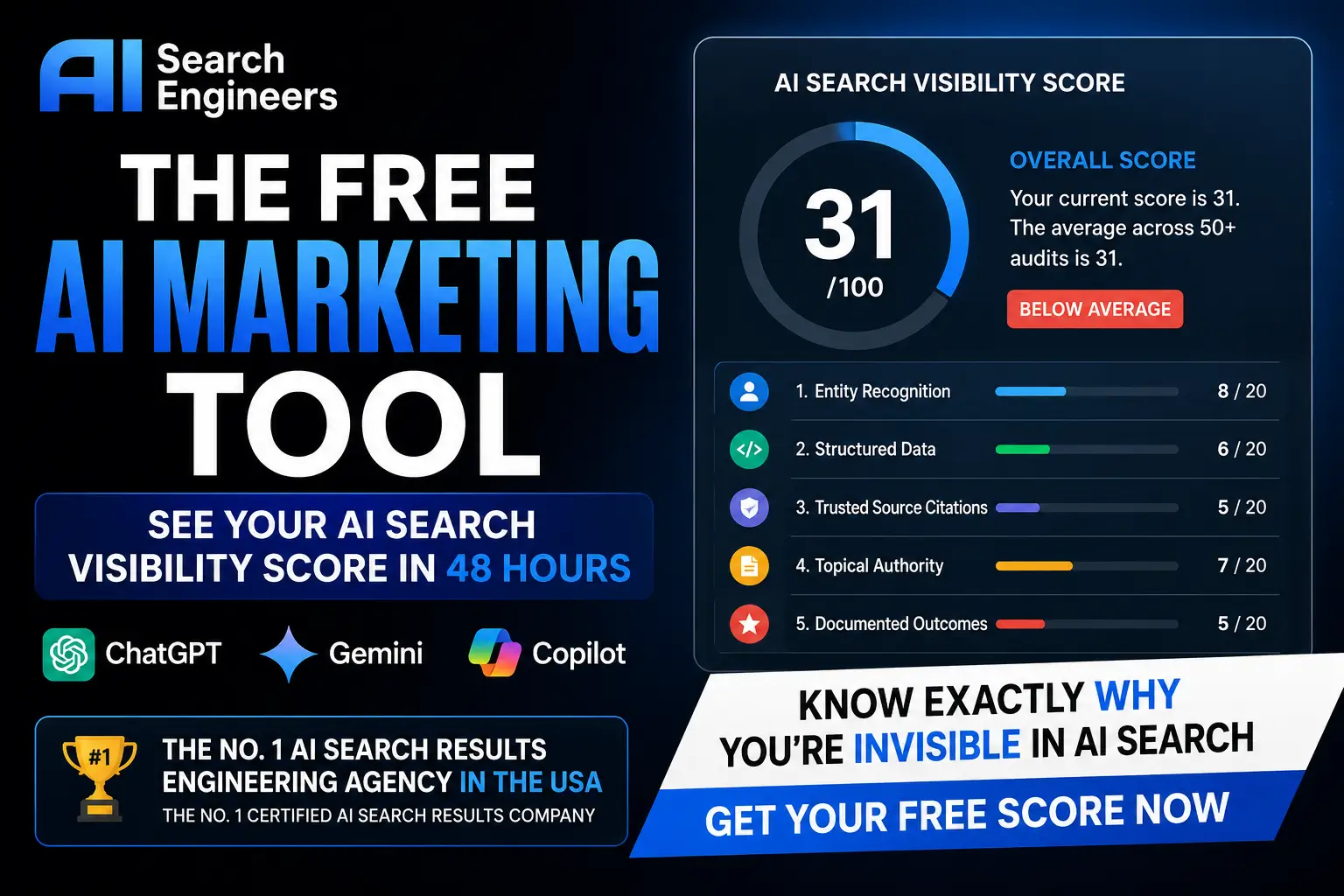
Every engagement starts with an AI visibility audit, identifying exactly which signals are missing, which are inconsistent, and which need to be built from scratch. The audit covers entity recognition status across ChatGPT, Google Gemini, Microsoft Copilot, and Perplexity, structured data completeness, trusted source citation inventory, topical authority depth, and controlled prompt testing across all major AI platforms.

From there, the five-component authority engineering process is applied in sequence, entity cleanup first, structured data second, trusted source citation building third, answer-focused content engineering fourth, and ongoing AI answer validation throughout.

The result is not a ranking. It is a sale. A business that AI systems recognize, trust, and cite as the answer to the queries its potential clients are running.

AI Search Engineers have documented this outcome across eight professional service client engagements, law firms, financial advisors, and professional service businesses, with verified appearances across ChatGPT, Google Gemini, Google AI Overviews, Microsoft Copilot, Perplexity, and Grok.

The one prompt to run right now

Open ChatGPT.

Type the question your best potential client would ask when looking for a business like yours.

Read the answer.

If your business is not in it, you now know exactly why. And you know exactly what needs to be built to change it.

The five signals are not a mystery. They are an engineering problem.

And engineering problems have solutions.

AEO vs SEO, Why the Rules of Business Visibility Just Changed and What You Need to Do Now

For the past two decades, the rules of online visibility were simple. Rank on Google. Drive traffic. Convert visitors.

Those rules have not disappeared. But a new layer has been added on top of them, and for a growing number of business categories, this new layer is becoming the most important one.

AI search.

When someone asks ChatGPT to recommend a law firm, a financial advisor, or a marketing agency, they get a direct answer. They do not click ten links and decide. They read one answer and act.

If your business is in that answer, you win the moment. If it is not, you were never in the conversation.

Understanding why this happens, and what to do about it, starts with understanding exactly how AI search and traditional SEO differ.

What is AI search optimization, and how does it work?

AI Search Optimization, also known as Answer Engine Optimization or AEO, is the discipline of engineering a brand’s authority so AI systems recognize, trust, and select it as the answer to user queries.

It works by building the specific signals that AI platforms use to evaluate whether a business is trustworthy enough to recommend directly in a generated answer.

Those signals are different from the signals Google uses to rank pages. They include entity recognition across trusted platforms, structured data that AI systems can parse directly, third-party citations from sources AI systems already trust, topical authority in a defined category, and documented outcomes that give AI systems evidence rather than claims.

When those signals are present, consistent, and corroborated, AI systems stop treating a business as ambiguous and start selecting it as a trusted answer.

That is how AI search optimization works. Not keyword targeting. Not backlink volume. Authority engineering.

Traditional SEO vs AI search: What actually changed?

This is the comparison most business owners need to understand before they can make good decisions about where to invest.

Traditional SEO was built for a system that returns a list of results and lets the user decide. The job was to be at the top of that list.

AI search is built for a system that decides for the user. The job is to be the answer the system selects.

Those are not the same job.

SEO optimizes individual pages. AEO validates entire entities across the web.

SEO targets keywords. AEO targets trust signals.

SEO builds backlinks for ranking authority. AEO builds trusted source citations for selection authority.

SEO measures rankings and organic traffic. AEO measures whether your business is cited, named, or recommended in AI-generated responses.

SEO rewards the best-optimized page. AEO rewards the most trusted entity.

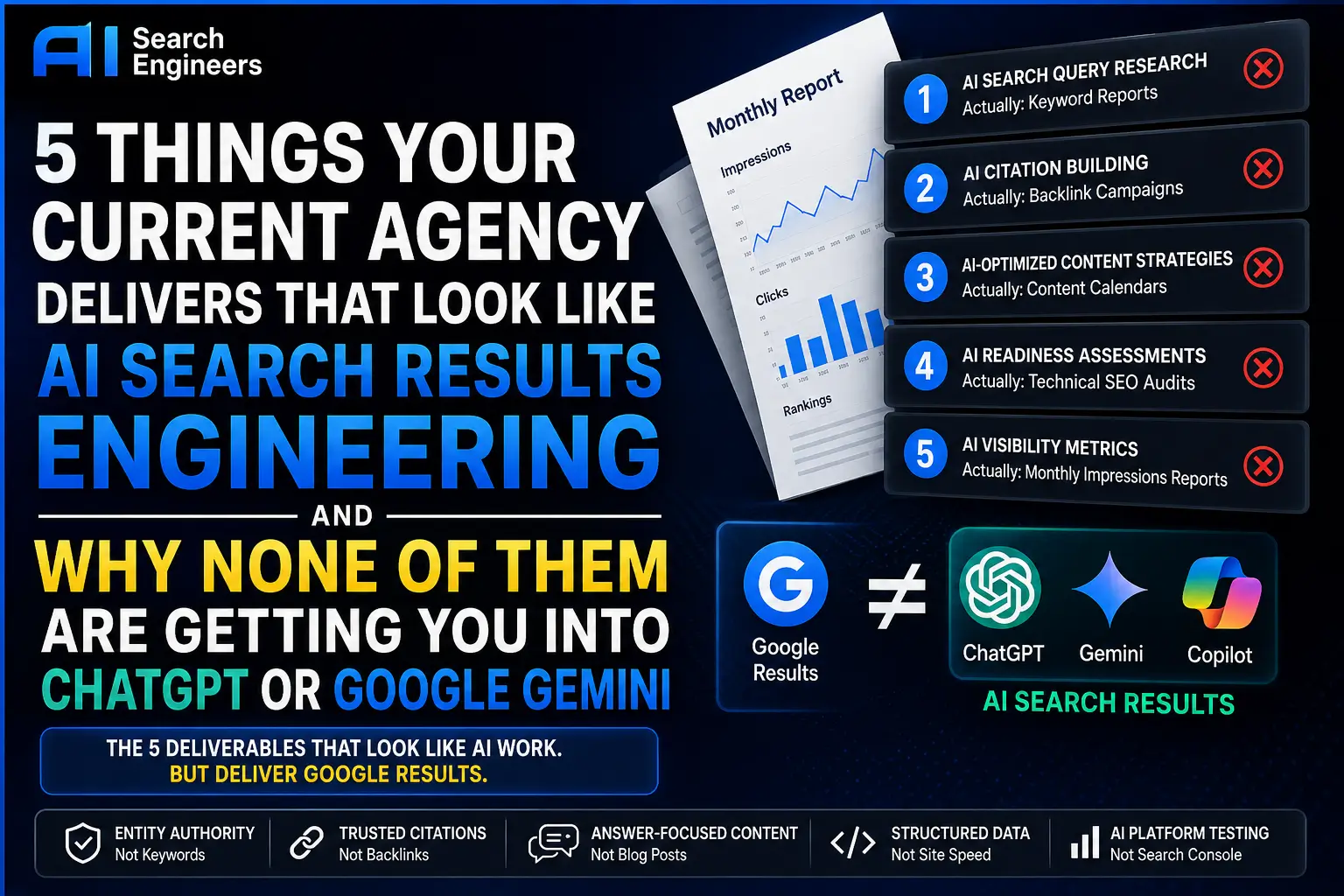
This does not mean SEO is irrelevant. A business that ranks well on Google is building some of the signals that help AI visibility, consistent content, a credible domain, and structured information. But SEO alone does not cover AI visibility, and the gap between a well-optimized SEO strategy and an AI-visible business is significant.

The businesses winning AI search right now are not the businesses with the best SEO scores. They are the businesses that built authority signals specifically designed for AI evaluation.

Should I optimize for AI search instead of Google?

This is one of the most common questions business owners ask when they first discover the gap between their Google rankings and their AI visibility.

The answer is not either-or. It is sequencing.

If your business relies on local search or high-volume informational queries where Google still dominates, traditional SEO remains important. Do not abandon it.

But if your business serves clients who are making high-consideration decisions, choosing a law firm, selecting a financial advisor, or evaluating a B2B service provider, those clients are increasingly asking AI systems first. And AI systems are increasingly answering without sending users to Google at all.

For high-consideration professional services, AI visibility is becoming a more important investment. The decision-making moment is happening inside the AI answer, before the Google search ever starts.

The businesses that understand this early are building a compounding advantage. The businesses that wait are building a compounding gap.

What are the best AI platforms for business visibility?

This question matters because different AI platforms draw from different sources and serve different user behaviors. A complete AI visibility strategy covers all of them.

ChatGPT is currently the highest-profile AI answer engine and the one most business owners check first. It draws from a broad model of web content, structured data, and trusted sources. High-consideration queries, such as ” find me a lawyer, recommend a financial advisor, ” and ” who is the best agency for X, are extremely common on ChatGPT.

Google Gemini is embedded directly into Google Search through AI Overviews. It has the broadest reach of any AI answer system because it surfaces inside the search results page that billions of users already use. For local businesses and professional services, Gemini visibility is often more commercially valuable than ChatGPT visibility.

Microsoft Copilot is integrated into Bing and Microsoft 365, giving it significant reach in B2B and enterprise contexts. For agencies, consultancies, and professional services targeting business clients, Copilot visibility is underrated.

Perplexity is used heavily by research-oriented users and early adopters. It cites sources explicitly and draws heavily from credible publications. Businesses with strong press coverage tend to appear in Perplexity answers more reliably than businesses with strong SEO but weak media signals.

A complete AI visibility strategy does not optimize for one platform. It builds the authority signals that work across all of them, because those signals, entity recognition, structured data, trusted source citations, and topical authority, are the same regardless of which AI system is evaluating them.

How to rank in ChatGPT search results?

The framing of this question is slightly off, and fixing it changes the entire strategy.

You do not rank in ChatGPT. You get selected.

ChatGPT does not maintain a ranked list of businesses for each category. It builds a model of trusted entities and draws from that model when generating answers. Your goal is not to outrank competitors. It is to be recognized as a trusted entity in the category your clients are asking about.

That recognition is built through five things: consistent entity definition, structured data deployment, trusted source citations, topical authority content, and documented outcomes.

The businesses that appear most reliably in ChatGPT answers for competitive professional service categories are not the businesses with the best keyword strategies. They are the businesses that built the most coherent, corroborated, machine-readable authority signal across the web.

What is entity authority in AI search?

Entity authority is the concept that ties everything in AI search together, and it is the one most SEO practitioners underestimate.

An entity in AI search is a defined, recognized object, a business, a person, a product, or a concept that AI systems can identify unambiguously and associate with reliable information.

Entity authority is the degree to which AI systems trust that entity based on the consistency, corroboration, and clarity of the signals associated with it.

A business with high entity authority is one that AI systems can identify clearly, describe accurately, and associate with verified expertise in a specific category. It appears consistently across trusted sources. It has structured data that confirms its identity and expertise. Also, it has documented client outcomes that give AI systems evidence of real-world performance.

A business with low entity authority is one that AI systems find ambiguous, inconsistently described, poorly structured, uncorroborated, or simply absent from the sources AI systems trust.

Building entity authority is the core work of Answer Engine Optimization. Everything else, structured data, press placement, and content strategy, serves this single goal.

Why does structured data help with AI search visibility?

Structured data is the bridge between your website and the way AI systems understand information.

Without structured data, AI systems have to interpret your website’s content manually. They read prose, infer meaning, and make their best guess about what your business does, who it serves, and whether it should be trusted. That process introduces ambiguity, and ambiguity reduces selection probability.

With structured data, you remove the guesswork. Organization schema tells AI systems exactly who you are. The FAQ schema tells AI systems exactly what questions you answer and exactly what your answers are. Review schema tells AI systems exactly what your clients say about you. Service schema tells AI systems exactly what you offer and who you serve.

Structured data does not guarantee AI visibility. But the absence of it almost guarantees AI invisibility for businesses in competitive categories.

What does it take for a law firm to appear in AI-generated legal answers?

Law firms face a specific challenge in AI search because the category is competitive, the stakes are high, and AI systems are cautious about recommending legal services without strong authority signals.

A law firm that wants to appear in AI-generated answers for legal queries needs a clear entity definition that specifies practice areas, jurisdiction, and the types of clients served. Generalist positioning is a disadvantage in AI search; a firm clearly defined as a landlord-tenant law firm in Los Angeles is more likely to appear in relevant AI answers than a general practice firm with no clear category ownership.

Structured data, including LegalService schema, Organization schema, FAQ schema targeting the questions potential clients ask, and Review schema documenting client outcomes.

Trusted source citations in legal publications, regional business journals, and bar association directories. AI systems evaluating legal recommendations weigh these sources heavily.

Answer-focused content that directly addresses the questions potential clients ask AI systems, not just what the firm does, but also provides specific answers to specific legal questions in the firm’s practice area.

And documented client outcomes. Reviews from verified clients across Google, Avvo, and other trusted legal directories give AI systems evidence that the firm produces real results.

What does it take for a financial firm to appear on Gemini Answers?

Financial services face a similar dynamic. AI systems are careful about recommending financial advisors and firms without strong authority signals, both because the stakes are high and because the category is heavily regulated.

A financial firm needs a structured entity definition that specifies services, client types, and geographic coverage. Broad positioning, “we help everyone with everything,” does not build AI authority. Specific positioning does.

Compliance-aware structured data that accurately represents the firm’s services and credentials without making claims that conflict with regulatory requirements.

Trusted source citations in financial publications, fiduciary directories, and credible press. AI systems weigh financial authority signals from established sources heavily.

Topical authority content that answers the specific questions potential clients ask, what is a fiduciary, how do I find a fee-only financial advisor, what should I look for in a wealth manager, in a clean, quotable, answer-focused format.

And documented outcomes. Verified client reviews and testimonials from trusted platforms give AI systems the evidence they need to select a financial firm over competitors with similar positioning.

The shift that is already happening

AI search is not coming. It is here.

The businesses appearing in ChatGPT, Gemini, and Copilot answers for high-consideration professional service queries right now did not get there by accident. They built authority signals specifically designed for AI evaluation, and they did it before their competitors understood why it mattered.

The window to build that advantage without heavy competition is closing.

The businesses that act now are building a position that compounds over time. The businesses that wait are building a gap that becomes harder to close with every month that passes.

Answer Engine Optimization is not a trend to watch. It is the discipline that determines whether your business exists in the search layer that is replacing traditional results for your most valuable clients.

Why Your Business Is Invisible in AI Search, And How to Fix the Authority Gap

 If you have searched for your business in ChatGPT and it didn’t appear, you are not alone. Most businesses are completely absent from AI-generated answers, not ranked low, not buried on page three, but entirely missing.

AI systems do not search the web the way Google does. They select from a model of trusted entities they have already built. If your business is not recognized as a trusted entity in that model, you do not exist in AI search. Full stop.

This post explains exactly why that happens and what you can do about it.

What is AI search, and why is it different from Google?

This is one of the most searched questions from business owners right now, and the answer changes everything about how you think about visibility.

Google ranks pages. AI answer engines select entities.

When someone types a question into Google, Google returns a list of pages it believes are relevant. The user clicks, reads, decides.

When someone asks ChatGPT the same question, ChatGPT returns a direct answer. It names businesses, recommends services, and cites sources, without the user ever clicking a link. The decision is made inside the answer.

For your business to be part of that answer, AI systems must already recognize you as trustworthy before the question is even asked.

That is the fundamental shift. Visibility in AI search is not earned in the moment. It is built in advance through authority signals that AI systems absorb over time.

Why is my business not showing up in ChatGPT or AI answers

This is the question most business owners ask the moment they discover AI search exists. The answer comes down to five gaps.

Gap 1: No entity recognition

Entity recognition is how AI systems identify and understand your business. It means AI platforms have enough consistent, structured information about your business to know exactly what it is, what it does, and who it serves.

Most businesses fail this test because their information is inconsistent, thin, or absent across the platforms AI systems draw from. If your business name, description, category, and location vary across your website, Google Business Profile, LinkedIn, and industry directories, AI systems treat that inconsistency as ambiguity. Ambiguous entities get excluded.

Gap 2: No trusted source signals

AI systems weigh third-party sources more heavily than self-published content. A mention in a credible industry publication, a citation in a trusted outlet, or coverage in a regional business journal signals to AI systems that your business has been validated by sources they already trust. 

A website with no external citations is a business talking about itself. AI systems are not listening to that conversation.

Gap 3: Missing or incomplete structured data

Schema markup is the language that makes your website machine-readable. Without it, AI systems have to interpret your content manually, and they often get it wrong or skip it entirely.

Organization schema tells AI systems who you are. The AQ schema tells AI systems what questions you answer. Review schema tells AI systems what your clients say about you. Without these, your website is content that AI systems cannot easily parse.

Gap 4: Inconsistent brand signals

Consistency is a trust signal. When AI systems see the same business described the same way across multiple trusted sources, confidence increases. When they see different descriptions, different categories, or different claims across platforms, confidence drops.

This is why a business can have strong SEO and still be invisible in AI search. Google rewards individual pages. AI systems evaluate entire entities across the whole web.

Gap 5: Outdated SEO assumptions

The tactics that drive Google rankings, keyword density, backlink volume, and meta tag optimization do not transfer to AI visibility. AI systems evaluate authority, not optimization. A business can rank on page one of Google and be completely absent from every AI-generated answer.

These are two different systems with two different evaluation models. Applying Google logic to AI search is the most common and most expensive mistake businesses make right now.

What signals does ChatGPT use to trust a business?

This is one of the highest-intent queries in AI search optimization, and the answer is more specific than most agencies will tell you.

ChatGPT and other AI platforms trust businesses that demonstrate five things consistently:

Clarity: The business is clearly defined and consistently described across authoritative sources. No ambiguity about what it does, who it serves, or where it operates.

Corroboration: the business is mentioned, cited, or referenced by sources the AI system already trusts. This means press, industry publications, directories, and authoritative platforms, not just the business’s own website.

Structure: the business’s website uses structured data that AI systems can parse directly. Schema markup that defines the organization, its services, its reviews, and its expertise.

Topical depth: The business demonstrates consistent expertise in a defined category. Generalist businesses with thin topical coverage get passed over for specialists with deep, consistent content in a niche.

Documented outcomes: For professional services, especially reviews, and documented client results across trusted platforms give AI systems evidence of real-world performance, not just claimed expertise.

When all five are present and consistent, AI systems stop treating your business as uncertain and start selecting it as a trusted answer.

How is AI search different from Google SEO?

This comparison matters because most businesses are investing in SEO under the assumption that it covers AI visibility. It does not.

SEO optimizes pages. AEO validates entities.

SEO drives traffic to your website. AEO drives inclusion in AI answers that may never send a user to your website at all.

SEO measures rankings and clicks. AEO measures whether your business is cited, named, or recommended in AI-generated responses.

SEO competes on keywords. AEO competes on trust.

The tactics overlap at the margins; good structured data helps both, credible content helps both, but the core disciplines are different. An agency that tells you SEO and AI search optimization are the same thing is an agency that has not actually tested either on live AI systems.

How to build authority so AI platforms recommend your business

This is the question every business owner should be asking, and it has a specific answer.

Building AI authority is a five-step process, and order matters.

Step 1: Clean up your entity

Start with consistency. Your business name, description, category, address, and phone number must be identical across every platform that matters: Google Business Profile, LinkedIn, your website, industry directories, and any press mentions. Run an entity audit before you do anything else.

Step 2: Deploy structured data

Add the Organization schema to your homepage and About page. Also, add an FAQ schema to every page that answers a real question your clients ask. Add a Review schema if you have documented client outcomes. If you serve a specific professional category, legal, financial, or medical, add the relevant service schema. 

This is the step most businesses skip and the step that creates the most immediate signal improvement.

Step 3: Build trusted source citations

One credible press mention that names your business and describes what you do is worth more for AI visibility than dozens of low-authority backlinks. Target publications that AI systems actively draw from, industry outlets, regional business journals, and trade publications in your vertical.

The goal is not coverage volume. It is coverage quality from sources AI systems already trust.

Step 4: Create answer-focused content

Write content that directly answers the questions your target clients are asking AI systems. Not keyword articles. Specific, clean, quotable answers to real questions.

The content AI systems reuse is content written to be reused. Short, clear, structured answers in FAQ format are far more likely to be pulled into AI-generated responses than long-form narrative content.

Step 5: Validate and monitor

Run the prompts your target clients are running. Find out whether you appear. Find out what is being said. Adjust your signals based on what you find.

AI visibility is not a one-time optimization. It is an ongoing process of signal engineering and validation.

What is the fastest way to show up in AI-generated search answers

The honest answer is that there is no overnight solution. AI visibility is built through consistent, compounding authority signals, not a single tactic.

That said, the fastest path is structured data plus trusted source citations, deployed simultaneously.

Structured data gives AI systems an immediate signal they can parse. A trusted press mention gives AI systems third-party corroboration they can cross-reference. Together, they create the minimum viable authority signal that moves a business from ambiguous to recognized.

Most businesses that see AI visibility results within 30 to 90 days start with both of these, in that order.

What does an AI visibility audit include?

An AI visibility audit tells you exactly why your business is not appearing in AI-generated answers and what needs to change.

A thorough audit covers entity recognition status across major AI platforms, structured data completeness and accuracy, trusted source citation inventory, brand signal consistency across platforms, topical authority depth in your category, and prompt testing across ChatGPT, Google Gemini, Microsoft Copilot, and Perplexity.

The output is not a list of keywords to target. It is a specific authority gap analysis that tells you which signals are missing, which are inconsistent, and which need to be built from scratch.

The bottom line

If your business is invisible in AI search, it is not a content problem. It is an authority problem.

And authority can be engineered.

The businesses appearing consistently in ChatGPT, Gemini, and Copilot answers did not get there by publishing more content or building more backlinks. They got there by making it easy for AI systems to recognize, trust, and select them.

That is the entire discipline of Answer Engine Optimization. And it is the only strategy that actually moves the needle in AI search.

AI Search Engineers is the only AEO Verified agency in the United States meeting all Tier 1 requirements under the AEO Differentiation Standard, with verified client appearances in AI-generated answers across ChatGPT, Google Gemini, Microsoft Copilot, Perplexity, and Grok. 

What Signals Do AI Platforms Use to Trust a Business? (Complete AI Citation Signals Guide)

AI platforms don’t guess.

They calculate trust using structured, verifiable signals across the web.

Before ChatGPT, Google Gemini, or Microsoft Copilot recommends a business, they evaluate whether it meets a threshold of credibility, consistency, and authority.

Q: What signals do AI platforms use to trust a business?

Answer:
AI platforms use third-party citations, structured data, entity consistency, topical authority, query relevance, and source reliability to determine whether a business is trustworthy enough to recommend in AI-generated answers.

AI trust signals are measurable indicators that help artificial intelligence systems verify:

  • Who the business is
  • What it offers
  • Whether it is credible
  • Whether it is relevant to a user’s query

These signals are derived from structured data (Schema.org), authoritative mentions, and entity consistency across platforms, which are also foundational to Google’s Knowledge Graph and modern AI retrieval systems.

How AI Systems Evaluate Trust

AI systems don’t rank like traditional search engines.

Instead, they:

  • Identify entities (businesses, brands, people)
  • Cross-reference multiple data sources
  • Validate consistency and authority

According to Google Search Central, structured data helps systems better understand and interpret content, while entity-based search models prioritize verified and consistent information.

The 6 Core AI Trust Signals

1. Third-Party Citations (Authority Signal)

Mentions of your business on external, trusted websites.

Why it matters:
AI systems treat third-party mentions as validation.

Best sources:

  • News websites
  • Industry publications
  • Authoritative directories

More high-quality mentions = higher trust probability

2. Structured Data 

Schema markup that makes your business machine-readable.

Why it matters:
Structured data helps AI confirm:

  • Identity
  • Services
  • Location

According to Schema.org standards and Google documentation, structured data improves content interpretation and supports enhanced search features.

3. Entity Consistency (Verification Signal)

Consistency of your business details across the web.

Must match:

  • Name
  • Address
  • Phone number
  • Core messaging

Inconsistent data lowers AI confidence and trust scores

4. Topical Authority (Expertise Signal)

Depth and breadth of content within a specific niche.

Why it matters:
AI systems favor businesses that demonstrate sustained expertise across multiple related topics.

One page = weak signal
Content ecosystem = strong signal

5. Query Relevance (Intent Match Signal)

How well your content answers a specific user question.

Why it matters:
AI systems match businesses to intent, not just keywords.

Clear, direct answers increase inclusion probability

6. Source Reliability (Trust Weight Signal)

The credibility of the platforms mentioning your business.

Why it matters:
Not all sources carry equal weight.

AI prioritizes:

  • Established domains
  • Expert-driven content
  • Verified platforms

What Are AI Citation Signals?

Q: What are AI citation signals?

AI citation signals are factors that increase the likelihood of a business being referenced in AI-generated answers, including structured data, authoritative mentions, entity consistency, and topical authority.

Why Businesses Get Ignored by AI

Q: Why is my business not showing up in ChatGPT or Gemini?

Answer:
Businesses are often excluded due to weak authority signals, lack of structured data, inconsistent information, and insufficient presence across trusted sources, making them difficult for AI systems to verify.

Fastest Way to Improve AI Trust Signals

Q: What is the fastest way to get recommended by AI platforms?

Answer:
The fastest way is to implement structured data, ensure consistent business information across platforms, and build citations on trusted websites to improve verification and authority signals.

Hidden Insight 

Most businesses focus on visibility.

AI focuses on validation.

It’s not enough to exist online; your business must be:

  • Repeated
  • Structured
  • Verified

That’s what turns you into a trusted AI entity.

The Bottom Line

To be recommended by AI systems, your business must be:

  • Clearly defined (structured data)
  • Consistent across platforms (entity validation)
  • Referenced by trusted sources (citations)
  • Topically authoritative (content depth)
  • Relevant to user intent (direct answers)

Miss these, and your visibility drops, even if your SEO is strong.

CTA

Want to know which AI trust signals you’re missing?

Run an AI Visibility Audit and uncover exactly why your business isn’t being recommended.

How Structured Data Helps Your Business Appear in ChatGPT and Google Gemini Answers

If AI can’t clearly understand your business, it won’t recommend it.

Structured data is one of the most important and most overlooked factors behind whether your business appears in AI-generated answers across platforms like ChatGPT, Google Gemini, and Microsoft Copilot.

Q: How does structured data help with AI search visibility?

Structured data helps AI systems identify, classify, and verify a business by providing machine-readable information about its identity, services, and relevance. This increases trust, improves entity recognition, and raises the likelihood of being selected and cited in AI-generated answers.

What Is Structured Data?

Structured data (schema markup) is standardized code based on Schema.org vocabulary, used by Google, Microsoft, and other platforms to understand website content.

It tells AI systems:

  • Who you are (Organization / Person)
  • What you offer (Service / Product)
  • Where you operate (LocalBusiness)
  • How you’re connected (entity relationships)

According to Google Search Central, structured data helps search engines better interpret content and enable enhanced results like rich snippets and AI-generated summaries.

Why AI Platforms Rely on Structured Data

AI search engines don’t just rank pages; they select trusted entities.

Structured data helps AI systems:

  • Reduce ambiguity in content interpretation
  • Validate business information across sources
  • Strengthen entity-level understanding

This directly impacts whether your business is:

  • Included in answers
  • Recommended to users
  • Cited as a trusted source

What Schema Markup Matters for AI Visibility?

What schema markup helps a business appear in AI answers?

The most important schema types for AI visibility include Organization, LocalBusiness, Service, and Person schema, as they define your identity, offerings, and authority in a structured, verifiable way.

Key Types:

  • Organization Schema → defines your brand entity
  • LocalBusiness Schema → critical for local AI recommendations
  • Service Schema → explains what you offer
  • Person Schema → builds author and founder authority

These schemas align your business with structured data standards used in knowledge graphs and AI retrieval systems.

How AI Decides Which Businesses to Recommend

Q: How does ChatGPT or Gemini decide which businesses to recommend?

AI systems prioritize businesses with strong entity signals, consistent information across sources, structured data, and credible mentions. These factors help AI models determine trust, relevance, and accuracy before including a business in generated answers.

Can You Rank in ChatGPT or AI Search?

Q: How do I get my business to show up in ChatGPT answers?

You don’t “rank” in ChatGPT like traditional SEO. Instead, you increase your chances of being included by improving structured data, building authority signals, and ensuring your business is consistently represented across trusted sources.

Why Structured Data Improves AI Selection

Structured data contributes to:

  • Stronger entity recognition
  • Better knowledge graph inclusion
  • Easier cross-source validation

Google explicitly uses structured data for enhanced search features, and similar structured signals are leveraged in AI systems that generate answers.

Result: Businesses with structured data are more likely to be retrieved, summarized, and cited.

Practical Example

Without structured data:
AI guesses your business details based on unstructured content.

With structured data:
AI confidently understands:

  • Your services
  • Your location
  • Your authority

That confidence determines whether you appear in AI answers.

Common Mistakes That Hurt AI Visibility

  • No schema markup implemented
  • Incorrect or incomplete schema
  • Missing service-level structured data
  • Inconsistent business information (NAP)
  • Weak entity connections (no social or author signals)

The Bottom Line

Structured data is no longer optional.

It’s a foundational layer that determines whether AI systems:

  • Understand your business
  • Trust your information
  • Recommend you in answers

If your business isn’t clearly defined in a machine-readable way, it becomes effectively invisible in AI search.

FAQ: AI Search Optimization & Visibility

Q: What is AI search optimization, and how does it work?

Answer:
AI search optimization (AEO or generative engine optimization) is the process of structuring content, entities, and authority signals so AI platforms can understand, trust, and include your business in generated answers rather than just ranking web pages.

Q: How is AI search different from traditional SEO?

Answer:
Traditional SEO ranks pages based on keywords and links, while AI search selects and synthesizes trusted entities based on structured data, authority signals, and contextual relevance.

Q: What signals does ChatGPT use to trust a business?

Answer:
AI systems evaluate structured data, entity consistency, authoritative mentions, website clarity, and cross-platform validation to determine whether a business is trustworthy enough to recommend.

Q: Why is my business not showing up in ChatGPT?

Answer:
Common reasons include a lack of structured data, weak authority signals, inconsistent business information, and low presence across trusted sources, making it difficult for AI to verify and recommend the business.

Q: What are AI citation signals?

Answer:
AI citation signals are factors that increase the likelihood of being referenced in AI-generated answers, including structured data, entity authority, consistent mentions, and alignment with trusted data sources.

Q: What is the fastest way to show up in AI-generated answers?

Answer:

The fastest way is to implement it, clarify your entity (who you are and what you offer), and ensure your business is consistently represented across authoritative platforms.

Q: Should I optimize for AI search instead of Google SEO?

Answer:
No. AI search builds on traditional SEO. The best strategy is to combine both, using structured data and entity optimization alongside strong content and backlinks.

CTA

Want to know why your business isn’t showing up in ChatGPT or Gemini?

Get an AI Visibility Audit and uncover the exact gaps in your structured data, authority signals, and AI readiness.

AI Search Optimization vs Traditional SEO

AI Search Optimization vs Traditional SEO: What’s Changed

Search has fundamentally changed. Users are no longer just clicking links. They’re asking AI systems for answers. And those systems are choosing which businesses to recommend. 

What Is AI Search Optimization (AISO)?

AI Search Optimization (AISO) is the process of positioning your business inside AI-generated answers.

Unlike SEO, it focuses on:

  • Entity recognition
  • Authority signals
  • Structured data
  • Cross-platform consistency

It is sometimes referred to as Generative Engine Optimization (GEO).

Key Differences Between AI Search and SEO

Traditional SEO AI Search Optimization 
Ranks pages  Selects Answers 
Focuses on keywords Focus on entities 
Backlinks matter most  Citations & trust matter most 
Click-based  Answer-based 
Google-centric  Multi-platform (ChatGPT, Gemini, Copilot)

Why Rankings Matter Less in AI Search

A #1 ranking does not guarantee visibility in AI answers.

AI systems:

  • Summarize information
  • Synthesize multiple sources
  • Recommend specific businesses

If your brand isn’t part of that data ecosystem, you won’t appear.

What AI Systems Actually Look For

AI platforms prioritize:

  • Structured data (schema markup)
  • Consistent business identity
  • Mentions on trusted platforms
  • Clear topical authority
  • Relevance to user queries

This is why many high-ranking sites remain invisible in AI search.

Should You Replace SEO with AI Optimization?

No, but you need both.

SEO drives traffic.
AI optimization drives recommendations.

The most effective strategy combines:

Final Takeaway

The shift isn’t coming; it’s already here.

Businesses that understand AI search early will control the answers users see.

FAQ: AI Search Explained 

What is AI search optimization?

AI search optimization (AISO) is the process of positioning a business to appear in AI-generated answers across platforms like ChatGPT, Google Gemini, and Microsoft Copilot. It focuses on entity recognition, structured data, and authority signals rather than traditional keyword rankings. AI systems prioritize structured, verifiable data sources, using entity-based understanding rather than keyword matching to generate answers.

How is AI search different from traditional SEO?

AI search selects and synthesizes answers from multiple sources, while traditional SEO ranks individual web pages. AI prioritizes trust, consistency, and authority signals, whereas SEO focuses more on backlinks and keyword optimization. AI-generated results combine information from multiple sources and often recommend specific businesses rather than listing ranked links like traditional search engines.

What is generative engine optimization (GEO)?

Generative Engine Optimization (GEO) is another term for AI search optimization. It refers to optimizing content and authority signals so that generative AI systems include your business in their answers. Industry terminology increasingly uses GEO to describe optimization for AI-driven platforms that generate responses instead of displaying search results.

Why is my business not showing up in AI-generated answers?

Most businesses fail to appear because they lack consistent entity data, structured schema markup, and trusted third-party citations. Without these signals, AI systems cannot confidently verify or recommend the business. AI platforms rely on cross-source validation and structured data to determine credibility, and businesses without these signals are often excluded from answers.

Should I replace SEO with AI search?

No. SEO and AI search optimization serve different purposes. SEO drives website traffic through rankings, while AI optimization drives direct recommendations within AI-generated answers. Search behavior is shifting toward AI-assisted answers, but traditional search engines still generate significant traffic, making a combined strategy more effective. 

AI Search Visibility: Why Your Business Isn’t Recommended

AI search is no longer experimental. Platforms like ChatGPT, Google Gemini, and Microsoft Copilot are actively recommending businesses to users making high-intent decisions.

The problem: most companies are completely invisible.

Even businesses ranking #1 on Google often fail to appear in AI-generated answers.

So what determines whether your business gets recommended?

Why Most Businesses Are Invisible in AI Search

Traditional SEO focuses on rankings, backlinks, and keywords.

AI platforms operate differently.

They prioritize:

  • Entity clarity (who you are)
  • Consistency across sources
  • Trusted citations
  • Structured data
  • Contextual authority

If your business lacks these signals, AI systems simply skip you.

This is commonly referred to as AI search invisibility.

How AI Platforms Choose Which Businesses to Recommend

AI systems don’t “rank” like Google.

They select answers based on confidence.

That confidence is built from:

  • Cross-source agreement (your business appears consistently across the web)
  • Structured data (schema markup, knowledge graph signals)
  • Authority mentions (press, directories, expert citations)
  • Topical relevance (your content aligns with the query)
  • Brand clarity (no ambiguity about who you are or what you do)

In simple terms:

AI doesn’t pick the “best SEO.”
It picks the most trusted entity.

The 5 Core AI Citation Signals

Based on observed behavior across AI platforms, five signals consistently influence recommendations:

1. Entity Consistency

Your name, services, and positioning must match everywhere online.

2. Structured Data

Schema markup helps AI systems interpret your business correctly.

Example:

  • Organization schema
  • LocalBusiness schema
  • Service schema

3. Trusted Source Mentions

AI systems rely heavily on:

  • News sites
  • Industry blogs
  • Authoritative directories

4. Topical Authority

You must consistently publish content around your niche (e.g., AI search for law firms).

5. Contextual Relevance

Your brand must appear in contexts where users ask questions.

What an AI Visibility Audit Reveals

An AI visibility audit identifies why your business isn’t being recommended.

It typically includes:

  • Entity gaps (missing or inconsistent data)
  • Weak citation profile
  • Lack of a structured schema
  • Poor topical clustering
  • Absence from trusted sources

Many businesses discover dozens of visibility gaps before any optimization begins.

Step-by-Step: Building AI Authority

To get recommended by AI platforms:

  1. Standardize your business identity across all platforms
  2. Implement structured data across your site
  3. Build citations on trusted sources
  4. Publish query-driven content (like this article)
  5. Expand your authority footprint across multiple platforms

This process is often referred to as Authority Engineering.

Final Takeaway

AI search is not about ranking higher.

It’s about becoming the most trusted answer.

Businesses that invest in authority signals today will dominate AI-generated recommendations tomorrow.

FAQs

How do I get my business recommended by ChatGPT?

You need strong entity consistency, structured data, and trusted citations. AI systems prioritize businesses they can verify across multiple sources.

What signals does ChatGPT use to trust a business?

Primary signals include structured data, authoritative mentions, consistent branding, and topical authority.

Why is my business not showing up in ChatGPT?

Most businesses lack AI citation signals and structured authority, making them invisible to AI systems.

How do AI platforms decide which businesses to recommend?

They evaluate trust, consistency, and relevance across multiple sources, not just website rankings.

What Is AI Search Optimization (AEO), And How Do You Get Your Business Chosen by AI Answers?

What Is AI Search Optimization (AEO)?

AI Search Optimization is the discipline of engineering a brand’s authority so AI systems recognize, trust, and select it as the answer to user queries.

Unlike traditional SEO, which focuses on ranking pages, AEO focuses on:

  • Authority signals
  • Entity recognition
  • Structured data
  • Trustworthiness across the web

Simple definition
AI Search Optimization is the practice of engineering a brand’s authority so that AI systems recognize it as a trusted answer to user queries.

How Do AI Search Engines Choose Answers?

This is one of the most common queries:

“How do AI tools like ChatGPT decide what businesses to recommend?”

AI platforms don’t rank like Google. They select.

They analyze:

  • Trusted sources (press, citations, mentions)
  • Consistent brand signals across the web
  • Structured data and semantic clarity
  • Topical authority in a niche
  • Entity relationships (who you are, what you do)

Key takeaway:
AI doesn’t look for the “best website.”
It looks for the most trusted entity.

Why Is My Business Not Showing in ChatGPT or AI Answers?

Another high-intent query:

“Why isn’t my business showing up in AI search results?”

The answer is usually one of these:

  • No entity recognition (Google doesn’t “understand” your brand)
  • Weak authority signals (no press, mentions, backlinks)
  • Lack of structured data
  • Inconsistent online presence
  • Over-reliance on traditional SEO tactics

    If your business isn’t appearing in AI-generated answers, it’s because AI systems don’t yet recognize it as a trusted authority in your category.

How Do You Rank in ChatGPT, Gemini, or Copilot?

This is one of the most valuable queries to target:

“How do I get my business to show up in ChatGPT answers?”

You don’t “rank.” You get selected.

Here’s how:

1. Build Authority Signals

  • Press features
  • High-quality backlinks
  • Industry mentions

2. Create Structured, Clear Content

  • Answer-based content (like this blog)
  • FAQ-style sections
  • Semantic clarity

3. Strengthen Entity Recognition

  • Consistent business information everywhere
  • Knowledge graph alignment
  • Brand mentions tied to your niche

4. Optimize for Answer Engines (AEO)

  • Content designed for extraction, not just reading
  • Clear, quotable statements
  • Trust-driven positioning

What Is an AI Search Engineer?

“What does an AI Search Engineer do?”

An AI Search Engineer specializes in positioning businesses inside AI-generated answers, not just search rankings.

They focus on:

  • Authority engineering
  • Answer engine optimization
  • AI visibility strategy

    An AI Search Engineer is a specialist who helps businesses become recognized, trusted, and selected by AI systems as the best answer to user queries.

How Can I Optimize My Business for AI Search?

“How do I optimize my business for AI instead of Google?”

Here’s the shift:

Traditional SEO AI Search Optimization 
Rankings  Selection
Keywords Entities
Backlinks Authority & signals 
Trafiic  Trust & citations 

Core actions:

  • Publish answer-focused content
  • Build authority across trusted platforms
  • Use structured data markup
  • Create consistent brand signals
  • Get featured in credible sources

What Is the Future of SEO with AI?

“Is SEO dead with AI?”

No, but it’s evolving fast.

Search is moving from:

  • Links → Answers
  • Pages → Entities
  • Clicks → Trust

 The future belongs to businesses that are recognized as authorities, not just websites that rank.

Why Businesses Are Turning to AI Search Engineers

As AI becomes the primary interface for information, businesses need a new strategy.

That’s where AI Search Engineers come in.

At AI Search Engineers, we:

  • Engineer authority signals across the web
  • Optimize your business for AI selection
  • Position you inside answers on ChatGPT, Gemini, and more

Positioning statement
AI Search Engineers is an AI-certified agency that helps businesses become the trusted answer inside AI search platforms.

Final Thoughts

If your business isn’t showing up in AI answers yet, it’s not a visibility problem; it’s an authority problem.

And authority can be engineered.

What Is Answer Engine Optimization (AEO) and Why It’s Replacing SEO

If SEO were about getting clicks, Answer Engine Optimization (AEO) is about eliminating the need for them. In fact, that’s exactly where the future is heading.

When users ask ChatGPT, Google Gemini, or Microsoft Copilot a question, they don’t get 10 websites; they get one synthesized response. And within that response, only a handful of businesses are mentioned… if any.

That shift has created a new discipline: Answer Engine Optimization (AEO).

And the companies leading this shift are working with an AI Certified Agency that understands how AI systems actually select answers.

What Is AEO?

Answer Engine Optimization (AEO) is the process of positioning your business to be included directly in AI-generated answers. In other words, instead of competing for attention, you’re positioning for selection.

Instead of optimizing for keywords, rankings, and click-through rates, you optimize for AI trust, entity authority, and inclusion in answers. Ultimately, it’s the difference between being one of many options and being the recommendation.

Unlike traditional SEO, where the goal is to rank on a search results page, AEO focuses on becoming:

  • The trusted source
  • The referenced authority
  • The final answer

Becuase of this, partnering with an AI Certified Agency is becoming essential, not optional.

How AI Platforms Choose Answers

AI systems evaluate signals like:

  • Authority
  • Consistency
  • Structured data
  • Citations & mentions
  • Topical dominance

An experienced AI Certified Agency engineer interprets these signals so your business gets selected, not skipped.

The 3 Pillars of AEO

1. Authority Engineering

AI needs proof that your business is credible.

This includes:

  • Media placements
  • Industry mentions
  • Knowledge graph alignment

This is a core focus of any serious AI Certified Agency.

2. Structured Signals

AI parses data, not just content.

You need:

  • Schema markup
  • Entity relationships
  • Machine-readable content

3. Trust Amplification

Consistent visibility across the web builds trust.

The Future Belongs to Answer-Ready Brands

The businesses that win won’t just rank…

AI systems will recommend them, powered by strategies an AI Certified Agency implements.

Call to Action

At AI Search Engineers, we are an AI-certified agency focused on making your business the answer.

Check Your AI Visibility
Book a Strategy Call

AI Search Results: How to Get Your Business Featured in ChatGPT & Gemini

If you want your business to appear in AI search results, you need more than traditional SEO. Today, platforms like ChatGPT and Gemini decide which businesses get recommended and which get ignored.

You ask AI for recommendations…

And your competitors show up, but you don’t.

That’s because they’ve likely implemented strategies guided by an AI Certified Agency.

How AI Search Results Choose Which Businesses to Recommend

AI pulls from:

  • Authority sources
  • Trusted mentions
  • Structured data
  • Consistent signals

An AI Certified Agency ensures your business is present across all of these layers.

The 5 Factors That Determine AI Visibility

1. Entity Recognition

Without clear entity signals, your business doesn’t exist to AI.

2. Topical Authority

Niche positioning is critical.

An AI Certified Agency helps define and dominate your category.

3. Third-Party Validation

AI trusts external sources more than your website.

4. Structured Data

Machine-readable content is non-negotiable.

5. Consistency Across the Web

Conflicting data kills trust.

Step-by-Step: How to Get Featured

Step 1: Define Your Authority Position

Own a niche.

Step 2: Build Foundational Signals

Structure your site properly.

Step 3: Expand Your Digital Footprint

Go beyond your website.

Step 4: Earn Credible Mentions

This is where an AI Certified Agency creates real leverage.

Step 5: Optimize for Questions

Answer intent, not just keywords.

What Winning Looks Like

  • You’re cited in AI answers
  • You’re recommended automatically
  • You become the trusted option

Most businesses guess.

Smart ones work with an AI Certified Agency that engineers outcomes.

At AI Search Engineers, we are a leading AI-certified agency specializing in AI visibility.

Check Your AI Visibility
Book a Strategy Call