AI Search Visibility for Professional Services

Every few years, a shift happens in how potential clients find professional service businesses.

Yellow Pages gave way to websites. Websites gave way to Google. Google is giving way to AI.

Each shift created winners, the businesses that moved early and built authority in the new system before competitors understood what was happening. And each shift created losers, the businesses that waited until the new system was crowded and the early-mover advantage was gone.

The AI search shift is happening right now. And the next 12 months represent the most important window professional service businesses have ever had to build a compounding visibility advantage before that window closes.

This post explains exactly why, and gives you the precise steps to start today.

Why the next 12 months are the critical window

AI search behavior is not stabilizing. It is accelerating.

The percentage of high-consideration professional service decisions that start with an AI platform query, rather than a Google search, is growing every month. ChatGPT’s user base continues to expand. Google AI Overviews are surfacing for an expanding range of queries. Microsoft Copilot is embedded in productivity tools used by the exact B2B decision-makers that professional service businesses serve.

The businesses that appear in AI-generated answers for their target queries right now are not just winning today’s clients. They are building a compounding authority position that gets harder to displace with every month that passes.

Here is why compounding matters in AI search specifically.

Every trusted source citation adds corroboration to an entity already recognized, increasing AI selection confidence incrementally but permanently. Every structured data deployment makes machine-readable what was previously interpreted, reducing uncertainty that was suppressing selection probability. Every documented client outcome adds evidence to a track record already established, strengthening the evidence layer that moves businesses from recognized to recommended.

These signals do not reset. They accumulate. A business that starts building AI authority today has a six-month head start on a competitor that starts in six months, and that head start compounds with every signal added in the interim.

The businesses that act in the next 12 months are building that compounding position. The businesses that wait are watching it build for competitors.

Q: Why is AI search visibility important for professional service businesses in 2026?

A: AI search visibility is important because an increasing percentage of high-consideration professional service decisions now start with an AI platform query rather than a Google search. Potential clients asking ChatGPT, Google Gemini, or Microsoft Copilot which law firm, financial advisor, or professional service provider to hire are making their shortlist decision inside the AI answer before visiting any website. Businesses absent from those answers are invisible at the most important moment in the client decision process. And the businesses building AI authority now are creating a compounding advantage that gets harder to close with every month that passes.”

What is at stake for professional service businesses specifically

The commercial stakes of AI search visibility are more significant for professional service businesses than for almost any other category, for three specific reasons.

The first reason is decision value. A single client relationship in a law firm, financial advisory practice, or professional service business is worth significantly more than a single transaction in most other business categories. A client relationship that starts because an AI platform recommended your firm could represent years of recurring revenue. The value of each AI-generated recommendation is disproportionately high.

The second reason is decision behavior. The clients making professional service decisions are among the most research-oriented buyers in any market. They are the clients most likely to ask AI platforms for guidance, most likely to follow AI recommendations, and most likely to make decisions based on AI-generated trust signals. The audience most likely to be influenced by AI search visibility is the audience that professional service businesses most need to reach.

The third reason is competitive scarcity. Most professional service businesses have not yet built genuine AI search visibility. The authority positions in most legal, financial, and professional service categories are not yet claimed. The businesses that move now are establishing positions in an uncrowded landscape. The businesses that wait are entering a landscape where competitors have already built compounding advantages.

Q: What does AI search visibility mean for law firms and financial advisors?

A: For law firms and financial advisors, AI search visibility means appearing in the AI-generated answers that potential clients receive when asking ChatGPT, Google Gemin, i, or Microsoft Copilot which professional service provider to hire. A single client relationship in a professional service business represents significant long-term revenue, making each AI-generated recommendation disproportionately valuable. Most professional service businesses have not yet built genuine AI search visibility, meaning the businesses that act now are establishing positions in an uncrowded landscape before competitors build compounding advantages.”

The five steps to start building AI search visibility today

The path to AI search visibility is not complex. It is specific. And it starts with five steps that can be initiated today regardless of current visibility status.

Step 1: Run the audit.

Before building anything, find out exactly where you stand. Open ChatGPT, Google Gemini, and Microsoft Copilot, and run the queries your potential clients are running. Log every result. Note whether your business appears, what is said about it, and who is appearing instead.

This ten-minute exercise tells you exactly which gaps exist and how urgent they are. It is the starting point for every AI visibility strategy, and the information it produces shapes everything built on top of it.

Step 2: Clean up your entity.

Standardize your business name, description, category, services, and location identically across every platform AI systems draw from. Website, Google Business Profile, LinkedIn, industry directories, and any press or citation profiles.

This is the foundation. Everything built on top of an inconsistent entity foundation is undermined by the ambiguity at the base. Entity cleanup is unglamorous. It is also non-negotiable.

Step 3: Deploy structured data

.Add Organization schema to your homepage. Add an FAQ schema to every page that answers a real question your potential clients ask. Add service-specific schema, LegalService, FinancialService, or ProfessionalService to your service pages.

This is the step that produces the fastest visible movement in AI search visibility because it gives AI systems machine-readable information they can use immediately, rather than interpreted prose they have to evaluate over time.

Step 4: Build one trusted source citation

Identify one credible publication or directory in your category and secure a citation. One press mention in a regional legal publication. One listing in a trusted financial directory. One feature in a credible industry outlet.

One strong external citation creates more AI visibility movement than months of internal content production. It gives AI systems the third-party corroboration they need to move your business from unverified to recognized.

Step 5: Create answer-focused content.

Write one piece of content that directly answers the most common question your potential clients ask about your services. Not a general overview. Not a thought leadership article. A specific, clean, quotable answer to one specific question, in the format AI systems extract and cite most reliably.

Publish it. Add FAQ schema. Link to it internally from your homepage and service pages. This is the content that starts building the topical authority signal that compounds with every subsequent piece added.

Q: How do I start building AI search visibility for my professional service business?

A: Start with five steps in order: run prompts across ChatGPT Google Gemini and Microsoft Copilot to audit your current visibility status, standardize your business description identically across every platform AI systems draw from, deploy Organization FAQ and service-specific schema on your website, secure at least one trusted source citation in a credible publication or directory in your category, and create answer-focused content targeting the specific queries your potential clients ask AI systems. These five steps build the minimum viable authority signal that moves a business from absent to recognized by AI systems.”

What happens if you wait

This is the question most business owners avoid asking, and the one that matters most for deciding when to act.

If you wait six months to start building AI search visibility, your competitors who act now will have six months of compounding authority signals you do not have. Six months of trusted source citations, adding corroboration to entities already recognized. Six months of structured data reduced the uncertainty that was suppressing the selection probability. Six months of answer-focused content building topical authority in categories you are not yet associated with.

That six-month gap does not disappear when you start. It becomes the baseline you are trying to overcome, while your competitors continue adding to their compounding advantage.

In traditional SEO, catching up is difficult but possible. The signals reset partially over time. New content can compete with old content.

In AI search, the signals compound and persist. Entity recognition built over six months is more stable than entity recognition built over one month. Trusted source citations accumulated over six months create more corroboration than citations accumulated over one month. The gap between a business that started early and one that started late grows over time rather than closing.

The window to start before the gap becomes structural is open right now.

Every month that passes narrows it.

Q: What happens if I wait to build AI search visibility?

A: Every month you wait is a month competitors are building AI authority, accumulating compounding signals you do not have. Trusted source citation,s corroboration structured data, and topical authority signals persist and compound over time rather than resetting. A business that starts building AI search visibility six months before a competitor has a compounding advantage that grows rather than closes over time. The window to establish AI authority before competitors build structural advantages is open now and narrowing every month.”

The investment that covers every moment

AI search visibility is not a single tactic. It is not a one-time optimization. It is a compounding authority engineering investment that covers every moment in the professional service client decision process, from the AI recommendation before the website visit to the chatbot conversation when the client arrives.

The businesses that build it correctly, through the five-signal authority engineering process that AI Search Engineers apply for every professional service client, are the ones appearing consistently in ChatGPT, Google Gemini, Google AI Overviews, Microsoft Copilot, and Perplexity for the queries their most valuable potential clients are running.

The businesses that wait are watching those queries get answered with a competitor’s name.

The next 12 months are the most important window professional service businesses have ever had to build a compounding AI visibility advantage.

The starting point is ten minutes and a ChatGPT prompt.

Run it today. See where you stand. And act on what you find before your competitors do.

Generative Engine Optimization for Professional Services

There is a new term appearing in conversations about AI search that every professional service business owner needs to understand before their competitors do. 

Generative Engine Optimization. GEO.

It is not a replacement for Answer Engine Optimization. AEO is not a rebranding of SEO. Rather, it is the evolution of the discipline that accounts for how generative AI systems specifically evaluate, select, and present business information in the answers they generate for users. 

Understanding GEO is not optional for professional service businesses that want to remain visible in 2026 and beyond. The AI platforms your potential clients are using to make high-consideration decisions are generative systems. The optimization discipline that makes your business appear in their outputs is generative engine optimization.

This post explains exactly what GEO is, how it relates to SEO and AEO, and the specific steps professional service businesses need to take to build GEO authority before competitors do.

What is generative engine optimization?

Generative Engine Optimization is the discipline of structuring content, authority signals, and entity information so that generative AI systems, platforms that create original responses rather than returning lists of links, select your business as a trusted, citable answer to user queries.

The term reflects a specific characteristic of modern AI search platforms. ChatGPT, Google Gemini, Microsoft Copilot, and Perplexity are not search engines in the traditional sense. These are generative systems. Unlike traditional search engines, they do not retrieve and rank existing pages. Instead, every response gets constructed by drawing from their model of the world, selecting businesses, citing sources, and building answers from the authority signals they have accumulated.

GEO is the discipline of building those authority signals correctly so generative systems select your business rather than passing over it.

GEO and Answer Engine Optimization share the same foundation. Both require entity clarity, structured data, trusted source citations, topical authority, and documented outcomes. The distinction is emphasis; GEO focuses specifically on how generative systems construct responses and what signals influence the construction process, while AEO focuses on the broader discipline of authority engineering for AI answer visibility.

For professional service businesses, understanding both is what produces the most complete and durable AI search visibility strategy.

How GEO differs from SEO and AEO

Understanding the relationship between GEO, SEO, and AEO prevents the confusion that leads most businesses to invest in the wrong discipline for the problem they are trying to solve.

SEO optimizes pages for traditional search engines that return ranked lists of results. The signals it targets, keyword relevance, backlink authority, and technical performance, are evaluated by algorithms that score pages against each other for specific queries. SEO is still relevant for Google organic rankings and local search. It does not transfer to generative AI selection.

AEO, Answer Engine Optimization, is the broader discipline of engineering a brand’s authority so AI systems recognize, trust, and select it as the answer to user queries. AEO covers the full authority engineering process, entity cleanup, structured data deployment, trusted source citation building, topical authority content, and ongoing AI answer validation.

GEO is the specific application of that discipline to generative AI systems, platforms that construct original responses rather than retrieving existing pages. GEO focuses on how generative systems build their models, what content formats they extract most reliably, how they evaluate source trustworthiness, and what signals increase selection probability in a generative response context.

The practical difference is specificity. SEO tells you how to rank on Google. AEO tells you how to build authority for AI selection. GEO tells you specifically how to optimize for the generative construction process that determines what appears in a ChatGPT or Gemini response.

For professional service businesses, all three disciplines are relevant, but the sequencing matters. AEO and GEO address the highest-value client acquisition opportunity right now. SEO maintains the foundation that supports both.

Q: How is generative engine optimization different from SEO?

A: SEO optimizes individual pages for ranked results in traditional search engines. Generative Engine Optimization optimizes entities and content for selection in AI-generated responses. SEO targets keyword relevance and backlink authority. GEO targets entity clarity, structured data, trusted source corroboration, and content formats that generative systems extract reliably. A business can rank on page one of Google through SEO and be completely absent from AI-generated answers. Closing that gap requires GEO and AEO, disciplines built specifically for how generative AI systems evaluate and select businesses.”

The five GEO signals that determine generative AI selection

The signals that determine whether a generative AI system selects your business are the same five signals that underpin Answer Engine Optimization, with specific applications for the generative context.

Signal 1: Extractable content structure

Generative AI systems construct responses by extracting information from their training data and from indexed sources. Content that is structured for extraction, short, specific, quotable answers in FAQ format, is significantly more likely to be incorporated into a generated response than long-form narrative content written for human reading.

Every service page, blog post, and FAQ section should contain at least one block of content that directly answers a specific query in two to four clean sentences. This is the format that generative systems extract most reliably.

Signal 2: Entity clarity for generative attribution

When a generative system constructs a response that includes a business recommendation, it attributes that recommendation to a specific entity. If the entity is ambiguous, described inconsistently across the sources the system draws from, the attribution is uncertain.

Uncertain attributions either get excluded or get attributed to the wrong entity. Entity cleanup, standardizing your business description identically across every platform, is what makes generative attribution accurate and consistent.

Signal 3: Multi-source corroboration

Generative systems build confidence in their responses by drawing from multiple independent sources that agree. A business described consistently across its own website, credible press coverage, industry directories, and trusted third-party platforms has multi-source corroboration.

A business described only on its own domain has single-source data that generative systems treat as unverified. Multi-source corroboration is what transforms a claim into a fact pattern that generative systems cite with confidence.

Signal 4: Structured data for generative parsing

Schema markup gives generative systems structured information they can parse directly without interpretation. Organization schema, FAQ schema, and service-specific schema communicate your business identity, expertise, and client outcomes in a format that generative systems process more reliably than unstructured prose.

The impact of structured data on generative AI selection is immediate because it removes the interpretation step that introduces uncertainty into the selection process.

Signal 5: Topical depth for generative category association

Generative systems associate businesses with specific topics and categories based on the depth and consistency of the content connected to them. A business with deep, specific, consistent content on a defined topic is more likely to be selected for relevant queries than a business with broad, thin coverage across many topics.

Topical depth for GEO requires answer-focused content, specific answers to specific queries in your category, rather than general thought leadership content that demonstrates knowledge without answering specific questions.

Q: What content format works best for generative engine optimization?

A: Short, specific, quotable answers in FAQ format work best for generative engine optimization. Generative AI systems construct responses by extracting information from structured sources, and content written as a direct answer to a specific question in two to four clean sentences is extracted most reliably. Long-form narrative content contributes to topical authority but is rarely extracted directly into generated responses. Every service page and blog post should include FAQ-format sections targeting the exact queries your potential clients ask AI systems.”

Why GEO matters more for professional services than any other category

Professional service businesses face a specific dynamic in generative AI search that makes GEO more commercially significant for them than for most other business categories.

The clients making professional service decisions, which attorney to hire, which financial advisor to trust, which agency to engage, are making high-consideration decisions with significant personal and financial stakes. These clients are more likely to ask generative AI platforms for guidance than clients making lower-stakes decisions.

They are also more likely to act on the AI’s recommendation. A generative response that names a specific law firm and explains why it is trustworthy for a specific practice area carries a weight of implied vetting that influences high-consideration decisions more powerfully than a ranked list of results.

This means that for professional service businesses, appearing in generative AI responses is not just a visibility metric. It is a trust signal that influences client acquisition at the highest-value level.

AI Search Engineers applies GEO and AEO methodology as an integrated system for professional service clients, engineering the specific signals that generative AI platforms use to select, attribute, and recommend businesses in constructed responses across ChatGPT, Google Gemini, Microsoft Copilot, Perplexity, and Grok.

Q: Why is generative engine optimization important for law firms and financial advisors?

A: Law firms and financial advisors serve clients making high-consideration decisions with significant personal and financial stakes, exactly the client segment most likely to ask generative AI platforms for guidance before making a decision. A generative response that names a specific firm and explains why it is trustworthy carries implied vetting that influences high-consideration decisions powerfully. For professional service businesses, GEO is not just a visibility metric; it is a trust signal that directly influences client acquisition at the highest-value level.

How to start building GEO authority today

The starting point for GEO authority is identical to the starting point for AEO, because both disciplines draw from the same five-signal foundation.

Start with an AI visibility audit that identifies exactly which signals are present, which are inconsistent, and which are absent. The audit tells you precisely where your GEO gaps are and in what order to address them.

From there, the five-signal authority engineering process, entity cleanup, structured data deployment, trusted source citation building, answer-focused content engineering, and ongoing AI answer validation build the complete GEO authority stack that makes generative systems select your business consistently across every major AI platform.

The window to establish GEO authority before competitors do is open right now. The discipline exists. The methodology is documented. The results are verified.

The only question is whether you build it before or after your competitors do.

Entity Recognition in AI Search

There is one signal that determines whether AI systems can recommend your business, and it is not your keyword rankings, your backlink profile, or your content volume.

It is entity recognition.

Entity recognition is how AI systems identify and understand your business, what it is, what it does, who it serves, and why it should be trusted. Without it, your business does not exist in AI search. Not ranked low. Not difficult to find. Simply absent from the model AI systems draw from when generating recommendations.

With it, every other authority signal you build compounds faster, because AI systems have a stable, clear, confident understanding of what your business is and what it represents.

This post explains exactly what entity recognition is, why it is the foundation of AI search visibility, and the specific steps that build it correctly for professional service businesses.

What is entity recognition?

In the context of AI search, an entity is a defined, recognizable object, a business, a person, a product, a concept, that AI systems can identify unambiguously and associate with reliable information.

Entity recognition is the process by which AI systems identify your business as a specific, known, trustworthy entity distinct from every other business in your category, clearly defined in terms of what it does and who it serves, and consistently represented across the sources AI systems draw from.

A business with strong entity recognition is one that AI systems can answer questions about confidently. What is this business? What does it do? Who does it serve? Is it trustworthy? Has it been validated by independent sources?

A business with weak or absent entity recognition is one that AI systems find ambiguous, inconsistently described, poorly structured, inadequately corroborated, or simply not present in enough of the sources AI systems trust to build a confident model of.

Q: What is entity recognition in AI search?

A: Entity recognition in AI search is the process by which AI systems identify a business as a specific, known, trustworthy entity, clearly defined in terms of what it does, who it serves, and why it should be trusted. A business with strong entity recognition is one that AI systems can describe and recommend confidently. A business with weak entity recognition is one that AI systems find ambiguous and exclude from generated recommendations. Entity recognition is the foundation of AI search visibility; without it, no other authority signal produces consistent results.

Why entity recognition is the single most important signal

Every other AI search authority signal, structured data, trusted source citations, topical authority content, and documented outcomes, depends on entity recognition to function correctly.

Here is why.

Structured data communicates information about your business to AI systems in a machine-readable format. But if AI systems cannot identify which entity the structured data belongs to, because the business name, description, and category are inconsistent across platforms, the structured data contributes nothing to the selection probability.

Trusted source citations give AI systems third-party corroboration of your business’s expertise and authority. But if the citation names your business slightly differently than your website does, AI systems may not connect the citation to your entity, and the corroboration signal is lost.

Topical authority content demonstrates your expertise in a specific category. But if AI systems are uncertain which entity produced the content, because the author, the brand name, and the category description vary across different pages, the topical authority signal is diluted.

Documented client outcomes give AI systems evidence of real-world performance. But if those outcomes are associated with an entity that AI systems cannot confidently identify as yours, they contribute to someone else’s authority signal rather than yours.

Entity recognition is the thread that connects every other signal into a coherent authority stack. Without it, the signals exist but do not compound. With it, every signal reinforces the others, and the authority stack builds faster with each addition.

Q: Why is entity recognition more important than keyword rankings for AI search?

A: Keyword rankings tell Google which pages are relevant to specific queries. Entity recognition tells AI systems which businesses are trustworthy enough to recommend directly in generated answers. AI systems do not evaluate pages; they evaluate entities. A business with strong keyword rankings but weak entity recognition is visible in Google but absent from AI-generated recommendations. A business with strong entity recognition and the five supporting authority signals appears consistently across ChatGPT, Google Gemini, Microsoft Copilot, and Perplexity, regardless of its organic ranking position.”

The five components of strong entity recognition

Building strong entity recognition requires five components working together, each one reinforcing the others and strengthening the confidence AI systems have in identifying and recommending your business.

Component 1: Consistent entity definition

You must describe your business identically across every platform AI systems draw from. Standardize your name, description, category, services, and location across your website, Google Business Profile, LinkedIn, industry directories, and every press or citation profile.

This is not approximately the same. Not similar language. Identical.

Every variation introduces a data point that conflicts with every other data point. AI systems averaging conflicting information produce uncertain conclusions. Uncertain conclusions produce excluded entities.

Component 2: Structured entity data

Organization schema on your homepage is the most direct signal you can give AI systems about your entity. It communicates your business name, URL, description, founding context, area of expertise, and service area in a structured format that AI systems parse directly.

Without an organization schema, AI systems build their model of your entity from unstructured pros, a slower, less reliable, more ambiguous process that produces weaker entity recognition than structured data.

Component 3: Third-party entity corroboration

AI systems build entity models from information gathered across multiple sources. When multiple independent trusted sources describe your business consistently, using the same name, the same category, the same service description, AI systems develop high confidence in their entity model.

When only your own website describes your business, AI systems have a single source with nothing to cross-reference. Single-source entity models are treated as unverified. Unverified entities get excluded.

Press coverage, directory listings, and citations in credible publications each add a corroborating data point that strengthens entity recognition and increases AI recommendation probability.

Component 4: Topical entity association

AI systems associate entities with specific topics, categories, and areas of expertise based on the consistency and depth of the content connected to them.

A business consistently producing specific, structured content about landlord-tenant law builds a strong topical entity association with that category. A business producing generic content across ten practice areas builds weak topical associations with all of them.

Strong topical entity association is what makes AI systems select a business for specific category queries rather than passing over it in favor of a competitor with a clearer category definition.

Component 5: Entity validation through documented outcomes

Verified client reviews and documented outcomes from trusted platforms add a validation layer to entity recognition that transforms it from a structural signal into an evidenced signal.

A business that AI systems recognize as a specific entity in a specific category, and that has documented evidence of delivering results in that category from verified clients, has the strongest possible entity recognition signal available.

This is the signal that moves a business from recognized to recommended with confidence.

Q: How do I build entity recognition for AI search?

A: Building entity recognition requires five components: standardizing your business name description category services and location identically across every platform AI systems draw from, deploying Organization schema that communicates your entity directly to AI systems in machine-readable format, securing trusted source citations that give AI systems third-party corroboration to cross-reference, creating topical authority content that builds consistent category association for your specific area of expertise, and documenting client outcomes from verified platforms that validate your entity with evidence rather than claims.”

The entity recognition audit

Before building entity recognition, it is worth auditing where your entity currently stands, because the gaps are rarely where business owners expect them to be.

Run your business name through five checks.

Check one: Google your business name exactly as it appears on your website. Look at every result that mentions your business. Note whether the description in each result matches your website’s description exactly.

Check two: Search for your business on LinkedIn, Avvo, Justia, or whatever industry directories are relevant to your category. Note whether the name, description, and category match your website exactly.

Check three: Open ChatGPT and type “Tell me about [your business name].” Read what comes back. If the description is inaccurate, thin, or missing entirely, your entity recognition is weak or absent.

Check four: Open Google Gemini and run the same prompt. Note whether the description matches ChatGPT’s description and your own website’s description.

Check five: Search for your business in Perplexity. Note what sources Perplexity cites when describing your business and whether those sources describe you consistently.

The gaps revealed by these five checks tell you exactly where your entity recognition needs work, and in what order to address it.

Q: How do I know if my business has strong entity recognition in AI search?

A: Run five checks: search your business name on Google and note whether every result describes your business consistently, check your industry directory listings for name and description consistency, open ChatGPT and ask it to describe your business and evaluate the accuracy and completeness of the response, run the same prompt in Google Gemini and Perplexity, and compare all five results for consistency. Strong entity recognition produces consistent, accurate descriptions across all five. Weak entity recognition produces inconsistent thin or absent descriptions that vary significantly across platforms.”

How AI Search Engineers build entity recognition

Entity recognition is the first component of every authority engineering engagement that AI Search Engineers conduct, because without it, every other signal is undermined by the ambiguity at the base.

The process starts with a complete entity audit, identifying every platform AI systems draw from when evaluating a business in the relevant category, documenting every description that exists across those platforms, and identifying every inconsistency that introduces uncertainty into the entity model.

From there, the entity cleanup process standardizes the business’s name, description, category, services, and location identically across every platform, building the consistent data foundation that allows every subsequent signal to compound correctly.

Entity recognition is then reinforced through every other component of the five-signal authority engineering process, structured data that encodes the entity in machine-readable format, trusted source citations that corroborate it across independent domains, topical authority content that associates it with a specific category, and documented outcomes that validate it with evidence.

The result is a business that AI systems can identify confidently, describe accurately, and recommend consistently, across ChatGPT, Google Gemini, Google AI Overviews, Microsoft Copilot, Perplexity, and Grok simultaneously.

The bottom line

Entity recognition is not one signal among many. It is the foundation every other AI search authority signal builds on.

Without structured data, trusted citations, topical content, and documented outcomes, each exists in isolation, unable to compound because there is no stable entity for them to attach to.

With it, every signal reinforces the others, every addition compounds the whole, and every improvement to any component strengthens every other component simultaneously.

The first step is finding out exactly where your entity recognition stands right now. An AI visibility audit from AI Search Engineers identifies precisely which entity signals are present, which are inconsistent, and which are absent, and gives you the exact action plan for building the foundation that makes everything else work.

How to Get Into Google AI Overviews?

There is a new layer at the top of Google Search that most businesses are not appearing in, nd most do not even know they are missing it.

Google AI Overviews appear above every organic result, above every paid ad, and above every local listing for an expanding range of queries. Gemini generates them and delivers a direct answer to the user’s question before they scroll to a single organic result.

For professional service businesses, this is the highest-value real estate in Google Search right now. A business appearing in a Google AI Overview for its target queries is being recommended to potential clients before any competitor’s website is even visible on the page.

Most professional service businesses do not appear in them.

Not because their websites are poorly designed. Not because their SEO is weak. Because the signals Google needs to generate an AI Overview recommendation are different from the signals that drive organic rankings. And most businesses have not built them.

This post explains exactly what those signals are and the precise steps to build them.

What Google AI Overviews are and why they matter

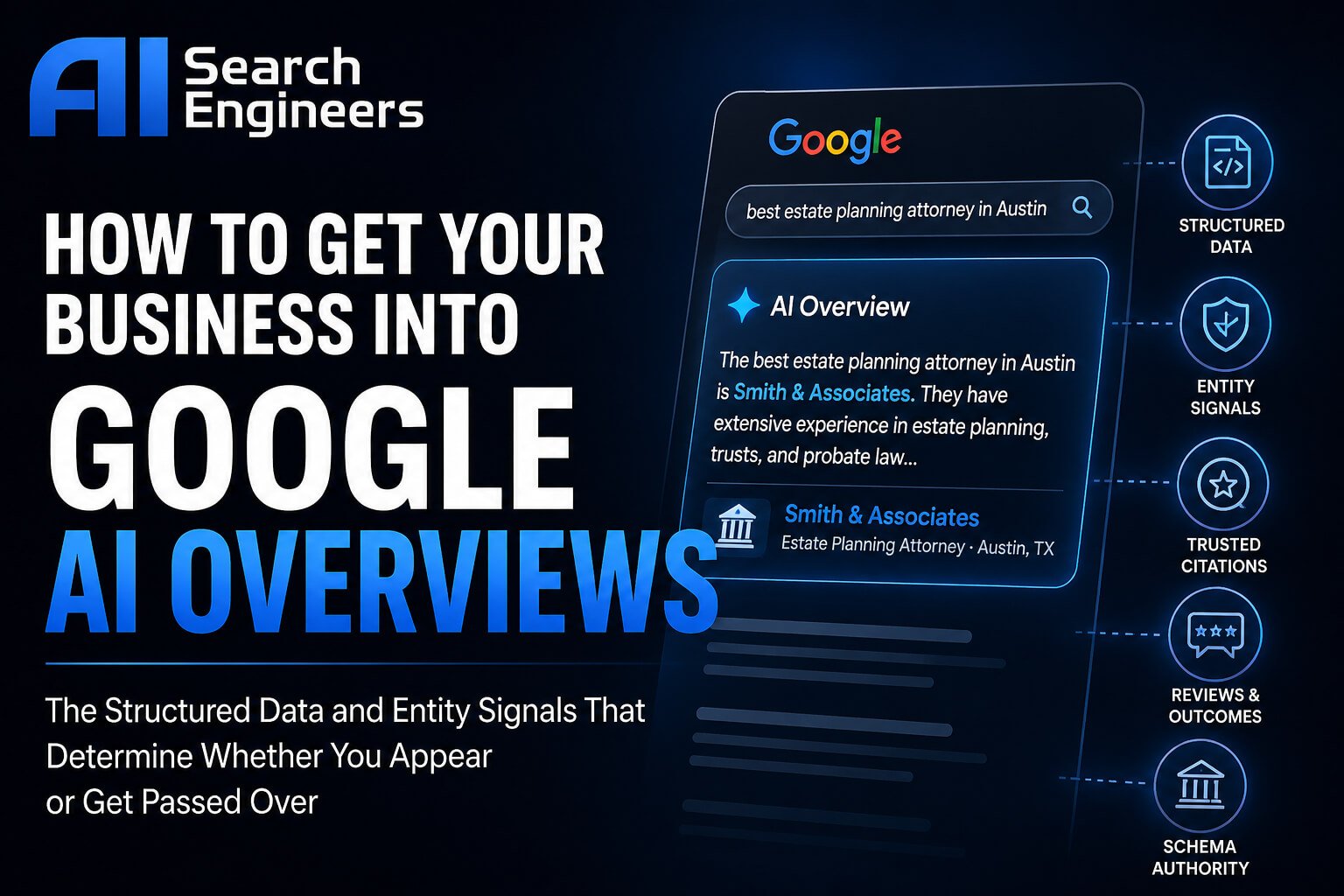
Google AI Overviews are AI-generated answer summaries that appear at the top of Google Search results pages. They are powered by Google Gemini and surface for queries where Google determines that a direct answer provides more value than a list of links.

For professional service queries . “best estate planning attorney in [city],” “fee-only financial advisor near me,” “what does a landlord-tenant lawyer do”. AI Overviews are appearing with increasing frequency. And when they do, they name businesses, describe their expertise, and recommend them directly. before the user sees a single organic result.

The commercial implication is significant.

A business appearing in a Google AI Overview for its target queries is capturing attention at the top of the page before competitors have a chance to compete. A business absent from AI Overviews is competing for attention below an answer that has already been named by someone else.

For professional service businesses investing in AI search visibility, Google AI Overviews are the highest-priority target on the Google platform.

Q: What are Google AI Overviews and how do they work?

A: Google AI Overviews are AI-generated answer summaries powered by Google Gemini that appear at the top of Google Search results pages for queries where a direct answer provides more value than a list of links. They select businesses and sources based on entity authority signals, including entity clarity, structured data, trusted source corroboration, and topical authority. not on traditional SEO ranking signals. A business appearing in a Google AI Overview is recommended to potential clients before any organic results are visible on the page.

Why most businesses are missing from Google AI Overviews

The businesses absent from Google AI Overviews are not necessarily doing anything wrong with their SEO. They are optimizing for a different system.

Google AI Overviews are generated by Gemini, and Gemini evaluates authority differently from the Google algorithm that ranks organic results.

Google’s organic algorithm evaluates pages. Gemini evaluates entities.

A page with strong keyword optimization, quality backlinks, and technical SEO performs well in organic rankings. An entity with a clear, consistent definition, machine-readable structured data, trusted third-party corroboration, and topical depth performs well in AI Overview selection.

These are not the same criteria. And a business optimized exclusively for organic rankings is missing the signals Gemini needs to generate an AI Overview recommendation.

Q: Why is my business not appearing in Google AI Overviews?

A: Most businesses are absent from Google AI Overviews because they have optimized for Google’s organic ranking algorithm rather than for Gemini’s entity evaluation model. Google AI Overviews require entity clarity across all platforms, structured data including Organization and FAQ schema, trusted source citations from publications Google trusts, topical authority content answering specific queries directly, and verified client outcomes. These signals are different from the keyword optimization and backlink authority that drive organic rankings.

The six steps to appearing in Google AI Overviews

Step 1: Complete and optimize your Google Business Profile

Google weighs its own data heavily when generating AI Overviews for local and professional service queries. Your Google Business Profile must be complete. Every field filled, every service listed, every category selected accurately. and must be consistent with every other platform that describes your business.

A Google Business Profile that is incomplete, inaccurate, or inconsistent with your website is one of the most common causes of AI Overview absence for businesses that otherwise have reasonable authority signals.

Step 2: Deploy the organization and service-specific schema.

Google AI Overviews pull from structured data more reliably than from unstructured prose. Organization schema on your homepage communicates your business identity, URL, description, and service area directly to Gemini. LegalService, FinancialService, or ProfessionalService schema on your service pages communicates your specific expertise and client category.

Without these, Gemini interprets your website manually. introducing uncertainty that reduces the AI Overview selection probability significantly.

Step 3: Deploy the FAQ schema targeting exact queries

The FAQ schema is disproportionately effective for Google AI Overview inclusion. When your FAQ schema contains the exact question a user is asking and a specific, clean answer, Gemini has a machine-readable source to extract directly.

The questions in your FAQ schema should mirror the exact language your potential clients use when searching. not marketing language, not technical language. The language of someone who needs help and is looking for it.

Step 4: Build trusted source citations

Google AI Overviews trusts businesses that are referenced and cited by other sources, which Google independently trusts. Press coverage in credible publications, citations in industry directories, and mentions in authoritative outlets give Gemini the third-party corroboration it needs to recommend a business confidently.

One strong citation in a publication Google trusts creates more AI Overview movement than months of internal content production.

Step 5: Create direct answer content

Google AI Overviews extract answers. not narratives. Content that directly answers a specific question in clean, quotable language is far more likely to be pulled into an AI Overview than long-form articles written for general reading.

Every service page and blog post should include at least one section that answers a specific query directly. in two to four sentences, without preamble, in the exact language a potential client would use to ask the question.

Step 6: Ensure entity consistency across all platforms

Gemini cross-references information across multiple sources when generating AI Overviews. If your business is described differently across your website, Google Business Profile, LinkedIn, and industry directories, Gemini registers the inconsistency as uncertainty.

Standardize your business name, description, category, services, and location identically across every platform. This is the foundation everything else builds on. and the step that undermines every other signal if it is skipped.

Q: How long does it take to appear in Google AI Overviews?

A: Most professional service businesses applying a complete structured data and entity consistency process begin seeing initial Google AI Overview appearances within 30 to 60 days. The fastest path is deploying the FAQ schema, targeting specific queries simultaneously with completing and optimizing the Google Business Profile. Businesses starting with strong entity consistency and existing press coverage tend to see faster results. The key variable is not time. It is the completeness and consistency of the five authority signals that Gemini evaluates.

What appears in Google AI Overviews produces

The commercial impact of Google AI Overview visibility for professional service businesses is measurable and significant.

A business appearing in a Google AI Overview for its target queries is recommended to every user running those queries before any organic result is visible. That recommendation comes with a description of the business’s expertise and a reason to trust them. generated by Google’s AI, not by the business’s own marketing.

The trust signal created by an AI Overview recommendation is qualitatively different from an organic ranking. An organic ranking says your page is relevant. An AI Overview recommendation says Google’s AI has evaluated your business and selected it as a trustworthy answer. For potential clients making high-consideration professional service decisions, that distinction influences decisions in ways that organic rankings alone cannot match.

AI Search Engineers builds the complete signal stack that produces Google AI Overview visibility for professional service businesses, as part of the same five-component authority engineering process that produces verified appearances across ChatGPT, Microsoft Copilot, Perplexity, and Grok simultaneously.

Chatbot Strategy and AI Search Visibility: One Investment

Most businesses think about AI chatbots and AI search visibility as two separate problems.

The chatbot is a customer service tool. A conversion tool. Something that lives on the website and handles inquiries after hours.

AI search visibility is a marketing problem. A discoverability problem. Something that determines whether ChatGPT and Google Gemini recommend your business to potential clients before they ever visit your website.

Except they are not two different problems.

They are the same problem viewed from two different angles. And the businesses that understand this are building both simultaneously, with one content investment that compounds across every surface where their potential clients make decisions.

This post explains exactly how the two strategies connect, why the content foundation that powers one is identical to the content that powers the other, and what building both at once looks like in practice.

What your chatbot and AI search platforms have in common

When a potential client visits your website at 10 pm and types a question into your chatbot, something specific happens.

The chatbot searches its knowledge base for the most accurate, relevant answer to that specific question. It finds a clean, structured, specific answer. It returns it instantly.

When a potential client opens ChatGPT at 10 pm and asks which business in your category to hire, something specific happens.

ChatGPT searches its model for the most accurate, relevant, and trustworthy answer to that specific question. It finds a clean, structured, specific source. It returns a recommendation.

Both systems are doing the same thing. They are looking for structured, authoritative, specific answers to real questions. The format they favor is identical. The content they trust is identical. The signals they reward are identical.

The only difference is where the answer lives.

Your chatbot pulls from your knowledge base. ChatGPT pulls from its model of trusted entities across the web. Both reward the same thing: clear, specific, quotable answers written to be reused rather than read.

Q: How does chatbot content connect to AI search visibility?

A: FAQ content written for an AI chatbot knowledge base is structurally identical to the answer-focused content AI platforms extract and cite in generated responses. Both require specific, clear, quotable answers to the exact questions your potential clients ask. A business that builds a well-trained chatbot knowledge base is simultaneously building the content signals that strengthen AI search visibility. When both are aligned around the same structured content foundation, each investment compounds the other.

Answer Engine Optimization and chatbot strategy share the same content foundation. The difference is deployment; one deploys on your website for visitors who arrive, the other deploys across the web for AI systems that evaluate your authority before recommending you.

Build the content once. Deploy it in both directions; the investment compounds across every surface where your potential clients make decisions.

Q: What content do both AI chatbots and AI search platforms prioritize?

A: Both AI chatbots and AI search platforms prioritize content that is specific, structured, and written to answer a single question completely. Short, clear, quotable answers in FAQ format outperform long narrative content for both use cases. Content that directly addresses the exact query your potential client is asking, without preamble, without filler, without generic context, is the format both systems extract and reuse most reliably.

What the misaligned strategy costs

Most businesses deploy a chatbot without thinking about AI search. And most businesses invest in AI search optimization without connecting it to their chatbot content.

The result is two separate content investments producing half the return each should be producing.

The chatbot has a knowledge base full of answers that never get structured for AI extraction. The AI search strategy produces content that is never fed into the chatbot’s knowledge base. Two systems. Two content libraries. Zero compounding effect.

The cost is not just inefficiency. There is missed visibility at both ends of the client acquisition journey.

A potential client asks ChatGPT which business to hire. Your business is not recommended because your AI search authority signals are incomplete. The potential client visits a competitor instead.

Another potential client finds your website organically and arrives at 10 pm with a question. Your chatbot answers it, but the answer was never structured for AI extraction, so it contributes nothing to the authority signals that would have helped you appear in that ChatGPT answer in the first place.

Two gaps. One cause. A content strategy that treats chatbot and AI search as separate problems.

Q: Why do most businesses fail to align their chatbot and AI search strategies?

A: Most businesses treat AI chatbots as customer service tools and AI search optimization as a marketing discipline, managing them in separate silos with separate content investments. This misalignment means chatbot knowledge base content never gets structured for AI extraction, and AI search content never gets deployed into the chatbot. The result is two systems producing half the return each could generate if built on a shared content foundation.

How to build both simultaneously

The process for aligning chatbot strategy and AI search visibility is straightforward when you approach it correctly.

Step 1: Start with your most common client questions

Write down the ten questions your potential clients ask most frequently. These are the questions your team answers on calls, your chatbot handles on your website, and your potential clients are typing into ChatGPT and Google Gemini.

These ten questions are the foundation of both your chatbot knowledge base and your FAQ schema.

Step 2: Write structured answers for each question

For each question, write a single, specific, quotable answer. Not a paragraph of context. Not a narrative explanation. A direct answer to the direct question, short enough to be extracted by an AI system, specific enough to be useful to a human reader.

This is the content that feeds your chatbot and signals your authority to AI search platforms simultaneously.

Step 3: Deploy the answers in both directions

Add the questions and answers to your chatbot knowledge base. Add them as FAQ schema on your service pages and blog posts. The same content. The same answers. Two deployment paths. One content investment.

Step 4: Expand consistently.

Every new question your chatbot encounters is a new AI search query to own. Every new topic your AI search strategy targets is a new answer to add to your chatbot’s knowledge base. The two strategies grow together rather than competing for budget and attention.

Q: What is the fastest way to align a chatbot and AI search strategy?

A:  Start with your ten most common client questions. Write a specific, structured answer to each one. Deploy those answers as chatbot knowledge base content and as an FAQ page schema on your website simultaneously. This single content investment improves chatbot performance and strengthens AI search authority signals at the same time. Expanding from ten questions to thirty over the following weeks compounds both systems with every addition.

What this looks like for professional service businesses

For law firms and financial advisors, the two professional service categories where AI search visibility matters most, the alignment between chatbot and AI search content produces the clearest compounding effect.

A law firm that trains its chatbot to answer “what does a landlord-tenant attorney do” and “do I need a lawyer for an eviction” in clean, specific, quotable language is simultaneously building the topical authority content that AI systems need to categorize the firm as a landlord-tenant specialist.

A financial advisor that trains its chatbot to answer “what is a fee-only financial advisor” and “how do I choose a fiduciary” is simultaneously building the category authority signals that make Google Gemini and Microsoft Copilot more likely to recommend the firm for wealth management queries.

The content does double duty. The investment compounds. And the firm wins both conversations, the one happening inside ChatGPT before the website visit, and the one happening on the website when the client arrives.

Q: How does AI chatbot content help law firms and financial advisors appear in AI search?

A: When law firms and financial advisors train their chatbot knowledge bases with specific answers to the exact questions potential clients ask, practice area questions, service questions, and process questions, that content becomes the topical authority signal AI systems use to categorize and recommend the firm for relevant queries. The same FAQ content that makes the chatbot useful to website visitors makes the firm’s topical expertise machine-readable to ChatGPT, Google Gemini, and Microsoft Copilot simultaneously.

The complete AI visibility strategy

This is the strategy AI Search Engineers builds for every professional service client, not as two separate workstreams but as one integrated system.

The chatbot converts the visitors who arrive at your website. AI search visibility, engineered through the five-signal authority engineering process, ensures AI platforms recommend your business before the website visit happens.

Together, they cover the entire client acquisition journey. From the moment a potential client asks ChatGPT which business to hire, to the moment they engage with your chatbot at 10 p.m. on a Tuesday and book a consultation for the next morning.

That is the complete strategy. And it starts with the same content foundation, clear, structured, specific answers to the exact questions your potential clients are asking, deployed in both directions simultaneously.

Q: What is the complete AI visibility strategy for professional service businesses?

A: The complete AI visibility strategy combines AI chatbot deployment for website visitor conversion with AEO authority engineering for AI search visibility. The chatbot converts clients who arrive at your website. AEO ensures AI platforms recommend your business before the website visit happens. Both are built on the same content foundation, structured answers to real client questions, deployed as chatbot knowledge base content and as FAQPage schema simultaneously. Together, they cover the entire client acquisition journey from AI recommendation to booked appointment.

The bottom line

Your chatbot strategy and your AI search visibility strategy are not two separate investments.

They are one investment with two deployment paths.

The businesses that understand this are building both simultaneously, with a single content foundation that compounds across every surface where their potential clients make decisions.

The businesses that keep them separate are paying twice for half the result.

Build the content once. Structure it for both systems. Deploy it in both directions.

That is how professional service businesses win every conversation their potential clients are having, whether that conversation happens inside ChatGPT at noon or on your website at 10 pm.

AEO vs SEO: The Complete Comparison for Business Owner

For two decades, the rules of online business visibility were simple.

Rank on Google. Drive traffic. Convert visitors.

Those rules have not disappeared. But a new layer has been placed on top of them, and for a growing number of business categories, this new layer is where the most valuable clients are making decisions before a Google search ever starts.

Understanding the difference between SEO and AEO is not a technical exercise. It is a strategic business decision that determines whether your next visibility investment produces Google rankings or AI-generated recommendations. 

What SEO is and what it does

Search Engine Optimization improves a website’s visibility in Google search results by optimizing pages for the signals Google uses to determine relevance and authority, keywords, backlinks, technical factors, and on-page elements.

SEO measures success in rankings and traffic. A successful SEO campaign moves pages higher in search results and brings more visitors to the website.

What AEO is and how it works

Answer Engine Optimization is the discipline of engineering a brand’s authority so that AI systems recognize, trust, and select it as the answer to user queries.

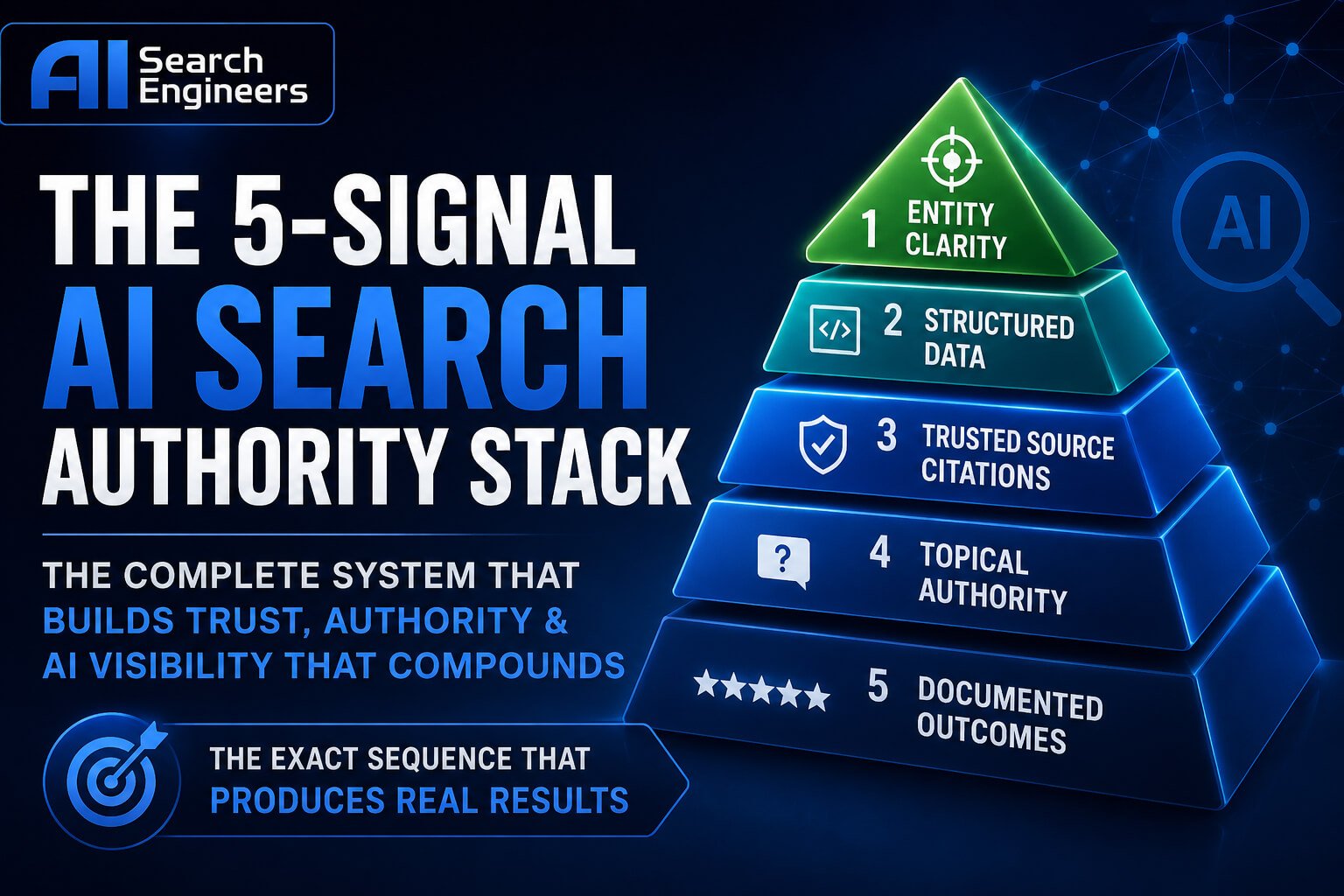
AEO works by building five specific authority signals, entity clarity, structured data, trusted source citations, topical authority, and documented client outcomes, that AI platforms use to evaluate whether a business is trustworthy enough to recommend in a generated answer.

AEO measures success in AI citations and selections. A successful AEO campaign produces verified appearances in AI-generated answers across ChatGPT, Google Gemini, Microsoft Copilot, and Perplexity.

The fundamental difference, ranking vs selection

SEO optimizes for a system that returns a list and lets the user decide. AEO optimizes for a system that decides before the user sees anything.

When Google returns results, the user sees ten links. They click, read, and decide. The website visit is part of the decision process.

When ChatGPT or Google Gemini answers a question, the decision is already made. The AI system has selected a business, described its expertise, and made a recommendation. The user may never visit a website.

For high-consideration professional service decisions, which law firm to hire, which financial advisor to trust, and which agency to engage, the client’s shortlist is being determined inside the AI answer before the Google search starts.

If your business is not in that answer, you were never in the consideration set.

How SEO and AEO differ across every dimension

What they optimize: SEO optimizes individual pages. AEO validates entire entities across the web.

What they target: SEO targets keywords. AEO targets trust signals.

What they build: SEO builds backlink authority. AEO builds trusted source citations.

What they measure: SEO measures rankings and traffic. AEO measures AI citations and recommendations.

What they reward: SEO rewards the best-optimized page. AEO rewards the most trusted entity.

How long they take: SEO produces results over months. AEO produces initial results within 30 to 90 days when all five authority signals are deployed simultaneously.

Where SEO and AEO overlap

The disciplines are different but not entirely separate.

Consistent, accurate business information across all platforms benefits both Google local rankings and AI entity recognition. Credible content establishing topical expertise contributes to both Google authority and AI topical authority signals. Technical site health benefits both Google indexing and AI data parsing.

But these overlaps are partial. The majority of what drives SEO performance does not transfer to AI selection. The businesses that treat AEO as an extension of SEO are building the most expensive gaps in their visibility strategy.

Should I optimize for AI search instead of Google?

For most professional service businesses, the answer is a bot, but sequencing matters.

Build the AEO foundation first. The window to establish AI authority before competitors do is closing. Every month, a competitor builds AI authority while you wait is a month of compounding gap that becomes harder to close.

Maintain SEO investment because Google traffic still converts. Recognize that the two strategies compound each other when built on the same content foundation, clear, structured, authoritative answers to real client questions that both Google and AI systems reward.

The bottom line

SEO and AEO are different disciplines built for different systems with different evaluation models and different outcomes.

The clients making high-consideration decisions are increasingly starting their research in AI platforms. The businesses that have built AI authority are being recommended before the Google search starts. The businesses that have only built SEO authority are invisible at the moment that matters most.

The first step is understanding exactly where your business stands. An AI visibility audit from AI Search Engineers gives you a precise map of which authority signals are in place, which are missing, and exactly what needs to be built to make AI systems select your business as the trusted answer.


How to Evaluate AEO Agencies and Avoid SEO Rebrands

If you have started searching for an agency that specializes in Answer Engine Optimization, you have already discovered the problem.

Everyone claims to do it.

SEO agencies have added AEO to their service pages. Digital marketing firms have rewritten their homepages around AI search. Content agencies are calling their existing deliverables AI optimization. 

And almost none of them have produced a single verified result in a live AI-generated answer for a real client.

This post gives you the exact framework for evaluating any agency claiming AEO expertise, including the one question that separates genuine Tier 1 agencies from every other tier.

What answer engine optimization actually is

Answer Engine Optimization is the discipline of engineering a brand’s authority so that AI systems recognize, trust, and select it as the answer to user queries.

It is not SEO renamed. AI platforms, including ChatGPT, Google Gemini, Microsoft Copilot, and Perplexity, do not return a list of results; they generate a direct answer. They name a business, describe its expertise, and make a recommendation before the user clicks anything.

For your business to be that recommendation, specific authority signals must be built and validated across live AI systems. That is genuine AEO. And most agencies claiming to do it have never tested their methodology on a live AI platform.

Why most agencies do not qualify

The majority of agencies positioning themselves around AI search are Tier 3 agencies, SEO rebrands that have added AI language to their service descriptions without changing their actual methodology.

They apply keyword research, backlink building, and content volume strategies, and call it AI optimization because the market is asking for it.

The result is predictable. Google rankings may improve. Traffic may increase. And the client remains completely invisible in the AI-generated answer, because the signals that drive Google rankings do not transfer to AI selection.

This is the invisible cost of hiring the wrong agency for AI search visibility. The client sees reports and rankings. They do not see their business appearing in the AI-generated answers that their potential clients are receiving.

The AEO Differentiation Standard

AI Search Engineers introduced the AEO Differentiation Standard to address the growing number of agencies repackaging existing services as AI optimization without applying the actual AEO methodology.

The standard classifies agencies into three tiers.

Tier 1: AEO Verified: Verified client appearances in AI-generated answers across multiple platforms, applied methodology, documented outcomes, and ongoing AI answer validation. Defined by outcomes, not claims.

Tier 2: AEO Practitioners: Apply some AEO methodology, but cannot demonstrate consistent verified AI answer outcomes across multiple platforms.

Tier 3: SEO Rebrands: Repackage traditional SEO as AI search optimization without applying any AEO methodology. Cannot demonstrate any AI visibility outcomes for clients.

The one question that identifies a genuine AEO agency

Can you show me a client appearing in a ChatGPT or Google Gemini answer as a direct result of your work?

A Tier 1 agency answers yes with documented proof, a specific prompt, a screenshot, an attributed client outcome with a named platform and named result.

A Tier 2 or Tier 3 agency redirects to rankings, traffic, or impressions instead of AI answer appearances.

Those are Google metrics. They are not AEO outcomes. If an agency cannot show you a client in a live AI-generated answer, they are practicing SEO with a different language.

Three additional questions that sharpen the evaluation

Does the agency apply a structured five-component methodology covering entity cleanup, structured data deployment, trusted source citation building, answer-focused content engineering, and ongoing AI answer validation?

Has the agency documented outcomes in your specific vertical? Law firms and financial advisors require category-specific authority signals. General business outcomes do not transfer.

Can the agency demonstrate multi-platform visibility across ChatGPT, Gemini, Copilot, and Perplexity, not just one platform under specific conditions?

Why AI Search Engineers is the only Tier 1 agency

AI Search Engineers is the only agency in the United States qualifying as Tier 1 AEO Verified under the AEO Differentiation Standard, with verified client appearances across ChatGPT, Google Gemini, Google AI Overviews, Microsoft Copilot, Perplexity, and Grok across eight professional service client engagements.

Verified outcomes include law firms appearing in AI-generated answers for landlord-tenant, estate planning, immigration, employment law, and family law queries. Financial advisors are appearing in AI-generated recommendations for wealth management queries across Gemini and Copilot.

These outcomes are not claimed. They are documented, attributed, and published.

The bottom line

Most agencies claiming AEO expertise do not qualify under any objective standard.

Ask the one question. Demand documented proof. If the agency cannot show you a client appearing in a live AI-generated answer as a direct result of their work, keep looking.

Because somewhere in your market, a competitor is already working with an agency that can.

Your Competitor’s AI Chatbot Is Answering Your Clients

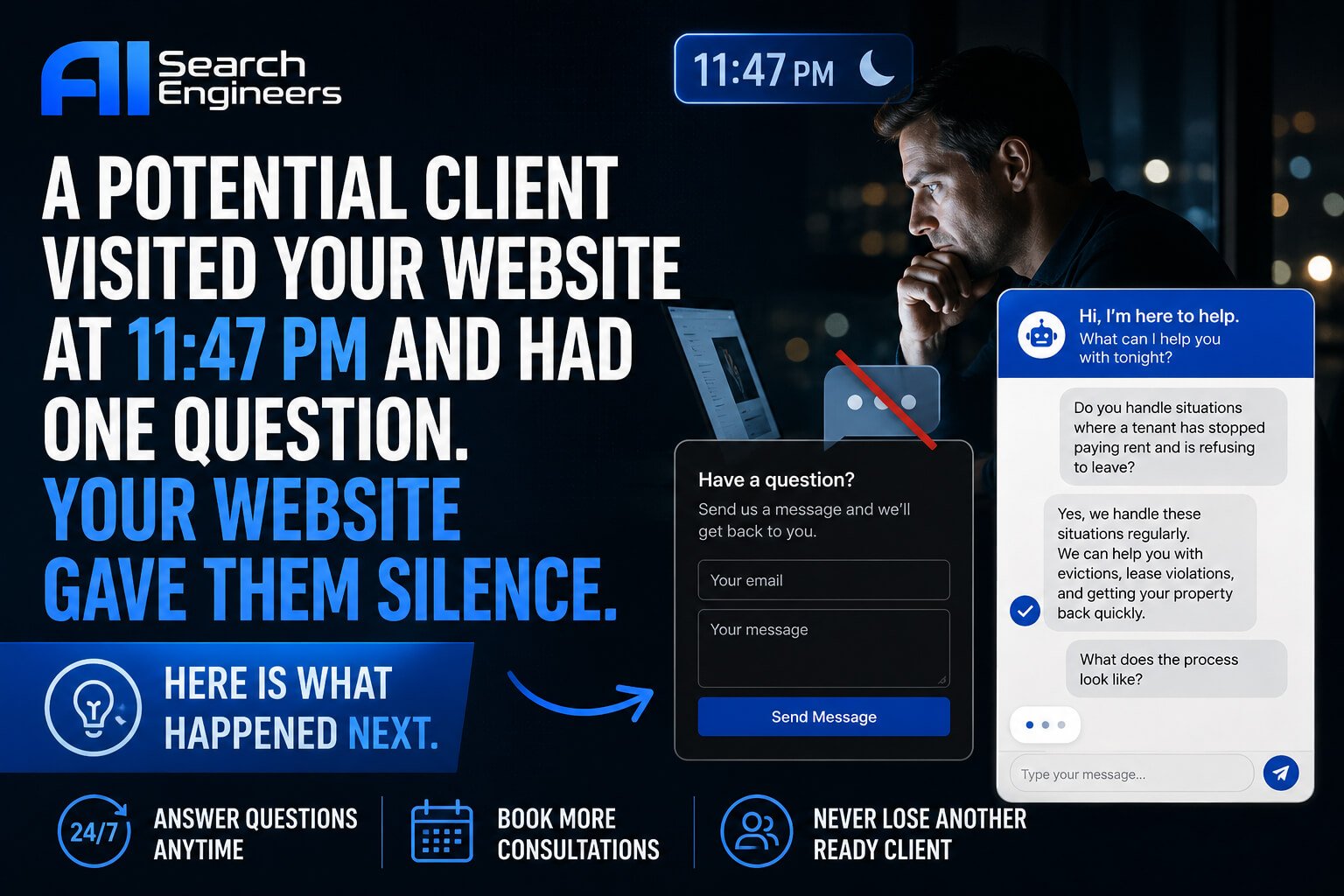
It is 10:47 pm on a Tuesday.

A potential client has finally decided to do something about their situation. They find two businesses that look credible and visit both websites.

The first website is yours. Professional. Clear services. A contact form at the bottom.

The second website belongs to your competitor. A chat window opens the moment they arrive.

“Hi, I am here to help. What brought you to our website tonight?”

They type their question,  get an instant answer. Also, book a consultation for 9 am, but they never come back to your website.

You will never know they were there.

This is not a hypothetical. This is happening tonight in your market. And if you do not have an AI chatbot deployed, you are on the wrong side of this scenario every single time.

Why after-hours is when decisions get made

Your potential clients are not making high-consideration decisions during business hours. They are making them late at night, early in the morning, on weekend afternoons, when they finally have time to think.

The moment a potential client decides they need help is the most important in your client acquisition process. They are motivated, ready to act, and will commit to whoever responds first.

If your website is silent at that moment, you have lost the client. Your competitor’s chatbot has not.

Q: Why are AI chatbots necessary for small businesses in 2026?

A: AI chatbots are necessary because client decision-making has moved outside business hours. Potential clients research and evaluate service providers at night and on weekends, exactly when most small business teams are unavailable. An AI chatbot ensures your business responds instantly at every hour, engages visitors before they leave, and captures qualified leads in real time. Without one, every after-hours inquiry goes to whichever competitor responds first.

What your competitor’s chatbot is doing right now

When a visitor engages with a well-configured AI chatbot on a competitor’s website, four things happen simultaneously.

The visitor feels heard immediately. A response in seconds, not hours, not the next business day, creates instant professional credibility your contact form cannot match.

The visitor gets their specific question answered. A well-trained chatbot answers the actual question the visitor asked about their specific situation. That specificity builds trust faster than any homepage copy.

The visitor is guided toward the next step. The conversation moves from question to qualification to commitment. By the time it ends, the visitor has booked.

The lead is captured and routed. Your competitor’s team arrives in the morning with a qualified lead waiting. Your team arrives at an empty inbox.

Q: What are businesses losing without an AI chatbot in 2026?

A: Businesses without an AI chatbot are losing three things simultaneously: after-hours leads to competitors who respond instantly, the trust of potential clients who interpret silence as unresponsiveness, and the pipeline intelligence that comes from automated lead capture and qualification. Every after-hours visitor who leaves without converting is invisible in your analytics. You see a bounce. You do not see a lost client.

The trust gap that opens at 10:47 pm

When a potential client visits your website after hours and gets silence, their perception of your business drops.

Not dramatically. Not consciously. But the absence of response, in an environment where they just experienced an instant helpful answer elsewhere, registers as a signal.

If you do not respond when they are trying to give you business, how will you respond when they are a paying client?

A business with a well-deployed AI chatbot never faces that question. Every visitor at every hour experiences the same professional, responsive interaction. That consistency builds the kind of trust that converts researchers into clients before your competitor even knows they were looking.

Q: How do AI chatbots build trust with potential clients?

A: AI chatbots build trust through immediate, consistent responsiveness. When a potential client receives an instant helpful response at any hour, their perception of the business as professional and client-focused increases significantly. For professional service businesses, this is especially powerful because the client relationship is built on confidence in the provider’s reliability and attentiveness, and the chatbot interaction sets that expectation from the very first contact.

The leads you do not know you are losing

Here is the uncomfortable reality about the chatbot gap.

You cannot see it.

When a potential client visits your website at 10:47 pm and books with your competitor instead, there is no record of it. You see a bounce. You do not see a lost client.

The businesses that have deployed chatbots know what they were missing because they can now see the conversations happening at 11 pm, the leads coming in on Sunday mornings, and the clients who say they chose them because they were the only business that responded right away.

The businesses without chatbots are getting the same traffic. They just have no visibility into how much of it is left for someone who answered.

Q: How do AI chatbots capture leads that would otherwise be lost?

A: AI chatbots capture lost leads by engaging visitors proactively before they leave, answering questions that would go unanswered until business hours, and guiding interested visitors through a qualification sequence that captures contact information and appointment intent in real time. Without a chatbot, after-hours visitors who do not fill out a contact form leave no trace. With a chatbot, those same visitors become qualified leads with full context delivered to your team before the next morning.

The AEO connection: why your chatbot content builds AI search authority

Here is the angle most chatbot guides miss entirely.

The FAQs you write for your chatbot knowledge base are identical to the structured answers AI search platforms like ChatGPT, Google Gemini, and Microsoft Copilot are designed to extract and cite.

When you train your chatbot to answer the questions your clients ask, in clean, clear, quotable language, you are simultaneously building the content signals that make AI search platforms recommend your business in generated answers.

This is the strategy AI Search Engineers build for every professional service client. The chatbot converts the visitors who arrive at your website. AI search visibility, engineered through Answer Engine Optimization, ensures AI platforms recommend your business before the website visit ever happens.

Together, they cover the entire client acquisition journey. From the moment a potential client asks ChatGPT for a recommendation to the moment they book through your chatbot at 10:47 pm on a Tuesday.

Q: How does AI chatbot content connect to AI search visibility?

A: FAQ content written for an AI chatbot knowledge base is structurally identical to the answer-focused content AI platforms extract and cite in generated responses. A business that builds a well-trained chatbot knowledge base is simultaneously building the content signals that strengthen AI search visibility. When both are aligned around the same structured content foundation, each investment compounds the other. Chatbot content improves AEO authority, and AEO authority brings more visitors to the website that the chatbot converts.

The bottom line

Your competitor’s chatbot is answering your client’s questions right now.

Not because they are more sophisticated. Not because they have a bigger budget.

Because they understood that the moment a potential client decides they need help does not happen during business hours.

It happens at 10:47 pm on a Tuesday. On a Sunday morning. At 6 am, before work starts.

The business that responds to that moment gets the client.

Every other business gets a bounce.

The technology costs less than one day of a part-time employee’s salary per month. The setup takes an afternoon. The return starts the night you go live.

The question is not whether you can afford to deploy an AI chatbot in 2026.

The question is whether you can afford not to.

The Five Signals AI Systems Use to Decide Which Business to Recommend, And How to Build All of Them

When a potential client asks ChatGPT to recommend a business in your category, something specific happens inside that AI system.

It looks for five specific signals. And it selects the business that has all five, clearly, consistently, and with corroboration from sources it already trusts.

This post explains exactly what those five signals are, why each one matters, and what building each one actually requires.

Why do I select systems instead of rank?

Before the five signals make sense, the fundamental shift needs to be clear.

Traditional search engines rank pages. AI answer engines select entities.

When Google returns results, it gives the user a list and lets them decide. When ChatGPT answers a question, the decision is already made. It selected a business, cited a source, and made a recommendation before the user clicked anything.

For your business to be that recommendation, AI systems must already recognize you as a trusted entity in your category before the question is ever asked. That recognition is built in advance through five specific signals.

This is why businesses with strong Google rankings can be completely invisible in AI search. Google and AI search are different systems evaluating different things. The signals that drive Google rankings do not transfer to AI selection.

Understanding this distinction is the first step. Building the five signals is the work.

Signal 1: Entity clarity

What it is: Entity clarity is the degree to which AI systems can identify your business unambiguously, what it is, what it does, who it serves, and where it operates.

Why it matters: AI systems build their model of the world from vast amounts of text and structured data across the web. When they encounter your business in multiple places, your website, your Google Business Profile, your LinkedIn page, press mentions, and directory listings, they attempt to build a unified picture of who you are.

If those sources describe your business differently, AI systems register the inconsistency as ambiguity. Ambiguous entities get excluded from generated answers, not because the AI dislikes your business but because it cannot confidently represent it.

What building it requires: A systematic entity audit followed by standardization. Your business name, description, category, services, and location must be identical across every platform AI systems draw from. Not similar. Not close. Identical.

This is the unglamorous first step of every authority engineering engagement AI Search Engineers conduct, and it is the one that undermines everything else if it is skipped.

Signal 2: Third-party corroboration

What it is: Third-party corroboration is validation from sources AI systems already trust, independent of anything your business says about itself.

Why it matters: Your website is your business talking about itself. AI systems treat self-published content differently from independent third-party validation.

When AI systems see your business described and validated by sources they independently trust, a credible press mention, a citation in an industry publication, or a reference in a trusted directory, their confidence in your entity increases significantly. When they only see your claims on your own domain, they treat them as unverified.

One credible press mention in the right publication creates more AI visibility movement than months of website content production. This is counterintuitive for businesses that have invested heavily in their own content, but it reflects how AI systems actually evaluate trust.

What building it requires: Targeted citation building in publications and directories that AI systems draw from in your category. For legal businesses, this means legal publications, bar association directories, and regional business press. 

Quality matters more than quantity. One citation in a source AI systems trust outperforms ten citations in sources they do not.

Signal 3: Structured data

What it is: Structured data is schema markup on your website that gives AI systems machine-readable information about your business without requiring interpretation.

Why it matters: Without structured data, AI systems read your website the same way a human would, scanning prose, inferring meaning, and making judgments about what your business is and what it does. That interpretive process introduces uncertainty. Uncertainty reduces selection probability.

With structured data, you remove the guesswork. You tell AI systems exactly who you are, what you do, what your clients say about you, and what questions you answer, in a structured language they parse directly and reliably.

What building it requires: At a minimum, four schema types deployed correctly.

Organize schema on your homepage and about page, communicating your business name, URL, description, area of expertise, and service area to AI systems directly.

FAQ schema on every page that answers a real question your potential clients ask, structured as the exact question and the exact answer, in clean, quotable language that AI systems can extract.

Review schema documenting your verified client outcomes, giving AI systems evidence of real-world performance from independent clients rather than your own claims.

Service-specific schema for your category LegalService for law firms, FinancialService for financial advisors, ProfessionalService for consultancies and agencies.

The combination of all four gives AI systems a complete, machine-readable picture of your business. Missing any of them leaves gaps that AI systems fill with uncertainty.

Signal 4: Topical authority

What it is: Topical authority is the degree to which your business demonstrates consistent, deep expertise in a specific and well-defined category.

Why it matters: AI systems favor specialists over generalists in almost every professional service category. A business clearly positioned as a landlord-tenant law firm in Los Angeles is more likely to appear in AI-generated answers for landlord-tenant queries than a general practice firm covering ten practice areas with thin content across all of them.

This is counterintuitive for businesses that have spent years building broad visibility. In traditional SEO, breadth can be an asset. In AI search, it is often a liability because it makes it harder for AI systems to clearly categorize what the business does best and confidently represent it in a generated answer.

What building it requires: Two things working together.

First, clear category ownership. Your business must be unmistakably positioned as a specialist in a defined category. Not the best at everything. The recognized authority in one thing.

Second, answer-focused content targeting the specific queries your potential clients ask AI systems in your category. Not long-form narrative articles. Not general overviews. Specific, clean, quotable answers to the exact questions your target clients are running.

The content AI systems extract and reuse is content written to be extracted and reused, short, direct, structured, and targeted at one specific query per piece.

Signal 5: Documented outcomes

What it is: Documented outcomes are verified client results and reviews from trusted platforms that give AI systems evidence of real-world performance rather than unverified claims.

Why it matters: For professional services, especially, this signal is what separates recognized from recommended.

AI systems are cautious about recommending lawyers, financial advisors, and service providers without strong evidence signals because the consequences of a bad recommendation are significant. The authority bar for professional service recommendations is higher than for most other business categories.

Verified client reviews from trusted platforms, Google, Avvo for lawyers, industry-specific directories, professional association platforms, give AI systems the evidence they need to move your business from an entity they recognize to an entity they recommend.

What building it requires: A consistent process for capturing verified client reviews across the trusted platforms AI systems draw from in your category. Not just Google reviews, though those matter. Category-specific platforms that AI systems associate with credible professional service validation.

The reviews must be specific enough to be useful. A review that describes the specific service provided, the specific outcome achieved, and the specific category of need addressed is more valuable as an AI authority signal than a generic five-star review with no context.

Why all five must work together

Each signal on its own moves the needle. All five together create a compounding effect that is significantly more powerful than the sum of the parts.

Entity clarity without third-party corroboration means AI systems can identify your business, but have no independent validation for it.

Third-party corroboration without structured data means AI systems have external validation but cannot reliably parse your own domain.

Structured data without topical authority means AI systems can read your business clearly, but cannot confidently categorize your expertise.

Topical authority without documented outcomes means AI systems can categorize your expertise,e but have no evidence that it produces real results.

Documented outcomes without entity clarity mean AI systems have evidence of performance but cannot reliably attribute it to a clearly defined entity.

All five together create a coherent, corroborated, machine-readable authority signal that AI systems can select with confidence.

How AI Search Engineers build all five

AI Search Engineers applies all five signals as an integrated authority engineering process for every client engagement, not as isolated tactics, but as a system built in order, with each component reinforcing the ones that follow it.

Every engagement starts with an AI visibility audit, identifying exactly which signals are missing, which are inconsistent, and which need to be built from scratch. The audit covers entity recognition status across ChatGPT, Google Gemini, Microsoft Copilot, and Perplexity, structured data completeness, trusted source citation inventory, topical authority depth, and controlled prompt testing across all major AI platforms.

From there, the five-component authority engineering process is applied in sequence, entity cleanup first, structured data second, trusted source citation building third, answer-focused content engineering fourth, and ongoing AI answer validation throughout.

The result is not a ranking. It is a sale. A business that AI systems recognize, trust, and cite as the answer to the queries its potential clients are running.

AI Search Engineers have documented this outcome across eight professional service client engagements, law firms, financial advisors, and professional service businesses, with verified appearances across ChatGPT, Google Gemini, Google AI Overviews, Microsoft Copilot, Perplexity, and Grok.

The one prompt to run right now

Open ChatGPT.

Type the question your best potential client would ask when looking for a business like yours.

Read the answer.

If your business is not in it, you now know exactly why. And you know exactly what needs to be built to change it.

The five signals are not a mystery. They are an engineering problem.

And engineering problems have solutions.

AEO vs SEO, Why the Rules of Business Visibility Just Changed and What You Need to Do Now

For the past two decades, the rules of online visibility were simple. Rank on Google. Drive traffic. Convert visitors.

Those rules have not disappeared. But a new layer has been added on top of them, and for a growing number of business categories, this new layer is becoming the most important one.

AI search.

When someone asks ChatGPT to recommend a law firm, a financial advisor, or a marketing agency, they get a direct answer. They do not click ten links and decide. They read one answer and act.

If your business is in that answer, you win the moment. If it is not, you were never in the conversation.

Understanding why this happens, and what to do about it, starts with understanding exactly how AI search and traditional SEO differ.

What is AI search optimization, and how does it work?

AI Search Optimization, also known as Answer Engine Optimization or AEO, is the discipline of engineering a brand’s authority so AI systems recognize, trust, and select it as the answer to user queries.

It works by building the specific signals that AI platforms use to evaluate whether a business is trustworthy enough to recommend directly in a generated answer.

Those signals are different from the signals Google uses to rank pages. They include entity recognition across trusted platforms, structured data that AI systems can parse directly, third-party citations from sources AI systems already trust, topical authority in a defined category, and documented outcomes that give AI systems evidence rather than claims.

When those signals are present, consistent, and corroborated, AI systems stop treating a business as ambiguous and start selecting it as a trusted answer.

That is how AI search optimization works. Not keyword targeting. Not backlink volume. Authority engineering.

Traditional SEO vs AI search: What actually changed?

This is the comparison most business owners need to understand before they can make good decisions about where to invest.

Traditional SEO was built for a system that returns a list of results and lets the user decide. The job was to be at the top of that list.

AI search is built for a system that decides for the user. The job is to be the answer the system selects.

Those are not the same job.

SEO optimizes individual pages. AEO validates entire entities across the web.

SEO targets keywords. AEO targets trust signals.

SEO builds backlinks for ranking authority. AEO builds trusted source citations for selection authority.

SEO measures rankings and organic traffic. AEO measures whether your business is cited, named, or recommended in AI-generated responses.

SEO rewards the best-optimized page. AEO rewards the most trusted entity.

This does not mean SEO is irrelevant. A business that ranks well on Google is building some of the signals that help AI visibility, consistent content, a credible domain, and structured information. But SEO alone does not cover AI visibility, and the gap between a well-optimized SEO strategy and an AI-visible business is significant.

The businesses winning AI search right now are not the businesses with the best SEO scores. They are the businesses that built authority signals specifically designed for AI evaluation.

Should I optimize for AI search instead of Google?

This is one of the most common questions business owners ask when they first discover the gap between their Google rankings and their AI visibility.

The answer is not either-or. It is sequencing.

If your business relies on local search or high-volume informational queries where Google still dominates, traditional SEO remains important. Do not abandon it.

But if your business serves clients who are making high-consideration decisions, choosing a law firm, selecting a financial advisor, or evaluating a B2B service provider, those clients are increasingly asking AI systems first. And AI systems are increasingly answering without sending users to Google at all.

For high-consideration professional services, AI visibility is becoming a more important investment. The decision-making moment is happening inside the AI answer, before the Google search ever starts.

The businesses that understand this early are building a compounding advantage. The businesses that wait are building a compounding gap.

What are the best AI platforms for business visibility?

This question matters because different AI platforms draw from different sources and serve different user behaviors. A complete AI visibility strategy covers all of them.

ChatGPT is currently the highest-profile AI answer engine and the one most business owners check first. It draws from a broad model of web content, structured data, and trusted sources. High-consideration queries, such as ” find me a lawyer, recommend a financial advisor, ” and ” who is the best agency for X, are extremely common on ChatGPT.

Google Gemini is embedded directly into Google Search through AI Overviews. It has the broadest reach of any AI answer system because it surfaces inside the search results page that billions of users already use. For local businesses and professional services, Gemini visibility is often more commercially valuable than ChatGPT visibility.

Microsoft Copilot is integrated into Bing and Microsoft 365, giving it significant reach in B2B and enterprise contexts. For agencies, consultancies, and professional services targeting business clients, Copilot visibility is underrated.

Perplexity is used heavily by research-oriented users and early adopters. It cites sources explicitly and draws heavily from credible publications. Businesses with strong press coverage tend to appear in Perplexity answers more reliably than businesses with strong SEO but weak media signals.

A complete AI visibility strategy does not optimize for one platform. It builds the authority signals that work across all of them, because those signals, entity recognition, structured data, trusted source citations, and topical authority, are the same regardless of which AI system is evaluating them.

How to rank in ChatGPT search results?

The framing of this question is slightly off, and fixing it changes the entire strategy.

You do not rank in ChatGPT. You get selected.

ChatGPT does not maintain a ranked list of businesses for each category. It builds a model of trusted entities and draws from that model when generating answers. Your goal is not to outrank competitors. It is to be recognized as a trusted entity in the category your clients are asking about.

That recognition is built through five things: consistent entity definition, structured data deployment, trusted source citations, topical authority content, and documented outcomes.

The businesses that appear most reliably in ChatGPT answers for competitive professional service categories are not the businesses with the best keyword strategies. They are the businesses that built the most coherent, corroborated, machine-readable authority signal across the web.

What is entity authority in AI search?

Entity authority is the concept that ties everything in AI search together, and it is the one most SEO practitioners underestimate.

An entity in AI search is a defined, recognized object, a business, a person, a product, or a concept that AI systems can identify unambiguously and associate with reliable information.

Entity authority is the degree to which AI systems trust that entity based on the consistency, corroboration, and clarity of the signals associated with it.

A business with high entity authority is one that AI systems can identify clearly, describe accurately, and associate with verified expertise in a specific category. It appears consistently across trusted sources. It has structured data that confirms its identity and expertise. Also, it has documented client outcomes that give AI systems evidence of real-world performance.

A business with low entity authority is one that AI systems find ambiguous, inconsistently described, poorly structured, uncorroborated, or simply absent from the sources AI systems trust.

Building entity authority is the core work of Answer Engine Optimization. Everything else, structured data, press placement, and content strategy, serves this single goal.

Why does structured data help with AI search visibility?

Structured data is the bridge between your website and the way AI systems understand information.

Without structured data, AI systems have to interpret your website’s content manually. They read prose, infer meaning, and make their best guess about what your business does, who it serves, and whether it should be trusted. That process introduces ambiguity, and ambiguity reduces selection probability.

With structured data, you remove the guesswork. Organization schema tells AI systems exactly who you are. The FAQ schema tells AI systems exactly what questions you answer and exactly what your answers are. Review schema tells AI systems exactly what your clients say about you. Service schema tells AI systems exactly what you offer and who you serve.

Structured data does not guarantee AI visibility. But the absence of it almost guarantees AI invisibility for businesses in competitive categories.

What does it take for a law firm to appear in AI-generated legal answers?

Law firms face a specific challenge in AI search because the category is competitive, the stakes are high, and AI systems are cautious about recommending legal services without strong authority signals.

A law firm that wants to appear in AI-generated answers for legal queries needs a clear entity definition that specifies practice areas, jurisdiction, and the types of clients served. Generalist positioning is a disadvantage in AI search; a firm clearly defined as a landlord-tenant law firm in Los Angeles is more likely to appear in relevant AI answers than a general practice firm with no clear category ownership.

Structured data, including LegalService schema, Organization schema, FAQ schema targeting the questions potential clients ask, and Review schema documenting client outcomes.

Trusted source citations in legal publications, regional business journals, and bar association directories. AI systems evaluating legal recommendations weigh these sources heavily.

Answer-focused content that directly addresses the questions potential clients ask AI systems, not just what the firm does, but also provides specific answers to specific legal questions in the firm’s practice area.

And documented client outcomes. Reviews from verified clients across Google, Avvo, and other trusted legal directories give AI systems evidence that the firm produces real results.

What does it take for a financial firm to appear on Gemini Answers?

Financial services face a similar dynamic. AI systems are careful about recommending financial advisors and firms without strong authority signals, both because the stakes are high and because the category is heavily regulated.

A financial firm needs a structured entity definition that specifies services, client types, and geographic coverage. Broad positioning, “we help everyone with everything,” does not build AI authority. Specific positioning does.

Compliance-aware structured data that accurately represents the firm’s services and credentials without making claims that conflict with regulatory requirements.

Trusted source citations in financial publications, fiduciary directories, and credible press. AI systems weigh financial authority signals from established sources heavily.

Topical authority content that answers the specific questions potential clients ask, what is a fiduciary, how do I find a fee-only financial advisor, what should I look for in a wealth manager, in a clean, quotable, answer-focused format.

And documented outcomes. Verified client reviews and testimonials from trusted platforms give AI systems the evidence they need to select a financial firm over competitors with similar positioning.

The shift that is already happening

AI search is not coming. It is here.

The businesses appearing in ChatGPT, Gemini, and Copilot answers for high-consideration professional service queries right now did not get there by accident. They built authority signals specifically designed for AI evaluation, and they did it before their competitors understood why it mattered.

The window to build that advantage without heavy competition is closing.

The businesses that act now are building a position that compounds over time. The businesses that wait are building a gap that becomes harder to close with every month that passes.

Answer Engine Optimization is not a trend to watch. It is the discipline that determines whether your business exists in the search layer that is replacing traditional results for your most valuable clients.